Shopping Cart



Email Security Best Practices for Saudi Businesses
Discover email security best practices for Saudi businesses to prevent phishing, malware, business email compromise, and data breaches while protecting sensitive communications.
By Blue Edge Team | Jun 30, 2026
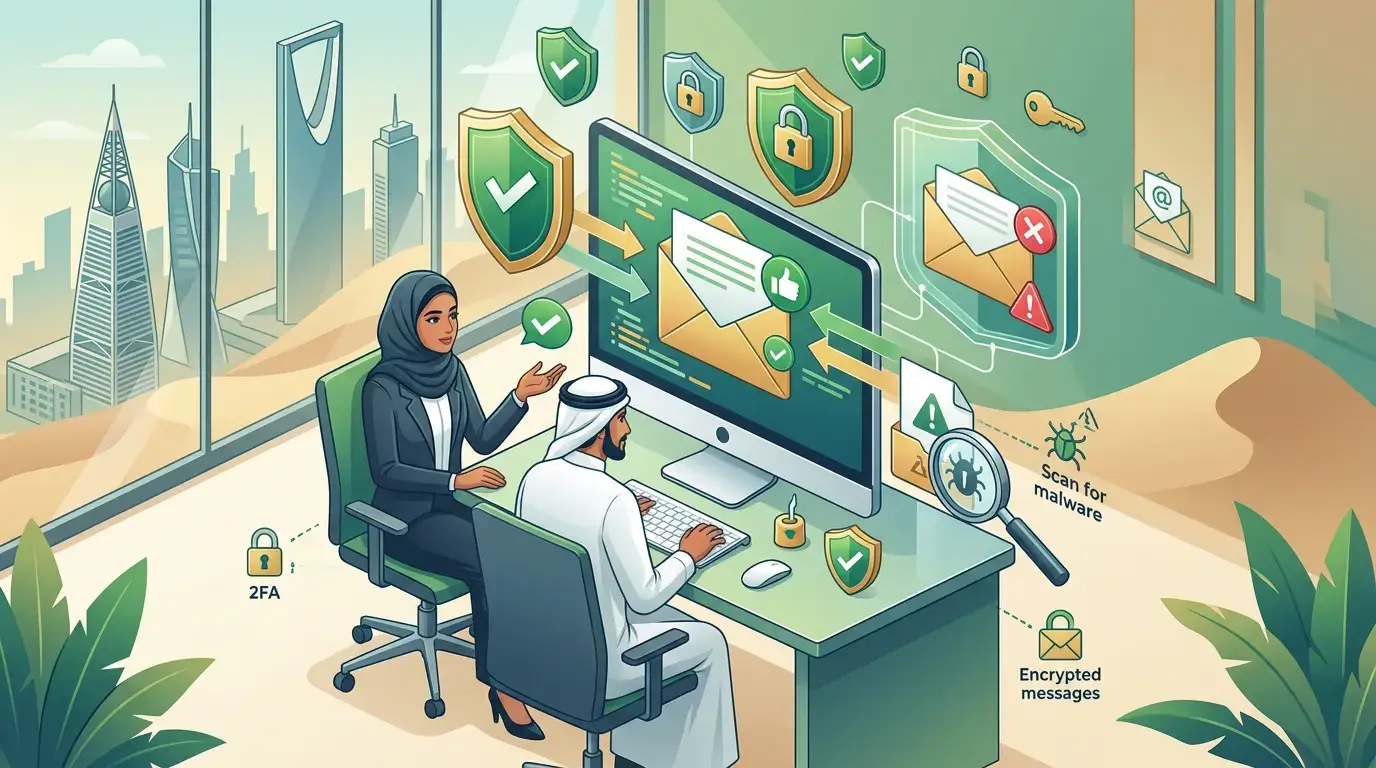
Email Security Best Practices for Saudi Businesses
Saudi businesses face a rapidly escalating email threat landscape, driven by surging phishing attacks and expanding digital infrastructure. Key best practices include deploying DMARC, SPF, and DKIM authentication, enforcing multi-factor authentication, training employees, encrypting communications, and aligning with NCA and PDPL compliance requirements.
Email remains the primary communication channel for businesses across Saudi Arabia—and the most exploited one. As the Kingdom accelerates its digital transformation under Vision 2030, cybercriminals are taking notice. Sectors including oil and gas, banking, healthcare, and government services are experiencing a surge in targeted email-based attacks, from sophisticated phishing campaigns to business email compromise (BEC) schemes engineered to deceive even cautious professionals.
The numbers tell a clear story. Saudi Arabia's cybersecurity market was valued at USD 6,940 million in 2024 and is projected to reach USD 17,534 million by 2030, reflecting a compound annual growth rate of 17.0% (Mark & Spark Solutions, 2025). This rapid investment signals just how serious the threat environment has become. Meanwhile, Astra Security reports that approximately 3.4 billion phishing emails are sent globally every day—and Saudi organizations are not immune.
This post outlines the most effective email security best practices your business can implement today, along with guidance on meeting Saudi Arabia's regulatory expectations.
Why Is Email Security a Critical Priority for Saudi Organizations?
Saudi Arabia's digital economy is expanding at pace. Cloud computing, remote work, e-commerce, and connected infrastructure have created more entry points for attackers to exploit. The National Cybersecurity Authority (NCA) has recognized this, establishing regulatory frameworks that mandate stricter cybersecurity controls across both public and private sector entities.
Phishing attacks in Saudi Arabia increased by 168% in Q2 2022 alone (MDPI, 2024), and the trajectory has not reversed. According to the WEF Global Cybersecurity Outlook 2025, 72% of cybersecurity professionals report that cyber risks have increased over the past year. For Saudi businesses, the cost of inaction extends beyond financial loss—it includes regulatory penalties, reputational damage, and potential breaches of nationally sensitive data.
What Are the Most Common Email Threats Targeting Saudi Businesses?
Understanding the threat landscape is the first step toward defending against it. The most prevalent email-based threats facing Saudi organizations include:
- Phishing attacks: Fraudulent emails designed to trick recipients into revealing credentials or clicking malicious links, often impersonating trusted institutions
- Business Email Compromise (BEC): Targeted attacks in which cybercriminals impersonate executives or vendors to authorize fraudulent financial transfers
- Ransomware delivery: Malicious attachments that encrypt organizational data and demand payment for its release
- Domain spoofing: Attackers forging sender domains to make emails appear legitimate
- Social engineering: AI-driven manipulations that exploit human psychology rather than technical vulnerabilities
What Are the Top Email Security Best Practices for Businesses in Saudi Arabia?
1. Deploy DMARC, SPF, and DKIM Authentication
Domain-based Message Authentication, Reporting, and Conformance (DMARC) is the foundational layer of email authentication. It works in conjunction with two supporting protocols:
- SPF (Sender Policy Framework): Specifies which mail servers are authorized to send emails on behalf of your domain
- DKIM (DomainKeys Identified Mail): Attaches a cryptographic signature to outbound emails, allowing recipients to verify authenticity
Together, these three protocols prevent domain spoofing, reduce phishing risk, and improve email deliverability. For Saudi businesses operating in regulated sectors, deploying DMARC with a strict enforcement policy is no longer optional—it is a foundational security requirement aligned with the NCA's Essential Cybersecurity Controls (ECC).
2. Enforce Multi-Factor Authentication on All Email Accounts
A compromised password alone should never be sufficient to access a business email account. Multi-factor authentication (MFA) requires users to verify their identity through a secondary method—such as an authenticator app, hardware security key, or biometric confirmation—before gaining access.
Even when credentials are leaked through data breaches or phishing, MFA prevents unauthorized access. Organizations should enforce MFA across all accounts, prioritizing executive, finance, and IT staff who are disproportionately targeted by Blue Edge attacks.
3. Train Employees to Recognize and Report Phishing
Technology alone cannot stop every threat. Human error remains the leading cause of successful email attacks. Regular, role-specific security awareness training equips staff to identify the warning signs of phishing attempts, including:
- Unusual sender addresses or display names that closely mimic legitimate ones
- Urgent language demanding immediate action
- Suspicious attachments with high-risk file types (.exe, .jar, .msi)
- Links where the anchor text does not match the actual destination URL
Saudi organizations should conduct simulated phishing exercises periodically to measure and reinforce employee vigilance. Establishing a clear internal process for reporting suspicious emails further strengthens the organization's overall security posture.
4. Encrypt Business Email Communications
Email encryption ensures that message content cannot be intercepted and read by unauthorized parties during transmission. This is especially critical for businesses in Saudi Arabia handling sensitive financial data, patient records, legal documents, or government contracts.
Organizations should implement TLS (Transport Layer Security) for email transmission encryption and consider end-to-end encryption solutions for highly sensitive communications. Additionally, employees should avoid using public Wi-Fi networks for accessing business email without a verified VPN connection.
5. Align with Saudi Arabia's NCA Requirements and PDPL Obligations
Saudi businesses are subject to two overlapping regulatory frameworks with direct implications for email security:
- NCA Essential Cybersecurity Controls (ECC): The NCA mandates specific technical and operational controls for organizations operating in Saudi Arabia, including requirements for email authentication, access management, and incident response.
- Personal Data Protection Law (PDPL): Saudi Arabia's PDPL governs the collection, processing, and storage of personal data. Email communications frequently contain personal data, making secure handling a legal obligation. Non-compliance carries the risk of regulatory penalties.
Businesses should conduct a formal gap assessment against the NCA ECC and PDPL requirements, and document their email security policies to demonstrate compliance readiness.
Strengthen Your Email Security Before the Next Attack Occurs
The threat to Saudi business email is not hypothetical—it is active, escalating, and increasingly sophisticated. Phishing volumes continue to rise, regulatory scrutiny is intensifying, and the cost of a breach extends far beyond the initial incident.
Implementing DMARC, SPF, and DKIM authentication, enforcing MFA, investing in employee training, encrypting sensitive communications, and aligning with NCA and PDPL requirements are not isolated measures—they form an interconnected defense that significantly reduces your organization's exposure.
Take the next step today. Assess your current email security configuration, identify gaps against the NCA Essential Cybersecurity Controls, and engage a qualified cybersecurity partner to implement the protections your business requires. A proactive approach now is far less costly than a reactive response later.
Frequently Asked Questions
-
What is DMARC and why do Saudi businesses need it?
DMARC (Domain-based Message Authentication, Reporting, and Conformance) is an email authentication protocol that prevents unauthorized parties from sending emails using your domain. Saudi businesses need DMARC to protect against domain spoofing and phishing, and to align with NCA Essential Cybersecurity Controls. Without DMARC, your domain can be impersonated to deceive customers, partners, or employees.
-
How does the Saudi PDPL apply to email communications?
The Saudi Personal Data Protection Law (PDPL) requires organizations to protect any personal data they process, including data transmitted via email. Businesses must implement appropriate technical safeguards—such as encryption and access controls—to prevent unauthorized disclosure of personal data through email channels. Non-compliance with the PDPL can result in regulatory penalties.
-
What is the most effective way to prevent phishing attacks in a Saudi organization?
The most effective defense combines technical controls with human awareness. Deploying DMARC, SPF, and DKIM authentication blocks a large volume of spoofed emails at the technical level. Regular phishing simulation training and a clear internal reporting process address the human element. Neither approach is sufficient in isolation—both are required for meaningful protection.
-
Is multi-factor authentication mandatory for Saudi businesses?
While MFA is not explicitly mandated for all private businesses under current law, the NCA's Essential Cybersecurity Controls strongly recommend it as a baseline security measure for access to critical systems, including email. Organizations in regulated sectors—such as government, finance, and healthcare—face stricter requirements. Regardless of sector, MFA is considered a cybersecurity best practice and is highly advisable for all Saudi businesses.
-
How often should employees receive cybersecurity awareness training?
Security awareness training should be conducted at least annually, with phishing simulation exercises repeated quarterly to maintain vigilance. New employees should complete training as part of their onboarding. Given the rapid evolution of email-based threats—including AI-generated phishing content—more frequent, targeted refreshers are increasingly recommended for high-risk roles such as finance, HR, and executive support.