Shopping Cart


- Articles
- Enterprise Communication
- Secure Enterprise Communication with End-to-End Encryption (E2EE) – 2026 Guide
Secure Enterprise Communication with End-to-End Encryption (E2EE) – 2026 Guide
Learn how end-to-end encryption (E2EE) secures enterprise communication. Explore benefits, compliance, and implementation strategies for businesses in 2026.
By Blue Edge Team | Published Apr 21, 2026 | Updated Sep 23, 2026 | 6 min read
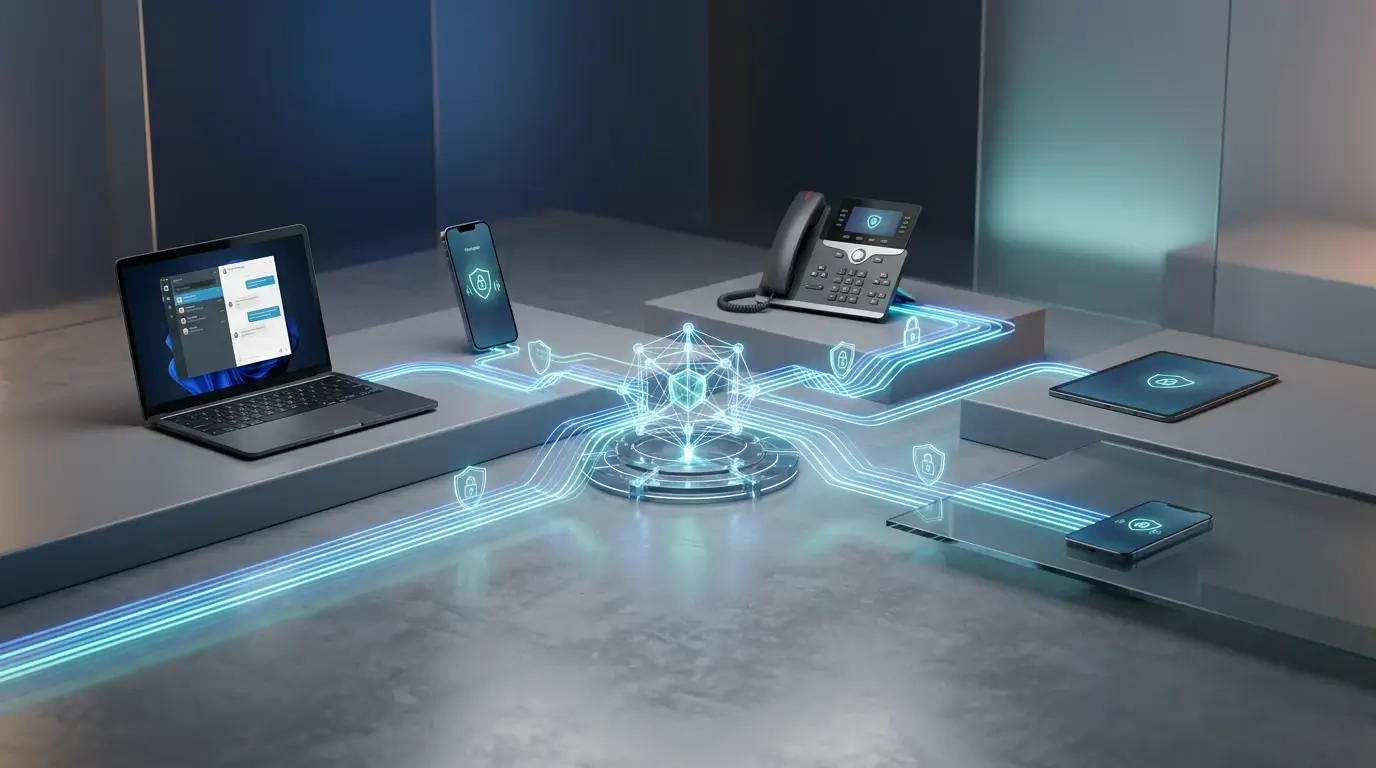
Corporate data represents the most valuable asset a modern organization possesses. Protecting this information requires robust infrastructure that guarantees privacy across all internal and external channels. As cyber threats grow more sophisticated, basic security measures fail to provide adequate protection for sensitive corporate data.
End-to-End Encryption (E2EE) has emerged as the definitive standard for safeguarding digital conversations. This technology ensures that only the communicating users can read the messages. In principle, it prevents potential eavesdroppers — including telecom providers, internet providers, and even the communication service provider — from accessing the cryptographic keys needed to decrypt the conversation.
This article outlines the fundamental mechanics of end-to-end encryption. You will learn how E2EE differentiates itself from legacy security protocols, why it is critical for regulatory compliance, and how to effectively integrate these systems into your enterprise architecture.
Implementing E2EE is no longer a discretionary IT decision; it is a fundamental requirement for operational integrity. Organizations that prioritize secure enterprise communication build a resilient foundation that protects their intellectual property, client confidentiality, and long-term business continuity.
Understanding End-to-End Encryption
To fully appreciate the value of secure enterprise communication, leaders must understand the technical mechanisms that protect their data. E2EE operates on a system of public and private cryptographic keys.
How E2EE Protects Data
When a user sends a message, the software encrypts the data on their device using a cryptographic key. The data travels across the network in an unreadable format. It only becomes decipherable once it reaches the recipient's device, which holds the matching private key required for decryption. This means that the data remains secure while in transit and on the server. If a malicious actor intercepts the data packet during transmission, they will only see randomized characters.
The Difference Between E2EE and Standard Encryption
Standard encryption protocols typically secure data between the user and the server. This model, known as encryption-in-transit, protects data from outside interception but leaves it vulnerable at the server level. If a breach occurs at the service provider's data center, the attackers can access the unencrypted information. End-to-End Encryption eliminates this vulnerability. Because the server never possesses the decryption keys, a server compromise does not result in a data breach for the end users.
The Core Benefits for Enterprise Environments
Adopting E2EE transforms how an organization manages risk. The benefits extend far beyond basic IT security, impacting legal compliance and overall corporate strategy.
Mitigating Cyber Threats
Data interception represents a primary vector for corporate espionage. Attackers actively target communication networks to steal financial reports, strategic plans, and client databases. E2EE neutralizes this threat by rendering intercepted data useless. Even if attackers compromise the network infrastructure, the encrypted contents remain inaccessible. This proactive defense mechanism dramatically reduces the probability of a successful data extraction attack. Learn more about the top cybersecurity threats facing organizations today and how to stay ahead of them.
Ensuring Regulatory Compliance
Global data protection regulations mandate strict security controls for personal and corporate data. Frameworks such as the General Data Protection Regulation (GDPR) and the Health Insurance Portability and Accountability Act (HIPAA) require organizations to implement adequate technical safeguards. Using E2EE provides verifiable proof that an organization is protecting data by default. This significantly lowers the risk of regulatory fines and legal liabilities associated with data exposure. Our IT technical consultations team can help you assess your compliance posture and close any gaps.
Protecting Intellectual Property
Research and development discussions, proprietary source code, and strategic acquisition plans often occur over enterprise messaging platforms. This intellectual property dictates an organization's competitive advantage. E2EE ensures that these highly sensitive discussions remain strictly confidential, accessible only to authorized personnel.
Challenges and Considerations in Implementation
While the security benefits are substantial, organizations must carefully manage the deployment of E2EE to maintain operational efficiency.
Balancing Security and Usability
Historical encryption methods often required complex key management by the end users, leading to poor adoption rates. Modern secure enterprise communication platforms automate this process. The encryption happens seamlessly in the background. Employees can communicate naturally without navigating complex security protocols. Selecting a vendor that prioritizes both high-level security and an intuitive user interface is critical for successful deployment.
Key Management Protocols
Effective encryption relies on secure key generation and storage. Enterprises must establish clear protocols for device management. If an employee loses their device, the organization must have mechanisms to remotely wipe the local data and revoke access credentials. Robust identity and access management (IAM) integration ensures that only authenticated users can generate and access the necessary decryption keys.
Establishing a Secure Communication Infrastructure
Deploying E2EE requires strategic planning and careful vendor evaluation. Organizations must look beyond marketing claims and verify the technical architecture of their chosen communication tools.
Evaluating Vendor Security Standards
When selecting a secure enterprise communication platform, organizations must demand transparency regarding the underlying encryption protocols. Look for platforms that utilize open-source cryptographic libraries. Open-source algorithms undergo rigorous public auditing by security researchers, ensuring that no hidden backdoors exist. Furthermore, verify that the vendor conducts regular third-party security audits to validate their infrastructure. For a broader view of how to evaluate your network's security posture, read our guide on securing your office network.
Training Your Workforce
Technology alone cannot prevent all security incidents. Human error remains a significant vulnerability. Organizations must train their staff on the importance of secure communication. Employees should understand why E2EE is implemented and how to recognize phishing attempts that aim to steal device access credentials. A knowledgeable workforce acts as the final perimeter in a comprehensive security strategy. Tools like KnowBe4 can help your teams build this security awareness through structured training programs.
Frequently Asked Questions
-
What is End-to-End Encryption (E2EE)?
E2EE is a secure communication process that prevents third parties from accessing data while it's transferred from one end system or device to another. The data is encrypted on the sender's system and only the intended recipient can decrypt it.
-
Does E2EE impact network performance?
Modern E2EE protocols are highly optimized and require minimal processing power. Encryption and decryption occur almost instantaneously on the user's device, meaning there is no noticeable impact on message delivery speed or network performance.
-
Can IT administrators read E2EE messages?
No. By definition, true E2EE prevents anyone except the sender and recipient from reading the messages. IT administrators cannot access the content of the communications, which protects data even if an administrator's account is compromised.
-
Is E2EE required for GDPR compliance?
While the GDPR does not explicitly mandate E2EE by name, it requires organizations to implement appropriate technical and organizational measures to ensure a level of security appropriate to the risk. E2EE is widely recognized as a best practice for meeting this requirement when transmitting personal data. See our cybersecurity checklist for a practical starting point.
-
How do we implement E2EE in our organization?
Implementation begins with auditing your current communication tools. You must select an enterprise messaging platform that offers E2EE by default, deploy the application to your workforce, and integrate it with your existing identity management systems to control access securely. Our IT installation and configuration team can manage this rollout end-to-end.
Securing Your Enterprise Future
The transition to secure enterprise communication is a strategic necessity. As threat actors continue to target corporate data, relying on outdated security models leaves your organization exposed to severe financial and reputational damage. End-to-End Encryption provides the definitive solution for protecting sensitive conversations, ensuring compliance, and safeguarding intellectual property.
To build a resilient infrastructure, begin by auditing your current communication channels. Identify areas where data travels without true end-to-end protection. Evaluate vendors that provide transparent, audited encryption standards, and begin migrating your sensitive workflows to these secure platforms. Explore our cybersecurity resources or speak with our IT consultants to design a security strategy that fits your organization. Taking these decisive actions will establish a secure environment where your enterprise can operate with absolute confidence.
About Blue Edge
Blue Edge Company is a value-added technology distributor based in Dammam, Saudi Arabia, supplying interactive displays, smart building systems, networking infrastructure and IT security software to businesses and residential projects across the Kingdom, with installation and technical support.
Learn more about Blue Edge →Published 21 April 2026 • Last updated 23 September 2026 • This article is reviewed when standards, regulations or product guidance change.