Shopping Cart


What Is a DMZ Network and Should Your Business Have One?
Learn what a DMZ network is, how it works, and why businesses use DMZs to improve cybersecurity, protect internal networks, and securely host public-facing services.
By Blue Edge Team | Jun 16, 2026
What Is a DMZ Network and Does Your Business Need One?
Quick answer: A Demilitarized Zone (DMZ) network is a secure physical or logical subnetwork that separates a company's internal local area network (LAN) from untrusted external networks, such as the internet. Businesses should implement a DMZ if they host public-facing services—like web, email, or domain name system (DNS) servers—to protect sensitive internal data from external cyber threats.
Modern businesses require secure, flexible, and high-performance communication systems. As external cyber threats become more sophisticated, organizations face the complex challenge of providing public access to their digital services while strictly guarding their internal databases.
Relying on a single firewall to protect an entire corporate network is no longer sufficient for enterprise-level security. A more robust structural approach is necessary to isolate vulnerabilities.
By reading this guide, you will understand the fundamental architecture of a DMZ network. You will also learn the precise security advantages it provides and discover the exact criteria to determine if your enterprise infrastructure requires this vital layer of defense.
How does a DMZ network actually work?
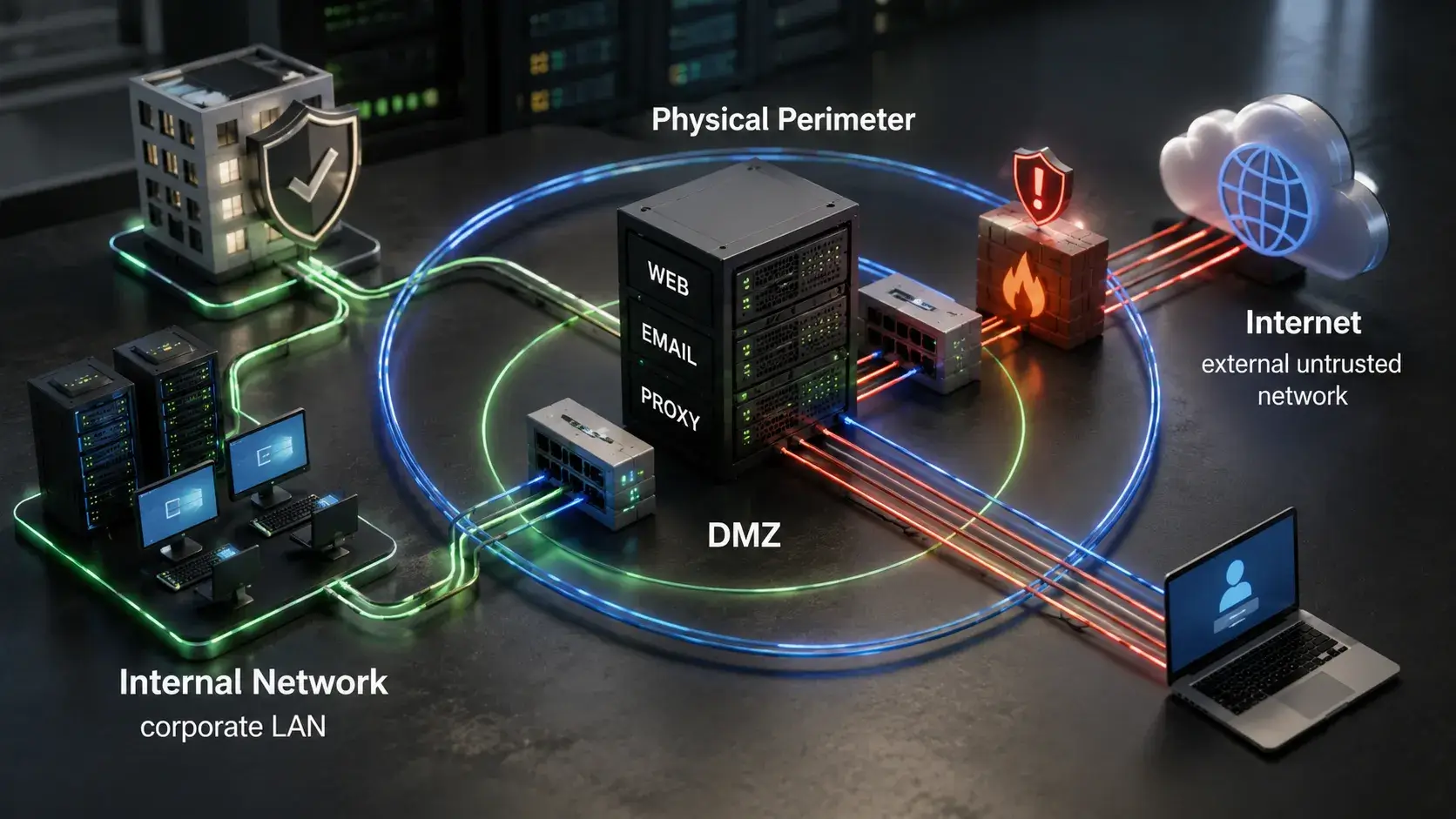
A DMZ network functions as an isolated buffer zone situated between your private internal network and the public internet. By placing public-facing servers inside this isolated zone, you ensure that external users can access the services they need without ever interacting with your secure internal local area network (LAN).
To achieve this level of security, network engineers typically deploy a dual-firewall architecture.
- The front-end firewall: This firewall sits between the internet and the DMZ. It is configured to allow specific external traffic (such as HTTP or HTTPS requests) to reach the public-facing servers hosted within the DMZ.
- The back-end firewall: This firewall sits between the DMZ and the internal LAN. It enforces strict access controls, ensuring that even if a server within the DMZ is compromised by a malicious actor, the attacker cannot easily pivot into the internal corporate network.
What are the main benefits of a DMZ network for businesses?
Implementing a DMZ network provides immediate, measurable enhancements to an organization's cybersecurity posture. The primary advantages include:
- Advanced access control: A DMZ strictly dictates which users and systems can communicate with specific network segments. It ensures external internet traffic never communicates directly with internal databases.
- Network reconnaissance prevention: Cybercriminals frequently scan public-facing servers to map internal IP addresses and find vulnerabilities. A DMZ prevents attackers from seeing past the buffer zone, keeping internal network structures hidden.
- Protection against IP spoofing: A properly configured DMZ verifies the legitimacy of incoming traffic. It acts as a staging area where security systems can detect and neutralize spoofed IP addresses before they reach the internal LAN.
- Uninterrupted performance: Isolating public traffic to a dedicated subnetwork prevents external user requests from consuming the bandwidth of your internal corporate network.
How do you know if your organization should use a DMZ?
Not every small business requires a complex dual-firewall architecture. However, you should choose to implement a DMZ network if your organization meets specific operational criteria.
Implement a DMZ network if your business requires:
- Public web servers: If your company hosts its own website or customer portals that require constant internet accessibility.
- Email servers: If you manage internal Microsoft Exchange servers or similar enterprise email systems that must process incoming messages from the external internet.
- File Transfer Protocol (FTP) servers: If your partners and clients frequently upload or download large files directly from your corporate infrastructure.
- Voice over IP (VoIP) systems: If your business utilizes advanced IP telephony and video conferencing solutions that require secure external gateways.
If your enterprise relies strictly on cloud-hosted applications managed by third-party providers (such as Software-as-a-Service platforms), a traditional on-premise DMZ may not be required. However, any organization hosting public-facing hardware on-site must utilize a DMZ to meet baseline industry security standards.
Securing Your Enterprise Infrastructure
Deploying a DMZ network is a proven, highly effective method for defending your organization's most valuable internal assets. By physically and logically separating your public-facing servers from your private LAN, you drastically reduce the attack surface available to cybercriminals.
Every product and network architecture you utilize should be tested and proven to meet the highest industry standards. A DMZ ensures optimal performance and durability while mitigating catastrophic risks.
Are you ready to upgrade your corporate network security? Contact our expert team today to schedule a comprehensive cybersecurity audit and seamlessly integrate a robust DMZ architecture into your enterprise infrastructure.
Frequently Asked Questions
-
What are the alternatives to a traditional DMZ network?
If a traditional on-premise DMZ does not fit your infrastructure, organizations can adopt a Zero Trust Network Access (ZTNA) model or utilize cloud-based Web Application Firewalls (WAF). Choose ZTNA if your priority is securing remote workers based on identity authentication rather than network location.
-
What are the common risks of improperly configuring a DMZ?
An improperly configured DMZ can create a false sense of security. If the back-end firewall rules are too permissive, a compromised server in the DMZ can be used to launch attacks directly into the internal LAN. Regular security audits and strict rule enforcement are required to prevent unauthorized pivot attacks.
-
How much does it cost to set up a DMZ network?
The cost of setting up a DMZ network varies based on the size of the enterprise and the required hardware. A basic dual-firewall setup using enterprise-grade equipment typically starts between $2,000 and $5,000 for hardware alone, excluding the professional installation, ongoing licensing, and maintenance fees required for optimal performance.