Shopping Cart


- Articles
- Cybersecurity
- Cloud Access Security Brokers (CASB) Explained
Cloud Access Security Brokers (CASB) Explained
Learn what a Cloud Access Security Broker (CASB) is, how it secures cloud applications, protects sensitive data, enforces compliance, and strengthens enterprise cybersecurity.
By Blue Edge Team | Published Jul 22, 2026 | Updated Nov 13, 2026 | 6 min read
Quick answer
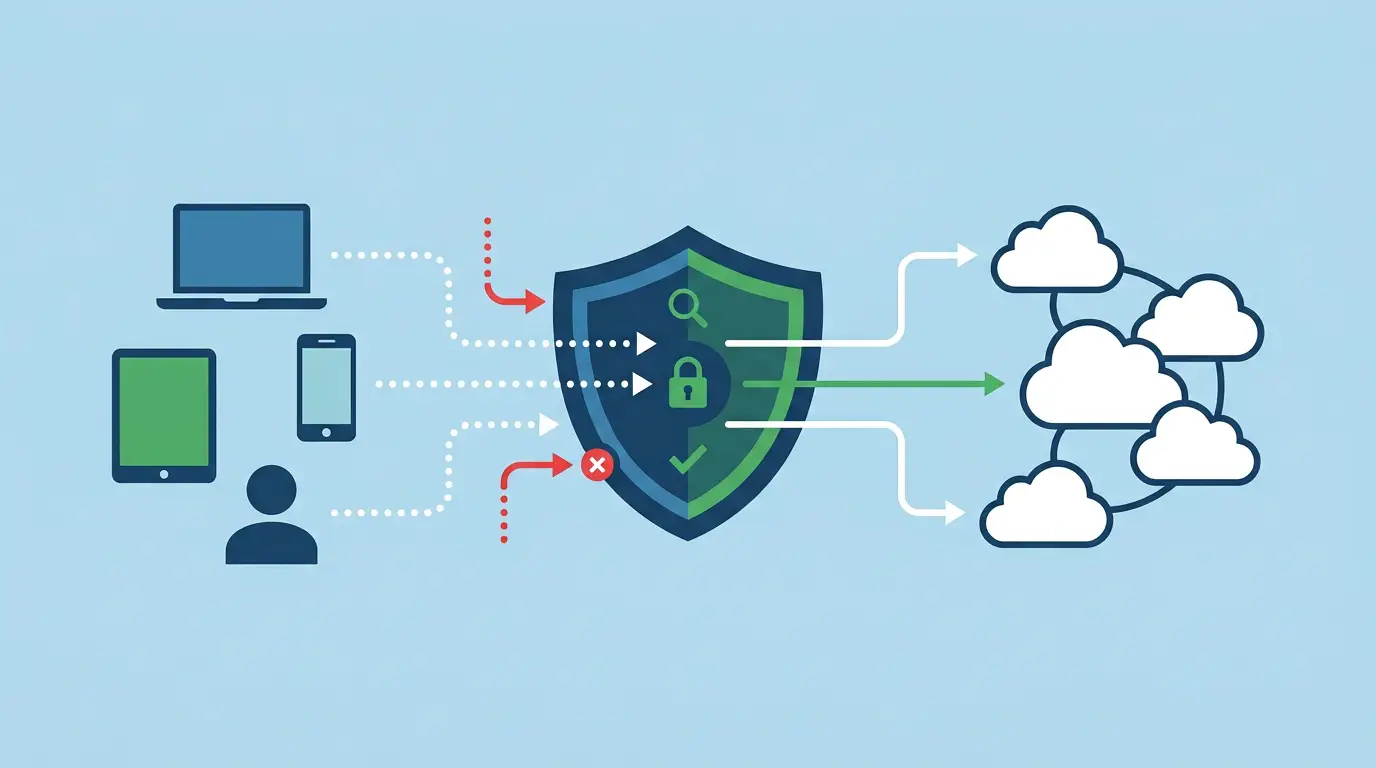
A Cloud Access Security Broker (CASB) is a security policy enforcement point—either on-premises or cloud-based—that sits between users and cloud service providers. CASBs give organizations visibility into cloud usage, enforce security policies, protect sensitive data, and defend against threats across cloud environments.
As organizations migrate critical workloads to the cloud, securing access to those environments has become a top priority. Shadow IT, data leakage, and compliance gaps are no longer theoretical risks—they are operational realities that IT and security teams face daily.
Cloud Access Security Brokers address these challenges directly. By acting as a gatekeeper between users and cloud services, a CASB enables organizations to extend their security policies beyond the corporate perimeter and into the cloud. This post breaks down what CASBs are, how they work, their core features, key benefits, and how to evaluate whether one is right for your organization.
What Is a Cloud Access Security Broker (CASB)?
Gartner coined the term "Cloud Access Security Broker" in 2012 to describe a category of security solutions designed to enforce enterprise security policies as cloud services are accessed. A CASB can be deployed as a proxy (forward or reverse), through API integration, or as a combination of both.
The defining characteristic of a CASB is its position in the network architecture: between the end user and the cloud service provider. This positioning allows the CASB to monitor traffic, apply policies, and respond to threats—regardless of whether a user is on-premises or working remotely.
What Are the Four Pillars of CASB Security?
Industry frameworks—including those defined by Gartner—organize CASB capabilities around four core pillars:
- Visibility: Discovering all cloud applications in use, including unsanctioned applications (shadow IT), and providing detailed activity logs.
- Compliance: Helping organizations meet regulatory requirements such as GDPR, HIPAA, PCI-DSS, and ISO 27001 by identifying data risks and enforcing data governance policies.
- Data Security: Applying data loss prevention (DLP) policies to prevent sensitive data from being stored, shared, or transmitted improperly through cloud services.
- Threat Protection: Detecting and responding to anomalous user behavior, compromised accounts, malware, and insider threats across cloud environments.
Key Features of a CASB Solution
A mature CASB solution typically includes the following features:
| Feature | Description |
|---|---|
| Shadow IT Discovery | Identifies all cloud apps in use, sanctioned or not |
| Data Loss Prevention (DLP) | Prevents unauthorized sharing or exfiltration of sensitive data |
| Access Control | Enforces role-based and context-aware access policies |
| Threat Detection | Uses behavioral analytics to identify anomalies and threats |
| Encryption & Tokenization | Protects data at rest and in transit within cloud environments |
| Compliance Reporting | Generates audit-ready reports aligned to regulatory frameworks |
| API Integration | Connects directly to cloud platforms for deep visibility and control |
Not every CASB product offers every feature at the same depth. Organizations should evaluate solutions based on the cloud platforms they use and the compliance obligations they must meet.
What Are the Benefits of Using a CASB?
- 1. Comprehensive Cloud VisibilityMany organizations are unaware of the full scope of cloud services their employees use. A CASB provides a complete inventory of cloud usage—often revealing hundreds of unsanctioned applications—enabling IT teams to make informed risk decisions.
- 2. Consistent Policy EnforcementSecurity policies applied at the network perimeter do not automatically extend to cloud services. A CASB bridges this gap, ensuring that the same data governance and access control policies apply whether a user is in the office, at home, or traveling.
- 3. Regulatory Compliance SupportFor industries subject to strict data regulations, a CASB simplifies compliance by identifying where regulated data resides, how it is being used, and whether it is at risk. This reduces both the effort and the uncertainty involved in audit preparation.
- 4. Reduced Risk of Data BreachesBy enforcing DLP policies and detecting abnormal behavior in real time, CASBs significantly reduce the likelihood of a costly data breach. According to IBM's Cost of a Data Breach Report 2023, the global average cost of a data breach reached $4.45 million—a figure that underscores the financial value of preventive security controls.
- 5. Support for Secure Remote WorkAs distributed workforces rely heavily on cloud collaboration tools, CASBs provide a scalable mechanism to secure access across diverse devices and locations without degrading the user experience.
CASB Deployment Models: Which One Is Right for Your Organization?
| Deployment Model | Best For | Limitation |
|---|---|---|
| Forward Proxy | Monitoring and controlling unmanaged devices | Requires endpoint configuration |
| Reverse Proxy | Agentless control for managed and unmanaged devices | Limited to browser-based access |
| API Mode | Deep integration with sanctioned cloud applications | Not effective for real-time blocking |
| Hybrid | Organizations needing comprehensive coverage | More complex to configure and manage |
Choose forward proxy deployment if your priority is controlling access from unmanaged or personal devices. Choose API mode if your focus is on sanctioned cloud platforms like Microsoft 365 or Google Workspace, where you need deep visibility into stored data and user activity. A hybrid approach is most appropriate for enterprises requiring both real-time enforcement and post-incident investigation capabilities.
How Does a CASB Fit Into a Broader Security Architecture?
A CASB does not operate in isolation. Organizations integrating a CASB should consider how it connects with other security tools, including:
- SIEM (Security Information and Event Management): CASBs can feed activity logs into a SIEM for centralized threat detection and incident response.
- Zero Trust Network Access (ZTNA): CASBs complement Zero Trust frameworks by enforcing least-privilege access policies for cloud resources.
- Endpoint Detection and Response (EDR): Combining CASB with EDR provides end-to-end visibility from the device to the cloud application.
- Secure Access Service Edge (SASE): Gartner's SASE architecture converges networking and security functions—including CASB—into a unified, cloud-delivered service.
Taking the Next Step with Cloud Security
Cloud environments will continue to expand, and the threat landscape will evolve alongside them. A Cloud Access Security Broker provides the visibility, control, and enforcement capabilities that modern organizations need to operate securely in multi-cloud and hybrid environments.
Selecting the right CASB requires a clear understanding of your organization's cloud usage patterns, regulatory obligations, and security architecture. Organizations should conduct a thorough cloud discovery assessment before evaluating vendors—this ensures the solution selected is aligned to actual risk exposure, not assumed exposure.
If you are ready to evaluate CASB solutions or want to learn how a CASB integrates with your existing security infrastructure, contact our team for a consultation tailored to your environment.
Frequently Asked Questions
-
What is the primary purpose of a CASB?
A CASB enforces enterprise security policies between users and cloud service providers. Its primary purpose is to provide visibility into cloud usage, protect sensitive data through DLP controls, ensure regulatory compliance, and detect threats such as compromised accounts or insider activity.
-
How is a CASB different from a firewall?
A firewall controls network traffic at the perimeter, primarily based on IP addresses and ports. A CASB operates at the application layer within cloud environments, enforcing granular policies based on user identity, data content, device context, and cloud application behavior. The two tools address different threat surfaces and are complementary.
-
Is a CASB necessary if I only use one cloud provider?
Yes. Even in single-cloud environments, a CASB provides visibility into how data is stored and accessed within that platform, enforces DLP policies, and detects anomalous user behavior. Many organizations discover significant compliance and security gaps after deploying a CASB—even in environments they previously considered well-controlled.
-
What cloud platforms do CASBs typically support?
Leading CASB solutions support major cloud platforms including Microsoft 365, Google Workspace, Salesforce, ServiceNow, AWS, Microsoft Azure, and Google Cloud Platform. Coverage varies by vendor, so organizations should verify compatibility with their specific cloud portfolio before selecting a solution.
-
How long does it take to deploy a CASB?
Deployment timelines vary based on the model chosen and the complexity of the environment. API-based integrations with sanctioned cloud applications can typically be completed within days. Full proxy-based deployments in large enterprises may require several weeks of configuration, testing, and policy tuning to operationalize effectively.
About Blue Edge
Blue Edge Company is a value-added technology distributor based in Dammam, Saudi Arabia, supplying interactive displays, smart building systems, networking infrastructure and IT security software to businesses and residential projects across the Kingdom, with installation and technical support.
Learn more about Blue Edge →Published 22 July 2026 • Last updated 13 November 2026 • This article is reviewed when standards, regulations or product guidance change.