Shopping Cart


- Articles
- Cybersecurity
- What Is Endpoint Detection and Response (EDR)?
What Is Endpoint Detection and Response (EDR)?
Learn what endpoint detection and response (EDR) is, how it works, and why it is essential for detecting, investigating, and responding to advanced cyber threats.
By Blue Edge Team | Published Jul 01, 2026 | Updated Sep 23, 2026 | 6 min read
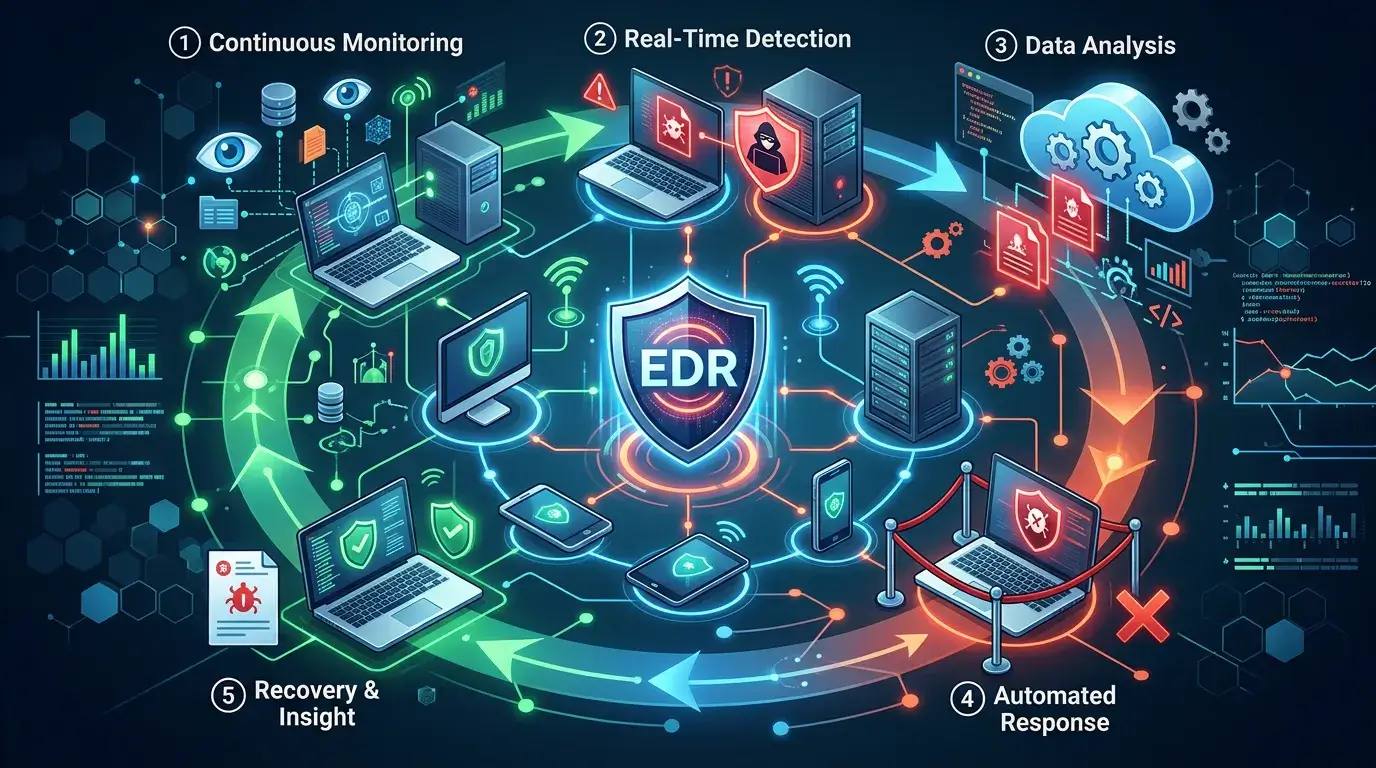
Endpoint Detection and Response (EDR) is a cybersecurity solution that continuously monitors end-user devices to detect, investigate, and respond to threats in real time. Unlike traditional antivirus software, EDR uses behavioral analytics and threat intelligence to catch both known and unknown attacks—before they become breaches.
Every device connected to your network is a potential entry point for attackers. Laptops, servers, workstations, and mobile endpoints all represent surfaces that cybercriminals actively probe. According to the Verizon 2025 Data Breach Investigations Report, ransomware was present in 44% of all data breaches last year. The average cost of a breach in the U.S. now stands at $10.22 million (IBM, 2025).
Traditional security tools are no longer enough. Attackers move fast—and they know it. The median dwell time before detection is just 11 days (Mandiant M-Trends, 2025), meaning an adversary can operate inside your network for nearly two weeks before anyone notices. Endpoint Detection and Response technology is specifically designed to close that gap.
This guide explains what EDR is, how it works, what to look for in a solution, and who needs it.
What Does "Endpoint Detection and Response" Mean?
The term was coined by Gartner analyst Anton Chuvakin. Gartner defines EDR as a solution that "records and stores endpoint-system-level behaviors, uses various data analytics techniques to detect suspicious system behavior, provides contextual information, blocks malicious activity, and provides remediation suggestions to restore affected systems."
In practical terms, EDR security software sits on every endpoint in your environment—monitoring, recording, and analyzing activity around the clock. When it detects behavior that matches a known attack pattern or deviates from established norms, it alerts your security team and, in many cases, takes automated action.
How Does Endpoint Detection and Response Actually Work?
EDR solutions work by deploying a lightweight agent on each endpoint. That agent collects a continuous stream of telemetry data—process creation, network connections, file modifications, registry changes, memory access, and more. This data feeds into a central platform (typically cloud-based) where it is analyzed at scale.
Here is what happens behind the scenes:
- Data collection: The EDR agent records every significant event on the endpoint in real time.
- Behavioral analysis: The platform applies behavioral analytics across billions of events, searching for Indicators of Attack (IOAs)—sequences of behavior that suggest malicious intent, even before a payload is delivered.
- Alert and investigation: When suspicious activity is detected, the system generates an alert with full context: which process triggered it, what commands were run, and which other endpoints may be affected.
- Response and containment: Security teams can isolate an endpoint from the network instantly—a process known as network containment—without disrupting the rest of the environment.
Think of it as a DVR for your endpoints. Everything is recorded, searchable, and available for forensic investigation—whether the incident occurred five minutes ago or 90 days ago.
What Are the Core Capabilities of a Strong EDR Solution?
Not all EDR tools are equal. When evaluating solutions, prioritize the following capabilities:
- Real-time endpoint visibility: Continuous monitoring across all devices, giving security teams a live view of adversary activity as it unfolds.
- Behavioral protection: Detection based on IOAs, not just known malware signatures. This is critical for catching novel threats and zero-day exploits.
- Threat intelligence integration: Context-enriched alerts that attribute activity to known threat actors and tactics, techniques, and procedures (TTPs).
- Managed threat hunting: Proactive human-led hunting for threats that automated systems may miss.
- Fast remediation: The ability to isolate endpoints, terminate malicious processes, and initiate recovery—directly from the EDR console.
- Cloud-based architecture: Cloud delivery ensures zero performance impact on endpoints while enabling real-time search and analysis at scale.
Leading EDR platforms in 2025 include CrowdStrike Falcon Insight XDR, Microsoft Defender for Endpoint, and Palo Alto Networks Cortex XDR.
How Is EDR Different from Traditional Antivirus Software?
This is one of the most common questions security teams ask—and the distinction matters significantly.
Traditional antivirus software relies on signature-based detection. It compares files against a database of known malware. If a threat is new or modified, antivirus often fails silently—and that silent failure is precisely what attackers count on.
EDR goes further in three critical ways:
| Feature | Antivirus | EDR |
|---|---|---|
| Detection method | Signature-based | Behavioral + intelligence-based |
| Threat coverage | Known threats only | Known and unknown threats |
| Response capability | Quarantine/delete | Isolate, investigate, remediate |
| Visibility | File-level | Full endpoint activity |
| Investigation support | Minimal | Deep forensic data |
EDR does not replace antivirus—many organizations run both. However, EDR is essential for catching the sophisticated, fileless, and human-operated attacks that signatures simply cannot detect.
Who Needs EDR, and Is It Right for Your Organization?
EDR is not exclusively for large enterprises. The 2025 cybersecurity landscape has made it relevant for organizations of all sizes.
EDR is particularly critical if your organization:
- Operates remote or hybrid workforces with distributed endpoints
- Handles sensitive customer, financial, or health data
- Operates in a regulated industry (healthcare, finance, government)
- Has a small or lean security team that cannot manually monitor every device
- Has experienced a security incident in the past 24 months
Nearly half of SMB owners report experiencing a cyberattack on their current business, and almost 1 in 5 of those later closed or went bankrupt as a result (NordLayer, 2025). The threat is not limited to large corporations.
Choose EDR if visibility and response speed matter more than basic prevention alone. Prioritize a managed EDR (MDR) service if your internal team lacks the capacity to triage and investigate alerts independently.
What Should You Look for When Choosing an EDR Tool in 2026?
The EDR market is growing rapidly. According to Strategic Market Research, the global EDR market was valued at USD 3.5 billion in 2024 and is projected to reach USD 9.8 billion by 2030—a compound annual growth rate of 17.5%. That growth reflects both increasing demand and increasing sophistication among vendors.
When selecting an EDR solution, ask the following:
- How quickly does the platform generate and prioritize alerts? Speed matters. Dwell time directly correlates with breach severity.
- Does it support behavioral detection, or only signatures? Signature-only tools will leave gaps.
- Can it integrate with your existing SIEM or XDR platform? Siloed tools create blind spots.
- Is threat hunting included, or is it an add-on? Proactive hunting catches what automated detection misses.
- How does the platform support incident response? Look for built-in containment, rollback, and remediation capabilities.
- Is it cloud-native? Cloud-based EDR scales without performance degradation on endpoints.
Protect Your Endpoints Before the Next Attack
Endpoint security is not a checkbox. It is an active discipline—one that requires continuous monitoring, behavioral intelligence, and fast response. EDR provides the visibility and tools your security team needs to detect threats early, investigate with precision, and contain damage before it escalates.
Evaluate your current endpoint security posture today. If your organization relies solely on antivirus or lacks visibility into endpoint activity, the gap between your defenses and modern threats is significant—and attackers are already aware of it.
Connect with a cybersecurity specialist to assess your EDR readiness and identify the solution best suited to your environment.
Frequently Asked Questions
-
What is the difference between EDR and XDR?
EDR (Endpoint Detection and Response) focuses specifically on monitoring and responding to threats at the endpoint level. XDR (Extended Detection and Response) expands that scope to include network, cloud, identity, and email data—providing a unified view across multiple security domains. Organizations with more complex environments often evolve from EDR to XDR as their security maturity grows.
-
Can a small business benefit from EDR, or is it only for enterprises?
EDR is relevant for organizations of any size. Small and mid-sized businesses are frequently targeted because they often have fewer security controls. Managed EDR (MDR) services make enterprise-grade endpoint protection accessible without requiring a large in-house security team.
-
How long does it take to deploy an EDR solution?
Deployment timelines vary by vendor and environment. Cloud-native EDR platforms can typically deploy agents across endpoints within hours to days. Full integration with existing SIEM or identity tools may take additional configuration time, often ranging from one to four weeks depending on organizational complexity.
-
Does EDR replace the need for antivirus software?
EDR and antivirus serve complementary roles. Antivirus handles known, signature-based threats efficiently. EDR extends protection to unknown, behavioral, and fileless threats. Many organizations run both in parallel. Some modern EDR platforms include built-in antivirus functionality, effectively consolidating both capabilities into one agent.
-
How does EDR help with ransomware specifically?
EDR detects ransomware-related behaviors—such as rapid file encryption, unusual process execution, or lateral movement—before the attack completes. Once detected, EDR can automatically isolate the affected endpoint, terminate malicious processes, and alert the security team with full context. This early intervention limits the blast radius and accelerates recovery compared to discovering the attack after the fact.
About Blue Edge
Blue Edge Company is a value-added technology distributor based in Dammam, Saudi Arabia, supplying interactive displays, smart building systems, networking infrastructure and IT security software to businesses and residential projects across the Kingdom, with installation and technical support.
Learn more about Blue Edge →Published 1 July 2026 • Last updated 23 September 2026 • This article is reviewed when standards, regulations or product guidance change.