Shopping Cart



When IT Operations Can't Keep Up, AIOps Steps In
Learn how AIOps helps IT operations automate monitoring, detect issues faster, reduce downtime, and improve operational efficiency with AI-driven insights.
By Blue Edge Team | Jul 15, 2026
When IT Operations Can't Keep Up, AIOps Steps In
AIOps (Artificial Intelligence for IT Operations) applies machine learning, big data analytics, and automation to replace manual, reactive IT management. According to Mordor Intelligence (January 2026), the global AIOps market stands at $18.95 billion in 2026 and is projected to reach $37.79 billion by 2031 at a 14.8% CAGR—driven by the need to cut alert noise, reduce MTTR, and manage increasingly complex hybrid infrastructures.
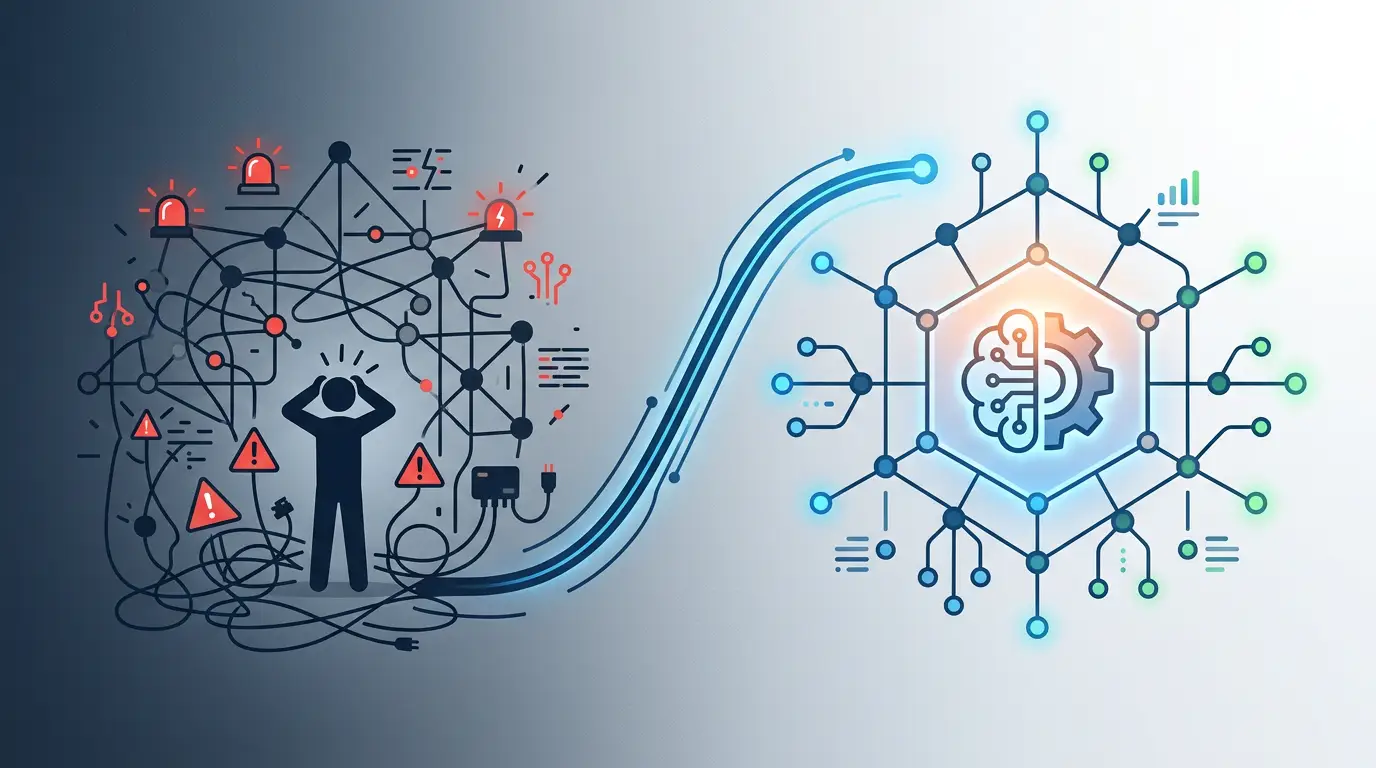
Every enterprise IT team has experienced it: a critical application goes down, the monitoring dashboard erupts with hundreds of simultaneous alerts, and engineers spend hours tracing logs across disconnected systems before finding the root cause. By the time a fix is deployed, the business has already absorbed the cost.
This is the structural failure of traditional IT operations—and it's why organizations across industries are turning to AIOps. The shift is not incremental. It represents a fundamental change in how infrastructure is monitored, analyzed, and managed. This post explains what AIOps is, how it compares to conventional approaches, which platforms lead the market, and where the technology is producing measurable results.
What Is AIOps, and How Does It Work?
AIOps stands for Artificial Intelligence for IT Operations. The term describes the integration of machine learning algorithms, big data analytics, and intelligent automation into enterprise IT infrastructure management.
Traditional IT operations rely on human oversight and static threshold rules—if a metric crosses a preset limit, an alert fires. AIOps replaces this model with a continuously learning system. An AIOps platform ingests telemetry from every layer of the enterprise environment: logs, metrics, network traces, event streams, and support tickets. Machine learning models analyze that data in real time, establish dynamic baselines of normal behavior, and flag deviations automatically—often before any human notices.
The architecture rests on three interconnected layers:
- Data Collection and Ingestion: A centralized engine that continuously gathers structured and unstructured data from APIs, operating systems, applications, network packets, and helpdesk systems.
- Machine Learning Analytics: The analytical core that filters noise, correlates events across systems, and surfaces the root cause of anomalies with precision.
- Automation and Orchestration: The action layer that connects to cloud APIs and configuration engines to execute corrective workflows—without waiting for a human to click a button.
How Large Is the AIOps Market in 2026?
Investment signals are unambiguous. According to Mordor Intelligence (January 2026):
- AIOps market size in 2026: $18.95 billion
- Projected market size by 2031: $37.79 billion
- CAGR (2026–2031): 14.8%
- North America leads with 42.54% of 2025 revenue
- Asia Pacific is the fastest-growing region at a 16.22% CAGR through 2031
- Healthcare is the fastest-growing vertical at a 16.66% CAGR—driven by patient safety requirements and strict audit obligations
- Large enterprises hold 74.89% of purchasing power, though SMEs are accelerating at a 15.44% CAGR as cloud-native pricing models lower entry barriers
Several recent acquisitions reflect the strategic urgency of this space. Cisco completed its $28 billion acquisition of Splunk in 2024, integrating AppDynamics, ThousandEyes, and Splunk analytics into the Cisco Observability Suite. IBM invested $150 million in July 2025 to enhance hybrid-cloud incident management by connecting Red Hat OpenShift telemetry with mainframe monitoring. These moves signal that full-stack AIOps platforms—not point solutions—are becoming the competitive standard.
AIOps vs. Traditional IT Operations: How Do They Actually Compare?
The differences between AIOps and traditional ITOps extend well beyond automation. The table below maps the key operational dimensions.
| Capability | Traditional IT Operations (ITOps) | AIOps |
|---|---|---|
| Monitoring Approach | Static thresholds, per-system alerts | Unified observability across all infrastructure layers |
| Incident Detection | Reactive; alert fires after breach | Real-time anomaly detection; flags deviations at the earliest stage |
| Root Cause Analysis | Manual log review; hours of investigation | Automated graph analytics; root cause identified in seconds |
| Alert Management | High-volume, siloed alerts; prone to alert storms | ML correlation groups thousands of alerts into a single incident case |
| Automation | Script-triggered, manually initiated | Closed-loop orchestration; self-executing corrective playbooks |
| Scalability | Limited by human headcount | Scales natively with cloud and hybrid environments |
| Data Processing | Fragmented, tool-specific | Centralized data lake; cross-domain correlation |
| Human Dependency | High; specialized expertise required for every incident | Reduced; platform handles routine triage autonomously |
| Visibility | Siloed by team and system | End-to-end observability across the full enterprise stack |
| Cost Model | Operational cost scales with infrastructure growth | Fixed platform investment; automation absorbs increased complexity |
According to research published on ResearchGate, AIOps implementations increase incident detection rates by 35%, improve problem-solving accuracy by 25%, and reduce MTTR by 40%. Dynatrace customers specifically reported a 60% reduction in MTTR through distributed-trace analytics that map anomalies directly to user sessions (Mordor Intelligence, January 2026).
Which AIOps Platforms Should Enterprise Teams Evaluate?
The AIOps vendor landscape divides into distinct categories. Selecting the right platform depends on your primary operational pain point—observability depth, event correlation, log intelligence, or autonomous remediation.
| Platform | Best For | Key Strength | Primary Trade-off |
|---|---|---|---|
| Dynatrace | Enterprise-scale observability and dependency mapping | Automated topology mapping; Grail 2.0 unifies logs, metrics, traces, and security | Heavy enterprise adoption path |
| Datadog | Unified hosted observability across apps, infra, and logs | Broad integrations; LLM Observability for AI workloads; $2B+ ARR in 2025 | Hosted cost scales with data volume |
| Splunk ITSI (Cisco) | Large enterprise log intelligence and service health | Full-stack analytics after Cisco integration with AppDynamics and ThousandEyes | High operational and licensing complexity |
| BigPanda | Alert correlation and incident intelligence | Reduces alert noise by up to 90% | Requires strong upstream telemetry discipline |
| PagerDuty AIOps | On-call operations and event correlation | Generative AI escalation using historical incident patterns | Starts after signals exist; not a full infrastructure workspace |
| ServiceNow AIOps | ITSM-centered operations and enterprise process workflows | Deep integration with ITSM ticketing and enterprise compliance workflows | Better suited to IT workflow than infrastructure debugging |
| IBM Watson AIOps | Hybrid-cloud environments spanning mainframe and cloud | Stitches Red Hat OpenShift telemetry with mainframe monitoring | Best for IBM-centric enterprise environments |
Guidance: Choose Dynatrace or Datadog when observability depth and telemetry coverage are the primary need. Choose BigPanda or PagerDuty when alert noise and event correlation are the dominant problem. Choose Splunk when log intelligence and IT service intelligence are the existing organizational backbone.
Where Is AIOps Delivering Measurable Operational Results?
Hybrid Cloud Infrastructure
As hybrid and multi-cloud workloads climbed to 87% of enterprise environments in 2025—up from 76% in 2023—the scale of telemetry data outpaced human capacity to manage it. AIOps platforms monitor container orchestrators such as Kubernetes in real time, tracking latency and memory variations at a microsecond level. When a container node begins to fail, the platform flags the anomaly, reroutes traffic to a healthy zone, and restarts the damaged container automatically. No ticket. No bridge call. No engineer pulled from another task.
Financial Services
A single hour of application downtime at a financial institution costs a median of $2 million in lost transactions and compliance penalties (Mordor Intelligence, January 2026). The EU Digital Operational Resilience Act now requires banks to restore critical services within two hours—converting MTTR from an operational metric into a regulatory mandate. AIOps platforms monitor the full transaction path from mobile interface through security layers down to accounting ledgers. When a database lock slows transaction processing by even a few milliseconds, the platform detects the bottleneck, traces it to the root query, and reroutes compute resources automatically.
Cybersecurity Operations
Modern threat actors move faster than traditional security logging tools can detect. An AIOps platform continuously analyzes user behavior across enterprise systems simultaneously. When an employee account logs in from one geography and attempts to download an unusual volume of database files from a different IP address minutes later, the platform correlates network logs with application access records, identifies the credential anomaly, and suspends account permissions—without human intervention. Speed is critical; manual detection of the same pattern might take hours.
E-Commerce During Peak Traffic Events
Flash sales and seasonal traffic spikes present a concentrated risk: the moment a site slows down, customers leave. An AIOps platform monitors user behavior trends, cart creation rates, and checkout success in real time. When traffic patterns suggest that page load times are degrading, the machine learning engine provisions additional web servers ahead of the bottleneck—before customers experience any friction.
What Are the Primary Challenges of AIOps Adoption?
Organizations should approach AIOps with a clear understanding of the operational and organizational obstacles.
- Tool sprawl and ROI uncertainty: Most enterprises still operate multiple overlapping monitoring tools, creating fragmented telemetry and delayed payback. According to Mordor Intelligence (January 2026), tool sprawl reduces projected CAGR impact by an estimated 1.8%—a signal of how significantly it constrains value realization.
- Talent shortages: The cybersecurity and IT operations workforce gap reached 3.5 million open positions in 2025 (ISC2, 2025 Cybersecurity Workforce Study). Only 12% of practitioners hold credentials in machine learning model governance. Enterprises often require six months of mentoring after certification before staff can manage platforms independently.
- Data sovereignty and governance: Regulated industries in Europe, Asia Pacific, and the Middle East face strict data residency requirements. The EU AI Act classifies AIOps applied to critical infrastructure as high risk, mandating transparency and human oversight. Compliance obligations directly shape deployment architecture choices.
- Vendor lock-in risk: Black-box algorithms create dependencies that are difficult to exit. Organizations should evaluate platform transparency and data portability before committing to long-term contracts.
Start Building an Intelligent IT Operations Strategy
AIOps does not displace experienced IT engineers. It removes the exhausting, repetitive work—log filtering, alert triage, routine restarts—that prevents those engineers from focusing on architecture, resilience, and strategic infrastructure improvements.
The organizations gaining the most from AIOps started with a specific problem: MTTR too high, alert volume unmanageable, hybrid cloud visibility insufficient. They defined measurable outcomes, selected a platform matched to their environment, and expanded from there.
The evidence is clear. The market growth is sustained. The operational case is documented. The next step is an assessment of your current IT operations posture—and a structured evaluation of where machine learning and automation can deliver the greatest immediate impact.
Ready to explore AIOps adoption for your enterprise infrastructure? [ Contact our team for a technical consultation] and let our specialists help you design a scalable, compliant, and high-performance IT operations strategy.
Frequently Asked Questions
-
What is the difference between AIOps and traditional IT operations (ITOps)?
Traditional ITOps relies on manual monitoring, static alert thresholds, and reactive problem-solving. Engineers respond to incidents after they occur, often spending hours tracing root causes across disconnected systems. AIOps replaces this model with continuous machine learning analysis that detects anomalies in real time, correlates events automatically, and executes corrective actions through closed-loop orchestration—often resolving issues before users are affected.
-
Does implementing AIOps require replacing existing IT infrastructure?
No. AIOps platforms are designed to integrate with existing infrastructure. They ingest data directly from the monitoring tools, cloud providers, ticketing systems, and log management platforms already in use. Most organizations begin by connecting core data streams and expand automation incrementally, reducing disruption during adoption.
-
How does AIOps reduce alert fatigue in enterprise environments?
Machine learning algorithms analyze historical alert patterns and group related events into a single, contextualized incident case. Rather than receiving hundreds of individual alerts from a single upstream failure, operations teams receive one correlated incident with a clear root cause summary. Specialists such as BigPanda and Moogsoft report noise reductions of up to 90% through this correlation approach.
-
Is AIOps suitable for small and mid-sized enterprises, or only for large organizations?
AIOps is increasingly accessible to SMEs. Cloud-based, consumption-priced platforms allow smaller organizations to deploy intelligent monitoring and automation without large upfront infrastructure investments. According to Mordor Intelligence (January 2026), SMEs represent the fastest-growing AIOps customer segment at a 15.44% CAGR through 2031—driven by SaaS pricing models and pre-configured deployment templates.
-
How long does it typically take to see results after deploying an AIOps platform?
Most organizations begin observing measurable improvements—reduced alert noise, improved system visibility, faster incident triage—within the first few weeks of connecting core data streams. Predictive capabilities and automated remediation accuracy increase over months as machine learning models ingest more historical operational data.
-
Which industries benefit most from AIOps in 2026?
IT and telecom currently represent the largest AIOps vertical at 32.28% of 2025 demand (Mordor Intelligence). Healthcare is the fastest-growing segment at a 16.66% CAGR, driven by patient safety requirements and strict audit obligations. Financial services, retail, and manufacturing each present clear use cases: transaction reliability, real-time traffic management, and predictive maintenance respectively.
-
What is driving AIOps market growth through 2031?
Three primary drivers are accelerating adoption: the surge in AI-driven observability demand as microservices multiply telemetry volume; the shift to hybrid and multi-cloud architectures—now adopted by 87% of enterprises—which manual tools cannot manage at scale; and regulatory pressure on MTTR, particularly in financial services under the EU Digital Operational Resilience Act. Generative AI copilots entered production at 38% of enterprises in 2025, further compressing incident response timelines.