Shopping Cart



The AI That Doesn't Wait: Edge Intelligence at the Data Source
By Blue Edge Team | Jul 15, 2026
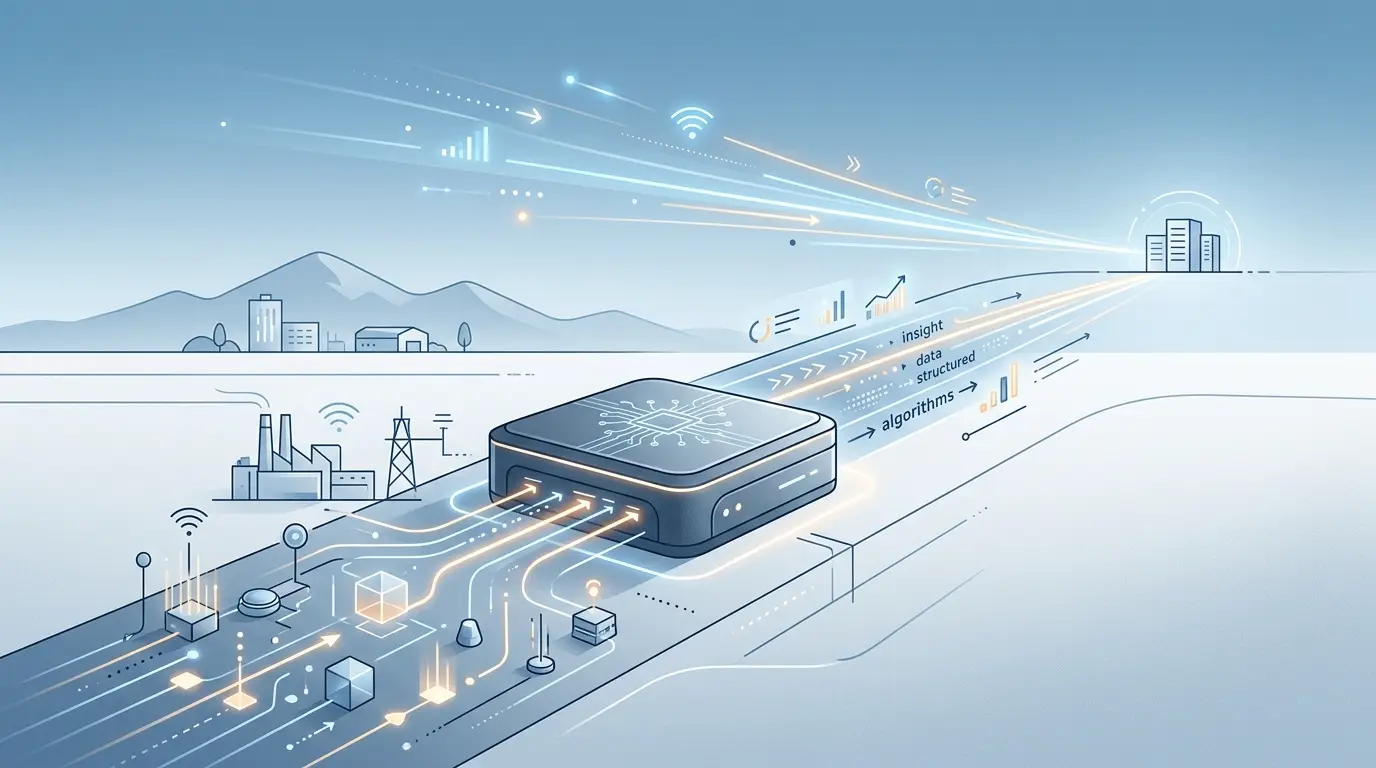
The AI That Doesn't Wait: Edge Intelligence at the Data Source
Edge AI processes data directly on local devices—rather than routing it to centralized cloud servers—enabling real-time decision-making with sub-5ms latency, up to 94% bandwidth reduction, and stronger data privacy. According to Grand View Research (June 2026), the global edge AI market was valued at $24.9 billion in 2025 and is projected to reach $118.7 billion by 2033 at a 21.7% CAGR.
Cloud AI changed how businesses operate. Edge AI is changing where that intelligence lives. The fundamental shift is architectural: rather than sending raw data to a distant server and waiting for a response, edge AI places compute power directly at—or close to—the source of data generation. The result is faster decisions, lower bandwidth costs, and greater operational resilience.
For enterprise IT leaders and system integrators in Saudi Arabia and beyond, this shift carries strategic consequences. Gartner projects that 75% of enterprise data will be created and processed at the edge by 2025, up from just 10% in 2018. The organizations that understand and act on this trend now are the ones building durable competitive advantages. This post provides a structured overview of what edge AI is, how it compares to cloud AI, where it is delivering measurable results, and which hardware platforms to evaluate.
What Is Edge AI, and How Does It Work at the Data Source?
Edge AI refers to the deployment of artificial intelligence models directly on local devices or edge infrastructure—rather than relying on centralized cloud processing. These devices can be industrial sensors, smart cameras, medical imaging equipment, autonomous vehicles, or ruggedized servers deployed at factory floors and retail locations.
The core principle is simple: move computation to the data, not the data to the computation. This eliminates the latency associated with cloud round-trips, reduces the volume of raw data transmitted over networks, and keeps sensitive information on-premises. According to Arm's Edge AI and IoT eBook (September 2025), the architecture is gaining traction across manufacturing, healthcare, agriculture, smart retail, and security surveillance—driven by four converging demands: latency sensitivity, energy efficiency, data privacy, and hardware-software co-optimization.
How Large Is the Edge AI Market in 2025 and 2026?
The market data reflects sustained, high-confidence investment—not speculative momentum.
According to Grand View Research (June 2026):
- Global edge AI market size: $24.9 billion in 2025
- Projected 2026 size: $30.0 billion
- Projected 2033 size: $118.7 billion
- CAGR (2026–2033): 21.7%
- North America holds the largest regional share at 36.0% in 2025
- Hardware leads all component segments at 51.8% revenue share in 2025
- Consumer electronics holds the largest end-use segment share in 2025
- Manufacturing is among the fastest-growing end-use verticals
Private 5G combined with edge AI is growing at 45% annually in manufacturing and logistics alone (Introl, December 2025)—a signal of accelerating adoption in industrial environments.
Edge AI vs. Cloud AI: What Is the Performance Difference for Real-Time Workloads?
Choosing between edge AI and cloud AI depends on your operational requirements. The table below compares both architectures across the dimensions that matter most to enterprise decision-makers.
| Criteria | Edge AI | Cloud AI |
|---|---|---|
| Latency | 1–20ms (far/near edge) | 50–200ms (cloud round-trip) |
| Bandwidth Usage | Up to 94% reduction vs. cloud | High; raw data must be transmitted |
| Data Privacy | Data stays on-premises or local | Data leaves the device to cloud servers |
| Connectivity Dependency | Operates offline or with intermittent connectivity | Requires consistent internet connection |
| Scalability | High infrastructure cost per site; best for latency-critical use cases | Highly scalable; cost-efficient for non-latency-sensitive workloads |
| Model Complexity | Constrained by device compute and memory | No hardware constraints; supports large, complex models |
| Cost Structure | Higher CapEx per edge site; lower bandwidth and cloud compute costs | Lower upfront cost; ongoing cloud compute and egress fees |
| Typical ROI Timeline | 18–24 months for bandwidth savings alone | Variable by workload |
| Best For | Autonomous systems, real-time inspection, healthcare diagnostics, surveillance | Large-scale model training, batch analytics, non-time-critical inference |
Guidance: Choose edge AI when latency is measured in milliseconds, data volumes are high, or privacy regulations restrict cloud transmission. Choose cloud AI when model complexity demands significant compute, datasets are large and centralized, or real-time response is not required.
Where Is Edge AI Already Delivering Measurable Results?
Manufacturing: Siemens and John Deere
Siemens has deployed edge AI servers directly on production lines to perform defect detection on 1 million parts daily, achieving a 99.7% identification accuracy rate with a 15ms inspection time per part. The result: $4.2 million in annual savings from reduced product recalls (Introl, 2024).
John Deere has equipped tractors and harvesters with GPU-based edge AI capable of processing 20 camera feeds simultaneously at 30fps during field operation. The system performs real-time weed detection and applies targeted herbicide—resulting in a 90% reduction in herbicide usage and approximately $50 per acre in chemical cost savings (Introl, 2024).
Retail: Walmart and Amazon Go
Walmart processes 2.3 billion surveillance camera frames daily across 4,700 stores using edge AI servers with T4 GPUs deployed locally at each location. Sending raw video to a centralized data center consumed 4.2 petabytes of network bandwidth monthly at $0.09 per GB. Edge deployment eliminated 94% of data movement, reducing inference latency from 380ms to 12ms and cutting cloud bandwidth costs from $18 million to $1.2 million annually (Introl, 2024).
Amazon Go stores deploy over 100 cameras per store with edge GPUs performing real-time pose estimation and object tracking. The system achieves 50ms from action to recognition and has eliminated the checkout process entirely across its store network.
Healthcare: Cleveland Clinic
Cleveland Clinic has deployed GPU clusters within radiology departments for on-premises CT and MRI analysis. The configuration processes 5,000 scans daily across facilities, reducing diagnosis time by 47%, with full scan analysis completed in approximately 3 minutes. All patient data remains on-premises, satisfying HIPAA requirements without cloud transmission risk (Introl, 2024).
Which Edge AI Hardware Platforms Should Enterprise Deployers Evaluate?
Hardware selection depends on deployment location, power envelope, and performance requirements. The table below summarizes the leading edge AI platforms.
| Platform | Performance | Power Envelope | Best Deployment Tier | Key Strength |
|---|---|---|---|---|
| NVIDIA Jetson AGX Orin | 275 TOPS | 60W | Far edge (1–5ms) | Robotics, industrial cameras, ruggedized deployments (-40°C to 85°C) |
| NVIDIA Jetson Orin Nano | 40 TOPS | 15W | Far edge | Cost-sensitive embedded applications |
| NVIDIA T4 | 260 TOPS (INT8) | 70W | Near edge (5–20ms) | Enterprise edge servers, retail analytics |
| NVIDIA A2 | 18 TFLOPS FP16 | 60W | Near edge | Growing workloads with MIG support |
| Google Edge TPU (Coral) | High inference efficiency | <5W | Far edge | Security cameras, smart home devices |
| Intel OpenVINO + Arc / Habana | Competitive FP16 | Varies | Near/regional edge | Alternative to NVIDIA; lower cost per unit |
| AWS IoT Greengrass | Managed runtime | 100MB footprint | Near/regional edge | Cloud-to-edge management continuity |
| Azure IoT Edge | Cloud-native dev | Variable | Near/regional edge | Microsoft ecosystem integration |
Note on software optimization: NVIDIA TensorRT achieves 5–10x inference speedup over unoptimized models through layer fusion and precision calibration—an important consideration when planning edge deployment performance budgets.
What Are the Primary Challenges of Deploying Edge AI at Scale?
Edge AI deployment introduces operational complexities that centralized cloud infrastructure does not.
- Hardware constraints: Edge devices operate with limited compute, memory, and power budgets. Deploying complex AI models requires techniques such as quantization, pruning, and model compression—all of which demand specialized engineering expertise.
- Infrastructure cost: A fully equipped edge site typically costs $15,000–$40,000 in CapEx (hardware, installation, ruggedization) and $8,000–$20,000 annually in OpEx. Financial modeling should confirm that bandwidth savings, reduced latency, or compliance value justifies the investment.
- Remote management: Distributed infrastructure requires robust over-the-air update mechanisms, fleet monitoring, and zero-touch provisioning. Lightweight orchestration tools such as K3s (90% less overhead than full Kubernetes) or AWS IoT Greengrass are commonly used.
- Security exposure: Physical access to edge devices expands the attack surface. Zero-trust architecture, hardware TPMs, secure boot, and encrypted storage are foundational requirements—not optional additions.
- Regulatory compliance: Industries such as healthcare and financial services face strict data residency requirements (GDPR, HIPAA, PCI DSS) that govern where inference may occur and what data may be transmitted.
Build a Scalable Edge AI Infrastructure with Confidence
Edge AI is not a replacement for cloud computing—it is a complementary architecture that handles the workloads cloud cannot: real-time decisions, high-volume local data, and privacy-sensitive processing. The enterprises generating the clearest ROI from edge deployments—Walmart, Siemens, Cleveland Clinic—began with a specific operational problem, defined measurable outcomes, and selected hardware matched to their latency and power requirements.
The next step is a structured pilot. Define your use case, identify the appropriate deployment tier (far, near, or regional edge), and evaluate hardware platforms against your power, performance, and integration constraints.
Ready to explore an edge AI deployment strategy for your organization? [ Contact our team for a technical consultation] and let our specialists help you design a scalable, compliant, and high-performance edge infrastructure.
Frequently Asked Questions
-
What is edge AI, and how does it differ from cloud AI?
Edge AI refers to running AI inference directly on local devices or servers near the data source, rather than transmitting data to a centralized cloud for processing. The key differences are latency (edge delivers 1–20ms vs. cloud's 50–200ms), data privacy (data stays on-premises), bandwidth consumption (edge reduces data movement by up to 94%), and offline resilience. Cloud AI remains better suited for model training, large-scale batch processing, and workloads without strict latency requirements.
-
What industries benefit most from edge AI in 2025 and 2026?
Manufacturing, healthcare, retail, agriculture, and autonomous vehicles currently demonstrate the clearest ROI from edge AI deployment. Manufacturing benefits from real-time defect detection and predictive maintenance. Healthcare uses on-premises inference for medical imaging to maintain patient data privacy. Retail uses edge AI for inventory tracking, fraud detection, and cashierless checkout. Agriculture applies it to precision farming and crop monitoring in areas with intermittent connectivity.
-
How much does it cost to deploy an edge AI system?
A fully equipped edge site typically requires $15,000–$40,000 in CapEx (hardware, installation, ruggedization, redundancy) and $8,000–$20,000 annually in OpEx (power, connectivity, remote management, maintenance). Organizations that transmit more than 10TB of data monthly typically achieve breakeven through bandwidth savings alone within 18–24 months, according to infrastructure analysis from Introl (December 2025).
-
Which edge AI hardware platform is best for industrial deployments?
The NVIDIA Jetson AGX Orin is the leading choice for industrial far-edge deployments, delivering 275 TOPS within a 60W power envelope. It supports ruggedized operation from -40°C to 85°C, making it appropriate for factory floors, outdoor agriculture equipment, and autonomous vehicles. For near-edge enterprise servers, the NVIDIA T4 (70W, 260 TOPS INT8) is widely used in retail and healthcare environments. Hardware selection should always be driven by latency requirements, power constraints, and the complexity of the AI models being deployed.
-
How does edge AI support data privacy and regulatory compliance?
Edge AI keeps data on-premises or within a defined network boundary, which eliminates the need to transmit sensitive information to external cloud infrastructure. This architecture directly supports compliance with GDPR (EU data residency), HIPAA (healthcare data encryption and access controls), and PCI DSS (payment data security). Cleveland Clinic's deployment is a concrete example: medical imaging analysis runs locally on GPU clusters within radiology departments, with no patient data transmitted to external servers.
-
Is edge AI compatible with existing cloud infrastructure?
Yes. Edge AI and cloud infrastructure are designed to work in a hybrid architecture. Lightweight orchestration platforms such as AWS IoT Greengrass and Azure IoT Edge extend cloud-native development tools to edge deployments. These platforms enable centralized fleet management, model updates, and monitoring while edge devices handle local inference. This hybrid model allows organizations to maintain cloud scalability for non-latency-sensitive workloads while offloading real-time processing to the edge.
-
What is the projected growth of the edge AI market through 2033?
According to Grand View Research (June 2026), the global edge AI market is projected to grow from $30.0 billion in 2026 to $118.7 billion by 2033, at a compound annual growth rate (CAGR) of 21.7%. North America leads with 36.0% revenue share, while the Asia Pacific region is among the fastest-growing markets, driven by large-scale investment in smart manufacturing, industrial robotics, and connected infrastructure in China, Japan, and South Korea.