Shopping Cart


- Articles
- IP Telephony
- IP Telephony for Hotels: Upgrading Guest Communication
IP Telephony for Hotels: Upgrading Guest Communication
Discover how IP telephony for hotels improves guest communication, streamlines hotel operations, reduces costs, and delivers seamless voice services with modern VoIP solutions.
By Blue Edge Team | Published Jul 26, 2026 | Updated Sep 23, 2026 | 5 min read
Quick answer
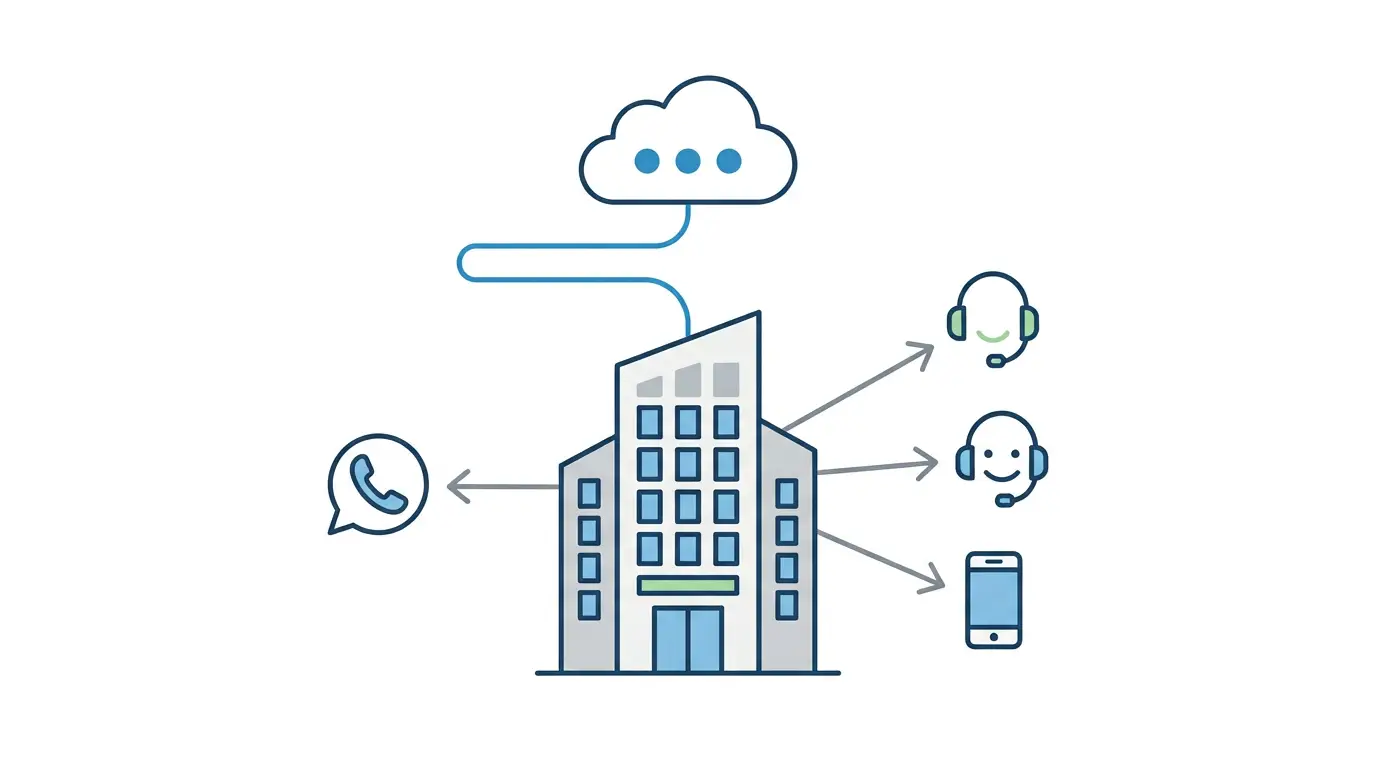
IP Telephony for hotels replaces traditional phone systems with internet-based voice communication, enabling features like room-to-room calls, front desk integration, voicemail-to-email, and multilingual auto-attendants—all at a significantly lower operational cost than legacy analog systems.
Hotels run on communication. From the moment a guest checks in to the moment they request a late checkout, seamless interaction between staff and guests defines the experience. Yet many properties still rely on outdated analog phone systems that are costly to maintain, difficult to scale, and unable to meet modern guest expectations.
IP Telephony—voice communication delivered over internet protocol (IP) networks—offers hotels a smarter, more flexible alternative. This post covers what IP Telephony is, its key features and benefits for hotels, how it compares to traditional systems, and what to look for when choosing a solution.
What Is IP Telephony, and How Does It Work in a Hotel Environment?
IP Telephony, also known as Voice over IP (VoIP), transmits voice calls as digital data packets over a network rather than through conventional copper telephone lines. In a hotel setting, this means all in-room phones, front desk handsets, conference room systems, and back-office lines operate through a centralized IP-based platform connected to the property's network infrastructure.
The system typically integrates with the hotel's Property Management System (PMS), enabling automated room status updates, guest name display on front desk screens, and direct billing of call charges to room accounts—all in real time.
Key Features of IP Telephony Systems for Hotels
A well-implemented IP telephony system delivers capabilities that go far beyond basic call handling:
- PMS Integration: Automatically syncs check-in and check-out data, so phones activate or deactivate based on room occupancy—no manual configuration required.
- Auto-Attendant & IVR: Multilingual interactive voice response menus guide guests to housekeeping, room service, concierge, or external lines without routing every call through a human operator.
- Voicemail-to-Email: Guests and staff receive voicemail recordings or transcripts directly in their email inbox, reducing missed communications.
- Call Queuing & Routing: Intelligent call distribution ensures front desk agents handle calls efficiently, with overflow options during peak periods.
- Do Not Disturb (DND) Management: Guests can set DND preferences from their in-room handset, which the PMS reflects in real time.
- Wake-Up Call Automation: Scheduled wake-up calls are delivered automatically, with confirmation logs stored for accountability.
- Emergency Line Support: IP systems can be configured to prioritize 911 or local emergency calls and alert the front desk simultaneously.
Benefits of IP Telephony for Hotel Operations
How Does IP Telephony Reduce Hotel Communication Costs?
One of the most immediate advantages is cost reduction. Traditional PSTN (Public Switched Telephone Network) systems require dedicated phone lines, expensive hardware, and ongoing maintenance contracts. IP Telephony consolidates voice communication over the existing data network, eliminating the need for separate cabling infrastructure.
Inter-departmental calls—between housekeeping, the kitchen, the front desk, and management—become free internal extensions. International call rates also drop significantly when routed through VoIP providers rather than traditional carriers.
How Does IP Telephony Improve the Guest Experience?
Guests increasingly expect responsive, frictionless service. IP Telephony supports this through faster call routing, personalized greetings using guest name data pulled from the PMS, and multilingual auto-attendant options that accommodate international travelers.
Staff can also receive calls on mobile softphone applications, meaning a front desk agent walking the lobby or a manager reviewing an event space remains reachable without returning to a fixed handset. This mobility directly reduces response times and improves service quality.
How Scalable Is IP Telephony for Growing Hotel Properties?
Adding extensions in a traditional phone system requires physical wiring and hardware changes—a process that is both time-consuming and expensive. IP Telephony allows new extensions to be provisioned through software configuration. A hotel expanding from 80 to 150 rooms can scale its communication system without rewiring the building.
This scalability also applies to multi-property hotel groups, where a centralized IP telephony platform can manage communication across multiple locations from a single administrative interface.
IP Telephony vs. Traditional Analog Systems: A Comparison
| Feature | IP Telephony | Traditional Analog |
|---|---|---|
| Infrastructure | Existing data network | Dedicated phone lines |
| Scalability | High — software-based | Low — hardware-dependent |
| PMS Integration | Native | Limited or unavailable |
| International Call Costs | Low (VoIP rates) | High (carrier rates) |
| Maintenance | Remote, centralized | On-site technician required |
| Mobility (softphone) | Supported | Not supported |
| Setup Time | Fast | Slow |
What to Look for When Selecting an IP Telephony Solution for Your Hotel
Not all IP telephony platforms are built with hospitality in mind. When evaluating options, prioritize the following:
- PMS Compatibility: Confirm the system integrates natively with your existing property management software.
- Reliability & Uptime Guarantees: Look for solutions with built-in redundancy and failover options to prevent communication outages during high-occupancy periods.
- Security: Voice data transmitted over IP networks must be encrypted. Ensure the provider supports SRTP (Secure Real-Time Transport Protocol) and TLS (Transport Layer Security).
- Support & Maintenance: Opt for a vendor that provides local technical support and remote system management, reducing downtime risk.
- Hospitality-Specific Features: Generic VoIP platforms may lack wake-up call automation, DND synchronization, or room-billing integration—features that are standard in purpose-built hotel solutions.
Elevating Hotel Communication Starts with the Right Infrastructure
IP Telephony delivers measurable improvements across every layer of hotel operations—from reducing communication costs and simplifying administration to providing guests with a more responsive, personalized experience. As hotels modernize their infrastructure, transitioning from legacy analog systems to IP-based communication is one of the highest-impact upgrades available.
The right IP telephony solution, properly integrated with your PMS and supported by a knowledgeable implementation partner, transforms how your property communicates—internally and with every guest.
If your hotel is ready to explore IP Telephony solutions tailored to the hospitality sector, consult with a certified communications specialist to assess your current infrastructure and identify the most effective path forward.
Frequently Asked Questions
-
Is IP Telephony reliable enough for a hotel environment?
Yes. Enterprise-grade IP telephony systems are designed with built-in redundancy, failover routing, and Quality of Service (QoS) configurations that prioritize voice traffic on the network. When deployed on a stable, properly configured network, IP telephony delivers consistent call quality and uptime comparable to—or better than—traditional analog systems.
-
Does IP Telephony work if the internet connection goes down?
Most hotel-grade IP telephony systems include failover options, such as routing calls through backup SIM-based connections or PSTN fallback lines, to maintain communication during an internet outage. This redundancy is a critical consideration when selecting a system for a hospitality environment.
-
How long does it take to implement IP Telephony in a hotel?
Implementation timelines vary depending on property size and existing infrastructure. A straightforward deployment in a mid-sized hotel typically takes several days to a few weeks. Properties with complex legacy systems or large room counts may require longer planning and installation phases.
-
Can IP Telephony integrate with all PMS platforms?
Most leading IP telephony solutions support integration with widely used PMS platforms through standard protocols such as FIAS (Fidelio Interface Application Specification). Compatibility should be confirmed with your telephony vendor before purchase, particularly for less common or customized PMS environments.
-
What is the cost difference between IP Telephony and a traditional analog system?
While the upfront investment in IP telephony hardware and software varies, most hotels realize significant long-term savings through reduced line rental costs, lower international call charges, and minimal on-site maintenance requirements. Total cost of ownership is generally lower than maintaining a legacy analog system over a five-to-ten-year period.
About Blue Edge
Blue Edge Company is a value-added technology distributor based in Dammam, Saudi Arabia, supplying interactive displays, smart building systems, networking infrastructure and IT security software to businesses and residential projects across the Kingdom, with installation and technical support.
Learn more about Blue Edge →Published 26 July 2026 • Last updated 23 September 2026 • This article is reviewed when standards, regulations or product guidance change.