Shopping Cart


- Articles
- IP Telephony
- IP Video Intercom for Compounds and Gated Communities
IP Video Intercom for Compounds and Gated Communities
IP video intercom for Saudi compounds: gate-to-villa call routing, visitor PINs, PoE and fibre limits, and what keeps the gate working in an outage.
By Blue Edge Team | Published Sep 02, 2026 | Updated Oct 03, 2026 | 14 min read
Quick answer
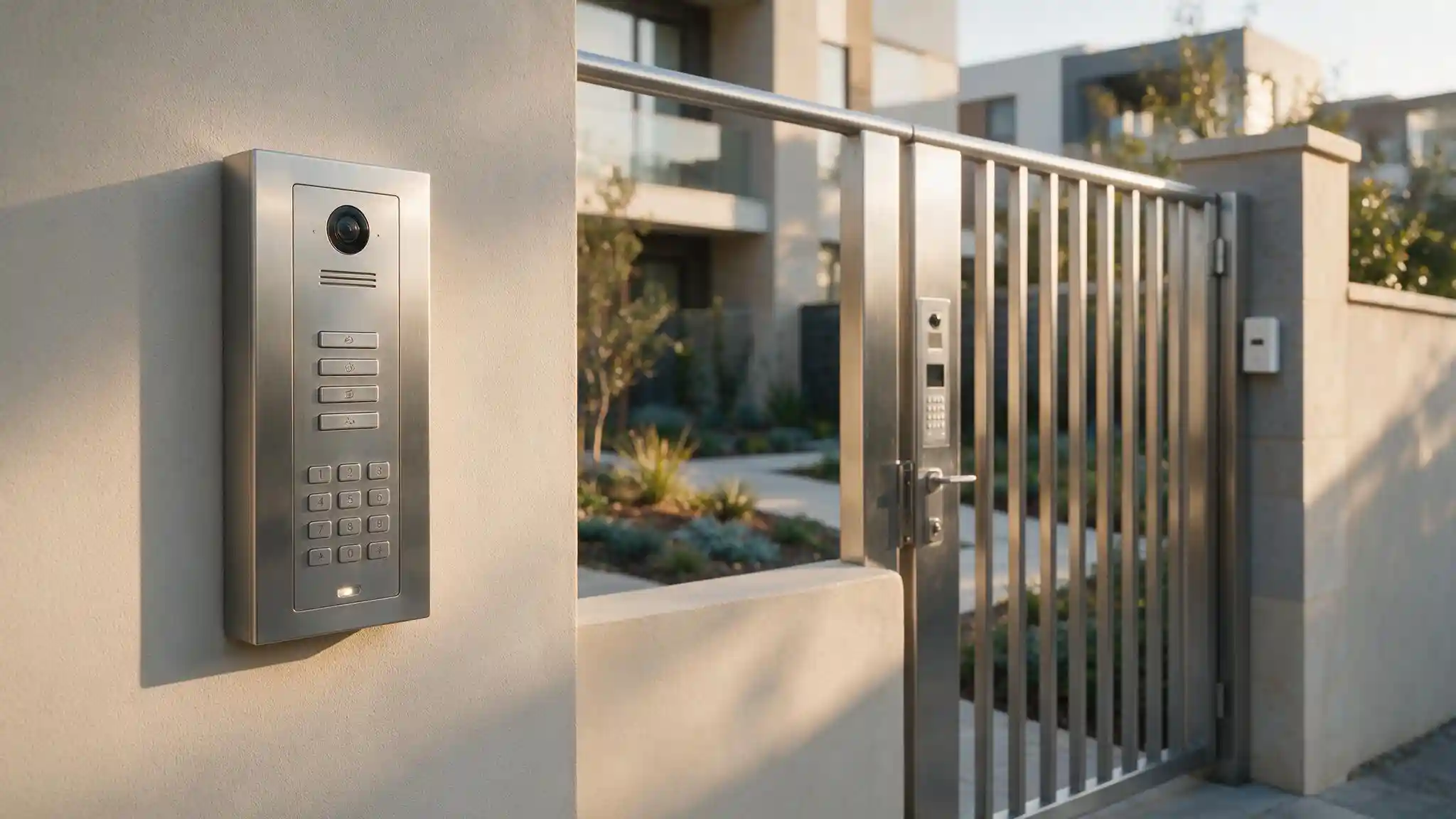
An IP video intercom is a door entry system that carries audio, video and door release over a standard IP network using SIP, instead of dedicated analog wiring. In a compound, it links the perimeter gate, each villa door station, resident indoor monitors, mobile apps and the guard house on one system, so a resident can answer the gate from a phone anywhere.
A compound intercom fails in a specific way. Not dramatically, but quietly, over about six months. Residents stop answering the indoor monitor because the call never reaches them when they are out. The guard starts phoning residents directly. A permanent gate PIN gets shared with every driver, cleaner and delivery service until it is no longer a credential.
The technology is rarely the problem. The design usually is: a system specified as a set of door stations rather than as a communication system spanning a site with distances, outages and a lot of daily visitors.
This guide covers how an IP video intercom works across a compound, how calls should route between gate, villa, mobile and guard house, how visitor access should be handled, the network limits that decide what is physically possible, and what Saudi conditions and regulations require.
What Is an IP Video Intercom and How Does It Work?
An IP video intercom is a door entry system that carries audio, video and door release signals over a standard Ethernet network using the Session Initiation Protocol (SIP), the same protocol that runs business phone systems. Pressing a button on the door station places a SIP call, the media travels as RTP streams, and the answering device sends a command back to release the door.
A compound system has four device types:
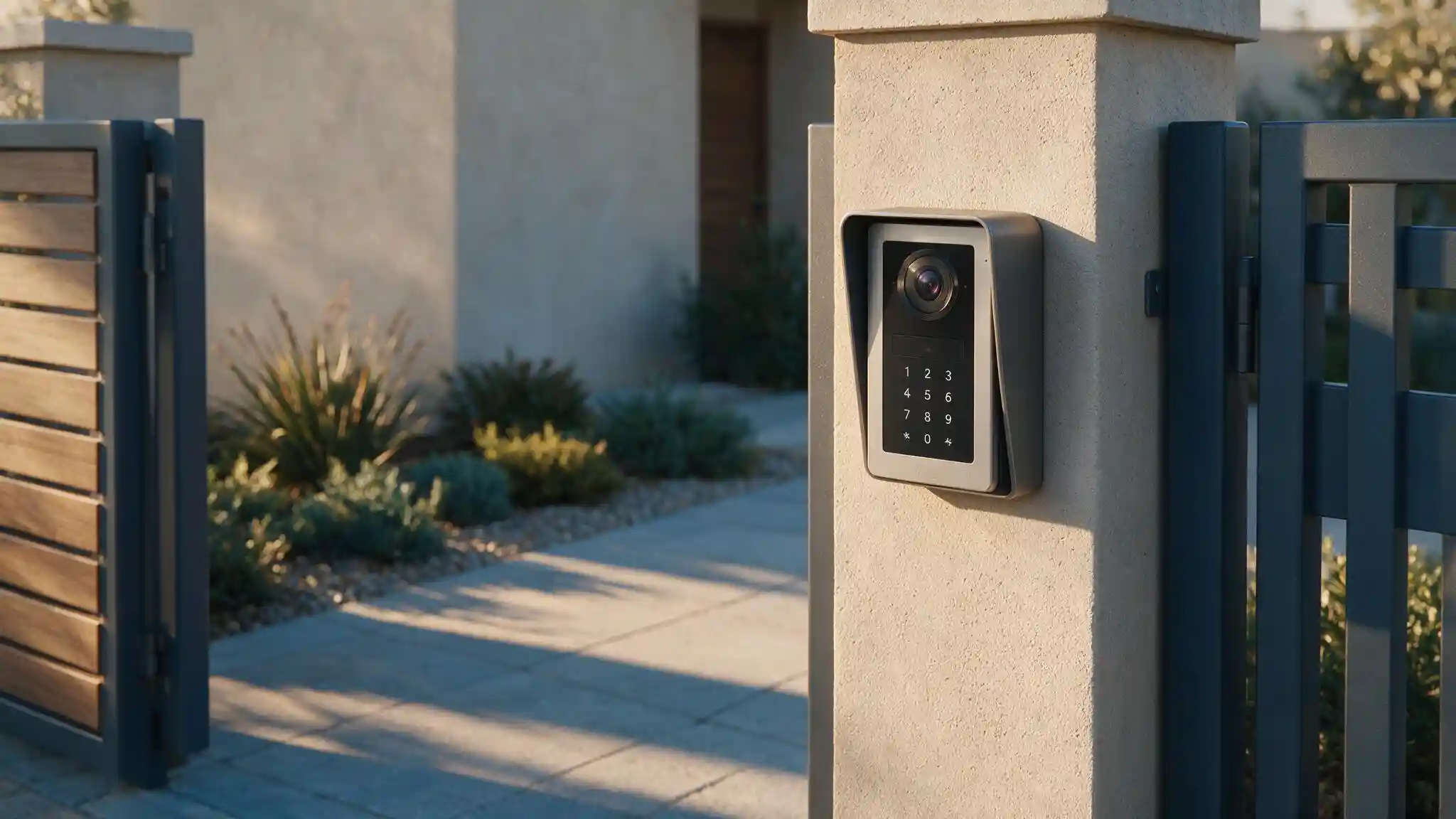
- Door stations at the perimeter gate, pedestrian gates and individual villa or apartment entrances, each with a camera, microphone, speaker and usually a card reader or keypad
- Indoor monitors inside each residence, which answer calls, show video and release the door
- Mobile applications carried by residents, so a call reaches them when nobody is home
- A guard station, either a dedicated monitor or software on a PC at the gate house, which answers overflow calls and manages the site
Because the system speaks SIP, it behaves like an extension of a phone system rather than a closed appliance. A door station can be reached by any registered endpoint, which is what makes gate-to-mobile answering possible in the first place. This is also why the same design principles that apply to SIP and VoIP systems apply here: registration, call routing, codecs and quality of service all matter.
Devices draw power over the same network cable using Power over Ethernet, which removes a separate power run to each gate and door.
How Does an IP Intercom Differ From a Traditional Analog System?
The table below compares the three system types found in Saudi residential developments.
| Criterion | IP video intercom | Analog 2-wire video intercom | Analog audio intercom |
|---|---|---|---|
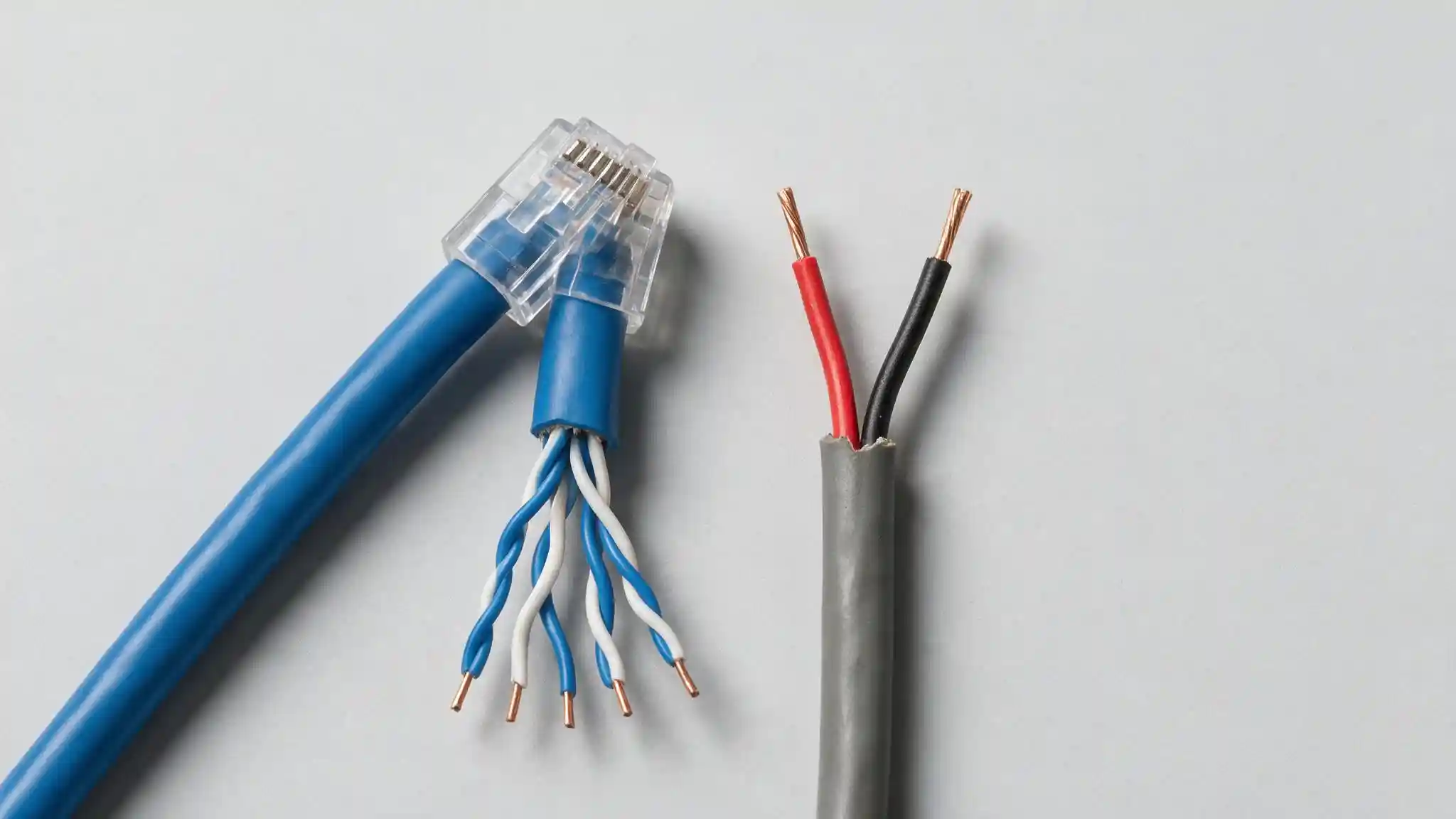
| Cabling | Cat6 twisted pair, one cable for data and power | Proprietary 2-wire bus | 2-wire or multi-core bus |
| Maximum distance | 100 m per copper run under ANSI/TIA-568, extended with fibre | Typically a few hundred metres on the bus | Similar bus limits |
| Video | Yes, digital, recordable | Yes, analog, limited resolution | No |
| Answer on mobile | Yes, through a SIP app | Rarely, and usually through a proprietary bridge | No |
| Scalability | Add devices by adding switch ports | Limited by bus capacity and riser design | Limited |
| Access control integration | Card, PIN, QR, mobile credential, face recognition | Limited, usually a separate system | Separate system |
| Temporary visitor credentials | Yes, time-limited PINs and QR codes | No | No |
| Guard station | Software or dedicated console, sees all gates | Usually one master station | Basic |
| Call logs and snapshots | Yes | No | No |
| Cost per door | Higher | Medium | Low |
| Best suited for | Compounds, gated communities, multi-building sites | Single small building with existing bus wiring | Legacy replacement only |
Key takeaway
The decisive advantage of an IP video intercom in a compound is not video quality, it is reach. An analog system connects a door to a monitor inside a fixed residence. An IP system connects a door to a person, wherever that person is, and escalates to a guard when nobody answers. For a site where residents are frequently out and visitor volume is high, that difference determines whether the system gets used or bypassed.
How Should a Compound Intercom Be Structured?
A compound intercom should be designed as three tiers, because a gate call and a villa door call are different events with different escalation paths.
Tier one, the perimeter. The main vehicle and pedestrian gates carry door stations with a resident directory, keypad and card reader. A visitor either calls a resident by name or number, or presents a credential. Residents entering by car use a card, mobile credential or automatic plate recognition rather than calling anyone.
Tier two, the residence. Each villa or apartment entrance has its own door station, so a visitor already inside the compound still announces themselves at the door. In apartment blocks within the compound, one multi-tenant door station serves the whole lobby.
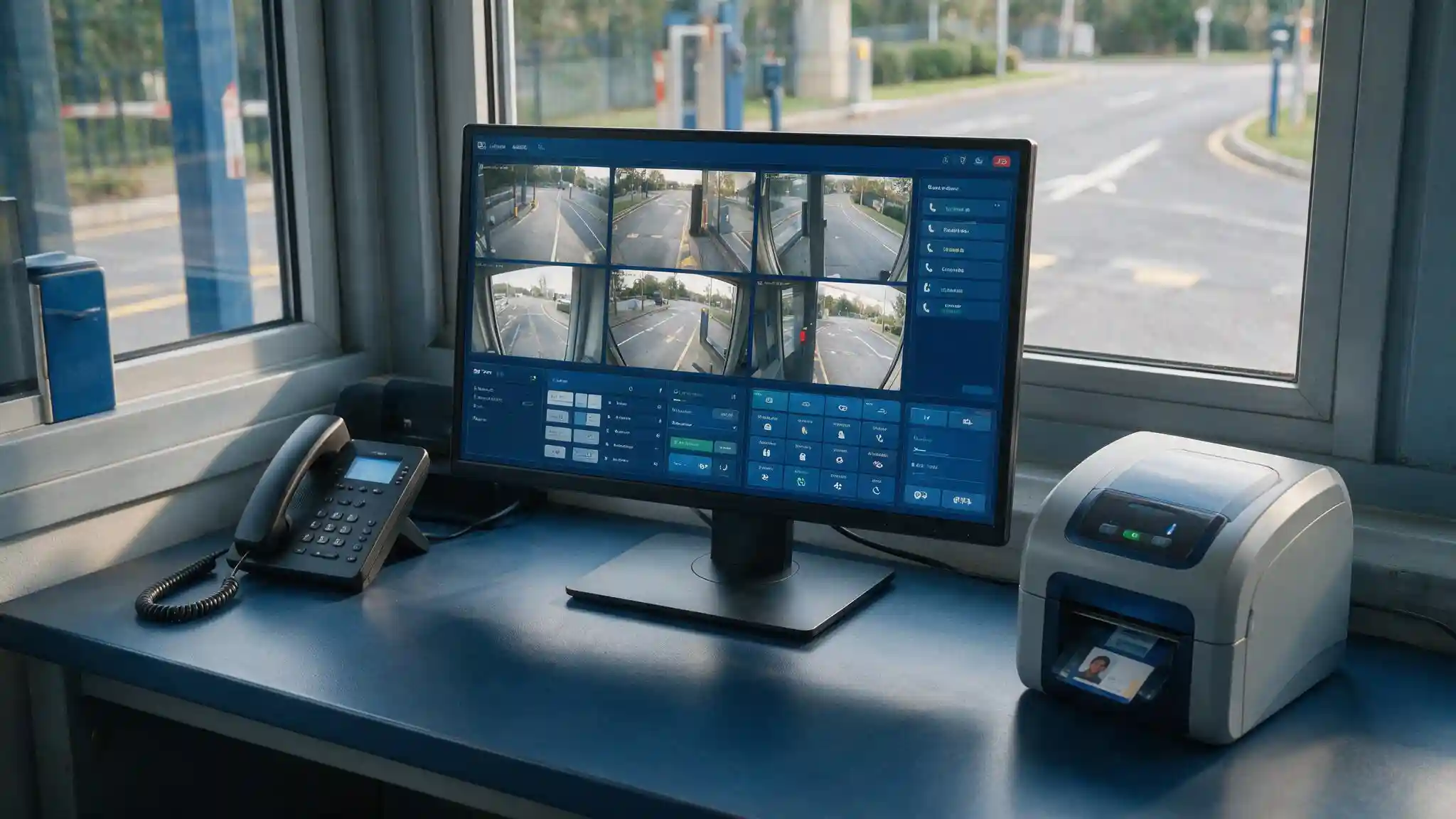
Tier three, the guard house. The guard station answers any call the resident does not, sees every gate camera, holds the site directory and issues temporary credentials. This tier is what stops the system from failing when residents are unreachable.
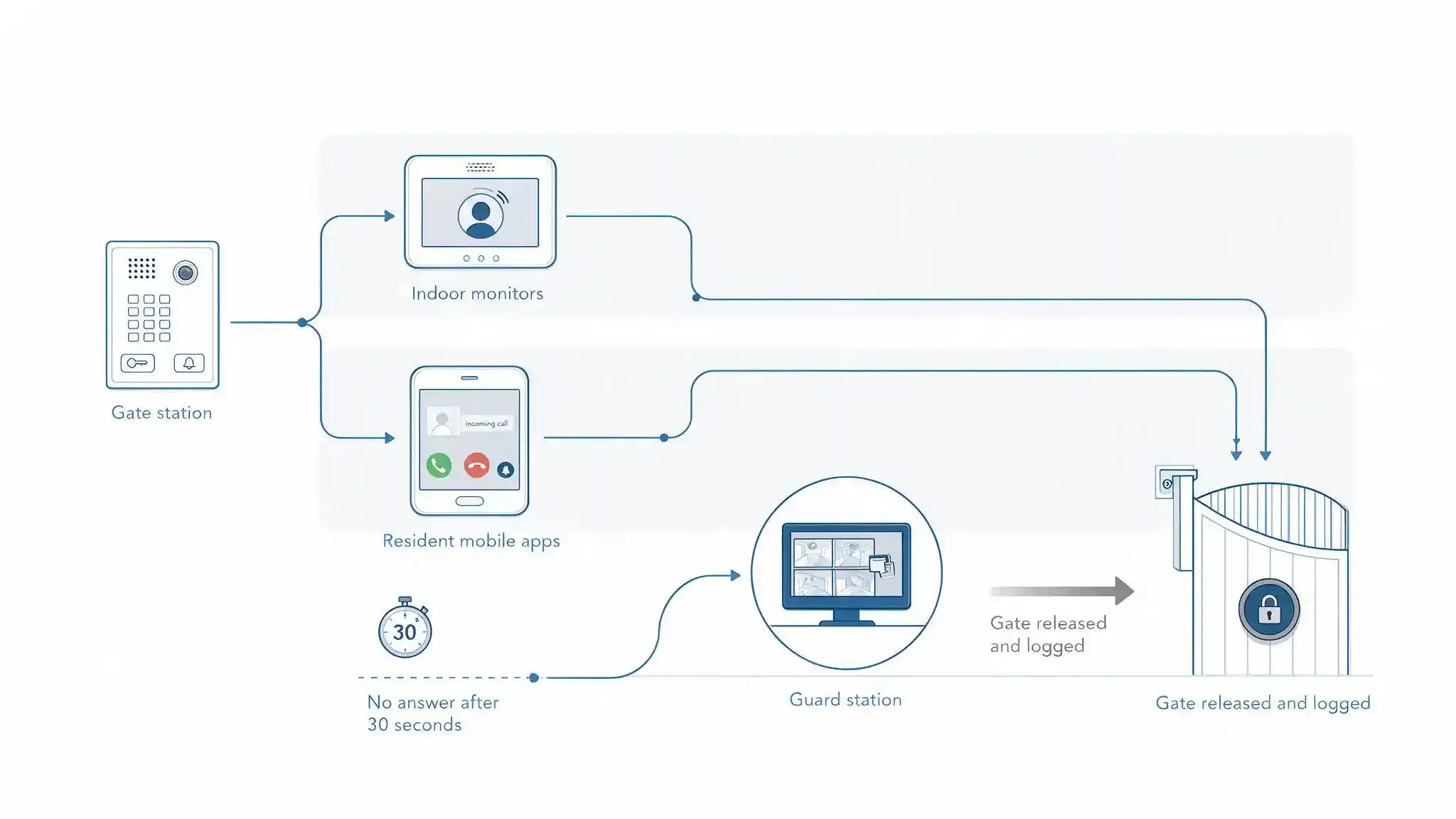
Call routing is the part most often left at factory defaults. A working sequence looks like this:
- Visitor calls the resident from the gate station
- The call rings the indoor monitor and the resident's mobile app simultaneously
- If nobody answers within a set time, the call forwards to the guard station
- The guard verifies and releases the gate, and the event is logged with a snapshot
Vehicle access is handled from the same system. A relay output on the door station or a separate door controller triggers the barrier, so a resident releasing the gate from a mobile phone opens the vehicle barrier rather than only the pedestrian gate. Configure the two as separate outputs, because they have different timings and different safety requirements.
Integration with the wider site is worth planning at the same time. An IP intercom that shares credentials with the site's access control system means a resident carries one card rather than three.
How Do Visitors, Couriers and Contractors Get Access?
Temporary, time-limited credentials are how a compound handles visitors without eroding its own security. This is the operational heart of the system and it is the feature most commonly left unconfigured.
Four credential types cover almost every case:
Time-limited PIN. A resident generates a code valid for a set window, sends it to a guest, and it expires automatically. Useful for a dinner guest or a weekend visitor.
QR code or link. Sent by message, scanned at the door station. Better than a PIN for one-time visitors because it cannot be verbally passed on.
Recurring schedule credential. A cleaner or driver receives a card or mobile credential valid only on specific days and hours, which is far safer than a permanent code.
Guard-issued visitor pass. For contractors and deliveries, the guard issues a credential at the gate against an ID record, valid for that day only.
Delivery volume deserves specific attention in Saudi compounds. Courier and food delivery traffic is high, and a system with no delivery workflow produces the single worst outcome in access control: one permanent PIN, known to hundreds of drivers, that nobody ever changes. Decide at design stage whether deliveries reach the door, stop at a parcel room, or are collected at the gate, and configure the credential model to match.
Every credential type should write to an audit log with a timestamp and a door station snapshot. That log is what turns the intercom from a convenience into a security record.
What Network Does an IP Intercom Need?
An IP intercom needs modest bandwidth and strict attention to distance and power, which is the reverse of what most people expect. The traffic is small. The physical layout of a compound is what causes problems.
How far can a door station be from the network room?
ANSI/TIA-568 limits a balanced twisted-pair channel to 100 metres including patch cords, and in a compound the main gate is frequently further than that from the nearest network room. This is the most common physical constraint in the entire project.
Three solutions work, in order of preference:
- Fibre to a local switch. Run fibre to a weatherproof outdoor cabinet or gate house, terminate into a small PoE switch, and keep every copper run under 100 metres. This is the correct answer for almost every compound, and the reasoning behind it is covered in fibre versus copper cabling.
- PoE extenders. Acceptable for a single moderate overshoot, but each extender adds a failure point and reduces available power.
- Wireless bridge. A last resort where trenching is impossible, and it introduces a dependency the door release should not have.
How much power and bandwidth does a door station need?
A door station with a display, card reader, night illumination and a heater or fan can exceed the 15.4 W that IEEE 802.3af provides at the port. Specify IEEE 802.3at capable switch ports for outdoor and multi-function stations, and size the PoE switch on its total power budget rather than its port count. Review the Power over Ethernet standards before finalising the design.
Bandwidth is not the constraint. A door call is a single video and audio stream lasting under a minute, comparable in scale to a VoIP call with video, and only a handful of calls occur simultaneously even on a large site. What matters is quality rather than volume: put the intercom on its own VLAN, apply quality of service so door calls are prioritised over general traffic, and keep jitter low. A call that connects with two seconds of delay gets abandoned.
What Happens If the Internet or Power Fails?
Whether the intercom survives an outage depends entirely on where the SIP server lives, and this is the single most important architectural decision in a compound deployment.
With an on-site SIP server, the intercom is a local system. Gate stations, indoor monitors and the guard station keep working through an internet outage because all call traffic stays inside the compound. Mobile app calls fail, since those need internet, but residents at home and the guard at the gate are unaffected.
With a cloud-only platform, everything depends on the connection. When the link drops, gate calls stop reaching anyone, and access falls back entirely to physical credentials at the door station.
For a residential compound, an on-site SIP server with cloud services layered on top is the sound choice. Residents get mobile answering when the internet is available, and the gate still works when it is not. The same continuity logic applies here as in IP telephony disaster recovery.
Three further resilience requirements belong in the specification:
- UPS on the gate house switch, SIP server and door controller. A power cut should not leave visitors unable to announce themselves, and it certainly should not leave residents unable to get in.
- Local credential caching at the door. Cards and PINs should validate at the door controller even if the server is unreachable.
- Fail-safe release tied to the fire alarm. Gates and doors on escape routes must release on a fire signal. This is a life safety requirement and it is not negotiable against a security preference.
What Do Saudi Conditions and Regulations Require?
Compound intercom systems in Saudi Arabia face two pressures that generic specifications ignore: an outdoor environment that destroys under-specified hardware, and camera regulation that applies to door stations.
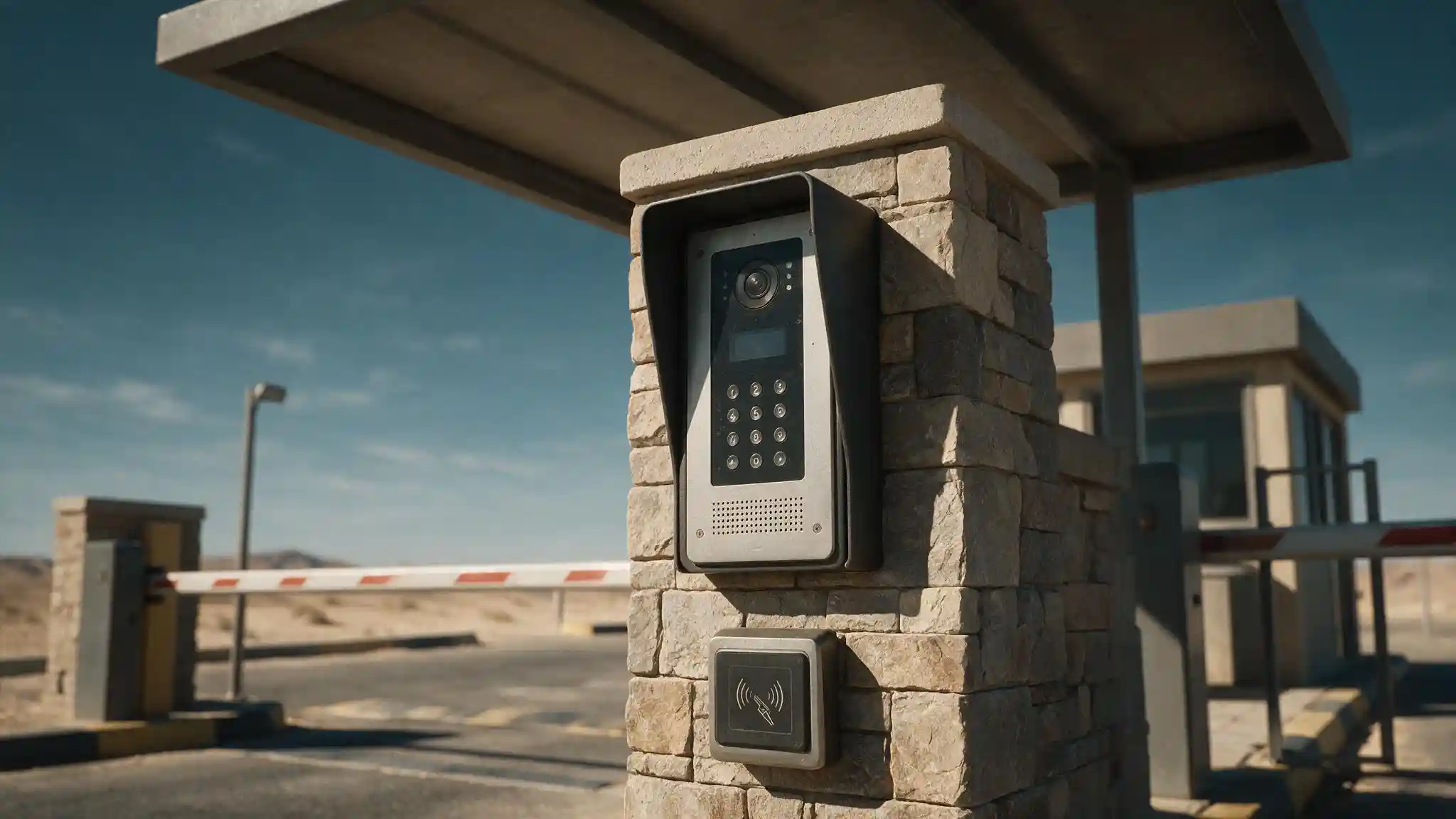
Climate is a specification input. An outdoor door station in the Eastern Province faces extreme summer ambient temperatures, blowing dust and, near Dammam, Khobar and Jubail, salt-laden coastal air. Specify accordingly:
- IP65 or IP66 ingress protection on every outdoor station
- IK vandal resistance at unmanned gates and public-facing entrances
- Confirmed operating temperature range covering peak local ambient, checking the display specification and not only the housing
- Flush or recessed mounting under a canopy, because direct sun degrades both the screen and the camera sensor
- Ventilated gate house enclosures, since heat also derates the PoE switch inside them
The wider principles are covered in network design for extreme desert climates.
Camera regulation applies. A door station has a camera, which places it within the scope of the Law of the Use of Security Surveillance Cameras, issued under Royal Decree No. M/34 of 1444H and administered by the Ministry of Interior. That law requires Ministry of Interior approval for installation and operation at covered facilities, mandates visible signage in monitored areas, and prohibits cameras in private spaces. Confirm your installer holds the relevant approval before award.
Call snapshots, video and access logs identify individuals, which makes them personal data under the Personal Data Protection Law (PDPL) administered by the Saudi Data and Artificial Intelligence Authority. A compound should define who can view visitor snapshots, how long logs are retained, and what happens to resident data when a lease ends. If the platform stores footage or logs abroad, that is a cross-border transfer and needs to be addressed before signing.
Interface language matters. Door stations and resident apps should support Arabic and English, and the resident directory should display names in both scripts. A directory that only renders one language is unusable for part of the community.
Blue Edge, a technology distributor based in Dammam, Saudi Arabia, supplies Akuvox IP intercom and door entry systems alongside the structured cabling and networking and IT installation and configuration services these deployments depend on.
What Are the Most Common Compound Intercom Mistakes?
Six mistakes account for most compound intercom problems, and all of them are design decisions rather than product faults.
Running copper past 100 metres to the gate house. The link works during commissioning and degrades intermittently afterwards. Fibre to a local switch is the fix, and it costs far less before the trench is backfilled.
Undersizing PoE for outdoor stations. Stations with displays, illuminators and heaters exceed 802.3af budgets, and the failures appear at night and in winter mornings when everything draws at once.
Choosing cloud-only with no local server. The gate stops working during an internet outage, which is the moment a compound most needs it to work.
Leaving call routing at defaults. If a gate call rings only the indoor monitor, residents who are out never answer, and the guard ends up phoning people manually.
Never configuring temporary credentials. The result is one permanent PIN shared with every delivery driver in the city, which is worse than having no access control at all.
Putting the intercom on the flat resident network. Door stations are network devices with cameras. They belong on a segmented VLAN with controlled access, not alongside residential Wi-Fi.
Design the Escalation Path, Not Just the Door Stations
A compound intercom succeeds or fails on what happens when the resident does not answer. That single scenario is the most common event on the system, and it is the one least often designed for. Get the escalation path right, give the guard house real tooling, and give residents a credible way to let in visitors from a phone, and the system stays in use.
Get it wrong and the compound reverts to what it did before: a guard with a mobile phone, a shared PIN and no record of who came through the gate.
Design the network alongside the intercom. Distance from the gate to the nearest switch, PoE budget, VLAN separation and where the SIP server sits decide whether the system works reliably, and none of those can be corrected after the cabling is buried.
Frequently Asked Questions
-
Can residents answer the gate from their mobile phone?
Yes. An IP video intercom registers the resident's mobile app as a SIP endpoint, so a gate call rings the indoor monitor and the phone at the same time, and the resident can see the visitor and release the gate from anywhere with an internet connection. Mobile answering requires internet at both ends, which is why an on-site SIP server matters: it keeps the gate and indoor monitors working even when the connection is down.
-
How far can a door station be from the network room?
A copper run is limited to 100 metres including patch cords under ANSI/TIA-568, and compound gates frequently sit further than that from the nearest network room. The standard solution is fibre to a weatherproof cabinet or gate house containing a small PoE switch, keeping every copper segment under 100 metres. PoE extenders can cover a single moderate overshoot but add failure points and reduce available power.
-
What happens to the intercom if the internet goes down?
With an on-site SIP server, gate stations, indoor monitors and the guard station keep working normally, because all call traffic stays inside the compound. Only mobile app calls fail, since those need internet. With a cloud-only platform, gate calls stop reaching anyone and access depends entirely on cards or PINs at the door. Add a UPS on the gate switch and server so a power cut does not stop entry.
-
Will an outdoor door station survive Saudi summer heat?
Only if specified for it. Check the operating temperature range of the display and camera, not just the housing, because screens typically have a lower maximum than the enclosure. Specify IP65 or IP66 ingress protection against dust, vandal resistance at unmanned gates, marine-grade materials near the coast, and mount the station under a canopy or recessed so it avoids direct sun through the afternoon.
-
Do intercom cameras fall under Saudi surveillance rules?
A door station contains a camera, which brings it within the scope of the Law of the Use of Security Surveillance Cameras administered by the Ministry of Interior, including approval, signage and restrictions on private spaces. Call snapshots and access logs identify individuals, making them personal data under the Personal Data Protection Law. Define retention periods, who may view visitor images, and where the platform stores that data before deployment.
Planning a compound or gated community project?
Blue Edge supplies IP intercom systems and the network infrastructure they run on across Saudi Arabia.
Call +966 53 9855 188 or contact our team to discuss your site.
Akuvox intercom solutionsAbout Blue Edge
Blue Edge Company is a value-added technology distributor based in Dammam, Saudi Arabia, supplying interactive displays, smart building systems, networking infrastructure and IT security software to businesses and residential projects across the Kingdom, with installation and technical support.
Learn more about Blue Edge →Published 2 September 2026 • Last updated 3 October 2026 • This article is reviewed when standards, regulations or product guidance change.
Our Related Articles