Shopping Cart



What Is Shadow IT—And Why It's a Growing Security Risk
Learn what Shadow IT is, why it poses serious cybersecurity risks, and how businesses can identify, manage, and secure unauthorized applications and devices.
By Blue Edge Team | Jul 23, 2026
What Is Shadow IT—And Why It's a Growing Security Risk?
TL;DR: Shadow IT refers to any software, hardware, or cloud service employees use without IT department approval. As remote work expands and SaaS adoption accelerates, shadow IT creates significant security, compliance, and data governance risks that organizations can no longer afford to overlook.
Shadow IT rarely starts with bad intentions. An employee needs a faster way to share files, so they use a personal Dropbox account. A marketing team adopts a project management tool without looping in IT. A developer spins up a cloud instance to test a new idea. Each decision seems harmless in isolation—but collectively, they create a hidden layer of technology operating entirely outside your organization's visibility and control.
This phenomenon—known as shadow IT—has grown dramatically as workforces have become more distributed and the barrier to adopting new software has dropped to near zero. Understanding what shadow IT is, why it happens, and how to manage it effectively is now a critical responsibility for IT leaders and business decision-makers alike.
What Is Shadow IT?
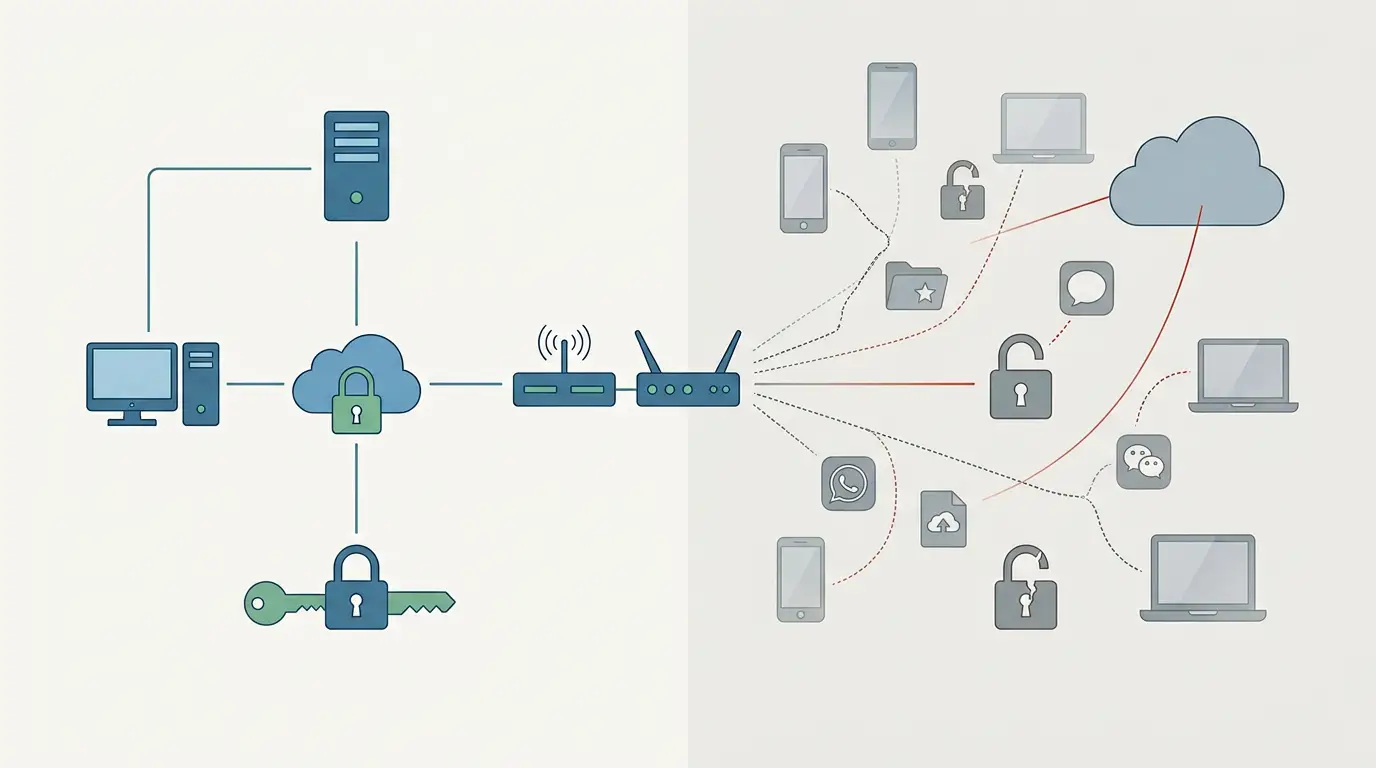
Shadow IT encompasses any technology—applications, devices, cloud services, or infrastructure—that employees use for work purposes without the knowledge or explicit approval of the IT department.
Common examples include:
- Messaging and collaboration apps (e.g., personal WhatsApp groups used for work communication)
- File sharing and storage services (e.g., Google Drive or Dropbox accounts not provisioned by IT)
- Project management tools adopted by individual teams without IT oversight
- AI-powered productivity tools accessed directly through personal accounts
- Browser extensions installed without security review
The defining characteristic of shadow IT is not the tool itself, but the lack of organizational awareness and governance around its use.
Why Is Shadow IT Becoming More Prevalent?
Several converging trends have accelerated the growth of shadow IT in recent years.
The rise of SaaS. Software-as-a-service platforms have made it trivially easy for individuals or teams to sign up and begin using powerful tools within minutes—no installation, no IT ticket, no waiting period. According to Gartner, the SaaS market continues to expand rapidly, making unsanctioned adoption increasingly difficult to detect.
Remote and hybrid work. When employees work outside the corporate network, IT visibility decreases. Workers operating from home environments are more likely to reach for familiar personal tools when workplace-approved solutions feel slow or limiting.
Slow IT procurement cycles. In many organizations, the formal process for evaluating and approving new software can take weeks or months. Employees facing immediate productivity needs often bypass this process out of practicality, not defiance.
The democratization of technology. Business users today are more technically capable than ever. The ability to provision cloud resources, configure integrations, or deploy applications no longer requires specialist knowledge—which means IT gatekeeping is easier to circumvent.
What Are the Key Risks of Shadow IT?
Shadow IT introduces risk across several critical dimensions. Below is a structured overview:
| Risk Category | Description |
|---|---|
| Security vulnerabilities | Unvetted apps may lack encryption, multi-factor authentication, or regular security patching |
| Data leakage | Sensitive organizational data stored in personal or unapproved cloud services is outside IT control |
| Compliance violations | Using non-approved tools may breach GDPR, HIPAA, SOC 2, or industry-specific regulations |
| Lack of visibility | IT teams cannot protect or manage assets they don't know exist |
| Integration risks | Unauthorized tools can create data silos, broken workflows, or incompatible systems |
| License and cost inefficiency | Duplicate or redundant tools may be purchased across departments without coordination |
Of these, data leakage and compliance exposure are consistently cited as the most consequential. When employees upload client data, financial records, or intellectual property to unapproved platforms, organizations lose the ability to enforce access controls, audit trails, or deletion policies—a significant liability under data protection regulations.
How Organizations Can Detect and Manage Shadow IT
Eliminating shadow IT entirely is neither realistic nor advisable. A more effective approach focuses on visibility, governance, and enabling legitimate alternatives.
Conduct a Shadow IT Discovery Audit
The first step is understanding the scope of the problem. Organizations can use Cloud Access Security Broker (CASB) tools, network traffic analysis, or endpoint management platforms to identify which applications are actively in use across the workforce. Many IT teams are surprised to discover hundreds of unsanctioned applications operating within their environments.
Establish a Clear IT Approval Process
A streamlined, transparent process for evaluating and approving new tools removes a primary incentive for shadow IT adoption. If employees know that submitting a request will receive a timely response, they are less likely to bypass the system. Define clear criteria for evaluation—security posture, data handling practices, vendor reliability—and communicate these standards organization-wide.
Implement an Acceptable Use Policy
Formal policies that define what employees can and cannot use for work purposes provide both guidance and accountability. An Acceptable Use Policy (AUP) should be specific, regularly updated, and accompanied by employee training to ensure awareness.
Offer Approved Alternatives That Meet Employee Needs
Shadow IT often signals a gap between what employees need and what IT currently provides. Where recurring patterns emerge—teams consistently adopting unauthorized file-sharing or messaging tools, for example—IT should evaluate whether approved alternatives adequately address those needs. Closing the functionality gap reduces the motivation to go around the system.
Apply Continuous Monitoring
Shadow IT management is not a one-time exercise. As new tools emerge and employee behaviors evolve, continuous monitoring is essential. Automated alerts for unusual data transfers, new application registrations, or unauthorized cloud activity enable proactive intervention before risks materialize.
The Business Case for Taking Shadow IT Seriously
The financial and reputational cost of a shadow IT-related breach can be substantial. According to IBM's Cost of a Data Breach Report (2023), the average cost of a data breach reached $4.45 million—a figure that makes the investment in proactive shadow IT governance straightforward to justify.
Beyond breach risk, unmanaged shadow IT creates operational drag. Fragmented tools lead to inconsistent data, poor collaboration, and duplicated effort. Organizations that establish strong IT governance frameworks consistently report better security outcomes, lower compliance risk, and more cohesive technology environments.
Building a Shadow IT Strategy That Works
Shadow IT is a symptom as much as it is a problem. When it proliferates, it often reflects a workforce that is resourceful and motivated—but underserved by existing IT infrastructure or processes.
The most effective shadow IT strategies balance control with enablement. Rather than adopting a purely restrictive posture, leading IT organizations focus on understanding employee needs, accelerating approval cycles, and fostering a culture where consulting IT is seen as helpful rather than bureaucratic. The goal is not to eliminate innovation—it is to ensure that innovation happens within a secure, well-governed framework.
Organizations that treat shadow IT as a strategic issue rather than a purely technical one are far better positioned to manage it effectively and sustainably.
Frequently Asked Questions
-
What is the difference between shadow IT and rogue IT?
Shadow IT refers to unauthorized technology use that typically occurs without malicious intent—employees seeking better tools for legitimate work purposes. Rogue IT implies deliberate circumvention of IT policy, often with awareness that the action violates organizational rules. In practice, the terms are sometimes used interchangeably, though shadow IT is the more commonly applied designation in enterprise security contexts.
-
Is shadow IT always a security risk?
Not every instance of shadow IT results in a breach or compliance violation, but all shadow IT carries inherent risk because it operates outside the organization's security controls and visibility. The severity of risk depends on the type of data involved, the security posture of the unsanctioned tool, and the organization's regulatory environment.
-
How common is shadow IT in enterprise organizations?
Shadow IT is extremely prevalent. Research has consistently found that a significant proportion of enterprise software usage occurs without IT knowledge. Some estimates suggest that shadow IT accounts for 30–40% of total IT spending in large organizations, though exact figures vary by industry and organizational size.
-
What tools are most commonly associated with shadow IT?
Cloud storage platforms, messaging applications, AI productivity tools, project management software, and browser extensions are among the most frequently cited categories of shadow IT. The rapid proliferation of AI-powered SaaS tools has added a significant new dimension to shadow IT risk in recent years.
-
Can shadow IT ever have positive outcomes?
Shadow IT occasionally surfaces genuinely useful tools that IT departments subsequently adopt officially. However, this does not justify the security and compliance risks associated with unsanctioned use. A better approach is to create accessible channels through which employees can recommend new tools for formal evaluation, capturing the innovation benefit without the associated exposure.