Shopping Cart



What Is a Softphone and How It Benefits Modern Businesses
Learn what a softphone is, how it works, and how businesses use softphone solutions to improve communication, support remote work, reduce costs, and increase productivity.
By Blue Edge Team | Jul 26, 2026
What Is a Softphone and How It Benefits Modern Businesses
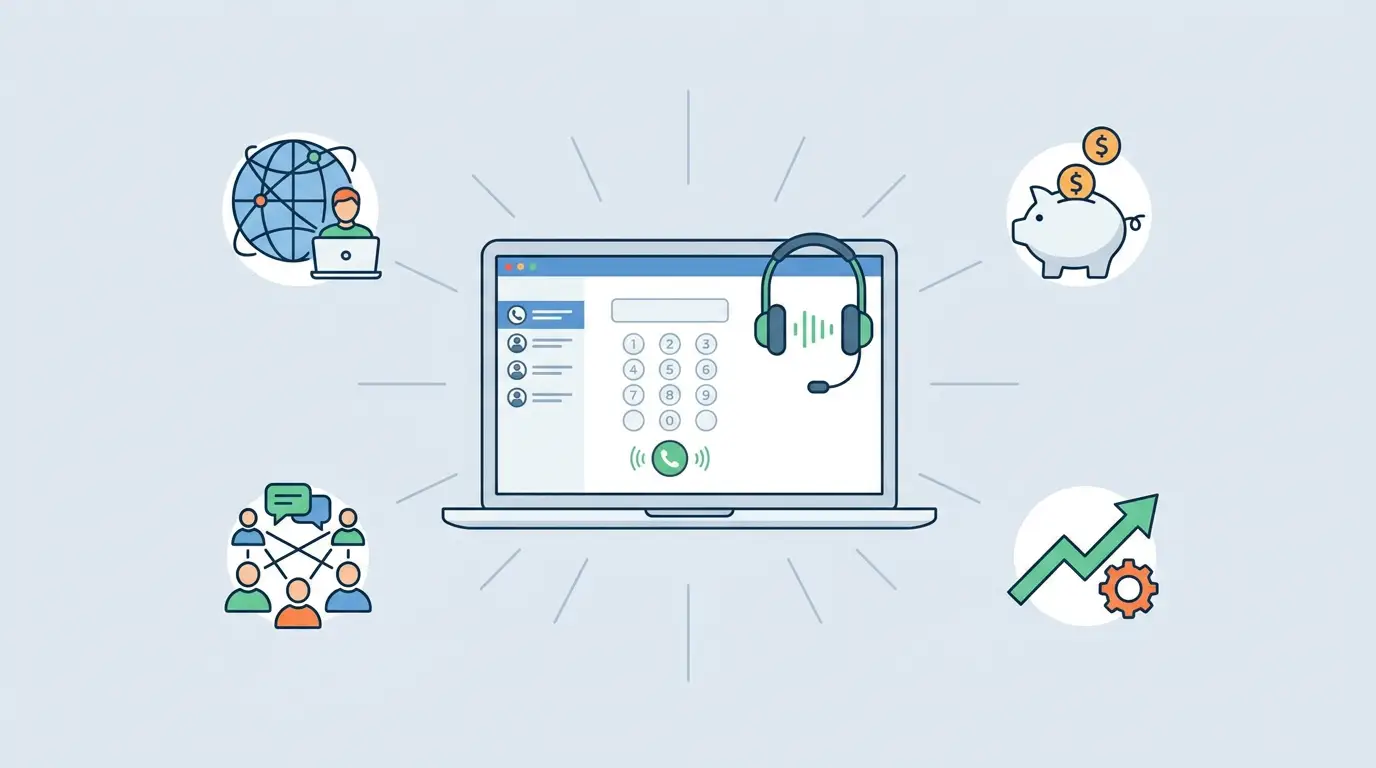
Quick answer: A softphone is a software application that enables voice and video calls over the internet using a device such as a computer, smartphone, or tablet—without requiring physical phone hardware. Softphones reduce communication costs, support remote work, and integrate with business tools like CRM platforms.
Business communication has changed significantly over the past decade. Physical desk phones—once a staple of every office—are giving way to software-based alternatives that offer far greater flexibility, lower costs, and richer features. The softphone sits at the center of this shift.
For organizations evaluating their communication infrastructure, understanding what a softphone is, how it works, and what it delivers in practice is an important starting point.
What Is a Softphone?
A softphone is a software application that replicates the functionality of a traditional telephone using Voice over Internet Protocol (VoIP) technology. Rather than routing calls through a conventional phone line, a softphone transmits voice data as packets over an internet connection.
Softphones can be installed on desktops, laptops, smartphones, or tablets. Users make and receive calls through a headset or the device's built-in microphone and speaker. Leading softphone platforms include Cisco Jabber, Zoiper, 3CX, and Microsoft Teams—each offering varying levels of functionality depending on enterprise needs.
Key Features of a Modern Softphone
Not all softphones are created equal. Enterprise-grade softphone solutions typically include:
- HD voice and video calling for high-quality communication
- Call recording for compliance and quality assurance
- Voicemail-to-email transcription for faster message retrieval
- Presence indicators showing colleague availability in real time
- CRM and helpdesk integration to streamline workflows
- Multi-device support enabling seamless transitions between devices
- Encrypted communication to protect sensitive conversations
- Conference calling and collaboration tools built in
These features position softphones not merely as a calling tool, but as a unified communication platform.
Softphone vs. Traditional Desk Phone: A Direct Comparison
| Feature | Softphone | Traditional Desk Phone |
|---|---|---|
| Hardware required | None | Yes |
| Setup cost | Low | Moderate to high |
| Remote work support | Full | Limited |
| Scalability | Instant | Requires hardware provisioning |
| Integration with business tools | Yes | Rarely |
| Maintenance | Software updates | Physical servicing |
| International calling cost | Low (VoIP rates) | Higher (PSTN rates) |
The comparison makes a clear case: for businesses prioritizing flexibility, scalability, and cost efficiency, softphones offer a structurally superior alternative to legacy hardware.
How Softphones Benefit Modern Businesses
How do softphones reduce communication costs for businesses?
Traditional phone systems carry substantial costs—hardware procurement, installation, line rentals, and ongoing maintenance. Softphones eliminate most of these expenses. Calls are routed over existing internet infrastructure, and international VoIP rates are significantly lower than standard PSTN charges.
For businesses with distributed teams or frequent international communication, the cost savings are material and measurable from the first billing cycle.
How do softphones support remote and hybrid work models?
A softphone operates wherever an internet connection is available. Employees working from home, a co-working space, or across different time zones access the same communication system with the same phone number and features as they would in a central office.
This consistency is operationally important. Clients and colleagues reach staff through a single business number regardless of physical location, maintaining professionalism and continuity.
How do softphones scale with business growth?
Adding a new user to a traditional phone system requires ordering hardware, configuring lines, and waiting for installation. With a softphone, onboarding a new team member takes minutes—install the application, assign an extension, and the user is ready.
This scalability makes softphones particularly well-suited to fast-growing businesses and organizations with fluctuating staffing requirements.
How do softphones integrate with existing business systems?
Enterprise softphone platforms integrate directly with CRM systems such as Salesforce, HubSpot, and Microsoft Dynamics. When an incoming call arrives, the relevant customer record surfaces automatically. After a call, interaction logs update without manual entry.
This level of integration reduces administrative burden, improves data accuracy, and gives customer-facing teams the context they need to communicate effectively.
Is a Softphone the Right Choice for Your Business?
Choose a softphone if:
- Your team operates remotely or across multiple locations
- You are scaling headcount and need flexible, low-cost provisioning
- Your business makes frequent international calls
- You require integration with CRM or collaboration platforms
A traditional phone system may still be appropriate if:
- Your operations are entirely on-site with no remote workforce
- Your industry has specific regulatory requirements tied to PSTN infrastructure
- Internet reliability at your location cannot support consistent VoIP quality
For most modern businesses, a softphone solution delivers a clear operational and financial advantage.
Build a Smarter Communication Infrastructure
Softphones represent a fundamental improvement in how businesses communicate—lower in cost, higher in flexibility, and richer in features than legacy hardware alternatives. As remote work becomes standard and business tools become increasingly interconnected, softphone adoption continues to accelerate across industries.
If your organization is evaluating its communication infrastructure, a softphone solution deserves serious consideration. Consult with a qualified technology partner to assess which platform aligns with your operational requirements and long-term communication strategy.
Frequently Asked Questions
-
What is the difference between a softphone and a VoIP phone?
A softphone is software installed on an existing device such as a laptop or smartphone. A VoIP phone is a dedicated hardware device that transmits calls over the internet. Both use VoIP technology, but a softphone requires no additional hardware investment.
-
Do softphones work without an internet connection?
No. Softphones depend entirely on an active internet connection to transmit voice data. A stable, high-bandwidth connection is recommended to ensure call quality, particularly for HD voice and video calls.
-
Are softphone calls secure?
Enterprise-grade softphones use end-to-end encryption protocols such as SRTP and TLS to protect voice data in transit. Organizations handling sensitive information should confirm that their chosen platform meets relevant industry security and compliance standards.
-
Can a softphone replace a business phone system entirely?
Yes, in most cases. A softphone integrated with a cloud PBX platform can replicate all core functionality of a traditional phone system—including extensions, call routing, voicemail, and conferencing—without physical hardware.
-
What equipment do I need to use a softphone?
At minimum, a device (computer, smartphone, or tablet), a reliable internet connection, and a headset with a microphone. Many softphones also support built-in device audio, making a dedicated headset optional for casual use.