Shopping Cart



Chatbots vs. Live Agents: Which One Do Your Customers Actually Need?
Compare chatbots vs live agents to discover which customer support solution improves response times, customer satisfaction, operational efficiency, and business communication.
By Blue Edge Team | Aug 10, 2026
Chatbots vs. Live Agents: Which One Does Your Customers Actually Need?
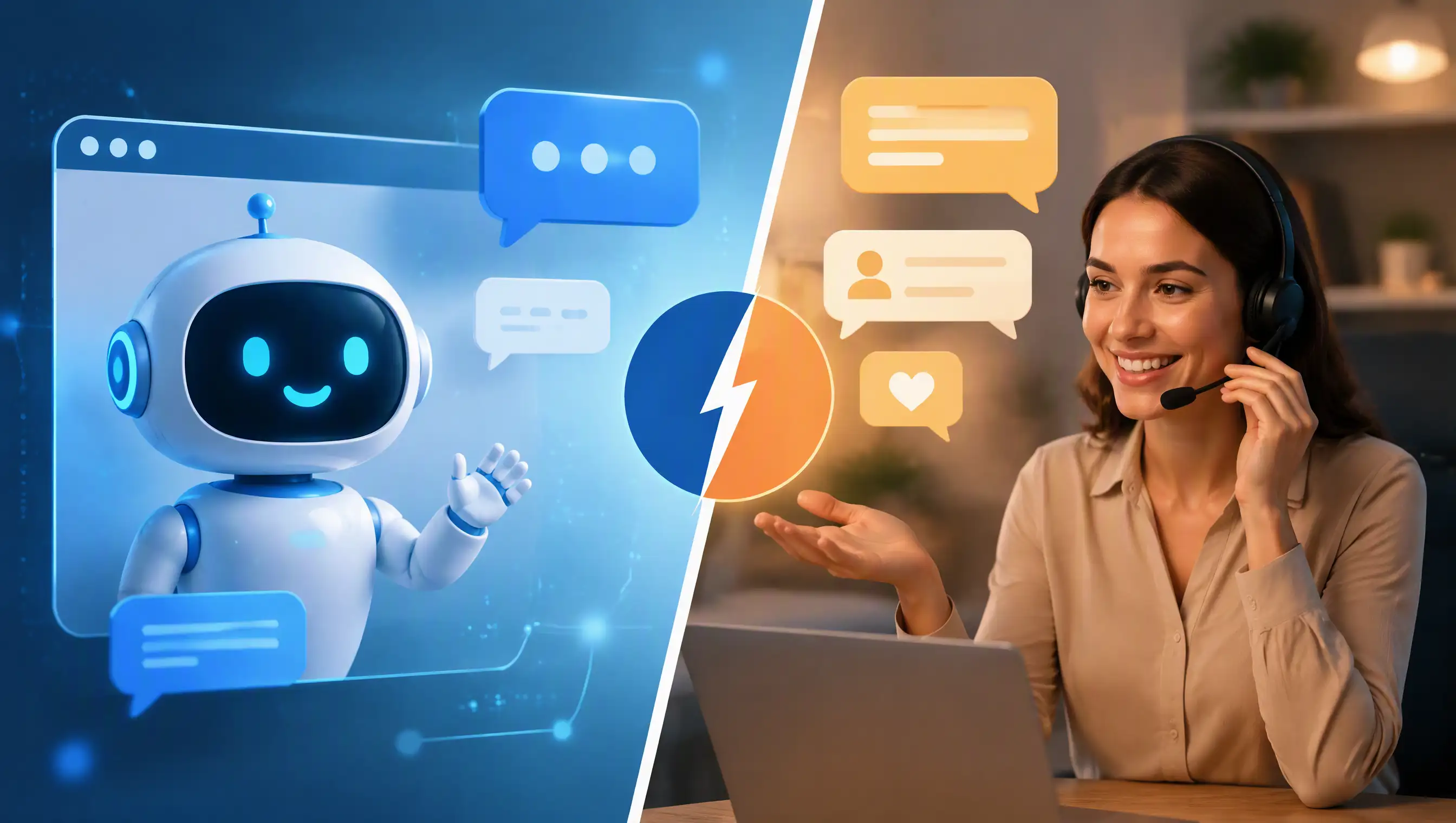
Chatbots excel at speed, scalability, and 24/7 availability, while live agents deliver empathy, nuanced judgment, and complex problem-solving. The most effective customer service strategies don't choose one over the other—they integrate both, routing customers to the right resource based on query type, urgency, and emotional context.
Customer expectations have never been higher. According to Salesforce's State of the Connected Customer report (2023), 88% of customers say the experience a company provides is as important as its products or services. That puts enormous pressure on support teams to respond faster, resolve issues more accurately, and do it all at scale—without sacrificing the human connection that builds loyalty.
Enter the debate: chatbots or live agents?
It's a question that's reshaping how businesses approach customer service. Chatbots promise round-the-clock availability and instant responses. Live agents bring empathy, adaptability, and the kind of nuanced judgment that no algorithm has fully replicated. But framing this as an either/or decision misses the point. The real question is: how do you deploy each effectively so that your customers get exactly what they need, exactly when they need it?
This post breaks down the strengths and limitations of both approaches, provides a direct feature-by-feature comparison, and outlines a practical framework for blending automation with human support in a way that serves your business—and your customers—at the highest level.
What Are Chatbots, and How Do They Work in Customer Service?
Chatbots are software applications programmed to simulate conversation with users, typically through text-based interfaces on websites, apps, or messaging platforms. They fall into two broad categories:
- Rule-based chatbots: Follow predefined scripts and decision trees. They handle structured queries effectively but struggle with anything outside their programmed scope.
- AI-powered chatbots: Leverage natural language processing (NLP) and machine learning to understand context, interpret intent, and generate dynamic responses. Platforms like Intercom, Drift, and Zendesk's AI tools fall into this category.
Modern AI chatbots have advanced considerably. They can manage appointment bookings, process refunds, answer FAQs, and even detect customer sentiment—all without human involvement.
What Do Live Agents Bring to Customer Support?
Live agents are trained customer service professionals who handle inquiries through phone, email, live chat, or in-person interaction. Their core advantage is human judgment—the ability to read between the lines, de-escalate frustration, and apply contextual reasoning to complex or emotionally charged situations.
Live agents are especially valuable when:
- A customer is distressed or dissatisfied
- The issue involves multiple variables or exceptions to standard policy
- A transaction has high financial or reputational stakes
- Trust-building is essential to the outcome
Despite automation's rise, live agents remain indispensable. A 2022 PwC study found that 82% of U.S. consumers want more human interaction in the future of customer service—not less.
Chatbots vs. Live Agents: A Feature-by-Feature Comparison
The table below provides a structured comparison across the dimensions that matter most to customer service operations.
| Feature | Chatbots | Live Agents |
|---|---|---|
| Availability | 24/7, no downtime | Limited to business hours (unless shift-based) |
| Response Time | Instant | Variable (seconds to hours depending on queue) |
| Scalability | Handles unlimited simultaneous conversations | Limited by headcount |
| Cost | Low cost per interaction at scale | Higher cost per interaction (salary, training, benefits) |
| Emotional Intelligence | Minimal; limited sentiment detection | High; capable of empathy and nuanced communication |
| Complex Problem Solving | Limited to predefined or trained scenarios | Highly capable; adapts to unique situations |
| Personalization | Data-driven, rule-based personalization | Deep, contextual personalization |
| Language & Tone Flexibility | Dependent on NLP model capability | Fully flexible; reads the room |
| Error Rate | Low for structured tasks; higher for ambiguous queries | Lower for nuanced judgment; variable under stress |
| Customer Satisfaction (CSAT) | High for simple queries; lower for complex ones | Consistently high for complex or emotional issues |
| Training Requirements | Initial setup + ongoing model refinement | Ongoing coaching, onboarding, and upskilling |
| Data Collection | Excellent; captures structured interaction data | Requires manual logging or CRM discipline |
Key takeaway: Neither column dominates across the board. Chatbots win on efficiency and scale. Live agents win on quality and complexity. The decision criteria should be query type—not budget alone.
Where Chatbots Outperform Live Agents
High-Volume, Repetitive Inquiries
Chatbots are purpose-built for volume. Tasks like password resets, order tracking, store hours, return policy explanations, and basic troubleshooting require no emotional intelligence—just accuracy and speed. Deploying live agents for these interactions is expensive and inefficient.
According to IBM, businesses that implement AI chatbots for tier-one support report up to a 30% reduction in customer support costs without a measurable decline in satisfaction for straightforward queries.
After-Hours Support
Customer issues don't follow business hours. A chatbot deployed across time zones ensures customers in different regions receive immediate acknowledgment and resolution for common problems—even at 2 a.m. This reduces ticket backlog and keeps customers from abandoning a brand due to delayed responses.
First-Contact Triage
Chatbots are effective at gathering initial information before routing a customer to the right department or agent. By collecting account details, describing the issue, and categorizing urgency, they reduce average handle time for live agents and improve first-contact resolution rates.
Where Live Agents Outperform Chatbots
Emotionally Sensitive Situations
Complaints about billing errors, product failures, or service disruptions can carry real emotional weight. A customer who has just experienced a loss—financial or otherwise—needs acknowledgment, not an automated script. Live agents can offer genuine empathy, adjust their tone in real time, and de-escalate tension in ways that chatbots simply cannot replicate.
Complex, Multi-Step Resolutions
Some customer issues span multiple systems, policies, or exceptions. A billing dispute involving a promotional code, a partial refund, and a loyalty points adjustment, for example, requires judgment calls that go beyond a chatbot's decision tree. Live agents can synthesize information across systems and apply contextual reasoning to reach a resolution.
High-Value Customer Relationships
Enterprise clients or high-lifetime-value customers often expect a dedicated point of contact. Routing these customers through automated channels can signal that the business undervalues their relationship. For accounts where retention is critical, live agent access is a strategic investment.
How to Build a Balanced Customer Service Model
The most effective approach is not a binary choice—it's a hybrid model that uses automation to handle scale and humans to handle depth.
Step 1: Map Your Query Types
Audit your support tickets and categorize them by complexity, frequency, and emotional sensitivity. Identify which queries are repetitive and structured (chatbot territory) versus which require judgment or empathy (live agent territory).
Step 2: Implement Smart Escalation Protocols
Design clear escalation triggers. A chatbot should automatically transfer a conversation to a live agent when:
- Sentiment analysis detects frustration or distress
- The query exceeds the bot's confidence threshold
- A customer explicitly requests human assistance
- The issue involves financial or legal sensitivity
Seamless handoffs—where the agent receives full conversation history before engaging—are critical to preventing customer frustration at transition points.
Step 3: Use Chatbots to Augment Agents, Not Replace Them
AI-assisted agent tools—where a chatbot suggests responses, retrieves relevant knowledge base articles, or auto-fills forms during a live interaction—can significantly reduce agent handle time without removing the human element. This approach, often called "agent assist," is one of the fastest-growing applications in enterprise customer service.
Step 4: Continuously Refine Based on Data
Both chatbot performance and agent quality should be measured against consistent KPIs: customer satisfaction score (CSAT), first response time, resolution rate, and escalation frequency. Use this data to optimize routing logic, update chatbot training data, and identify agent coaching opportunities.
The Competitive Advantage of Getting This Balance Right
Organizations that deploy chatbots and live agents strategically—not interchangeably—gain a compounding advantage. Operational costs decrease as automation absorbs high-volume, low-complexity queries. Agent bandwidth improves as they focus exclusively on work that requires human expertise. And customer satisfaction increases because every interaction is handled by the most appropriate resource.
Forrester Research (2023) found that companies that lead in customer experience outperform laggards on revenue growth by nearly 80%. The quality of your support model is not a back-office concern—it is a direct driver of commercial performance.
What's the Right Customer Service Strategy for Your Business?
Choose a chatbot-first model if: Your support volume is high, your queries are largely transactional, and your customer base is comfortable with digital self-service.
Choose a live agent-first model if: Your product is complex, your clients are enterprise-level, or your brand promise is built on a premium, high-touch experience.
Choose a hybrid model if: You need to scale efficiently without compromising customer experience quality—which describes most businesses operating today.
The goal is not to automate the customer out of the conversation. The goal is to ensure that every customer reaches the right resource at the right moment.
Frequently Asked Questions
-
What types of customer queries are best handled by chatbots?
Chatbots perform best on structured, repetitive queries with predictable answers. These include order status requests, FAQ responses, appointment scheduling, password resets, and basic product information. When the query is clearly defined and the resolution path is consistent, chatbots deliver fast and cost-effective service without requiring human involvement.
-
When should a chatbot escalate to a live agent?
A chatbot should escalate to a live agent when the customer expresses frustration or distress, when the query falls outside the bot's trained knowledge, when the issue involves financial or legal complexity, or when the customer explicitly asks to speak with a person. Effective escalation protocols include transferring full conversation context to the agent to avoid forcing the customer to repeat themselves.
-
Are chatbots cost-effective for small businesses?
Yes, particularly for businesses with high inquiry volume relative to their support team size. Many chatbot platforms offer tiered pricing models that make AI-assisted support accessible at smaller scale. The cost savings are most significant when chatbots successfully deflect a high percentage of tier-one queries that would otherwise require paid agent time. The key is selecting a platform that integrates with your existing CRM and support tools.
-
How do chatbots affect customer satisfaction scores?
Customer satisfaction scores (CSAT) for chatbot interactions tend to be high when the query is simple and resolved on first contact. They drop significantly when the chatbot fails to resolve the issue, offers irrelevant responses, or creates friction in the escalation process. According to Zendesk's Customer Experience Trends Report (2023), customers who experience a poor automated interaction are less likely to contact support again—and more likely to churn.
-
What is the difference between a rule-based chatbot and an AI-powered chatbot?
A rule-based chatbot follows a fixed decision tree and can only respond to queries within its programmed parameters. An AI-powered chatbot uses natural language processing (NLP) and machine learning to interpret intent, handle varied phrasing, and generate context-aware responses. AI-powered chatbots are significantly more flexible and capable of managing a wider range of queries, though they require more initial training data and ongoing refinement to maintain accuracy.
Ready to Optimize Your Customer Service Model?
Delivering exceptional customer service at scale requires more than tools—it requires a strategy that aligns automation with human expertise in a deliberate, measurable way.
Our team can help you design a customer service framework that reduces operational costs, improves resolution rates, and protects the customer relationships that matter most. Whether you're evaluating chatbot platforms, restructuring your live agent workflows, or building an integrated hybrid model from the ground up, we have the expertise to guide the process.