Shopping Cart


- Articles
- Cybersecurity
- Cyber Threat Hunting: Going Beyond Alerts in Saudi Arabia
Cyber Threat Hunting: Going Beyond Alerts in Saudi Arabia
Why hunting needs telemetry and retention first, how to build a hypothesis, what to hunt for, and turning every hunt into a permanent detection rule.
By Blue Edge Team | Published Sep 09, 2026 | Updated Oct 03, 2026 | 14 min read

Quick answer
Cyber threat hunting is the proactive search for adversary activity that has evaded existing detection controls, driven by a hypothesis rather than by an alert. It starts from the assumption that something has already got through, and its most valuable output is not the intruder it finds but the detection rule it produces, which turns a manual search into permanent automated coverage.
Every security tool in an organisation shares one limitation. It reports what it was built to recognise. An attacker who does something the tool does not recognise generates no alert, and an empty alert queue is then indistinguishable from an environment with nothing wrong in it.
Threat hunting exists because those two situations look identical from a dashboard. It is the discipline of going to look when nothing has told you to.
It is also the security capability most often bought before it can work. An organisation with thirty days of partial logs and no asset inventory can purchase a hunting service and will receive a report finding nothing, because there was nothing to look through.
This guide covers what hunting actually is, what has to exist before it produces anything, how to structure a hunt, what to look for first, and how to build the capability without a twenty-four hour security operations centre.
What Is Threat Hunting?
Cyber threat hunting is the proactive, hypothesis-driven search for adversary activity that existing detection controls have not flagged. The defining characteristic is that nothing triggered it. A hunt begins with a question rather than an alert.
The underlying assumption is deliberate and uncomfortable: assume something has already got through. Not as pessimism, but as a working method. If you assume the perimeter held, you will never look behind it, and the only evidence you will ever have that it held is the absence of alerts from tools that cannot see what they were not built to see.
Hunting is a search, not a scan. The hunter forms a specific idea about how an adversary might be operating in this environment, works out what evidence that behaviour would leave, and goes looking for that evidence in the data the organisation already collects.
The output people expect is a discovered intruder. The output that actually matters is a detection rule, and that distinction shapes everything else in this article.
Hunting, Monitoring, Response or Testing?
The table below separates five activities that are frequently conflated in budget discussions.
| Criterion | Security monitoring | Threat hunting | Incident response | Penetration testing | Red team engagement |
|---|---|---|---|---|---|
| What starts it | An alert fires | A hypothesis | A confirmed incident | A scheduled engagement | A scheduled engagement |
| Underlying assumption | Tools will catch it | Something evaded the tools | It already happened | We may be breachable | We may not notice |
| Primary output | Triaged alerts | Detection rules and visibility gaps | Containment and recovery | A list of exploitable weaknesses | An assessment of detection |
| Requires historical data | Limited | Yes, substantially | Yes | No | No |
| Cadence | Continuous | Periodic and structured | On demand | Annual or on change | Annual for mature programmes |
| Skills required | Alert triage and process | Investigation and environment knowledge | Coordination and forensics | Offensive testing | Offensive and evasion |
| What it proves | The tools are working | Whether anything evaded them | How well you recover | Whether you can be broken into | Whether you would see it |
Key takeaway
Monitoring and hunting are not competing purchases, they answer different questions. Monitoring tells you whether the things you already detect are happening. Hunting tells you whether something you do not detect is happening, and every successful hunt should end by converting that gap into a rule the monitoring layer can then handle automatically. An organisation that hunts without feeding the results back into detection is repeating the same manual search every quarter and calling it a programme.
What Do You Need Before You Can Hunt?
This section is the one most vendors skip, and it decides whether anything else in this article is achievable.
Hunting is searching through evidence. If the evidence was never collected, or was deleted, the hunt returns nothing and the organisation concludes it is secure. That conclusion is unearned.
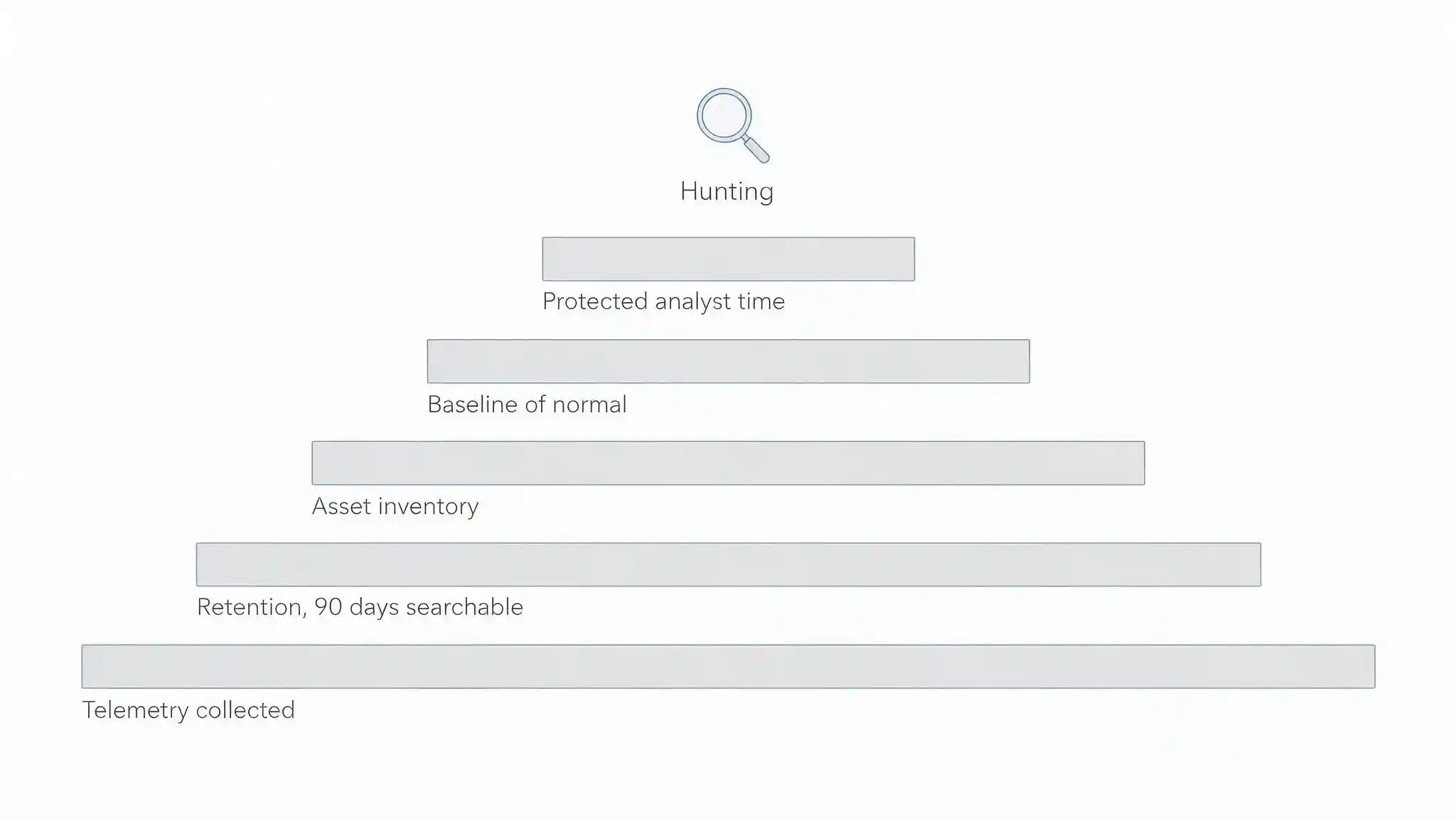
Five prerequisites, in order:
Telemetry. You cannot hunt for process execution without process data, or for command and control without DNS or network records. At minimum, hunting needs endpoint process and command line data, authentication events including successes, DNS queries, network connection records and cloud control plane activity.
Retention long enough to look backwards. Hunting is retrospective by nature. If an adversary established access three months ago and you hold thirty days of logs, the hunt cannot reach the activity that matters. Ninety days searchable is a workable floor, with longer retention on low-volume high-value sources such as authentication and privilege changes, as set out in security logging and retention.
An asset inventory. Anomaly detection requires knowing what is normal, and you cannot identify the unexpected host if you do not know which hosts are expected. The systems missing from the inventory are precisely where an adversary is least likely to be noticed, which is why hunting depends on the work described in attack surface management.
A baseline of normal. Which accounts log in from where, which servers initiate outbound connections, which processes run on which systems. Without this, every unusual finding looks alarming and every genuine finding looks ordinary.
Time that is genuinely protected. Hunting is not something an analyst does between alert tickets. It requires uninterrupted blocks, because the value comes from following a line of enquiry through several steps rather than glancing at a query result.
If several of these are missing, the correct sequence is to build them first. Telemetry and retention are the foundation, and an organisation that fixes those has improved its security materially even before the first hunt runs.
How Do You Structure a Hunt?
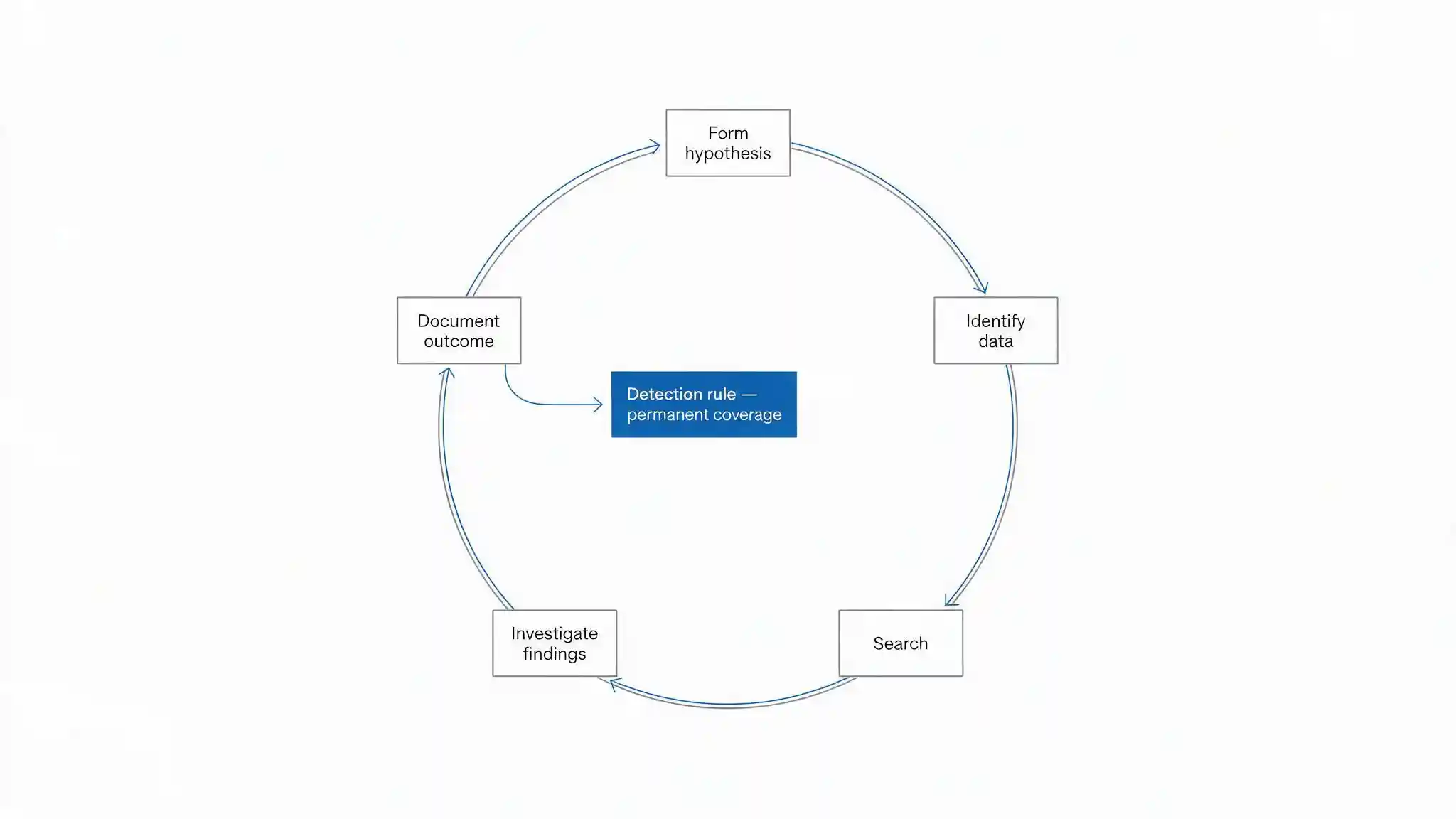
A hunt has six steps, and skipping the last one is the most common way a programme produces nothing durable.
- 1. Form a specific hypothesis. A hypothesis is a testable statement about how an adversary might be operating, not a topic. "Look for suspicious PowerShell" is not a hypothesis. "An adversary establishing persistence would create a scheduled task executing a script interpreter from a user-writable directory, and we would see that in process creation and task creation events" is one, because it states what you expect and where you expect to find it.
- 2. Identify the data that would prove or disprove it. Establish this before searching. If the required data does not exist, stop and record that as a visibility gap, which is a finding in its own right and frequently more valuable than the hunt would have been.
- 3. Search. Query the data, filtering toward the specific behaviour rather than browsing broadly.
- 4. Investigate what surfaces. Most results will be legitimate activity that happens to match the pattern. Working out why an unusual thing is normal in your environment is itself worth doing, because it builds the baseline.
- 5. Document, including negative results. A hunt that finds nothing is not a failed hunt. It reduces uncertainty, it proves you had the visibility to look, and recording it stops you repeating the same search in six months. Record the hypothesis, the data used, the query and the outcome.
- 6. Operationalise the finding. This is the step that makes hunting worth funding. Convert the hunt into a detection rule so that the same behaviour is caught automatically next time. A hunt that identifies a technique and does not produce a rule has bought you one detection. A hunt that produces a rule has bought you permanent coverage.
Should you hunt for indicators or techniques?
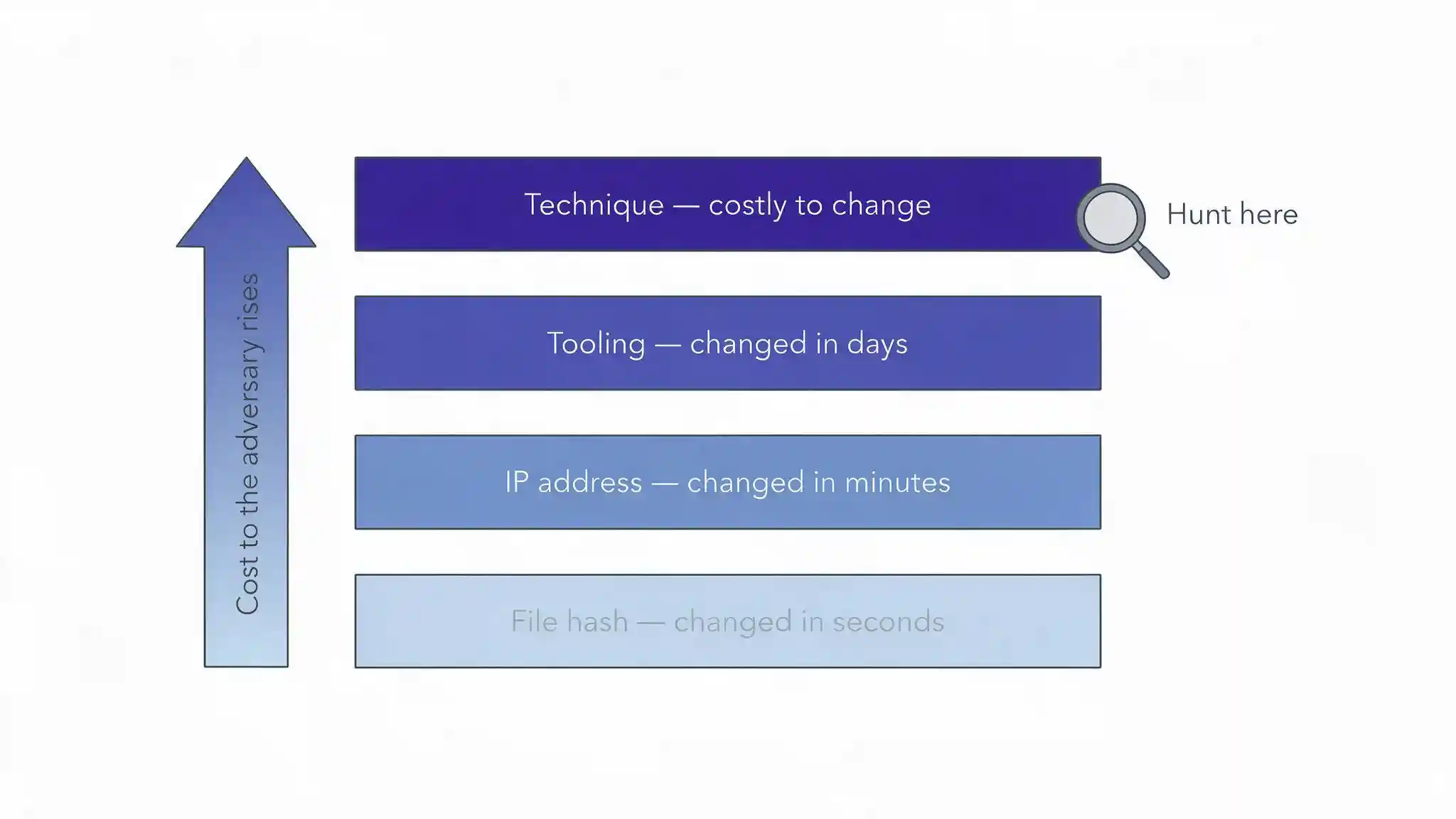
Hunt for techniques. The distinction matters commercially because of how expensive each is for an adversary to change.
Indicators such as file hashes, IP addresses and domain names are trivial to alter. An attacker recompiles a tool and the hash changes, moves to a new server and the address changes. Searching for known indicators finds only adversaries who have not bothered to change them, which is a diminishing population.
Techniques are the behaviours underneath: how persistence is established, how credentials are gathered, how data is staged before exfiltration. Changing a technique requires the adversary to change how they operate, which is far more costly than changing an address. A hunt built around a technique keeps working after the indicators have rotated.
MITRE ATT&CK is the widely used knowledge base of adversary tactics and techniques, and it serves two purposes in hunting. It supplies a structured library of techniques to build hypotheses from, and it gives a way to track which techniques you have hunted for and which you have never examined, which turns an ad hoc activity into measurable coverage.
What Should You Hunt for First?
Start with behaviours that are cheap to search, rare in a healthy environment, and consistently present in real intrusions. Ten hunts worth running before anything more sophisticated:
- Rare process execution. Binaries seen on only one or two hosts across the estate, particularly running from user-writable directories.
- Unusual parent and child process relationships. A document application launching a script interpreter, or a web server process spawning a command shell.
- New persistence mechanisms. Scheduled tasks, services and autorun entries created recently, especially outside change windows.
- Service accounts behaving interactively. Accounts intended for automation performing interactive logons, which is a strong signal because the legitimate use case does not produce it.
- Authentication at unusual times or from unusual sources. Administrative accounts active outside working patterns, and in Saudi organisations specifically, activity during the Friday and Saturday weekend.
- Servers initiating outbound connections. Most servers should answer requests, not make them. Outbound traffic from a database server deserves an explanation.
- DNS queries to newly registered or algorithmically generated domains. One of the most productive sources for identifying command and control.
- Data staging. Archive files appearing in temporary directories or shared folders, particularly large ones created shortly before an outbound transfer.
- Account and privilege changes outside process. New accounts, new group memberships and new administrative rights that do not correspond to a joiner or change record.
- Remote access tooling outside the approved list. Legitimate remote support tools are frequently used by adversaries precisely because they are legitimate and therefore unremarkable.
Each of these can be expressed as a hypothesis, tested against data most organisations already collect, and converted into a rule afterwards. None require specialist tooling beyond what a reasonable logging platform provides.

Can You Hunt Without a Security Operations Centre?
Yes, and most organisations in the Kingdom will have to, because a fully staffed round-the-clock operations centre is out of reach for all but the largest.
Hunting scales down more gracefully than monitoring does. Monitoring needs continuous coverage to be useful, since an alert nobody sees for eleven hours has limited value. Hunting is periodic by nature, so a structured half day each month with the right data delivers real results, while an unstaffed platform delivers none.
A workable model for a mid-sized organisation:
- One hypothesis per month, chosen from the list above, worked properly rather than three worked superficially.
- A fixed, protected slot in the calendar, treated as unavailable for other work.
- The existing tooling's data, rather than a new platform. Most organisations already collect more than they search.
- A running record of every hunt, its outcome and any resulting rule, so coverage accumulates visibly over a year.
- A managed service for depth, where the internal team lacks the experience, while keeping the environment knowledge in house, because an external hunter who does not know your environment cannot distinguish unusual from abnormal.
That last point is worth emphasising. Environment knowledge is at least as valuable as hunting expertise. An experienced external analyst will find generic patterns. Someone who knows that a particular server has never initiated an outbound connection in four years will find the thing that matters.
What Should Saudi Organisations Consider?
Four factors shape hunting priorities in the Kingdom.
The regional threat profile is targeted rather than opportunistic. Organisations in energy, government, finance and critical infrastructure in this region face adversaries pursuing specific objectives, and the region has a documented history of destructive attacks aimed at disruption rather than extortion. That changes hunting priorities in a specific way: a destructive operation does not announce itself with a ransom note, so there is no moment where alert-driven detection is handed an obvious signal. What precedes it is a quiet period of reconnaissance, credential gathering and lateral movement, which is exactly the activity hunting exists to find and exactly the activity that generates no alerts.
Hunt the periods when nobody is watching. The Saudi working week runs Sunday to Thursday, and adversaries deliberately operate during low-staffing windows. Make Friday and Saturday activity a standing hunt, and extend it to Eid periods and Ramadan adjusted hours, which is the same reasoning applied to incident readiness in tabletop exercises.
Hunt the estate nobody documented. The systems most likely to host undetected activity are the ones with no owner: servers built by an integrator during a project, building and operational technology equipment outside the IT inventory, and cloud resources created for a migration and never removed. Hunting scoped to the managed estate will not find them, which is why hunting and attack surface management are the same programme viewed from two directions, and why operational technology environments need their own approach as described in OT and ICS security.
Regulatory expectations already point this way. Event logging, monitoring and threat management are control domains within the National Cybersecurity Authority's Essential Cybersecurity Controls (ECC), and entities operating critical systems carry the Authority's additional critical systems controls. Financial institutions carry the obligations of the SAMA Cybersecurity Framework. A documented hunting programme with recorded hypotheses, outcomes and resulting detections is straightforward evidence against those expectations, which is a useful argument when seeking budget.
One caution on data. Hunting queries examine records of individual activity, so the same considerations apply as to security logging generally: the data is personal data under the Personal Data Protection Law (PDPL) administered by the Saudi Data and Artificial Intelligence Authority. Keep the purpose stated, restrict who can query, and log the queries themselves.
Blue Edge, a technology distributor based in Dammam, Saudi Arabia, distributes NinjaOne endpoint and patch management, which supplies endpoint visibility and remediation, and KnowBe4 security awareness training for the human side of the same problem.
What Are the Most Common Threat Hunting Mistakes?
Six mistakes account for most programmes that produce nothing.
Buying hunting before having telemetry and retention. A search through data that was never collected returns nothing, and the organisation mistakes that for a clean result.
Hunting indicators instead of techniques. File hashes and addresses are trivial for an adversary to change, so indicator searches find only those who did not bother.
Searching without a hypothesis. Browsing a data platform hoping something looks wrong is not hunting, produces inconsistent results and cannot be measured or repeated.
Not recording negative results. An unrecorded hunt gets repeated, and the organisation loses the evidence that it had visibility and looked.
Not converting findings into detection rules. Without this step, hunting buys one detection at a time instead of permanent coverage, and the same search runs again next quarter.
Hunting only the documented estate. The systems most likely to host undetected activity are the ones nobody inventoried, and a hunt scoped to the asset list cannot reach them.
Build the Data First, Then Go Looking
Threat hunting has a reputation as an advanced capability for mature organisations, and that framing puts it out of reach for businesses that would benefit from it most. The reality is more accessible and more demanding at the same time.
More accessible, because a single well-formed hypothesis worked properly once a month, using data the organisation already collects, is a genuine hunting programme. It needs no dedicated team and no new platform.
More demanding, because it does not work without the foundation. Telemetry, ninety days of searchable retention, an asset inventory and a sense of what normal looks like are not optional preparation, they are the thing being searched. An organisation missing them should build them first, and will be measurably better defended by the time the first hunt runs.
Then treat the detection rule as the deliverable. Finding an intruder is the outcome everyone hopes for and rarely gets. Converting a manual search into automated coverage happens every single time, accumulates across a year, and is the reason the programme is worth funding.
Frequently Asked Questions
-
How is threat hunting different from security monitoring?
Monitoring reacts to alerts generated by tools, so it covers the activity those tools were built to recognise. Hunting starts from a hypothesis when nothing has fired, and searches for activity that evaded detection entirely. The two are complementary rather than alternative: monitoring confirms that known threats are being caught, and hunting looks for what is not being caught, then converts each finding into a rule monitoring can handle automatically.
-
Can you hunt with only 30 days of log retention?
Barely, and not for the activity that matters most. Hunting is retrospective, so if an adversary gained access three months ago, thirty days of data cannot reach the events that would show how. Ninety days immediately searchable is a workable floor, with longer retention on low-volume high-value sources such as authentication events and privilege changes, which cost very little to keep.
-
Should you hunt for indicators or techniques?
Techniques. Indicators such as file hashes, IP addresses and domain names are trivial for an adversary to change, so searching for them finds only those who have not rotated them. Techniques are the behaviours underneath, such as how persistence is established or how credentials are gathered, and changing those requires the adversary to change how they operate. A technique-based hunt keeps working after indicators have changed.
-
What do you do when a hunt finds nothing?
Record it. A hunt that finds nothing reduces uncertainty and demonstrates that you had the visibility to look, both of which are worth having documented. Record the hypothesis, the data used, the query and the outcome, so the search is not repeated needlessly. If the hunt could not run because the required data did not exist, that is a visibility gap and often a more valuable finding than the hunt itself.
-
Can you hunt without a full security operations centre?
Yes. Hunting is periodic rather than continuous, so it scales down far better than monitoring does. One hypothesis worked properly each month, in a protected calendar slot, using data the organisation already collects, is a genuine programme. Keep a running record so coverage accumulates visibly, and consider a managed service for depth while retaining environment knowledge internally, since knowing what is normal here is as valuable as hunting expertise.
Reviewing your detection and visibility?
Blue Edge works with organisations across Saudi Arabia on endpoint management, patching and security awareness.
Call +966 53 9855 188 or contact our team to discuss your requirements.
NinjaOne in Saudi ArabiaAbout Blue Edge
Blue Edge Company is a value-added technology distributor based in Dammam, Saudi Arabia, supplying interactive displays, smart building systems, networking infrastructure and IT security software to businesses and residential projects across the Kingdom, with installation and technical support.
Learn more about Blue Edge →Published 9 September 2026 • Last updated 3 October 2026 • This article is reviewed when standards, regulations or product guidance change.