Shopping Cart



What Is Demand Response and How Does It Work in Smart Buildings?
Learn how demand response in smart buildings helps reduce energy costs, improve grid stability, and optimize energy consumption through intelligent building automation systems.
By Blue Edge Team | Jun 22, 2026
What Is Demand Response and How Does It Work in Smart Buildings?
Quick answer: Demand response is a strategy that adjusts a building's electricity use in response to grid conditions or price signals. In smart buildings, automated systems temporarily reduce or shift energy consumption during peak demand periods. This eases pressure on the power grid, lowers energy costs, and supports a more stable, sustainable energy system.
Electricity grids face their greatest strain during peak demand, when thousands of buildings draw power at the same time. These moments push energy prices higher and increase the risk of outages. Demand response offers a practical solution by giving buildings the ability to adjust their energy use precisely when it matters most.
For facility managers and building owners, demand response represents both a cost-saving opportunity and a step toward greater sustainability. Smart buildings make this process seamless, using automation to respond to grid signals without disrupting occupant comfort.
This article explains what demand response is, how it functions within smart buildings, the technologies that make it possible, and the benefits it delivers. The five frequently asked questions at the end address the most common concerns for those considering this approach.
What Is Demand Response?
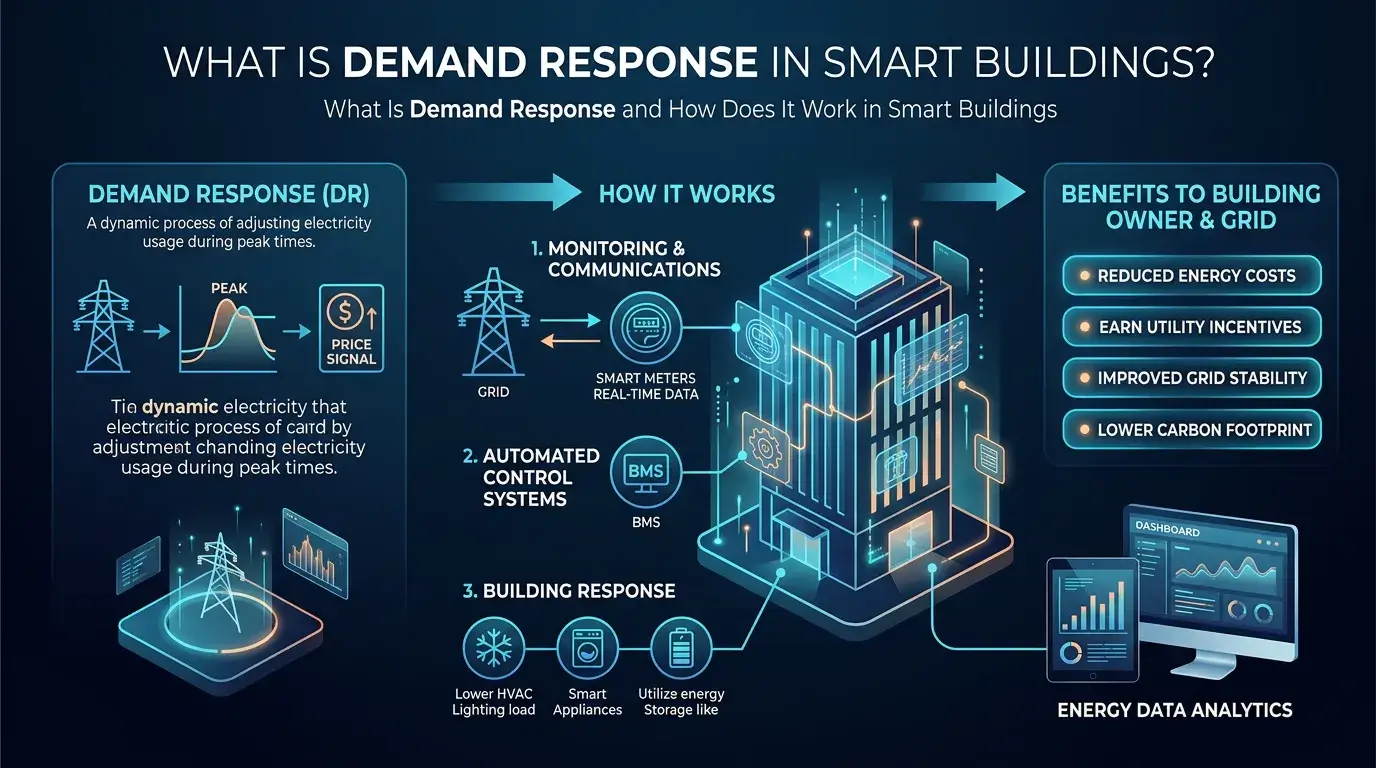
Demand response is a coordinated adjustment of electricity consumption based on signals from the power grid or an energy provider. Instead of generating more power to meet rising demand, utilities encourage consumers to reduce or shift their usage during critical periods.
These critical periods, often called peak events, occur when overall electricity demand approaches the limits of available supply. During these windows, energy providers send signals to participating buildings, requesting a temporary reduction in consumption. In return, building owners typically receive financial incentives or lower energy rates.
There are two main types of demand response:
- Manual demand response: Building staff receive a notification and manually adjust equipment, such as dimming lights or raising thermostat setpoints.
- Automated demand response (ADR): Building systems respond to grid signals automatically, with no human intervention required. This is the model most common in smart buildings.
How Does Demand Response Work in Smart Buildings?
Smart buildings are equipped with connected systems that monitor and control energy use in real time. This connectivity is what makes automated demand response effective and reliable.
The process generally follows these steps:
- Signal reception: The building's energy management system receives a demand response signal from the utility or a third-party aggregator.
- Automated decision-making: The system evaluates current conditions, including occupancy, temperature, and equipment status.
- Load adjustment: The system reduces or shifts energy use across selected systems, such as HVAC, lighting, and EV charging.
- Verification: The building reports its actual reduction back to the utility, confirming participation and securing any incentives.
Because these actions are automated, the building can respond within seconds while keeping occupants comfortable. For example, a smart HVAC system might pre-cool a building before a peak event, then ease back during the event itself without a noticeable change in temperature.
What Technologies Enable Demand Response?
Several core technologies work together to make demand response possible in smart buildings:
- Building Management Systems (BMS): Centralized platforms that monitor and control HVAC, lighting, and other building systems.
- Internet of Things (IoT) sensors: Devices that collect real-time data on occupancy, temperature, and energy use.
- Smart meters: Tools that measure electricity consumption with precision and communicate directly with utilities.
- Energy management software: Applications that analyze data, automate responses, and verify performance.
Together, these technologies give building operators detailed visibility and precise control over energy consumption. The result is a system that responds intelligently to grid conditions while maintaining operational efficiency.
What Are the Benefits of Demand Response?
Demand response delivers measurable value for building owners, utilities, and the broader energy system. The key benefits include:
- Lower energy costs: Reducing consumption during peak periods avoids the highest electricity rates and can generate incentive payments.
- Grid stability: Coordinated reductions ease pressure on the grid, lowering the risk of blackouts during high-demand events.
- Sustainability: By reducing peak demand, buildings decrease reliance on carbon-intensive "peaker" power plants that operate only during peak periods.
- Operational insight: The data generated through demand response helps identify additional opportunities for efficiency.
These benefits make demand response an attractive option for organizations seeking to control costs while supporting environmental goals.
Who Should Consider Demand Response?
Demand response is well suited to commercial and industrial buildings with significant, flexible energy loads. Office buildings, shopping centers, hotels, hospitals, and manufacturing facilities are strong candidates, particularly those with large HVAC systems.
Choose automated demand response if your priority is reliability and minimal staff involvement. Manual demand response may suit smaller facilities with limited automation, though it requires more active management and offers less precision.
Moving Toward a Smarter Energy Future
Demand response transforms buildings from passive energy consumers into active participants in grid management. By adjusting consumption intelligently during peak periods, smart buildings reduce costs, strengthen grid reliability, and advance sustainability goals.
For building owners and facility managers, the next step is to assess your current energy systems and identify whether your facility can support automated demand response. Consulting with an energy management provider or your local utility will clarify available programs, potential incentives, and the technologies needed to participate effectively.
Frequently Asked Questions
-
How much money can demand response save a building?
Savings vary based on building size, energy use, and local utility programs. Many commercial buildings reduce peak energy costs significantly and earn additional income through incentive payments. The exact figure depends on how much load a building can shift and the structure of the local demand response program.
-
Does demand response affect occupant comfort?
No, when properly configured, demand response should not noticeably affect comfort. Smart buildings use strategies such as pre-cooling and gradual adjustments to maintain a stable environment. Occupants typically do not perceive the small, temporary changes made during a peak event.
-
How is demand response different from energy efficiency?
Energy efficiency focuses on reducing overall energy consumption at all times, such as by installing LED lighting. Demand response focuses on temporarily adjusting energy use during specific peak periods. The two approaches complement each other, and many buildings use both.
-
What equipment is needed to participate in demand response?
A building typically needs a building management system, smart meters, and energy management software to participate in automated demand response. IoT sensors enhance precision by providing real-time data. The specific requirements depend on the utility program and the building's existing infrastructure.
-
Is demand response only for large buildings?
No, demand response is not limited to large buildings, though larger facilities with flexible loads see the greatest returns. Smaller buildings can participate, often through manual programs or by joining an aggregator that combines multiple sites to meet program requirements.