Shopping Cart


- Articles
- Smart Buildings
- Digital Twin Technology: The Future of Smart Buildings
Digital Twin Technology: The Future of Smart Buildings
Discover how digital twin technology helps smart buildings improve energy efficiency, enable predictive maintenance, optimize space utilization, and enhance facility management.
By Blue Edge Team | Published Jun 17, 2026 | Updated Sep 23, 2026 | 6 min read
Quick answer
Digital twin technology creates real-time virtual replicas of physical buildings, enabling facility managers and engineers to monitor performance, simulate scenarios, and reduce operational costs. Smart buildings that adopt digital twins report significant energy savings and faster maintenance response times—making this one of the most impactful innovations in modern building management.
Smart buildings are no longer defined by automated lighting or keycard access. The standard has shifted. Today, leading facilities integrate digital twin technology to create living, breathing virtual models of their physical infrastructure—capable of predicting failures, optimizing energy use, and transforming how buildings are managed from the ground up.
This post explains what digital twin technology is, how it applies to smart buildings, and why organizations across real estate, healthcare, and commercial infrastructure are adopting it now.
What Is Digital Twin Technology in the Context of Smart Buildings?
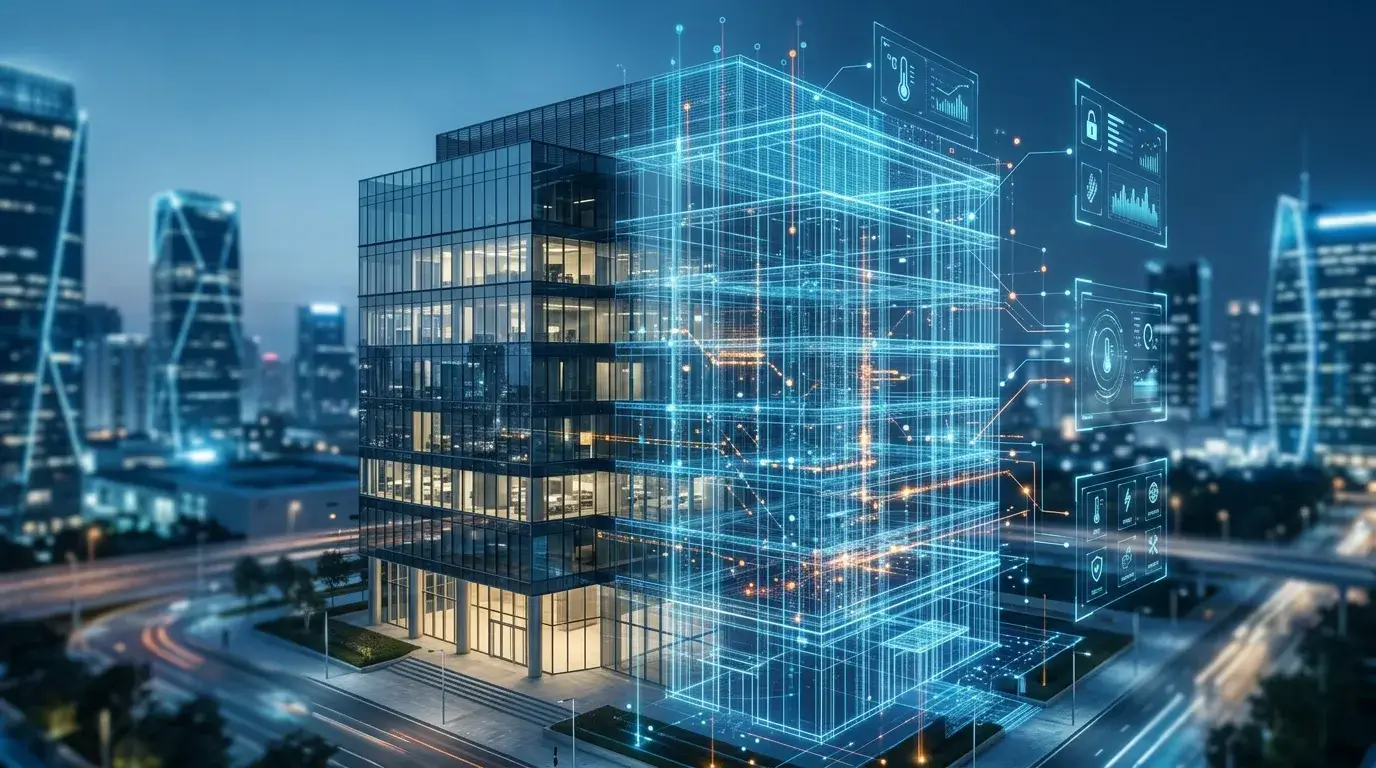
A digital twin is a precise, real-time virtual replica of a physical asset—in this case, a building. It connects to the physical structure through IoT sensors, building management systems (BMS), and data feeds, continuously updating to reflect actual conditions.
Unlike static building information models (BIM), a digital twin is dynamic. It processes live data from HVAC systems, electrical networks, occupancy sensors, and structural components—giving facility teams a complete, accurate picture of building performance at any given moment.
Key components of a smart building digital twin include:
- IoT sensor integration — Continuous data collection from mechanical, electrical, and plumbing systems
- Real-time data synchronization — Instant reflection of physical changes in the virtual model
- Simulation capabilities — The ability to test scenarios (e.g., energy load changes, emergency evacuations) without affecting the physical building
- AI and machine learning layers — Predictive analytics that identify trends and anomalies before they become problems
What Are the Core Benefits of Digital Twins for Smart Buildings?
How Do Digital Twins Improve Energy Efficiency?
Energy consumption is one of the largest operational costs in commercial buildings. Digital twins allow facility managers to simulate different energy configurations and identify inefficiencies without trial and error in the physical space.
According to the International Energy Agency (IEA), buildings account for nearly 30% of global energy consumption. Digital twin platforms address this directly by modeling energy flows in real time and recommending adjustments to HVAC, lighting, and cooling systems based on occupancy and weather data.
The result: measurable reductions in energy waste, lower utility costs, and progress toward sustainability targets—without compromising occupant comfort.
How Do Digital Twins Enable Predictive Maintenance?
Reactive maintenance is costly. Equipment failure leads to unplanned downtime, emergency repairs, and accelerated asset degradation. Digital twins shift this model entirely.
By continuously analyzing sensor data, a digital twin can detect early warning signs—unusual vibration in a pump, abnormal temperature spikes in electrical panels, or declining airflow in ventilation ducts. Maintenance teams receive alerts before failure occurs, allowing them to schedule repairs at the lowest possible cost and disruption.
The impact is significant: According to Deloitte, predictive maintenance can reduce maintenance costs by up to 25% and eliminate up to 70% of unexpected equipment breakdowns.
How Do Digital Twins Support Space Optimization and Occupancy Planning?
Post-pandemic, space utilization has become a strategic priority. Organizations need to understand how their buildings are actually being used—not how they were designed to be used.
Digital twins integrate occupancy data to map real usage patterns across floors, meeting rooms, and common areas. Facility managers can identify underutilized zones, reconfigure layouts, and make evidence-based decisions about leasing, consolidation, or expansion.
This capability is especially valuable for:
- Corporate campuses managing hybrid workforces
- Healthcare facilities optimizing patient flow and clinical space
- Retail environments improving customer experience through foot traffic analysis
How Do Digital Twins Strengthen Building Security and Safety?
Safety simulation is one of the most powerful—and underutilized—applications of digital twin technology. Facility teams can run virtual emergency scenarios (fire evacuations, flood events, power outages) to evaluate response plans without any physical risk.
Digital twins also integrate with access control and surveillance systems, providing a unified view of security across the entire building. Anomalies—such as unauthorized access or unusual movement patterns—can be flagged and investigated in real time through the virtual model.
What Industries Are Adopting Digital Twin Technology for Buildings?
Digital twin adoption spans multiple sectors, each with distinct use cases:
- Commercial Real Estate — Portfolio managers use digital twins to benchmark performance across multiple properties and improve asset valuation
- Healthcare — Hospitals apply digital twins to manage critical infrastructure, ensure compliance with safety regulations, and optimize clinical space
- Education — Universities monitor energy use across large campuses and plan future infrastructure investments based on usage data
- Manufacturing — Industrial facilities use digital twins to align building operations with production schedules, reducing energy waste during low-activity periods
- Government and Public Infrastructure — Municipalities apply digital twin models to civic buildings for sustainability reporting and long-term capital planning
What Are the Key Challenges of Implementing Digital Twin Technology?
Digital twin adoption is not without complexity. Organizations should be prepared to address the following:
- Data integration barriers — Legacy building systems often lack the connectivity needed to feed real-time data into a digital twin platform. Retrofitting older infrastructure requires careful planning and investment.
- Cybersecurity risks — A highly connected building creates a larger attack surface. Robust cybersecurity protocols must be embedded from the outset, not added as an afterthought.
- Implementation costs — Initial setup—including sensor deployment, software licensing, and system integration—requires significant upfront investment. However, ROI is typically realized within 2–4 years through energy savings and maintenance reductions.
- Specialist expertise — Managing a digital twin ecosystem requires cross-disciplinary expertise spanning IoT, data science, building engineering, and cybersecurity. Organizations may need to invest in training or partner with a specialized solutions provider.
Where Is Digital Twin Technology Headed in Smart Building Management?
The trajectory is clear. Digital twins are evolving from building-level tools into city-scale infrastructure models. Singapore's Virtual Singapore project and the UK's National Digital Twin Programme demonstrate how governments are already applying this technology to entire urban environments.
At the building level, the next generation of digital twins will integrate:
- Generative AI to automate operational recommendations and reduce the burden on facility teams
- Digital twin-as-a-service (DTaaS) platforms that lower the barrier to entry for mid-sized organizations
- Interoperability standards that allow digital twins from different vendors and systems to share data seamlessly
As these capabilities mature, digital twin technology will transition from a competitive differentiator to a baseline expectation in smart building design and operations.
Start Building Smarter Today
Digital twin technology delivers a clear operational advantage: better energy performance, fewer equipment failures, more efficient use of space, and stronger safety protocols—all grounded in real-time data.
The organizations that act now will be best positioned to manage increasingly complex building portfolios, meet sustainability mandates, and deliver superior experiences to occupants.
Ready to explore how digital twin technology can transform your building operations? Contact our team today for a consultation and discover the right smart building solution for your facility.
Frequently Asked Questions
-
What is a digital twin in a smart building?
A digital twin is a real-time virtual replica of a physical building. It connects to IoT sensors and building systems to continuously mirror actual conditions, enabling facility teams to monitor performance, simulate scenarios, and make data-driven decisions.
-
How much does digital twin technology cost for buildings?
Costs vary based on building size, existing infrastructure, and the complexity of integration. Smaller deployments may start from tens of thousands of dollars, while large commercial or industrial facilities may require significantly higher investment. Most organizations realize ROI within 2–4 years through energy and maintenance savings.
-
Can digital twins work with existing building management systems?
Yes, but integration complexity depends on how modern the existing systems are. Newer BMS platforms typically support API-based connectivity, while legacy systems may require additional middleware, gateways, or hardware upgrades to transmit usable data.
-
Is digital twin technology secure?
Security is a critical consideration. A well-implemented digital twin requires encrypted data transmission, network segmentation, access controls, and ongoing cybersecurity monitoring. Organizations should work with providers that incorporate security by design.
-
What is the difference between a digital twin and BIM (Building Information Modeling)?
BIM is a static 3D model used primarily during design and construction. A digital twin is dynamic—it updates in real time based on live data from the physical building. BIM can serve as a foundation for a digital twin, but the two serve fundamentally different purposes.
About Blue Edge
Blue Edge Company is a value-added technology distributor based in Dammam, Saudi Arabia, supplying interactive displays, smart building systems, networking infrastructure and IT security software to businesses and residential projects across the Kingdom, with installation and technical support.
Learn more about Blue Edge →Published 17 June 2026 • Last updated 23 September 2026 • This article is reviewed when standards, regulations or product guidance change.