Shopping Cart


- Articles
- Smart Buildings
- Elevator Access Control in Saudi Arabia: How It Works
Elevator Access Control in Saudi Arabia: How It Works
How elevator access control works in Saudi towers and offices: readers, relay controllers, visitor access, fire release and PDPL rules for face data.
By Blue Edge Team | Published Sep 29, 2026 | Updated Oct 03, 2026 | 11 min read
Quick answer
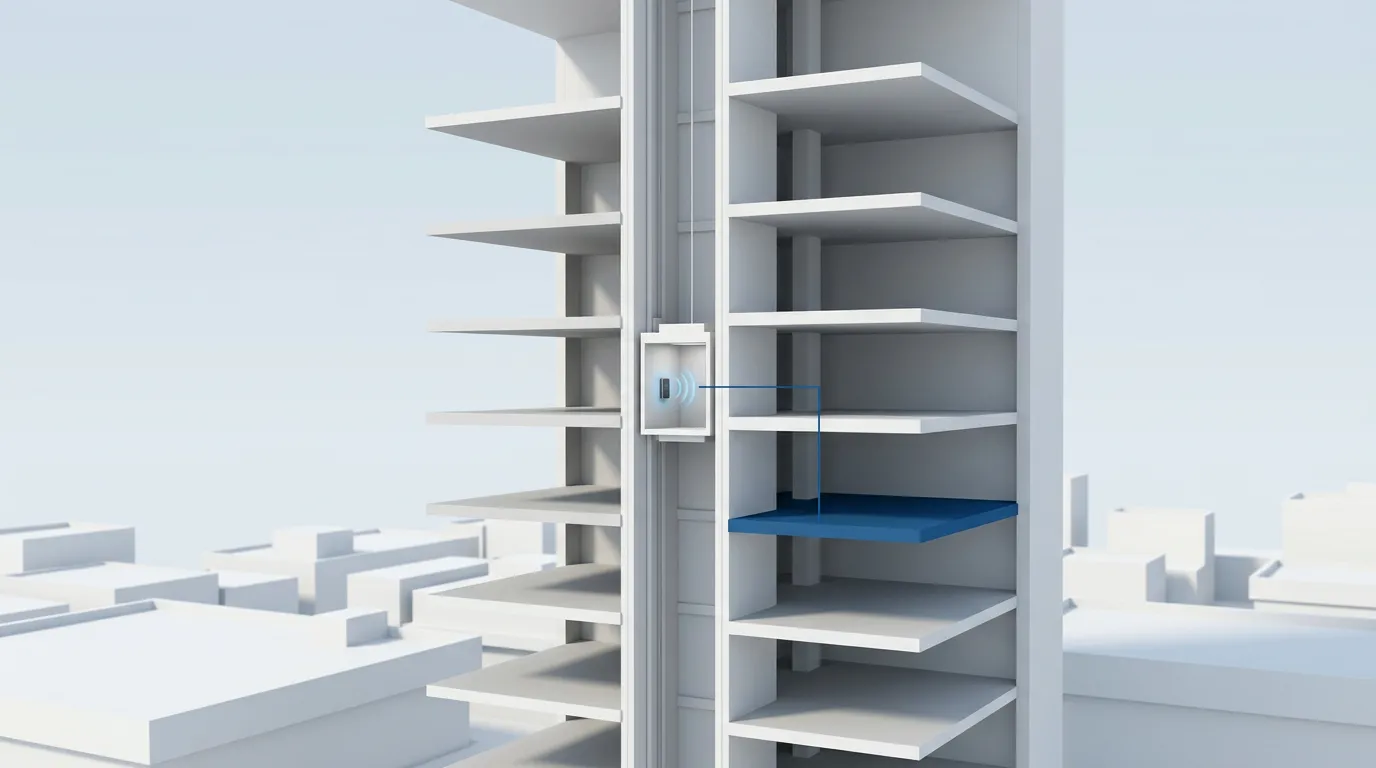
Elevator access control links a reader in the lift car or lobby to a controller wired into the lift's buttons, so each card, face or PIN releases only the floors that person may reach. Akuvox's EC33, for example, controls 32 floors from one board and up to 128 with extra boards.
In many Saudi residential towers and office buildings, anyone who reaches the lift lobby can ride to any floor. Residents notice strangers on their corridor, tenants ask why visitors walk past reception, and a guard beside the lift costs a salary every month without solving the problem after hours.
Elevator access control fixes this by deciding who can travel where, without changing how the lift itself runs. It is not the same as a smart lift: our guide to smart elevator systems covers dispatch and maintenance, while this one covers floor access.
This guide explains how the system works step by step, compares the main integration methods, and covers what Saudi owners must plan for: fire safety approval, prayer-time schedules, face data under the PDPL and local support. It ends with the mistakes that cost most to undo.
What Is Elevator Access Control?
Elevator access control is a security layer that decides which floors a person can reach by lift, by releasing only the floor buttons or lift calls their credential allows. A typical system has four parts:
- Credential reader: a card reader, keypad or face-recognition terminal in the car or the lift lobby.
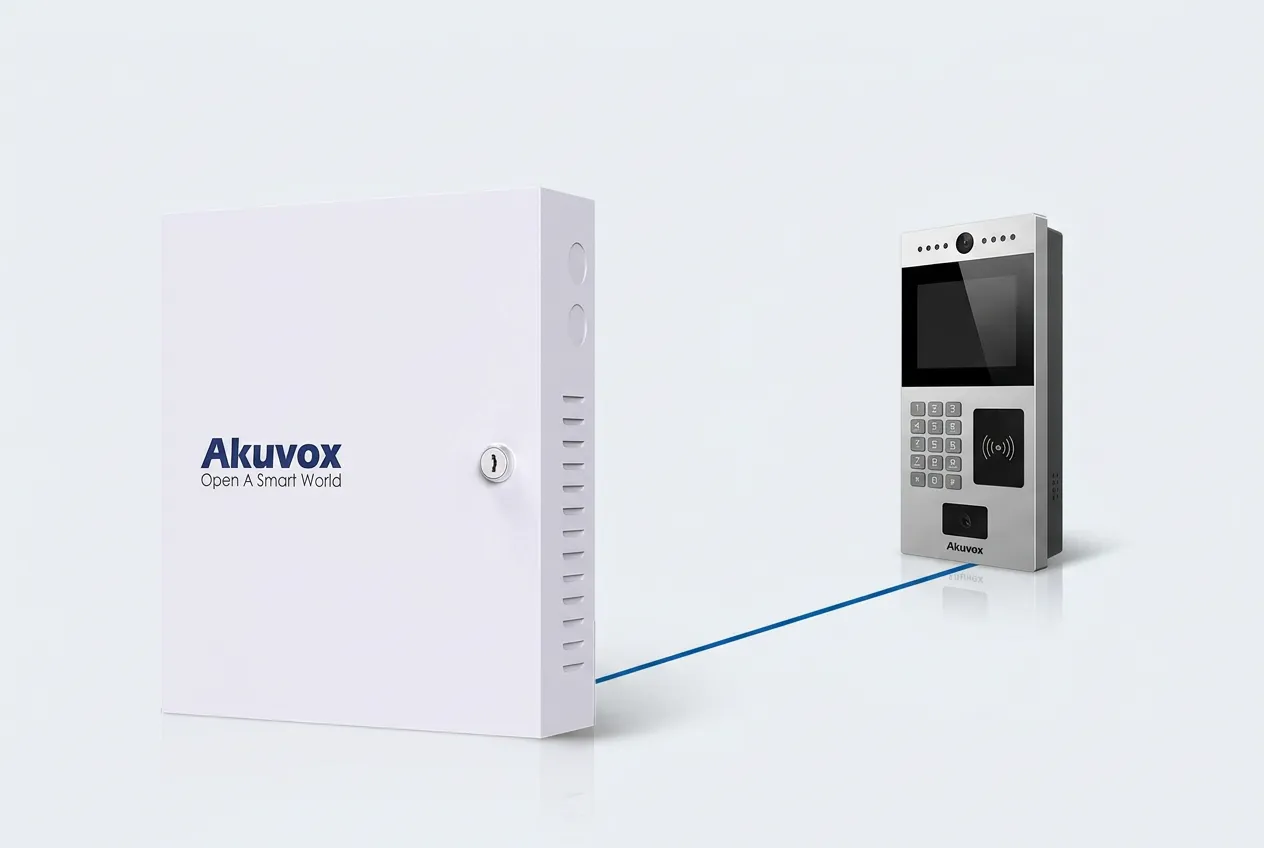
- Elevator controller: a relay board, such as the Akuvox EC33, wired into the lift's button circuits, with one relay standing for one floor.
- Management software: where the property manager sets each user's floors, schedules and visitor rules, on site or in the cloud.
- Interfaces: links to the intercom, the fire alarm panel and, in some buildings, the lift maker's own control system.
Is elevator access control the same as a smart elevator?
No. A smart elevator system decides how cars are dispatched and maintained, while elevator access control decides who may travel where, and it can be added to a conventional lift.
Does it take over the lift's safety systems?
No. The access controller only permits or blocks button presses and lift calls, while the lift's own controller still runs the doors, drive and safety circuits.
How Does Elevator Access Control Work, Step by Step?
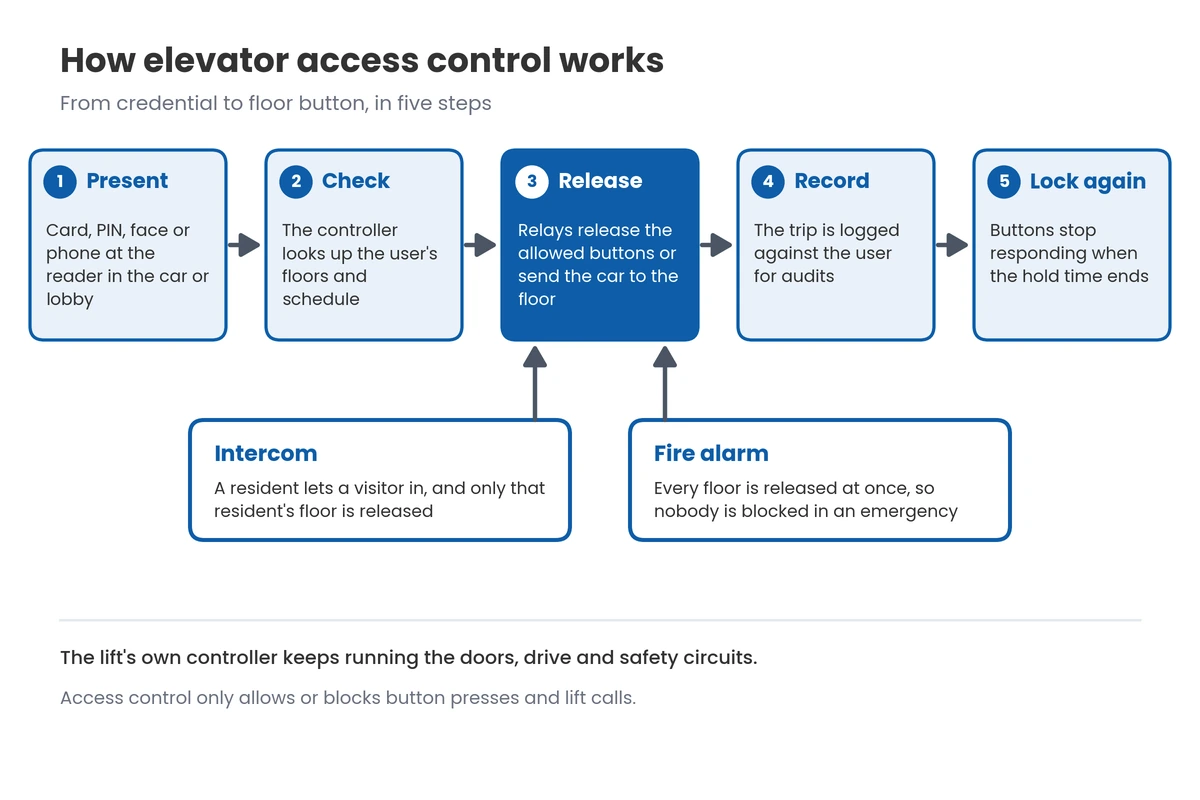
A user presents a credential, the system checks which floors that person may reach at that moment, and a relay releases the matching buttons or calls the lift. In practice it runs in five steps:
- Present a credential at the reader in the car or lobby: a card, PIN, face or phone.
- Check the rules: the controller or cloud platform looks up the user's floors and schedule.
- Release the floor: relays wired into the button circuits release the authorised buttons, or register the user's floor directly.
- Record the trip: the event is logged against the user for audits and incident reviews.
- Lock again: when the relay's hold time ends, the buttons stop responding until the next valid credential.
Should the credential send the lift straight to the floor or unlock the buttons?
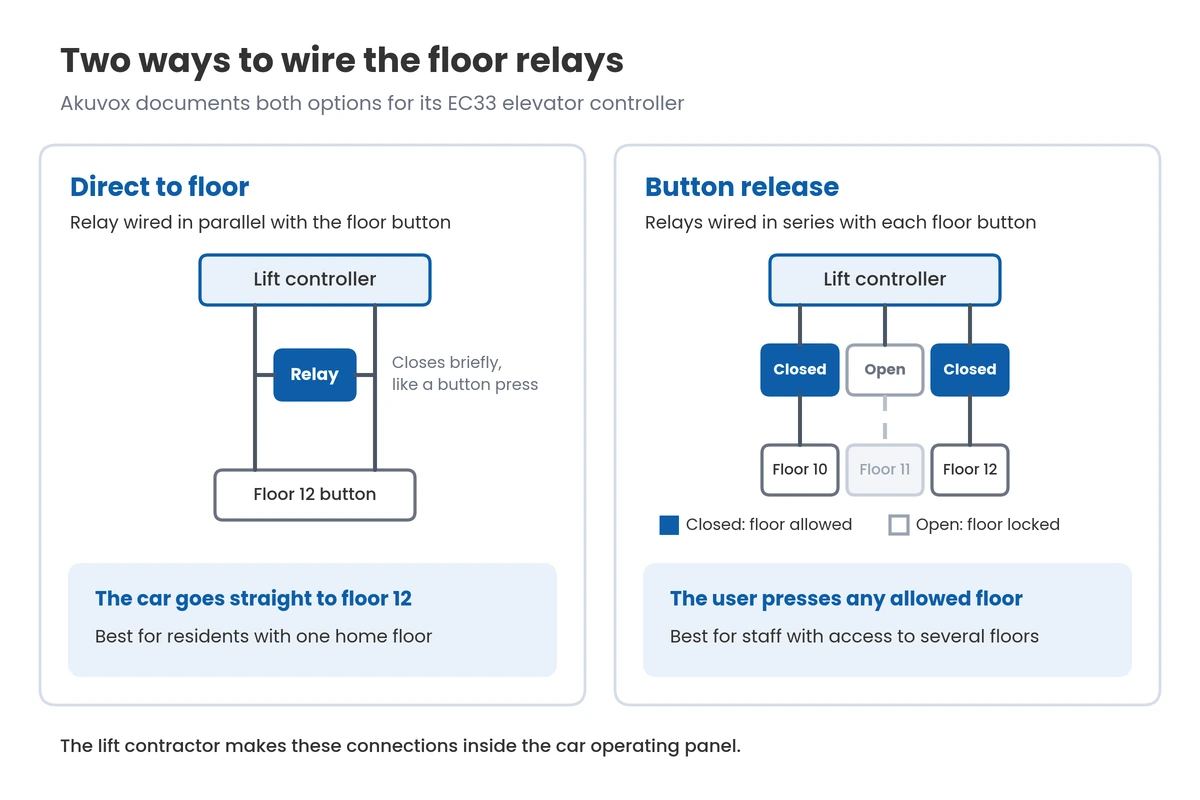
Both work, and the wiring decides which. Akuvox documents both options for the EC33: with the relay wired in parallel with a floor button, a valid credential sends the car straight to the user's floor, and with the relay wired in series with the button line, the credential releases the authorised buttons for the user to press. Direct-to-floor suits residents with one home floor, while button release suits staff who work across several floors.
What happens when a visitor arrives?
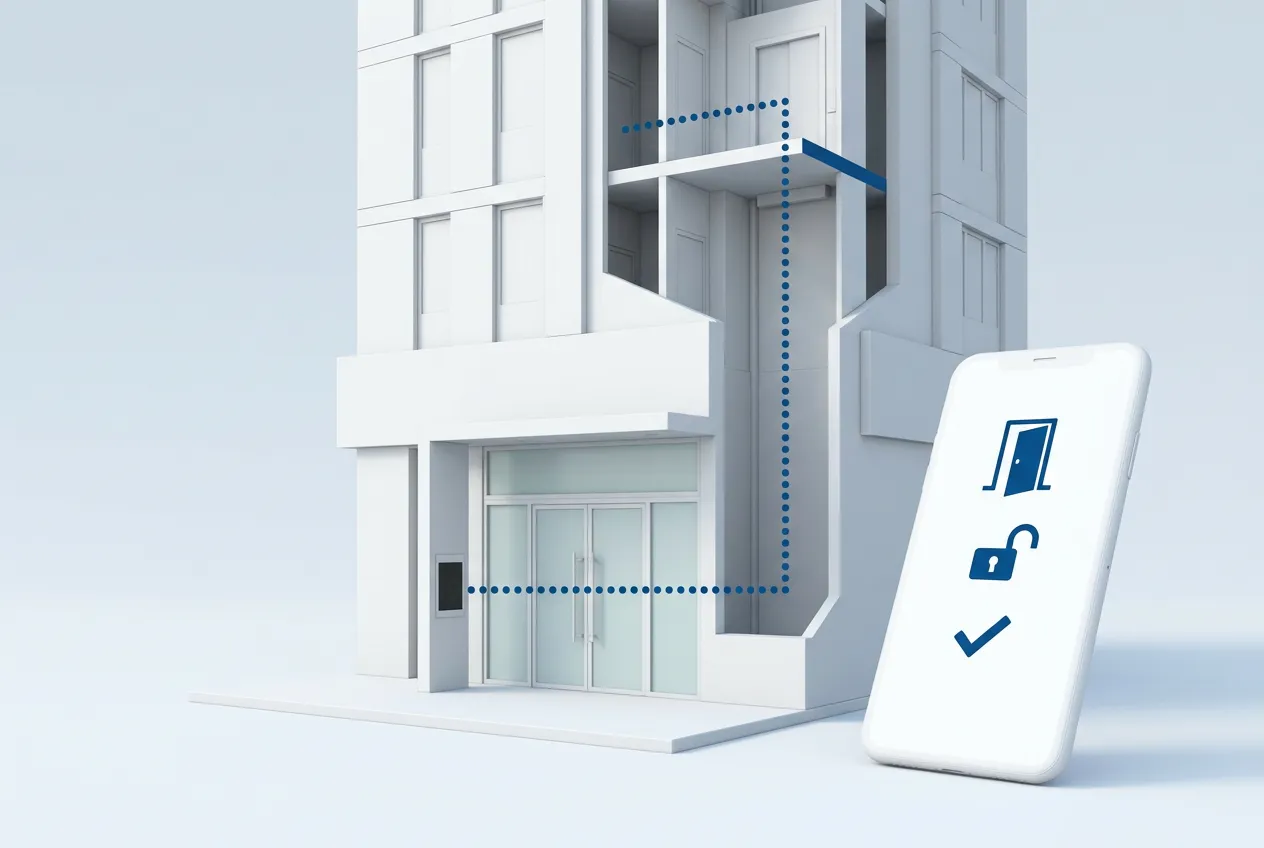
The visitor is let in by the person they came to see, and the lift serves only that floor. In an intercom-linked design, the visitor calls the resident from the door station, the resident opens the door, and the controller calls the lift to the lobby and releases only the resident's floor for the hold time. Our guide to IP video intercoms for compounds covers the door-station side; confirm that your intercom and lift controller support this sequence before you buy.
How Do You Choose an Elevator Access Control System?
Start from three questions: how many outputs you need, where the readers go, and whether the lifts already use destination dispatch. The answers decide the controller, the wiring and the lift company's role.
How many relay outputs will you need?
Count outputs, not floors: every controlled floor button in every car needs its own relay. The numbers that matter:
- Outputs needed: controlled floors × lift cars, so 24 floors across 3 cars means 72 outputs.
- Akuvox EC33: 32 floors on the main board, and up to 128 with up to four boards connected in series.
- Axis: one AXIS A9210 I/O relay module takes up to 16 AXIS A9910 expansion modules, for up to 64 relays on a single PoE cable.
- Credentials: Akuvox terminals read faces, RF cards and PINs, and phone NFC opening works on Android only.
Should the reader sit in the car, the lobby or both?
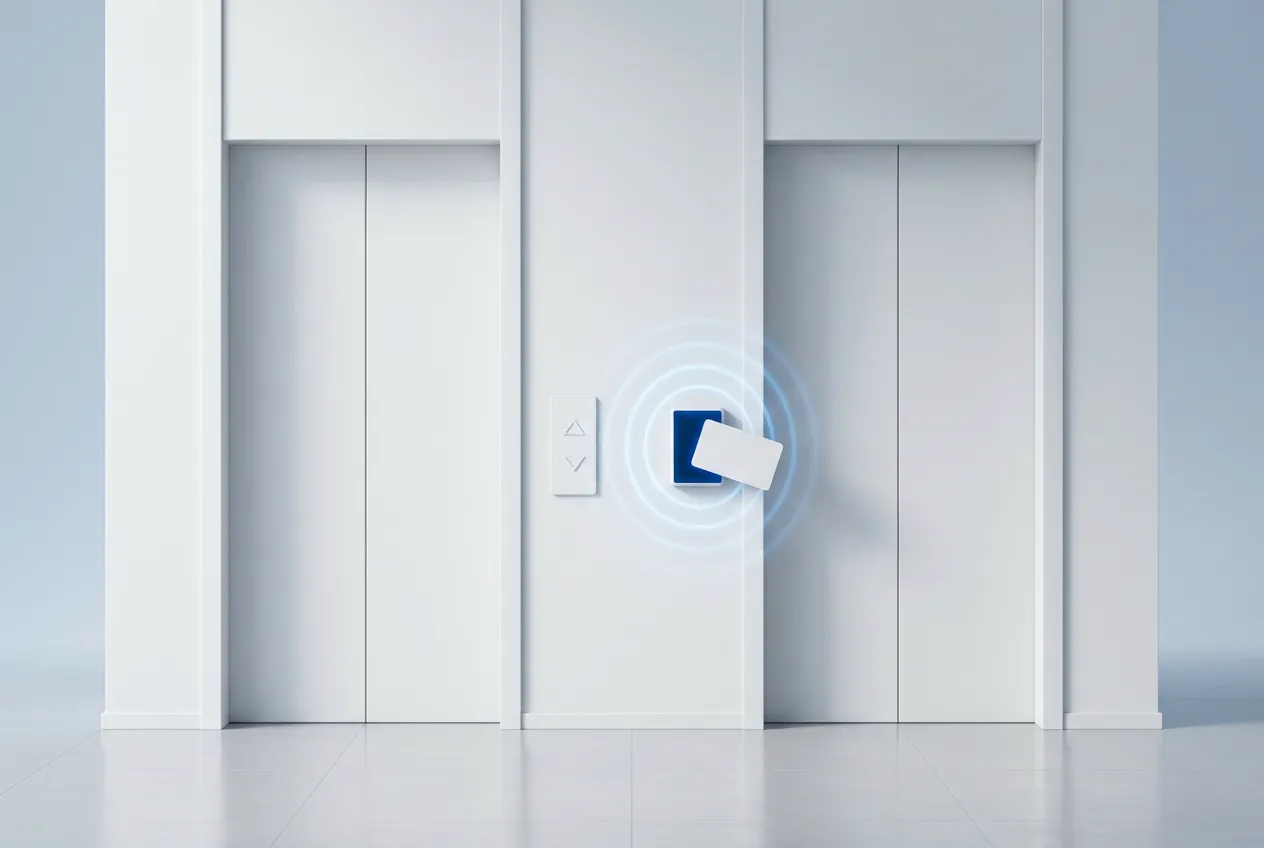
Put it in the car to control destinations, and in the lobby to control who can call a lift at all. A lobby reader beside the call buttons suits car parks and service floors, where the first job is keeping people out of the lift, while high-security buildings use both.
Relay control or the lift maker's interface?
Use relay control for conventional lifts, and a high-level interface only where the lifts run destination dispatch. Relays work with most lift brands and any access system, while a high-level interface passes each user's floors to the lift's group controller in software and depends on the lift maker's product, licence and commissioning.
Which Elevator Access Control Method Suits Your Building?
Six methods cover almost every building, from a key switch for one penthouse to a software link with destination dispatch. The table compares how they work and what each demands from the lift company.
| Method | How it works | Best for | Lift company involvement | Main limitation |
|---|---|---|---|---|
| Key switch | A key enables one restricted floor button | A penthouse or single private floor | Low: fitting the switch | Keys get copied or lost, and nothing is logged |
| Standalone card reader | Reader and relays in the car, programmed at the device | Small buildings with few users | Moderate: wiring into the car panel | Every change is made at each lift separately |
| Networked relay controller | Reader checks the user and the controller releases floors over the network | Residential towers, offices and compounds | Moderate: wiring into button circuits | One relay per floor per car, so wiring grows with height |
| Lobby call control | Reader beside the call buttons enables the lift call | Car parks, service floors, lobby screening | Moderate: wiring into call buttons | Car buttons stay open unless also controlled |
| Intercom-linked release | Resident lets a visitor in and the lift serves only that floor | Towers and compounds with frequent visitors | Moderate: same wiring as relay control | Intercom and controller must be compatible |
| High-level interface | Access system sends floors to the lift's group controller in software | New high-rise buildings with destination dispatch | High: the lift maker's interface and licence | Tied to the lift brand and newer controllers |
Key takeaway
For most Saudi residential towers and mid-size offices, a networked relay controller linked to the intercom is the practical choice, because it works with existing lifts, handles visitors and is managed from one system. Add lobby call control on car park levels, and keep key switches for a single private floor at most.
What Do Saudi Building Owners Need to Consider?
Four local factors shape the design more than any feature list: fire safety approval, prayer times and shared floors, face data under the PDPL, and who keeps the system running. Miss one and the installation fails an inspection or draws complaints.
Does elevator access control affect fire safety approval?
It can, so design the fire release before anything else. Fire protection in Saudi buildings falls under the Civil Defence Law and the fire code of the Saudi Building Code, and buildings need an electronic Civil Defence licence. Connect the fire alarm so every floor releases in an alarm (the EC33's fire alarm function switches all relays on at once), agree the lift's fire recall with the lift contractor and fire alarm designer, and include the interface in fire tests, as our article on fire safety integration in smart buildings explains.
How should prayer times and shared floors be handled?
Use schedules rather than leaving floors open. The EC33 applies schedules per relay, so a prayer room floor can open to all staff around prayer times, a gym or pool floor can follow its opening hours, and cleaners can reach service floors only during their shift; review the schedules when working hours change in Ramadan.
Can lift readers use face recognition under the PDPL?
Yes, but treat the face data carefully. The PDPL classes biometric data used to identify a person as sensitive data, so give residents and staff a clear notice, keep templates only while the access right lasts, restrict who can export them, and offer a card or PIN to anyone who prefers not to enrol.
Who keeps the system running in the Kingdom?
A local team that knows both the controller and your lift. Controllers often sit in the machine room, so check the rated operating temperature against a rooftop machine room in August, then confirm who holds spare boards and readers in Saudi Arabia and how fast they respond.
Blue Edge, a value-added technology distributor based in Dammam, supplies projects across Saudi Arabia with Akuvox elevator control, intercoms and access control terminals, including the EC33 elevator access controller, and with Axis access control, whose I/O relay modules connect Axis network door controllers to lifts for floor access. Blue Edge also provides structured cabling and networking and IT installation and configuration for the controllers, readers and door stations.
What Are the Most Common Elevator Access Control Mistakes?
The expensive mistakes are made at the wiring and planning stage, not in the software. Here they are, worst first:
- Wiring into the lift without the lift company. Work inside the car operating panel that the lift contractor has not approved can void the maintenance contract and take the lift out of service while it is redone.
- Locking the exit floors. If the lobby or car park exits need a credential, guests cannot get back down, which brings complaints on day one and a real risk in an emergency.
- Leaving the controller on a flat network with its default password. The EC33's web interface can open every floor at once, so anyone on the network who finds the login can undo the system; use a separate network segment and change the password at installation.
- Forgetting the network path to the car. A reader in the car needs power and data through the lift's travelling cable, and adding conductors after handover costs far more than specifying them at the start.
- Buying a controller that does not talk to your intercom. Separate systems mean double data entry and no visitor floor release; with Akuvox, all door phones and access control terminals except the A094 and E20 integrate with the EC33.
- Leaving visitors, cleaners and deliveries out of the plan. Residents start holding lifts for strangers, and within weeks the restrictions are switched off.
Map Every Floor Before You Choose a Controller
List every floor and every car, then mark each floor as free, restricted or scheduled. Include the basements, the lobby, the prayer room, the gym and the service floors, because these are the floors most plans forget.
Walk the building with the lift contractor. Confirm how the car operating panels are wired, whether the travelling cable has spare conductors, where the controller can sit, and how the fire alarm will signal the lifts.
Then choose the credential and the visitor flow together. Decide whether residents and staff use cards, faces or phones, and test the intercom-to-lift sequence with a real visitor before signing off.
Frequently Asked Questions
-
Can elevator access control be added to an existing lift?
Yes, in most cases. Relay-based control connects to the button circuits of conventional lifts, so it rarely needs a new lift controller. The lift contractor has to confirm the panel wiring and approve the connection, and older lifts with unusual button circuits may need an interface board from the lift maker.
-
How much does elevator access control cost?
The price depends mainly on controlled floors multiplied by cars, the reader type, whether an intercom already exists, and the lift contractor's charge for connecting the panels. Ask for a quote against a floor-by-floor list, so every relay, reader and cable run is priced before work starts.
-
Who should install elevator access control?
Three parties share the job. The security installer supplies and programmes the readers, controller and software; the lift contractor makes the connection inside the lift and signs it off; and the fire alarm contractor links the alarm so every floor releases. Agree who does what, in writing, before work starts.
-
Does elevator access control need an internet connection?
Not for day-to-day floor control. An Akuvox EC33 can run as an on-premise project, set up through its own web interface, or be managed through Akuvox's SmartPlus cloud, which needs internet access for remote changes. Either way, the controller connects over Ethernet, so plan a wired data point for it.
-
Can basement parking floors be controlled as well?
Yes. Basement floors are wired like any other floor, and the EC33 lets the floor count start from a basement level, such as -3, with a separate ground-floor setting. Restricting parking levels stops visitors wandering into the car park, while residents can still ride from their parking level to their own floor.
Sources & References
- Akuvox — Configure Access Control for EC33 Elevator Systems (two wiring scenarios, credentials, compatible devices, on-premise and cloud setup) vendor documentation
- Akuvox — EC33 device settings (relays, fire alarm function, schedules, Wiegand, RS485 expansion to 128 floors, basement floor numbering) vendor documentation
- Axis Communications — Network I/O relay modules (AXIS A9210 and AXIS A9910, elevator floor-access integration) vendor documentation
- Saudi Central Bank (SAMA) — Circular on implementing the Civil Defense Law and the Saudi Building Code fire protection requirements regulator
- Bureau of Experts at the Council of Ministers — Personal Data Protection Law (official text, Arabic) official legal text
Planning elevator access control for a tower, compound or office?
Blue Edge supplies the Akuvox EC33 elevator access controller, Akuvox intercoms and access control terminals, and Axis access control, with structured cabling and installation for the lift lobby and machine room.
Call or WhatsApp +966 53 9855 188, contact the Blue Edge team, or see the Akuvox range in Saudi Arabia.
About Blue Edge
Blue Edge Company is a value-added technology distributor based in Dammam, Saudi Arabia, supplying interactive displays, smart building systems, networking infrastructure and IT security software to businesses and residential projects across the Kingdom, with installation and technical support.
Learn more about Blue Edge →Published 29 September 2026 • Last updated 3 October 2026 • This article is reviewed when standards, regulations or product guidance change.