Shopping Cart


- Articles
- Smart Buildings
- Fire Safety Integration in Modern Smart Buildings
Fire Safety Integration in Modern Smart Buildings
Learn how integrated fire safety systems improve emergency response, enhance occupant safety, support compliance, and strengthen smart building operations.
By Blue Edge Team | Published Jun 17, 2026 | Updated Sep 23, 2026 | 6 min read
Quick answer
Modern smart buildings integrate fire safety through interconnected detection systems, AI-driven analytics, building automation protocols, and real-time emergency response tools. This integration reduces response times, improves evacuation efficiency, and ensures regulatory compliance—making fire safety smarter, faster, and more reliable than traditional standalone systems.
Fire safety has always been a non-negotiable priority in building design. But as buildings grow smarter—equipped with IoT sensors, building management systems (BMS), and automated controls—fire safety is evolving alongside them.
Traditional fire detection systems operate in isolation. Smart buildings demand something more cohesive: a unified ecosystem where fire safety communicates directly with HVAC, lighting, access control, and emergency systems. The result is faster detection, coordinated response, and significantly reduced risk to occupants and assets.
This post breaks down exactly how fire safety integration works in modern smart buildings, what technologies are driving it, and what facility managers and building owners need to know.
How Does Fire Safety Integrate with Smart Building Systems?
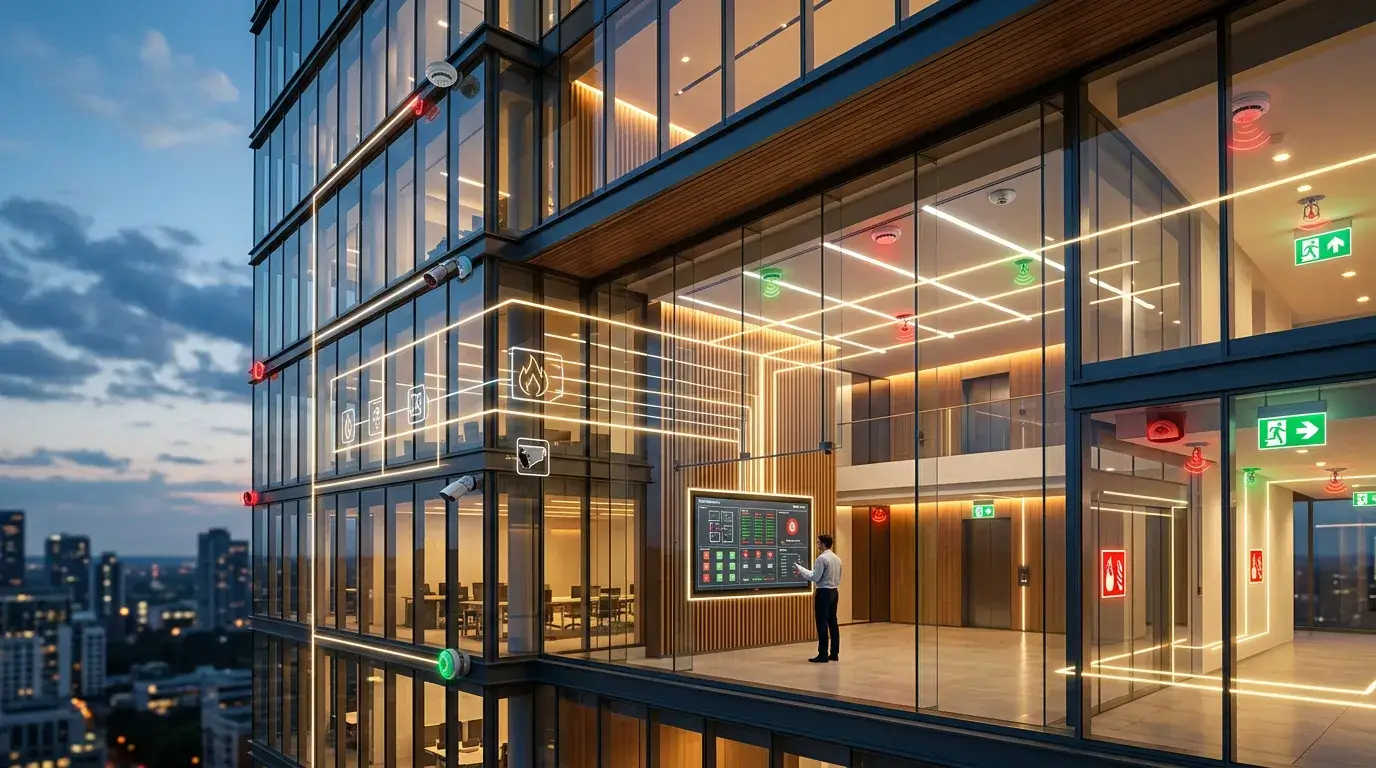
Smart building integration connects fire safety infrastructure to a centralized building management system. Rather than triggering an alarm in isolation, a fire event activates a coordinated chain of automated responses across multiple systems simultaneously.
Key integration points include:
- HVAC control: Ventilation systems shut down or switch to smoke extraction mode to prevent fire spread through ductwork.
- Access control: Emergency exits unlock automatically; elevators return to ground level and go offline.
- Lighting systems: Emergency lighting and directional indicators activate along evacuation routes.
- Communication systems: PA systems broadcast evacuation instructions; alerts push to mobile devices and security dashboards in real time.
This level of coordination is only possible when fire safety systems are built on open communication protocols—such as BACnet, Modbus, or KNX—that allow seamless data exchange across platforms.
What Technologies Power Smart Fire Detection Today?
AI-Enhanced Detection Sensors
Modern fire detection has moved well beyond basic smoke detectors. Multi-criteria detectors now analyze combinations of smoke density, heat rate-of-rise, carbon monoxide levels, and optical signals simultaneously. AI algorithms process this data to distinguish actual fire conditions from false alarms—a critical capability in environments like commercial kitchens, manufacturing floors, or server rooms.
IoT-Connected Devices
IoT-enabled detectors transmit continuous status data to the BMS, enabling predictive maintenance. Rather than discovering a faulty sensor during an emergency, facility managers receive alerts when device performance degrades—before it becomes a liability.
Video Smoke Detection (VSD)
Camera-based detection systems use image processing algorithms to identify smoke or flame patterns visually. VSD performs exceptionally well in high-ceiling spaces—warehouses, atriums, and industrial facilities—where conventional point detectors may respond too slowly.
Wireless Fire Alarm Systems
Wireless technology eliminates the installation complexity of traditional hardwired systems, making it practical for retrofitting fire safety integration into existing buildings without structural modifications.
Why Does Integrated Fire Safety Improve Emergency Response?
Speed and accuracy are the two variables that determine outcomes in a fire emergency. Integrated systems address both.
Faster detection comes from multi-sensor data fusion—where several detection inputs are analyzed together rather than independently. This reduces the time between ignition and alarm activation.
Smarter response comes from automation. When a fire is confirmed, the BMS executes pre-programmed emergency scenarios instantly—no manual intervention required. HVAC dampers close, evacuation routes illuminate, and security personnel receive precise location data within seconds.
Reduced false alarms matter more than most building managers realize. According to fire safety research, false alarms account for the majority of fire service call-outs in commercial buildings. AI-driven verification significantly reduces unnecessary evacuations, which disrupt operations and erode occupant trust in the system.
What Are the Compliance Requirements for Smart Fire Safety Integration?
Integrated fire safety systems must meet recognized standards regardless of their technological sophistication. Compliance is not optional—and smart system design must account for regulatory requirements from the outset.
Relevant standards include:
- NFPA 72 (National Fire Alarm and Signaling Code) – governs installation, testing, and maintenance of fire alarm systems in the United States.
- EN 54 – the European standard for fire detection and fire alarm systems.
- IEC 60364 – addresses electrical installations in buildings, including emergency systems.
- Local building codes – vary by jurisdiction and must be verified during system design.
Integration with third-party systems—such as BMS or security platforms—must not compromise the integrity or independence of the fire alarm system. Many standards require that fire safety systems maintain standalone functionality even if the broader network fails.
What Challenges Come with Fire Safety Integration in Smart Buildings?
Cybersecurity Vulnerabilities
Connecting fire safety systems to networked infrastructure introduces cybersecurity risk. A compromised BMS could theoretically interfere with fire system responses. Robust network segmentation, encrypted communication, and regular security audits are essential when integrating fire safety into smart building ecosystems.
Interoperability Between Legacy and Modern Systems
Many existing buildings use fire alarm panels that predate modern open-protocol standards. Integrating these with contemporary BMS platforms often requires middleware gateways or full system replacement—both of which carry cost and planning implications.
System Complexity and Maintenance
Greater integration means greater interdependency. When one system requires maintenance, it may affect others. Facilities teams need specialized training to manage integrated environments, and maintenance schedules must account for all connected components.
Best Practices for Implementing Fire Safety Integration
- Design for interoperability from the start. Specify open-protocol systems (BACnet, KNX) to ensure compatibility across vendors and future upgrades.
- Conduct regular integrated testing. Test fire safety responses across all connected systems—not just the alarm panel—to verify coordinated behavior under emergency conditions.
- Segment your network. Isolate fire safety systems on a dedicated network segment to limit exposure to broader IT vulnerabilities.
- Train facility teams comprehensively. Staff responsible for building operations must understand how integrated systems behave during an emergency, not just under normal conditions.
- Document all integrations. Maintain accurate, up-to-date records of all system connections, protocols, and configurations for compliance audits and emergency planning.
The Future of Fire Safety in Smart Buildings
The trajectory is clear: fire safety systems will become increasingly predictive rather than reactive. Digital twin technology—virtual replicas of physical buildings—will allow fire scenarios to be modeled and tested before they occur. Machine learning will refine detection accuracy over time as systems accumulate more event data. And as 5G connectivity expands, real-time communication between building systems and emergency services will become faster and more reliable.
Buildings that invest in properly integrated fire safety today are better positioned to adopt these advancements as they mature—without costly infrastructure overhauls.
Frequently Asked Questions
-
What is fire safety integration in smart buildings?
Fire safety integration connects fire detection and alarm systems to a building's broader automation infrastructure—including HVAC, lighting, access control, and communications—so that a fire event triggers a coordinated, automated emergency response across all systems simultaneously.
-
How does AI improve fire detection accuracy?
AI algorithms analyze data from multiple sensors in combination—smoke, heat, gas, and optical inputs—to verify fire conditions before triggering an alarm. This significantly reduces false alarm rates while improving detection speed.
-
Can fire safety systems be integrated into existing buildings?
Yes. Wireless fire alarm systems and protocol gateways make integration feasible in retrofit scenarios. However, older panels using proprietary protocols may require replacement or middleware solutions to achieve full integration.
-
What cybersecurity risks apply to integrated fire safety systems?
Connecting fire systems to networked infrastructure creates potential attack surfaces. Risks are mitigated through network segmentation, encrypted data transmission, access controls, and regular security audits.
-
Which standards govern integrated fire safety systems?
Key standards include NFPA 72 (US), EN 54 (Europe), and IEC 60364. Local building codes also apply and vary by jurisdiction. Standards require that fire alarm systems maintain standalone functionality independent of other integrated systems.
-
How often should integrated fire safety systems be tested?
Testing schedules depend on local regulations and manufacturer recommendations. Integrated systems should undergo coordinated functional testing—verifying responses across all connected systems—at least annually, in addition to routine device-level inspections.
Take the Next Step Toward Smarter Fire Safety
Integrating fire safety into a modern smart building system requires precise planning, the right technology partners, and a clear understanding of both technical and regulatory requirements.
If your facility is ready to move beyond standalone fire systems, our team can help. We design and implement fully integrated fire safety solutions tailored to your building's infrastructure—ensuring compliance, reliability, and performance when it matters most.
About Blue Edge
Blue Edge Company is a value-added technology distributor based in Dammam, Saudi Arabia, supplying interactive displays, smart building systems, networking infrastructure and IT security software to businesses and residential projects across the Kingdom, with installation and technical support.
Learn more about Blue Edge →Published 17 June 2026 • Last updated 23 September 2026 • This article is reviewed when standards, regulations or product guidance change.