Shopping Cart


- Articles
- IoT Solutions
- IoT Device Lifecycle Management: The Complete Guide
IoT Device Lifecycle Management: The Complete Guide
Learn how IoT device lifecycle management helps businesses securely deploy, monitor, maintain, update, and retire connected devices while improving performance and reducing operational costs.
By Blue Edge Team | Published Aug 11, 2026 | Updated Sep 23, 2026 | 10 min read
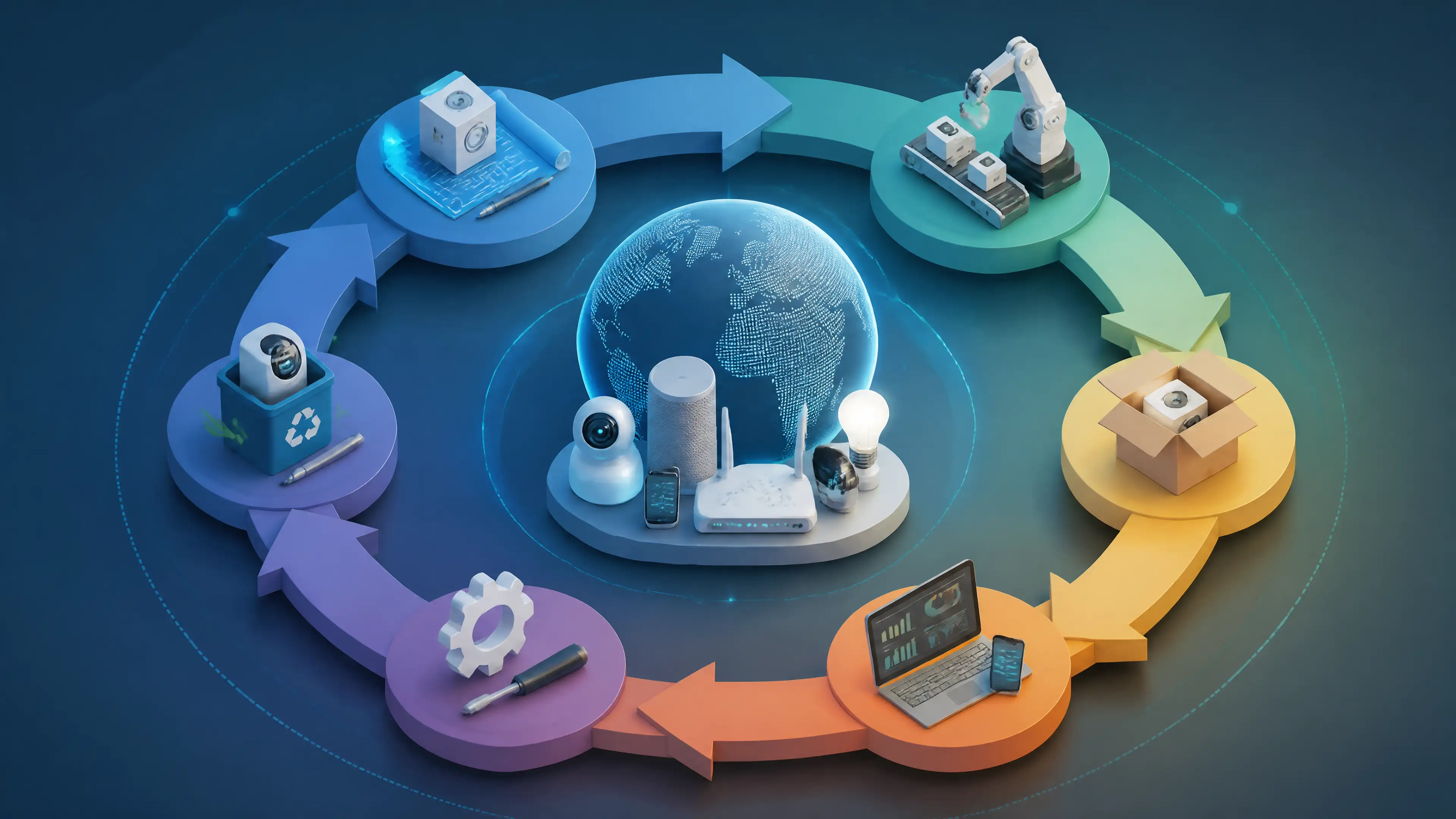
IoT device lifecycle management covers every phase of a connected device's life—from initial deployment to final retirement. Organizations that implement structured lifecycle management reduce security vulnerabilities, cut operational costs, and extend device performance across large-scale IoT deployments.
Managing a single smart device is straightforward. Managing thousands of them—spread across multiple locations, running different firmware versions, and communicating over varied network protocols—is an entirely different challenge.
IoT device lifecycle management is the structured process of overseeing connected devices from the moment they are provisioned to the moment they are decommissioned. Without a clear framework in place, organizations risk accumulating outdated firmware, unpatched security vulnerabilities, and orphaned devices that quietly drain resources while creating compliance exposure.
The scale of this challenge is growing rapidly. According to Statista, the number of connected IoT devices worldwide is projected to exceed 29 billion by 2030. Each of those devices requires provisioning, monitoring, updating, and eventually retiring. For IT teams, network administrators, and technology decision-makers, the question is no longer whether lifecycle management matters—it is how to do it well.
This guide breaks down every phase of the IoT device lifecycle, compares the key tools and approaches available, and offers actionable guidance for building a management framework that scales with your organization.
What Are the Stages of the IoT Device Lifecycle?
IoT device lifecycle management is typically organized into five distinct phases. Each phase presents its own technical requirements and operational decisions.
Phase 1: Planning and Procurement
Before a single device is powered on, organizations must define the use case, evaluate hardware options, and establish procurement standards. This phase involves selecting devices that align with long-term connectivity requirements, security standards, and vendor support commitments.
Key considerations at this stage include:
- Compatibility with existing network infrastructure and protocols (e.g., MQTT, CoAP, Zigbee, LTE-M)
- Vendor longevity and the availability of long-term firmware support
- Security certifications such as IEC 62443 or FIPS 140-2 compliance
- Total cost of ownership, accounting for maintenance, updates, and eventual replacement
Decisions made during procurement have a compounding effect on every subsequent phase. A device selected without a clear end-of-life (EOL) policy from the vendor can become a costly liability within three to five years.
Phase 2: Deployment and Provisioning
Deployment involves physically installing devices and configuring them for secure network access. Provisioning—the process of registering a device with a management platform and assigning credentials—is the most security-sensitive step in the entire lifecycle.
Best practices for secure provisioning include:
- Assigning unique device identities using X.509 certificates or hardware-based attestation
- Implementing zero-touch provisioning (ZTP) for large-scale deployments to reduce human error
- Enforcing network segmentation to isolate IoT devices from critical business systems
- Disabling default credentials before any device goes live
A poorly provisioned device is a persistent attack vector. According to the ENISA Threat Landscape for IoT report, weak authentication and insecure default configurations remain among the most exploited vulnerabilities in connected device deployments.
Phase 3: Operations and Monitoring
Once deployed, devices enter their longest lifecycle phase—active operation. This is where ongoing monitoring, performance management, and security oversight become daily responsibilities.
Effective operational management includes:
- Real-time telemetry monitoring to detect anomalies in device behavior or network traffic
- Automated alerting for connectivity loss, threshold breaches, or unexpected reboots
- Asset inventory management to maintain an accurate, up-to-date register of all active devices
- Remote diagnostics to troubleshoot issues without requiring physical site visits
The operational phase is also where the gap between managed and unmanaged IoT environments becomes most visible. Organizations using centralized IoT management platforms consistently report faster incident response times and lower mean time to repair (MTTR) compared to those relying on manual oversight.
Phase 4: Maintenance and Updates
Firmware updates, security patches, and configuration changes must be delivered reliably and at scale. This phase is where many organizations encounter the most operational friction—particularly in environments with thousands of heterogeneous devices.
A structured update management strategy should address:
- Over-the-air (OTA) update capabilities to push firmware changes without physical access
- Staged rollouts that test updates on a subset of devices before full deployment
- Rollback mechanisms to revert to previous firmware versions if an update causes instability
- Patch prioritization based on CVE severity ratings and device criticality
Delaying security patches is one of the most common and consequential failures in IoT lifecycle management. The 2023 Armis State of Cyberwarfare report found that unpatched firmware was a contributing factor in the majority of OT and IoT-related security incidents analyzed.
Phase 5: Retirement and Decommissioning
Every device has a fixed operational lifespan. When a device reaches end-of-life—whether due to hardware failure, vendor EOL, or security obsolescence—it must be decommissioned in a structured and secure manner.
Proper decommissioning includes:
- Revoking device credentials and removing it from identity management systems
- Wiping stored data to prevent unauthorized access to sensitive information
- Updating asset inventories to reflect the removal
- Disposing of hardware in compliance with e-waste regulations (e.g., WEEE Directive in the EU)
Skipping any of these steps leaves residual risk. A decommissioned device that retains valid credentials or stored credentials is a potential re-entry point for threat actors—even after it has been physically removed from service.
IoT Lifecycle Management Platform Comparison
Selecting the right platform is central to executing lifecycle management at scale. The table below compares six leading IoT device management platforms across key capability areas.
| Feature | AWS IoT Device Management | Azure IoT Hub | Google Cloud IoT Core | IBM Watson IoT | Particle IoT | Losant |
|---|---|---|---|---|---|---|
| OTA Firmware Updates | ✅ Yes | ✅ Yes | ✅ Yes | ✅ Yes | ✅ Yes | ✅ Yes |
| Zero-Touch Provisioning | ✅ Yes | ✅ Yes | ❌ No | ⚠️ Limited | ✅ Yes | ❌ No |
| Device Shadowing / Twin | ✅ Yes | ✅ Yes | ✅ Yes | ✅ Yes | ❌ No | ✅ Yes |
| Multi-Protocol Support | ✅ MQTT, HTTP | ✅ MQTT, AMQP, HTTP | ✅ MQTT, HTTP | ✅ MQTT, HTTP | ⚠️ Proprietary | ✅ MQTT, HTTP |
| Real-Time Monitoring | ✅ Yes | ✅ Yes | ✅ Yes | ✅ Yes | ✅ Yes | ✅ Yes |
| Edge Computing Support | ✅ AWS Greengrass | ✅ Azure IoT Edge | ✅ Yes | ⚠️ Limited | ❌ No | ⚠️ Limited |
| Built-In Security Features | ✅ Advanced | ✅ Advanced | ✅ Advanced | ✅ Advanced | ⚠️ Basic | ⚠️ Basic |
| Scalability | Enterprise | Enterprise | Enterprise | Enterprise | Mid-market | SMB–Mid-market |
| Pricing Model | Pay-as-you-go | Pay-as-you-go | Pay-as-you-go | Custom | Subscription | Subscription |
| Best Suited For | AWS-integrated enterprises | Microsoft ecosystem users | Google Cloud users | Regulated industries | Hardware startups | Smaller IoT deployments |
How to choose: AWS IoT Device Management suits organizations already operating within the AWS ecosystem and requiring enterprise-grade scalability. Azure IoT Hub is the logical choice for Microsoft-centric environments. Particle IoT offers an accessible entry point for hardware-focused teams building connected products at mid-scale. For smaller deployments where simplicity outweighs raw capability, Losant provides a lower-complexity alternative.
What Are the Biggest Challenges in IoT Device Lifecycle Management?
Managing Device Heterogeneity at Scale
Most enterprise IoT environments contain devices from multiple manufacturers, running different operating systems, and communicating over different protocols. Achieving centralized visibility across this landscape requires either a platform with broad protocol support or a middleware layer that normalizes data before it reaches the management system.
Balancing Security with Operational Continuity
Applying firmware updates introduces a window of risk. In critical operational environments—manufacturing floors, healthcare facilities, or utility infrastructure—taking devices offline for updates may not be operationally acceptable. Staged rollouts and blue-green deployment strategies help minimize disruption while maintaining patch currency.
Shadow IoT and Inventory Gaps
Shadow IoT refers to devices connected to an organization's network without formal registration or oversight. These devices are invisible to management platforms and represent unmonitored attack surfaces. Regular network scanning using tools such as Nmap, Forescout, or Armis can surface unauthorized devices before they become a liability.
Regulatory Compliance Across Jurisdictions
Organizations operating across multiple regions must navigate a growing body of IoT-specific regulation, including the EU Cyber Resilience Act, the UK Product Security and Telecommunications Infrastructure (PSTI) Act, and NIST's IoT cybersecurity guidance (NISTIR 8259). Lifecycle management documentation—particularly around update delivery and decommissioning—is increasingly required for compliance audits.
Key Metrics for Measuring IoT Lifecycle Management Effectiveness
A lifecycle management framework is only as strong as the visibility it provides. The following metrics offer a structured basis for evaluating program performance:
| Metric | Description | Target Benchmark |
|---|---|---|
| Firmware Currency Rate | % of devices running the latest approved firmware | ≥ 95% |
| Mean Time to Patch (MTTP) | Average time from patch release to full deployment | ≤ 30 days for critical patches |
| Device Availability | % uptime across monitored device fleet | ≥ 99.5% |
| Provisioning Lead Time | Time from device receipt to live deployment | ≤ 24 hours (with ZTP) |
| Decommissioning Compliance Rate | % of retired devices processed per policy | 100% |
| Unregistered Device Detection Rate | Rate at which shadow IoT devices are identified | Reviewed monthly |
Tracking these metrics over time enables IT and operations teams to identify systemic weaknesses, justify investment in lifecycle tooling, and demonstrate compliance posture to auditors and stakeholders.
How to Build an IoT Lifecycle Management Framework: A Practical Roadmap
Building a structured lifecycle management program does not require replacing existing infrastructure overnight. A phased approach allows organizations to establish foundational capabilities before scaling complexity.
Step 1 — Establish complete device inventory. Use network discovery tools to identify and catalog every connected device, including manufacturer, model, firmware version, and network location. No lifecycle management program is effective without an accurate asset register.
Step 2 — Define lifecycle policies for each device category. Establish documented policies covering provisioning standards, update cadence, monitoring requirements, and decommissioning procedures for each device class in your environment.
Step 3 — Select and integrate a centralized management platform. Choose a platform that aligns with your existing cloud infrastructure, protocol requirements, and scale. Prioritize platforms that support OTA updates, automated alerting, and device identity management.
Step 4 — Automate provisioning and update workflows. Reduce manual touchpoints through zero-touch provisioning and automated patch deployment pipelines. Automation reduces human error and accelerates response to critical security patches.
Step 5 — Implement continuous monitoring with defined escalation paths. Configure alerting thresholds and define clear escalation procedures for anomalies. Ensure that monitoring coverage includes both connectivity metrics and security telemetry.
Step 6 — Schedule regular lifecycle reviews. Conduct quarterly reviews of device fleet health, firmware currency, and EOL exposure. Use these reviews to plan ahead for device refresh cycles and emerging compliance requirements.
The Long-Term Value of Getting Lifecycle Management Right
IoT device lifecycle management is not a one-time implementation project—it is an ongoing operational discipline. Organizations that treat it as a continuous program rather than a deployment checklist gain compounding advantages: lower incident rates, reduced operational costs, longer device service life, and stronger compliance posture.
The cost of neglect compounds just as quickly. An unpatched device becomes a compromised device. An untracked device becomes a shadow asset. A device retired without proper credential revocation becomes a persistent vulnerability.
The most resilient IoT environments are built on a simple principle: every device is accounted for, every phase is managed, and nothing is left to chance.
As IoT deployments scale and regulatory expectations increase, the organizations best positioned for long-term success will be those that establish structured lifecycle management practices now—before the complexity of their device fleets outpaces their ability to manage them.
Frequently Asked Questions
-
What is IoT device lifecycle management?
IoT device lifecycle management is the end-to-end process of overseeing connected devices across all phases of their operational life, including planning, deployment, provisioning, monitoring, maintenance, and decommissioning. The goal is to maintain device security, performance, and compliance throughout each phase.
-
Why is firmware update management critical in IoT lifecycle management?
Unpatched firmware is one of the most common entry points for cyberattacks targeting IoT environments. Regular firmware updates close known vulnerabilities, maintain protocol compatibility, and ensure devices continue to meet security standards. Delayed patching significantly increases the risk of exploitation, particularly for devices exposed to public networks.
-
How does zero-touch provisioning improve IoT deployment efficiency?
Zero-touch provisioning (ZTP) automates the configuration and registration of devices upon first network connection, eliminating manual setup steps. This reduces provisioning time, minimizes the risk of configuration errors, and is particularly valuable in large-scale deployments where manual configuration of hundreds or thousands of devices is not operationally feasible.
-
What is shadow IoT and why does it pose a security risk?
Shadow IoT refers to connected devices operating on an organization's network without official registration or oversight. Because these devices are invisible to management platforms, they receive no firmware updates, generate no monitored telemetry, and represent uncontrolled attack surfaces. Regular network scanning is the primary method for detecting and remediating shadow IoT exposure.
-
When should an IoT device be decommissioned?
An IoT device should be decommissioned when it reaches vendor end-of-life (meaning security patches are no longer available), when it can no longer be updated to meet current security standards, or when it is replaced by a newer model. Decommissioning should always include credential revocation, data wiping, and asset register updates to prevent residual security exposure.
Ready to Strengthen Your IoT Device Management Program?
Whether you are deploying your first connected device fleet or managing thousands of assets across multiple sites, a structured lifecycle management approach is the foundation of a secure and scalable IoT environment.
Contact our team today to discuss how the right combination of platforms, policies, and expertise can help your organization manage IoT devices with confidence—from initial deployment through to responsible retirement.
About Blue Edge
Blue Edge Company is a value-added technology distributor based in Dammam, Saudi Arabia, supplying interactive displays, smart building systems, networking infrastructure and IT security software to businesses and residential projects across the Kingdom, with installation and technical support.
Learn more about Blue Edge →Published 11 August 2026 • Last updated 23 September 2026 • This article is reviewed when standards, regulations or product guidance change.