Shopping Cart


- Articles
- IoT Solutions
- Smart Irrigation and Landscape Control for Compounds
Smart Irrigation and Landscape Control for Compounds
Smart irrigation for Saudi compounds: ET and soil moisture control, hydrozoning, leak detection by flow, and why salt leaching still needs extra water.
By Blue Edge Team | Published Sep 07, 2026 | Updated Oct 03, 2026 | 13 min read
Quick answer
A smart irrigation system is a landscape watering system that adjusts run times automatically from measured conditions such as weather, evapotranspiration and soil moisture, instead of running a fixed timer schedule. In Saudi Arabia it must still apply a deliberate leaching fraction, because eliminating all excess water allows salts to accumulate in the root zone.
The largest water loss on most compounds is not inefficient scheduling. It is a broken lateral running unnoticed on a night cycle, or a stuck valve irrigating the same bed for three weeks while the landscape team works elsewhere on the site.
Smart controllers are sold on watering less. They earn far more of their money by noticing when something has failed, and by stopping it within minutes rather than at the next inspection.
This guide covers how smart controllers actually decide when to water, how a compound should be zoned, how flow monitoring finds leaks, the wiring and connectivity a large site needs, and the water quality and salinity realities that make Saudi landscape irrigation different from the international default.
What Is a Smart Irrigation System?
A smart irrigation system is a landscape watering system that adjusts run times and schedules automatically based on measured conditions rather than a fixed clock. The controller decides how long each zone runs from data about weather, plant demand, soil condition and system performance.
A compound-scale installation contains:
- A central controller, or several satellite controllers reporting to a central platform
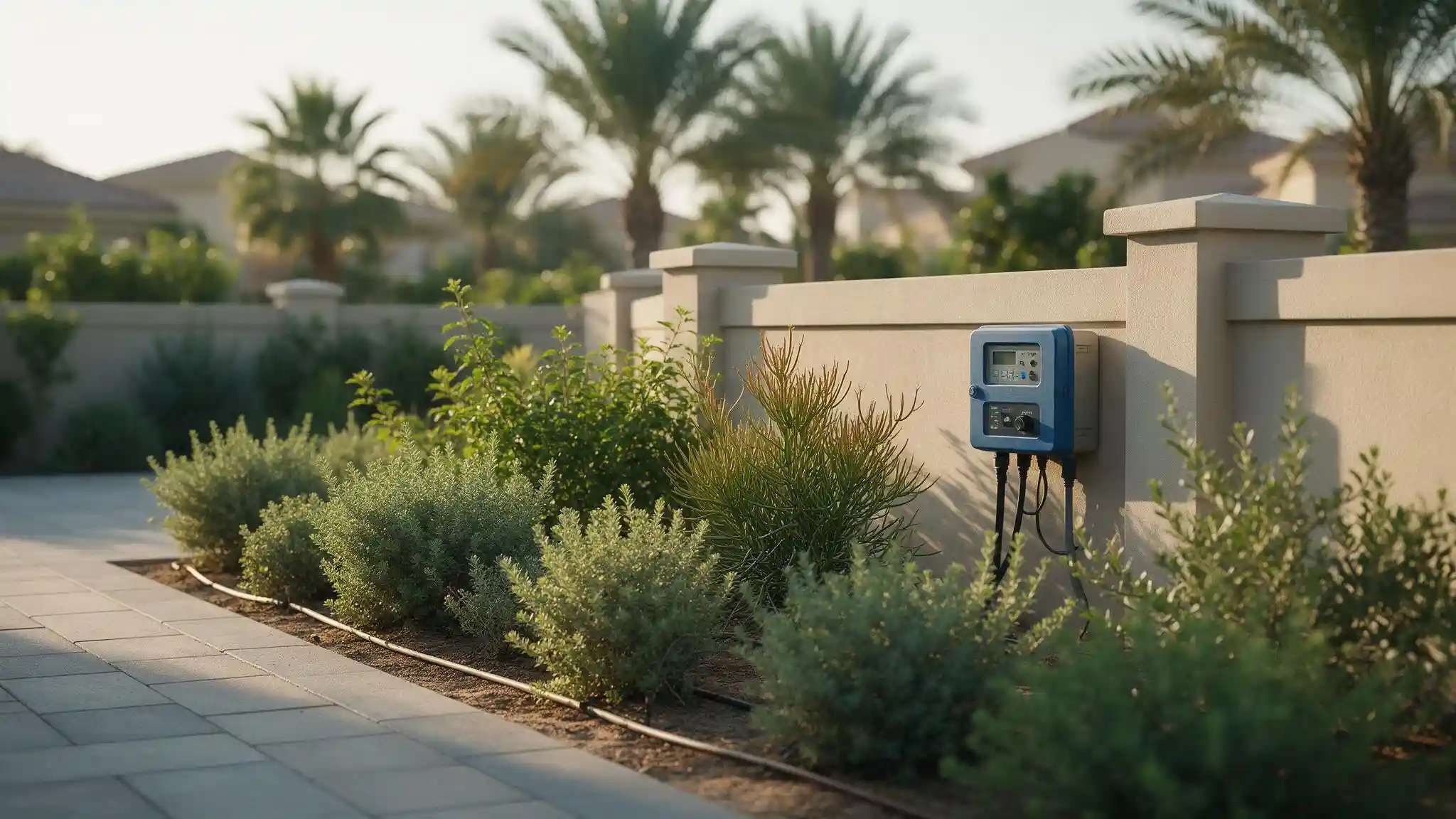
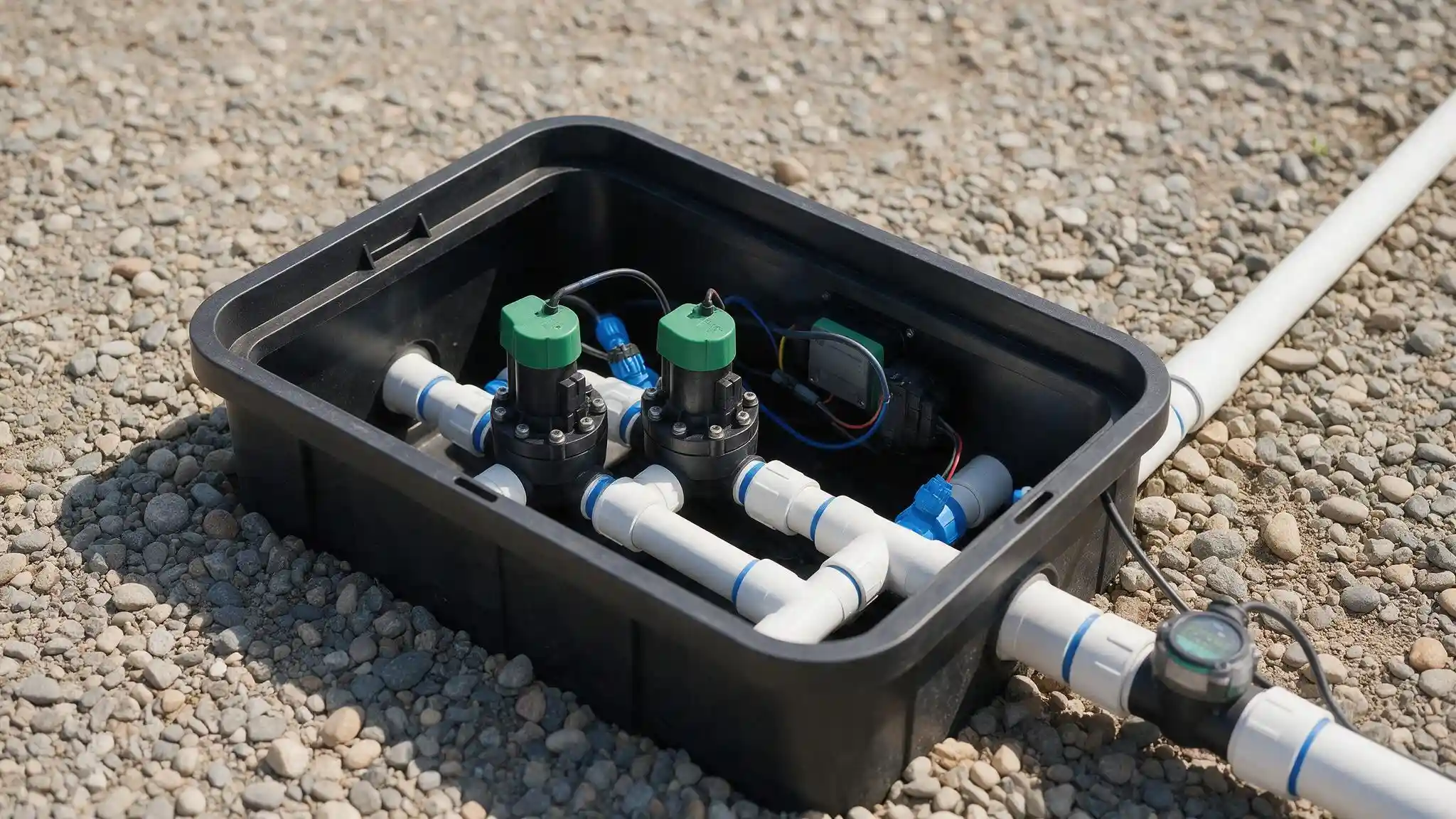
- Solenoid valves, typically 24 volt alternating current, grouped into zones and housed in valve boxes
- A master valve and flow sensor on the mainline, which together enable leak detection and automatic shutdown
- Weather input, either an on-site weather station or a subscription weather data feed
- Soil moisture sensors in representative planting areas
- Distribution hardware, meaning drip line and emitters for beds and shrubs, and sprays or rotors for turf
The distinction that matters is between a controller that waters on a schedule and one that waters to a requirement. The first repeats the same programme regardless of conditions. The second calculates what the landscape actually lost and replaces it.
How Do Smart Controllers Decide When to Water?
Three control methods are in commercial use, and they answer the question differently.
| Criterion | Fixed timer | Weather-based (ET) control | Soil moisture control |
|---|---|---|---|
| How the decision is made | Preset days and run times | Calculates plant water loss from weather data and replaces it | Measures water content in the root zone and irrigates below a threshold |
| Hardware required | Controller and valves only | Weather station or weather data subscription | Buried sensors in each representative zone |
| Responds to actual site conditions | No | Indirectly, through weather | Directly, at the point of measurement |
| Accounts for soil type and drainage | No | Only through configuration | Yes, measured |
| Ongoing maintenance | Minimal | Weather station calibration or subscription | Sensor verification, cabling or battery replacement |
| Detects system faults | No | No | Indirectly, a zone that never wets suggests a fault |
| Main failure mode | Waters through the season regardless of need | Wrong plant or soil settings produce systematic over or under watering | Poor sensor placement makes readings unrepresentative |
| Best suited for | Small sites with simple planting | Most compounds and commercial landscapes | High-value planting and verification of ET schedules |
Key takeaway
Weather-based control should form the schedule and soil moisture sensing should verify it. Evapotranspiration control calculates how much water the landscape lost to soil evaporation and plant transpiration, then replaces it, which handles seasonal change automatically. Soil moisture sensors then confirm the water is actually reaching the root zone, and catch the cases where the calculation and reality diverge. Running either alone is workable. Running both, with moisture readings able to skip a scheduled cycle, is what a compound should specify.
Evapotranspiration is worth understanding rather than accepting as a marketing term. Reference evapotranspiration is the water loss from a standard reference surface under given weather conditions, calculated from temperature, humidity, solar radiation and wind. A coefficient for the plant type then adjusts that figure to the landscape actually planted. Feed the controller the wrong plant coefficient or the wrong soil type and it will apply the wrong volume with complete consistency, which is worse than a timer because nobody questions it.
How Should a Compound Be Zoned?
Zoning decides whether a system can be efficient at all, and it is settled by the landscape design long before a controller is chosen.
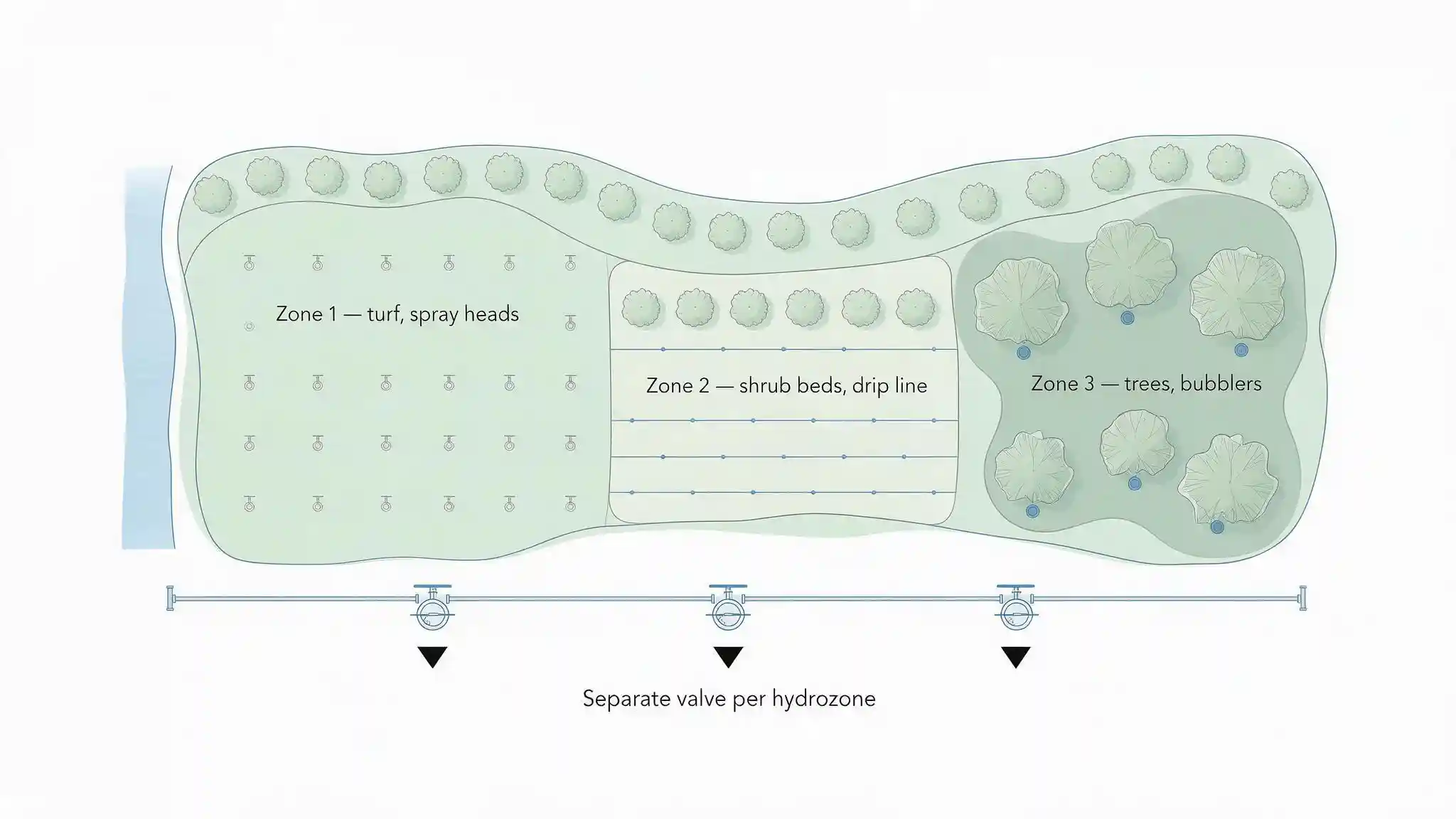
Hydrozoning is the practice of grouping plants with similar water requirements onto the same irrigation zone. Turf, shrubs, groundcover and trees have very different demands, so putting them on one valve means the zone is scheduled for whichever plant is thirstiest and everything else is overwatered. Group by water requirement first, then by sun exposure, since a bed in permanent shade needs materially less than the same planting in open sun.
Never mix drip and spray on the same zone. Drip emitters and spray heads apply water at completely different rates, so any run time is wrong for one of them. This is the most common and most expensive zoning error, and it cannot be corrected by programming.
Match precipitation rates within a zone. All heads on a single valve should apply water at a comparable rate, otherwise parts of the zone are soaked while others stay dry regardless of run time.
Choose the delivery method by planting type. Drip and subsurface drip deliver water directly into the root zone with very little exposed to evaporation and wind, which makes them the correct choice for shrubs, hedges, planters and beds in a Gulf climate. Sprays and rotors remain necessary for turf, and they lose a significant proportion of applied water to evaporation and drift when operated in daylight or wind.
Cycle and soak scheduling deserves a mention. Applying a long single run to compacted or sloped ground produces runoff onto paving before the water infiltrates. Splitting the same volume into several shorter cycles separated by soak periods puts the water into the soil instead of into the drainage.
How Does Flow Monitoring Find Leaks?
A flow sensor on the mainline, paired with an expected flow figure for each zone, turns the irrigation controller into a fault detection system. This is usually where a smart system pays for itself, because the water lost to a single undetected failure exceeds a season of scheduling refinement.
The controller compares measured flow against expected flow and identifies four conditions:
- High flow during a zone indicates a broken lateral, a sheared sprinkler head or a split drip line
- Low flow during a zone indicates clogged emitters, a partially closed isolation valve or a failing solenoid
- Unscheduled flow with every zone off indicates a mainline leak or a valve stuck open
- No flow when a zone should be running indicates a failed valve, a wiring fault or a closed supply
Configure the system to close the master valve automatically on unscheduled flow and to alarm rather than simply log. A compound with a mainline leak at two in the morning has a problem measured in hours, and an alert that waits for someone to open a dashboard on Sunday is not a control.
Establish the expected flow per zone during commissioning, with the system as built, and record it. Flow learning carried out on a partially complete site produces baselines that generate false alarms for years, and false alarms are how alerting gets switched off.
The benefit extends beyond water. Persistent leaks under paving and hardstanding undermine sub-base material and cause settlement, and a slow leak near a building can affect foundations. Detecting flow anomalies is a structural protection as much as a water saving, and it complements broader smart water management across the site.
What Wiring and Connectivity Does a Large Site Need?
Compound irrigation covers distances that make wiring architecture a significant cost, and two decisions dominate.
Two-wire decoder systems versus conventional station wiring. A conventional system runs a separate conductor from the controller to every valve, so a hundred-zone site carries a hundred wires back to a central point. A two-wire decoder system runs a single two-conductor path around the site, with an addressable decoder at each valve that responds only to its own address. On a large compound the reduction in cable, trenching and labour is substantial, and adding a zone later means tapping the existing path rather than pulling a new home run.
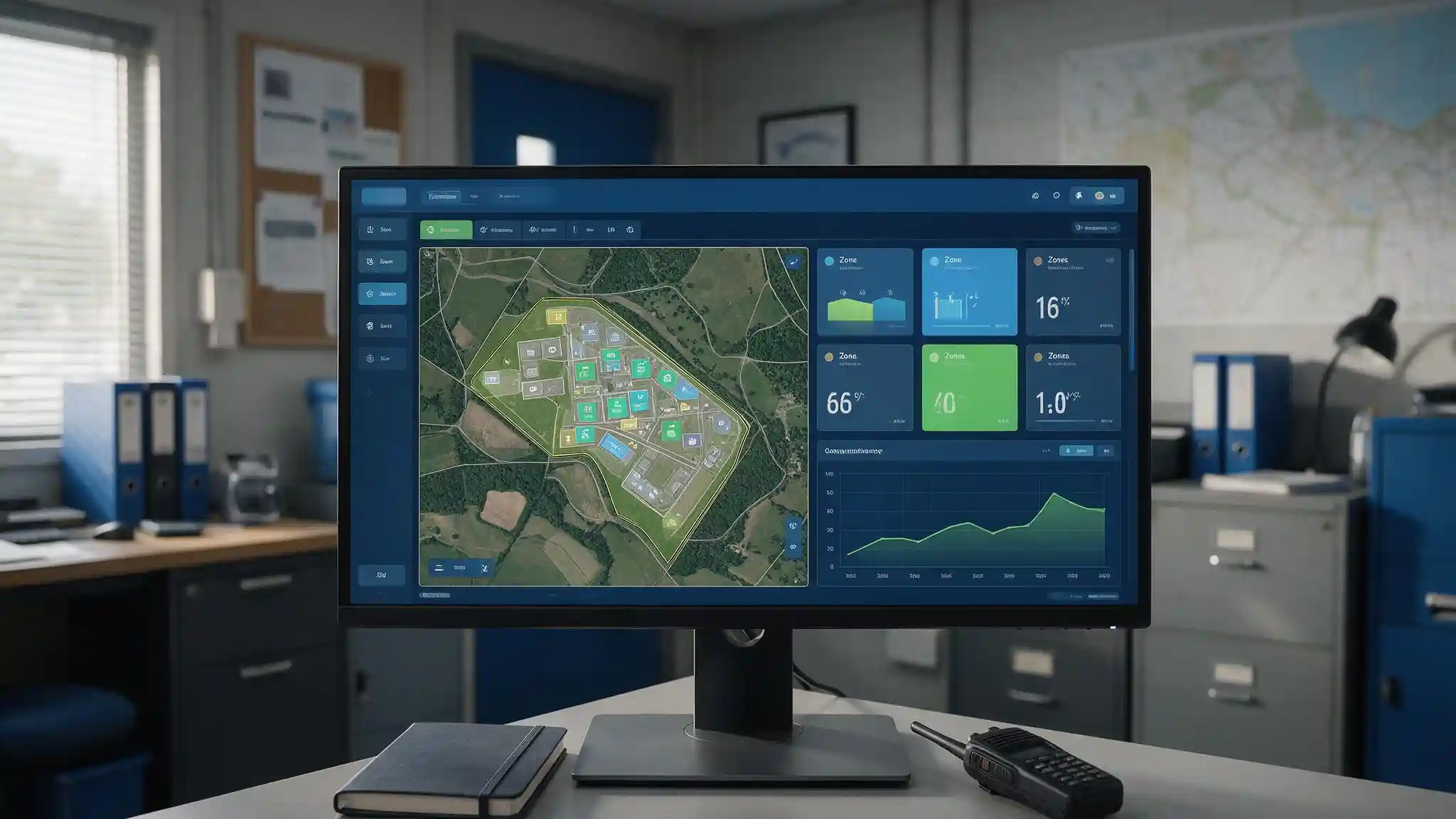
Sensor connectivity. Soil moisture sensors, flow meters and weather stations are scattered across a wide area with no convenient power or data. Low-power wide-area networking suits this well, and the choice between the main options is covered in NB-IoT versus LoRaWAN. LoRaWAN handles battery-powered sensors distributed over a compound with multi-year battery life, while cellular connectivity suits satellite controllers that need a direct route to a central platform. Either way the data usually lands through an IoT gateway into the management platform.
Three further requirements belong in any compound specification:
- Local autonomy. The controller must continue running its schedule when connectivity is lost. Losing a data link should cost you visibility and remote adjustment, never irrigation.
- Surge and lightning protection. Irrigation field wiring is long, buried and exposed, and surge damage to decoders and controller outputs is a common and expensive failure. Follow the manufacturer's grounding and surge specification precisely rather than treating it as optional.
- Network separation. Where the irrigation platform touches the site network, place it on its own VLAN and include the controllers in the asset inventory like any other connected device.
Environmental rating matters at every enclosure. Controller cabinets, decoders and valve box wiring connections face heat, dust and occasional flooding of the box itself, and the design principles are the same as set out for extreme desert climates.
What Do Saudi Compounds Need to Get Right?
Four factors make Saudi landscape irrigation different, and the first one contradicts the standard efficiency logic.
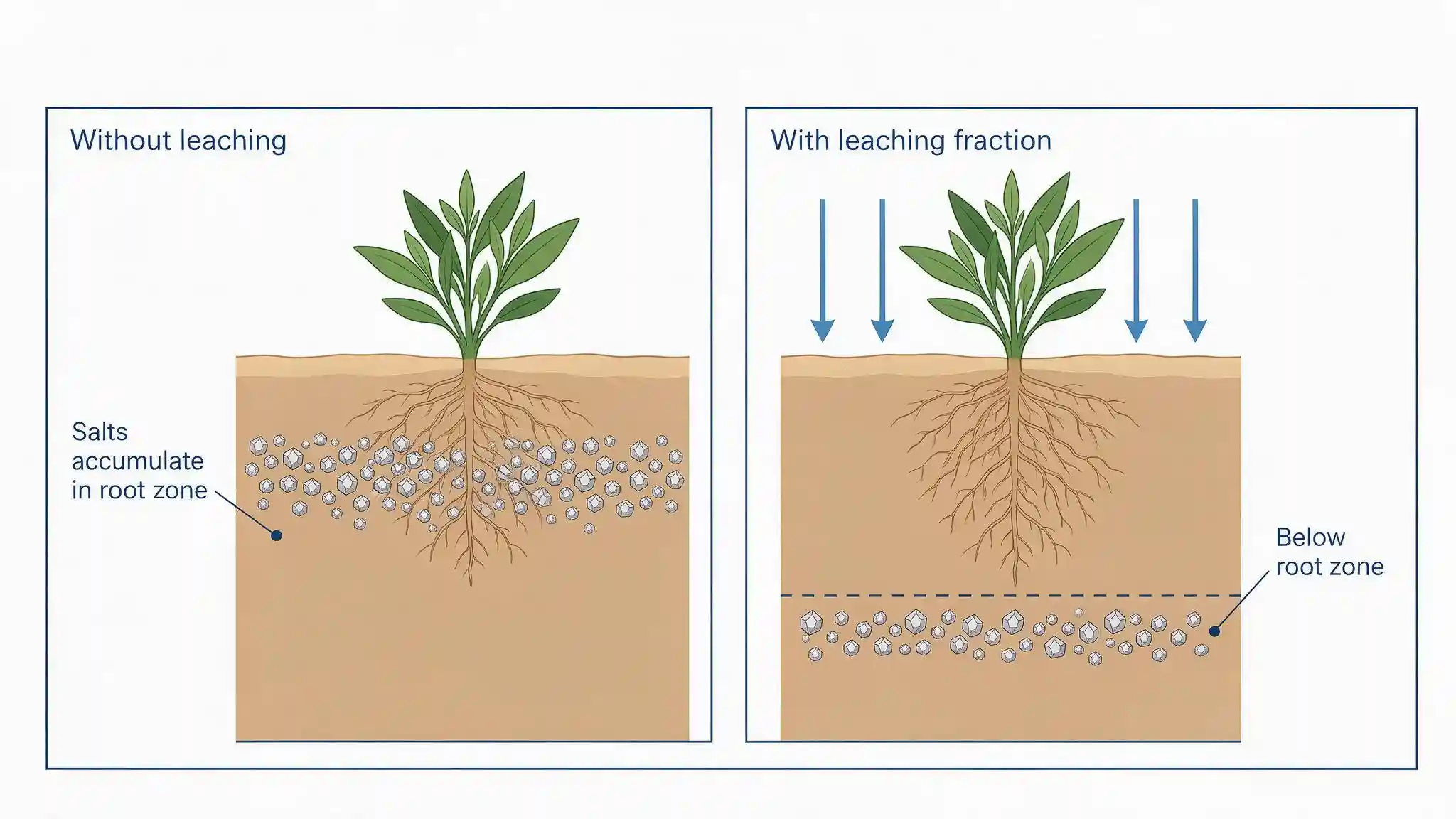
Saline water requires a deliberate leaching fraction. Irrigation water in Saudi Arabia frequently carries significant dissolved salts, whether it comes from a well, a blended supply or treated effluent. In a climate with effectively no rainfall to flush the soil, those salts accumulate in the root zone with every irrigation cycle, and the concentration rises until plants suffer. The remedy is a leaching fraction, meaning water applied deliberately in excess of plant demand at intervals to move salts below the root zone.
This matters for control strategy. A smart controller tuned purely to eliminate excess application will, over a season or two, produce salt damage that looks like a plant health problem rather than an irrigation problem. Configure periodic leaching cycles into the schedule, size them against the salinity of the actual supply, and treat the water saved as slightly lower than a naive efficiency calculation suggests. Have the irrigation water tested rather than assumed.
Treated effluent brings its own requirements. Many Saudi developments irrigate landscape with treated sewage effluent rather than desalinated potable water, which is both the cheaper and the environmentally sound choice. It carries obligations: a physically separate distribution network with the standard purple identification, clear signage in irrigated areas, backflow prevention, and strict avoidance of any cross-connection with potable supply. Confirm the requirements with the local authority and the development's utility provider before design.
Filtration is not optional with drip. Treated effluent and well water both carry solids that clog emitters, and a clogged drip zone kills planting slowly and invisibly because nothing looks wrong from the surface. Install filtration graded to the emitter manufacturer's requirement, make the filter accessible, and put its cleaning interval into the maintenance contract rather than leaving it to be discovered.
Heat, dust and the watering window. Specify ultraviolet-stabilised drip line or bury it, because exposed polyethylene degrades quickly under Saudi sun. Expect dust to foul sensors and filters faster than any datasheet interval suggests. Irrigate at night or in the early morning to minimise evaporation and wind drift, and coordinate the window with compound quiet hours and pedestrian movement so sprays are not running when residents are walking to their cars.
Two supporting points. Plant selection influences water demand more than any controller can, so native and adapted species reduce the baseline before automation touches it. And Saudi Arabia's Mostadam green building rating system assesses water efficiency, so a monitored irrigation system with metered consumption produces the evidence a certification submission needs.
Blue Edge, a technology distributor based in Dammam, Saudi Arabia, supplies Akubela smart building and IoT systems alongside the structured cabling and networking and IT installation and configuration services that site-wide sensor and control networks depend on.
What Are the Most Common Smart Irrigation Mistakes?
Six mistakes account for most disappointing compound irrigation systems.
Mixing drip and spray on one zone. The two apply water at completely different rates, so no run time is correct for both, and programming cannot fix a hydraulic error.
Poor hydrozoning. Turf and shrubs sharing a valve means the zone runs for the thirstiest plant and everything else is overwatered for the life of the landscape.
No flow sensor. Without one the system cannot detect a broken lateral, a stuck valve or a mainline leak, which removes the largest single source of saving.
Badly placed soil moisture sensors. A sensor sitting directly beside an emitter, outside the root zone, or in soil unrepresentative of the area reports numbers that describe nothing useful.
Eliminating all excess application. Without a leaching fraction, salts accumulate in the root zone and the landscape declines slowly, which is usually diagnosed as a planting problem rather than a control problem.
No filtration or filter maintenance on drip. Emitters clog progressively, plants die in patches, and the cause is invisible from the surface until the planting is already lost.
Detect Failures First, Then Optimise the Schedule
The order of value in compound irrigation is the opposite of the way it is usually sold. Start with flow monitoring and automatic shutdown, because a single undetected failure wastes more water than a season of careful scheduling saves and can damage paving and structures while it does so.
Then get the hydraulics right, since hydrozoning, matched precipitation rates and separating drip from spray set the ceiling on how efficient any controller can be. Then add evapotranspiration scheduling with soil moisture verification. Then configure the leaching cycles that keep the root zone viable with saline supply water.
Plan the wiring and connectivity alongside the landscape. Two-wire decoder architecture, sensor network coverage, controller autonomy and surge protection determine whether the system stays reliable across a large site, and none of them can be added cheaply once the grounds are planted and the trenches are closed.
Frequently Asked Questions
-
How does an evapotranspiration controller decide when to water?
An evapotranspiration controller calculates how much water the landscape lost to soil evaporation and plant transpiration, using temperature, humidity, solar radiation and wind data, then applies a coefficient for the plant type and replaces that volume. Because the calculation follows the weather, run times shorten in mild conditions and lengthen in extreme heat without anyone reprogramming the controller. Accuracy depends entirely on the plant and soil settings being configured correctly.
-
Can drip and spray share the same irrigation zone?
No. Drip emitters and spray heads apply water at completely different rates, so any single run time either drowns one or starves the other. Separate them onto different valves, group plants with similar water needs onto the same zone, and keep heads within a zone at matched precipitation rates. This is a hydraulic constraint that no controller setting can compensate for.
-
How does a flow sensor detect an irrigation leak?
The controller compares measured mainline flow against the expected flow for whichever zone is running. Higher than expected flow indicates a broken lateral or sheared head, lower flow indicates clogged emitters or a failing valve, and any flow at all when every zone is off indicates a mainline leak or a stuck valve. Configure the master valve to close automatically on unscheduled flow and to raise an alarm rather than only logging it.
-
Why does saline irrigation water need extra watering?
Because there is no rainfall to flush the soil. Salts dissolved in the irrigation supply accumulate in the root zone with every cycle, and the concentration keeps rising until plants are damaged. A leaching fraction is water applied deliberately beyond plant demand at intervals to move those salts below the roots. Test the irrigation water, size the leaching cycles against its salinity, and build them into the schedule rather than optimising them away.
-
When should a compound irrigate?
At night or in the early morning, when temperature and wind are lowest and evaporation and drift losses are smallest. Daytime spray irrigation in Gulf conditions loses a significant proportion of applied water before it reaches the soil. Coordinate the watering window with quiet hours and resident movement so sprays are not operating on pedestrian routes, and use cycle and soak scheduling on compacted or sloped ground to prevent runoff.
Planning a compound or landscape project?
Blue Edge supplies IoT and building control systems along with the network infrastructure behind them across Saudi Arabia.
Call +966 53 9855 188 or contact our team to discuss your site.
Akubela smart building solutionsAbout Blue Edge
Blue Edge Company is a value-added technology distributor based in Dammam, Saudi Arabia, supplying interactive displays, smart building systems, networking infrastructure and IT security software to businesses and residential projects across the Kingdom, with installation and technical support.
Learn more about Blue Edge →Published 7 September 2026 • Last updated 3 October 2026 • This article is reviewed when standards, regulations or product guidance change.