Shopping Cart


- Articles
- IoT Solutions
- What Is an IoT Gateway—And Why Does Your Network Need One?
What Is an IoT Gateway—And Why Does Your Network Need One?
Learn what an IoT gateway is, how it connects IoT devices to the cloud, enhances security, processes edge data, and improves the performance of enterprise IoT networks.
By Blue Edge Team | Published Aug 11, 2026 | Updated Sep 23, 2026 | 8 min read
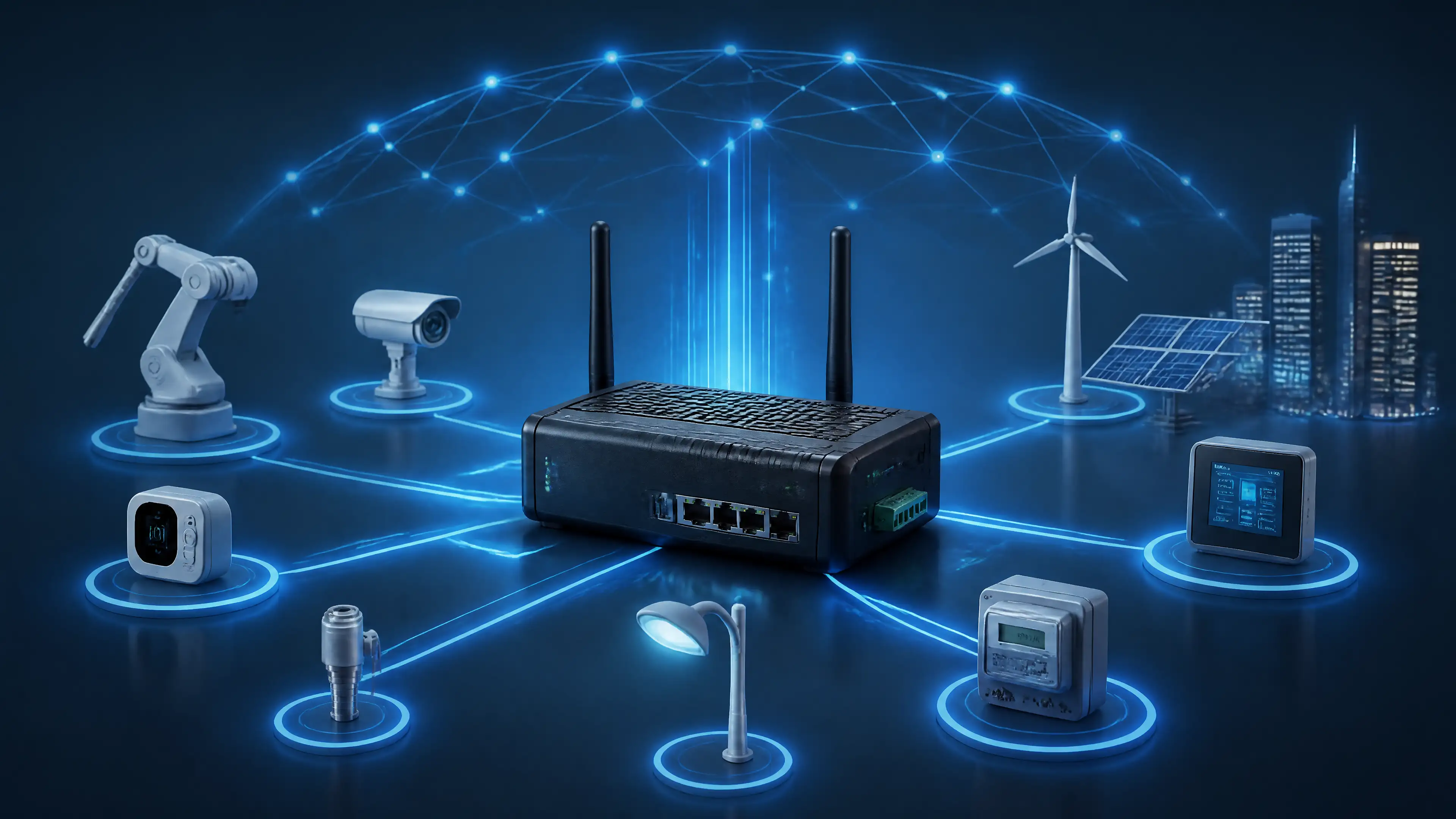
TL;DR: An IoT gateway is a physical or virtual device that connects IoT endpoints—sensors, cameras, controllers—to the cloud or enterprise network. IoT gateways handle data filtering, protocol translation, local processing, and security enforcement, making them a critical component in any scalable, secure IoT deployment.
The number of connected IoT devices worldwide is projected to surpass 29 billion by 2030, according to Statista (2023). Yet most organizations deploying IoT infrastructure focus heavily on the endpoints—the sensors, cameras, and actuators—while underestimating the connective layer that makes it all function. That layer is the IoT gateway.
An IoT gateway serves as the intelligent bridge between your field devices and your cloud or enterprise systems. Without one, raw data from hundreds or thousands of endpoints floods your network with unstructured, unfiltered information—creating bandwidth inefficiencies, security vulnerabilities, and analytical bottlenecks.
This guide explains exactly what an IoT gateway is, how it works, what features differentiate one from another, and why deploying one is not optional for serious IoT infrastructure—it is foundational.
How Does an IoT Gateway Work?
At its core, an IoT gateway performs four primary functions:
- Protocol translation — Field devices communicate using a wide variety of protocols: MQTT, Modbus, Zigbee, Z-Wave, BLE, and others. The IoT gateway translates these into a standardized format compatible with your cloud platform or enterprise network.
- Edge computing — Rather than sending all raw data to the cloud for processing, the gateway performs local computation—filtering, aggregating, and analyzing data at the edge. This reduces latency and bandwidth consumption significantly.
- Data management — The gateway determines which data is actionable, which should be stored locally, and which warrants transmission upstream. This intelligent filtering is what separates a gateway from a simple router.
- Security enforcement — IoT gateways authenticate devices, encrypt data in transit, and act as a firewall between your operational technology (OT) network and the broader IT environment.
In practical terms, consider a manufacturing facility with 400 sensors monitoring temperature, pressure, and machine performance. Without a gateway, each sensor transmits independently to the cloud—creating massive redundancy and exposure. With a gateway, data is aggregated locally, anomalies are flagged in real time, and only meaningful insights are forwarded upstream.
IoT Gateway vs. Traditional Router vs. Edge Server: What Is the Difference?
These three devices are often confused, but they serve fundamentally different roles in a network architecture.
| Feature | IoT Gateway | Traditional Router | Edge Server |
|---|---|---|---|
| Protocol translation | ✅ Yes | ❌ No | ⚠️ Limited |
| Edge computing | ✅ Yes | ❌ No | ✅ Yes |
| Device authentication | ✅ Yes | ❌ No | ⚠️ Varies |
| Multi-protocol support | ✅ Yes | ❌ No | ⚠️ Varies |
| Local data processing | ✅ Yes | ❌ No | ✅ Yes |
| Cloud connectivity | ✅ Yes | ✅ Yes | ✅ Yes |
| Designed for IoT endpoints | ✅ Yes | ❌ No | ❌ No |
| Compact/ruggedized form | ✅ Often | ⚠️ Sometimes | ❌ Rarely |
| Cost | Medium | Low | High |
| Deployment complexity | Medium | Low | High |
The key distinction: A traditional router moves packets. An edge server processes large workloads. An IoT gateway does both—while also speaking the language of your field devices.
What Are the Core Features to Look for in an IoT Gateway?
Not all IoT gateways are created equal. When evaluating solutions for your deployment, the following features determine long-term performance and scalability.
Multi-Protocol and Multi-Network Support
Your gateway must support the full range of communication protocols used by your devices—both wired (Ethernet, RS-485, Modbus) and wireless (Wi-Fi, LTE, 5G, Zigbee, LoRaWAN). Single-protocol gateways create integration constraints that become costly to resolve later.
Onboard Edge Processing Power
The gateway's processor determines how much computation can occur locally. Higher-capacity gateways equipped with dedicated CPUs or AI accelerators can run machine learning inference at the edge—enabling predictive maintenance, anomaly detection, and automated responses without cloud dependency.
Security Architecture
Look for hardware-based security features: secure boot, trusted platform modules (TPM), encrypted storage, and built-in VPN support. Software-only security in a field-deployed device is insufficient for industrial or critical infrastructure environments.
Remote Management Capabilities
Enterprise-grade gateways should support remote firmware updates, configuration management, and diagnostics via a centralized platform. This is non-negotiable for large-scale deployments where physical access to each device is impractical.
Environmental Durability
For deployments outside of controlled environments—manufacturing floors, transportation hubs, agricultural sites—gateways must meet industrial standards such as IP67 ingress protection, wide operating temperature ranges (−40°C to 85°C), and resistance to vibration and humidity.
IoT Gateway Feature Comparison: Industrial vs. Commercial vs. Residential
The right gateway depends on the scale, environment, and demands of your deployment. The following table provides a structured comparison across three deployment categories.
| Criteria | Industrial IoT Gateway | Commercial IoT Gateway | Residential IoT Gateway |
|---|---|---|---|
| Target environment | Factory, utility, transport | Office, retail, healthcare | Smart home |
| Processing power | High (multi-core, AI-capable) | Medium | Low |
| Protocol support | Extensive (Modbus, PROFINET, etc.) | Moderate | Basic (Zigbee, Z-Wave, Wi-Fi) |
| Security standards | IEC 62443, TPM, secure boot | TLS encryption, basic auth | WPA2/3 encryption |
| Durability | IP67, wide temp range | Standard indoor | Indoor use only |
| Remote management | Full enterprise platform | Partial | App-based |
| Scalability | Thousands of endpoints | Hundreds of endpoints | Tens of endpoints |
| Average cost range | $500–$5,000+ | $100–$500 | $30–$150 |
| Typical use case | Predictive maintenance, SCADA | Building automation, POS | Smart lighting, HVAC |
Choose an industrial gateway if operational continuity, regulatory compliance, or safety-critical monitoring are requirements. Choose a commercial gateway if your deployment is facility-based with moderate device density. Choose a residential gateway for consumer-grade smart home automation where security and processing demands are lower.
Why Do Organizations Need an IoT Gateway in 2025?
The argument for deploying an IoT gateway has grown stronger as IoT networks have scaled and threat landscapes have evolved. There are five specific reasons why a gateway is no longer optional infrastructure.
1. Bandwidth Efficiency at Scale
Transmitting raw data from every endpoint to the cloud is economically and technically unsustainable at scale. IoT gateways reduce upstream data volume by 60–90% through local aggregation and filtering, according to industry benchmarks from Eclipse Foundation IoT surveys. This directly reduces cloud storage and data egress costs.
2. Latency-Sensitive Applications Require Local Processing
Applications such as real-time machine control, autonomous vehicle coordination, or patient monitoring cannot tolerate cloud round-trip latency. Processing at the gateway reduces response time from hundreds of milliseconds to single-digit milliseconds.
3. Legacy Device Integration
Most enterprises operate legacy OT equipment that predates modern IP networking. IoT gateways provide the protocol translation layer that enables these older devices to participate in modern IoT architectures without expensive replacement.
4. Segmented Security Posture
Direct cloud connectivity for every IoT endpoint creates an expansive attack surface. A gateway establishes a single, hardened point of control—authenticating devices, encrypting traffic, and isolating compromised endpoints before they can affect the broader network.
5. Regulatory and Data Sovereignty Compliance
In sectors such as healthcare (HIPAA), finance (PCI DSS), and critical infrastructure (NERC CIP), data processing location matters. IoT gateways enable local processing and storage to ensure sensitive data never leaves a compliant environment.
How to Deploy an IoT Gateway: A Structured Approach
Deployment success depends on methodology, not just hardware selection. The following framework applies to enterprise and industrial deployments.
Step 1 — Inventory your endpoints. Document every device that will connect through the gateway, including its communication protocol, data output format, and transmission frequency.
Step 2 — Define processing requirements. Determine which computations must occur locally (real-time alerts, safety triggers) versus which can be deferred to the cloud (trend analysis, reporting).
Step 3 — Select the gateway. Match your inventory and processing requirements against the feature comparison criteria outlined above. Prioritize security and protocol compatibility above cost.
Step 4 — Configure security policies. Establish device authentication rules, define network segmentation boundaries, and enable encrypted communication before connecting any endpoints.
Step 5 — Pilot before scaling. Deploy in a controlled environment with a representative sample of your endpoints. Validate data accuracy, latency performance, and failover behavior before full rollout.
Step 6 — Establish remote monitoring. Configure your gateway management platform for continuous health monitoring, automated firmware updates, and alert escalation.
The Strategic Value of an IoT Gateway in Enterprise Architecture
Treating an IoT gateway as a commodity hardware purchase is a strategic mistake. The gateway defines the security boundary of your OT network, determines the latency floor of your real-time applications, and sets the ceiling on how many devices your infrastructure can accommodate.
Organizations that deploy gateways as a deliberate architectural decision—selecting for protocol breadth, edge processing capability, and remote manageability—consistently report higher ROI from their IoT investments. Those that treat connectivity as an afterthought frequently encounter integration failures, data quality issues, and security incidents that erode confidence in the entire initiative.
An IoT gateway does not simply move data. It governs it.
Frequently Asked Questions
-
What is the difference between an IoT gateway and an IoT hub?
An IoT hub is typically a cloud-based service (such as Azure IoT Hub or AWS IoT Core) that manages device communication and data ingestion at the platform level. An IoT gateway is a physical or virtual device deployed at or near the field site that handles local processing, protocol translation, and security before data reaches the cloud. The two are complementary—the gateway handles edge functions; the hub handles cloud-side orchestration.
-
Can an IoT gateway function without internet connectivity?
Yes. Many industrial IoT gateways are designed to operate in offline or intermittent-connectivity environments. They store data locally during connectivity outages and synchronize with the cloud when the connection is restored. This capability—often called store-and-forward—is essential for remote or mobile deployments.
-
How many devices can a single IoT gateway support?
Device capacity varies significantly by gateway model and vendor. Entry-level commercial gateways typically support 50–200 endpoints. Industrial-grade gateways can manage thousands of concurrent device connections. Capacity depends on the gateway's processing power, memory, and the data transmission frequency of connected devices.
-
Is an IoT gateway the same as an edge computing device?
Not exactly. Edge computing refers to the broader practice of processing data near its source rather than in a centralized cloud. An IoT gateway performs edge computing as one of its functions, but it also handles protocol translation, device management, and security enforcement—capabilities that generic edge servers do not provide natively.
-
How do I secure an IoT gateway from cyberattacks?
Effective IoT gateway security requires multiple layers: hardware-rooted secure boot to prevent firmware tampering, mutual TLS authentication for device-to-gateway communication, network segmentation to isolate OT traffic, and a disciplined patch management process for firmware updates. Physical security of the gateway hardware is equally important in field deployments.
Ready to Build a More Intelligent IoT Infrastructure?
Deploying the right IoT gateway is one of the highest-leverage decisions in any connected infrastructure project. It determines your network's security posture, processing capability, and scalability ceiling—all at once.
Our team specializes in enterprise IoT architecture, gateway selection, and end-to-end deployment. Whether you are integrating legacy OT equipment, scaling an existing deployment, or designing a new IoT network from the ground up, we can help you select and deploy the right solution for your environment.
[Contact our IoT specialists today] to schedule a no-obligation consultation and receive a tailored gateway recommendation for your specific use case.
About Blue Edge
Blue Edge Company is a value-added technology distributor based in Dammam, Saudi Arabia, supplying interactive displays, smart building systems, networking infrastructure and IT security software to businesses and residential projects across the Kingdom, with installation and technical support.
Learn more about Blue Edge →Published 11 August 2026 • Last updated 23 September 2026 • This article is reviewed when standards, regulations or product guidance change.