Shopping Cart


- Articles
- IoT Solutions
- How IoT Is Transforming Retail Operations in Saudi Arabia
How IoT Is Transforming Retail Operations in Saudi Arabia
Discover how IoT in retail operations helps Saudi businesses improve inventory management, customer experiences, store automation, and operational efficiency through connected technologies.
By Blue Edge Team | Published Jun 29, 2026 | Updated Sep 23, 2026 | 6 min read
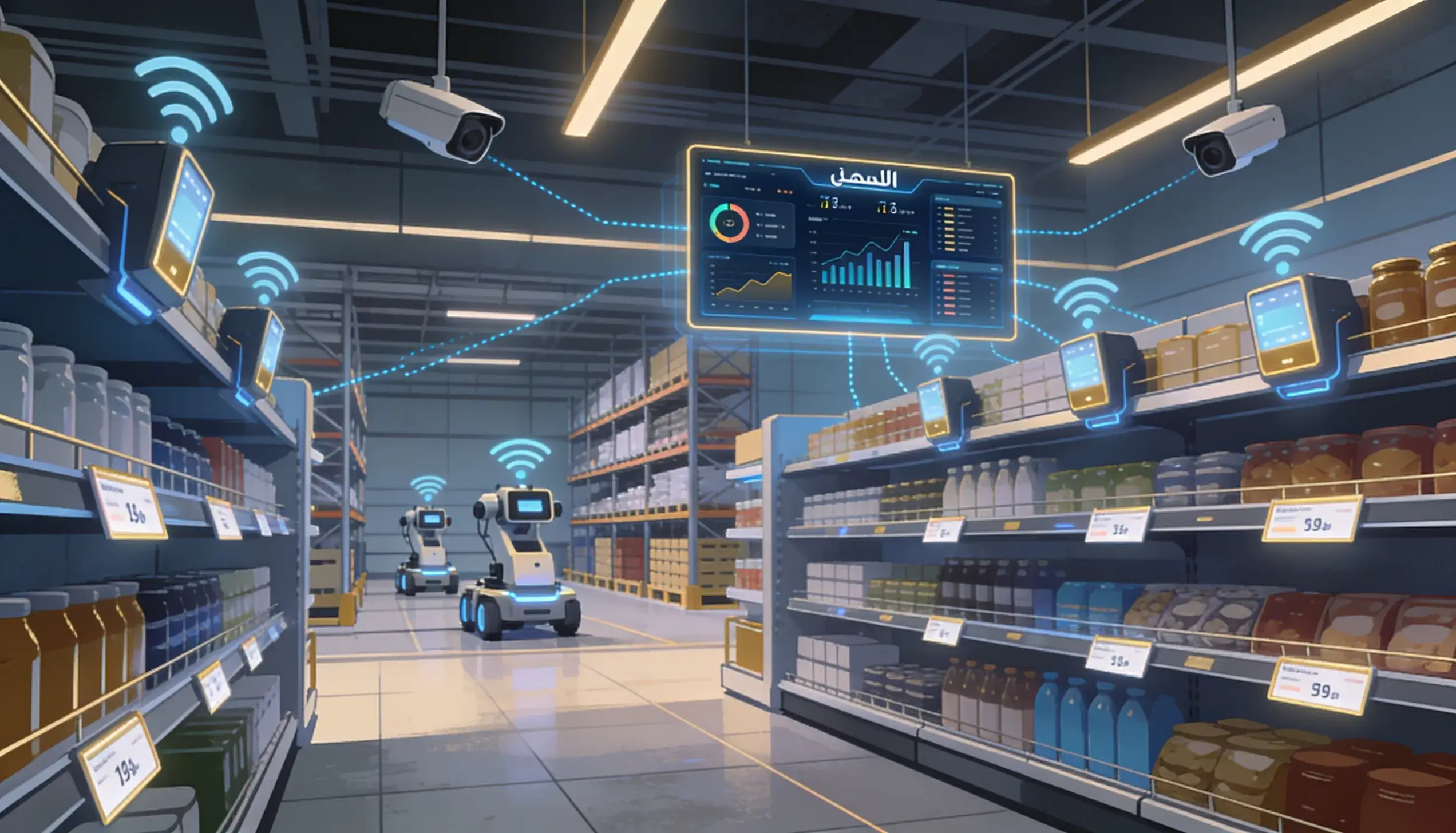
IoT is reshaping Saudi retail through smart inventory management, connected supply chains, and data-driven customer experiences. Backed by Vision 2030 and a national IoT market projected to reach $3.1 billion by 2025 (IDC), Saudi retailers are deploying connected technologies at a pace that is setting new regional benchmarks.
Saudi Arabia's retail sector is undergoing one of the most significant technological overhauls in its history. The Kingdom's retail technology market, valued at USD 560 million in 2025, is forecast to reach USD 5,130 million by 2034—a compound annual growth rate of 25.54%, according to IMARC Group. At the center of this surge is the Internet of Things (IoT): a network of connected sensors, devices, and systems that collect and exchange real-time data to optimize how stores operate.
This is not simply a technology trend. It reflects a deliberate national strategy. Saudi Arabia's Vision 2030 framework explicitly prioritizes digital transformation across all economic sectors, and retail is no exception. Government-led investments of over $27 billion in digital infrastructure over the past six years have created the connectivity backbone that IoT solutions depend on. With a 99% internet penetration rate, 5G coverage reaching 80% of the country—and over 95% in Riyadh—Saudi Arabia now offers retailers one of the most robust digital environments in the world for deploying IoT at scale (International Trade Administration, 2026).
Understanding precisely how IoT is being applied in retail operations—and why it matters—is essential for any business operating or expanding within the Kingdom.
Why Is IoT Adoption Accelerating in Saudi Retail Right Now?
Several converging forces are driving IoT integration across Saudi retail operations.
Vision 2030 sits at the top of that list. The Kingdom's strategic framework is pushing retailers to modernize, adopt omnichannel approaches, and improve consumer experiences through technology. Retailers aligning with Vision 2030's digitalization goals are accessing government support, favorable regulatory conditions, and a growing base of tech-savvy consumers.
5G infrastructure is the second major catalyst. Saudi Arabia was among the first countries in the MENA region to deploy 5G networks, with coverage now nearly double the global average (International Trade Administration, 2026). High-bandwidth, low-latency connectivity is a prerequisite for real-time IoT data transmission. Without it, smart shelves, connected logistics, and in-store sensors cannot perform reliably at scale. Saudi retailers now have that infrastructure.
Consumer demand is also shifting. Saudi Arabia's e-commerce market was valued at $6.1 billion in 2024 (Statista), with user penetration expected to surpass 75% by 2027. Consumers accustomed to frictionless digital experiences now expect the same precision and personalization when they shop in physical stores. IoT helps bridge that gap.
How Is IoT Changing Retail Operations on the Ground in Saudi Arabia?
Smart Inventory and Shelf Management
Manual stock-taking is slow, error-prone, and costly. IoT-enabled smart shelves—fitted with weight sensors, RFID readers, and computer vision systems—eliminate these inefficiencies by tracking inventory levels in real time. When a product runs low, the system triggers an automatic replenishment alert, reducing out-of-stock incidents and minimizing lost sales.
RFID technology is particularly effective here. Tags attached to individual products communicate with store readers continuously, providing accurate, up-to-the-minute stock counts without requiring manual scanning. For Saudi retailers managing large-format stores or multi-location operations, this level of visibility translates directly into reduced waste and stronger margins.
IoT-enabled smart labels also allow for dynamic pricing displays. Rather than printing and replacing paper labels, retailers can update prices across an entire store floor from a central system—saving labor hours and responding faster to promotional cycles or demand fluctuations.
Supply Chain and Logistics Optimization
Retail supply chains are complex. Goods move across ports, warehouses, and distribution centers before reaching store shelves, and any disruption at any point creates downstream problems. IoT addresses this by embedding visibility throughout the chain.
GPS trackers and connected sensors on delivery vehicles provide real-time location data and environmental monitoring—critical for perishable goods requiring temperature control. Warehouse IoT systems track the movement of pallets and individual SKUs, reducing picking errors and improving throughput. These capabilities align directly with the IoT use cases prioritized by Saudi digital economy initiatives: predictive maintenance, asset tracking, fleet management, and warehouse optimization (International Trade Administration, 2026).
Saudi Arabia's smart city projects—including NEOM, Qiddiya, and the Red Sea development—are being designed from the ground up with integrated IoT infrastructure. Retailers entering these developments will operate within ecosystems where connected logistics are the default, not the exception.
In-Store Customer Experience and Operational Efficiency
IoT extends beyond back-end operations. In-store sensors monitor foot traffic patterns, dwell times, and customer flow, providing retailers with behavioral data that was previously unavailable. This intelligence supports better store layout decisions, staffing optimization, and targeted promotions.
Smart payment systems—another IoT application—are gaining particular traction in Saudi Arabia. Digital payments already accounted for over 57% of retail transactions in 2021, surpassing Vision 2030's 55% target ahead of schedule. The Kingdom now aims to reach 70% cashless transactions by 2030. IoT-enabled point-of-sale systems, contactless payment terminals, and self-checkout stations are accelerating this shift while simultaneously reducing checkout friction.
Energy management is an often-overlooked benefit. IoT sensors that regulate lighting, air conditioning, and refrigeration based on real-time occupancy data can reduce energy consumption significantly—a meaningful cost saving for large retail formats operating in Saudi Arabia's climate.
What Role Does Saudi Arabia's Digital Infrastructure Play in IoT Retail Deployment?
Infrastructure matters as much as intent. Saudi Arabia's IoT market is estimated to reach $3.1 billion by 2025, growing at an annual rate of 13%, according to the International Data Corporation (IDC). This growth is underpinned by the Kingdom's investment in cloud computing, with public cloud spending forecast to surpass $2.7 billion in 2025 and reach $5 billion by 2027 (IDC).
Cloud infrastructure is foundational to enterprise IoT. The data generated by connected retail devices—from shelf sensors to supply chain trackers—requires storage, processing, and analytical capabilities that only cloud platforms can deliver at scale. Saudi Arabia's Cloud First Policy, introduced in 2019, mandates that government entities prioritize cloud solutions, and the private sector has followed suit. Major hyperscalers including Google, Microsoft, and Amazon Web Services have established a strong foothold in the Kingdom, ensuring that retailers have access to world-class cloud services locally.
This combination of high-speed connectivity, cloud availability, and government-backed digitalization creates a uniquely favorable environment for IoT retail deployments.
The Bottom Line: IoT in Saudi Retail Is Not Optional—It's Competitive
Retailers that have not yet integrated IoT into their operations are not simply missing an efficiency opportunity. They are falling behind competitors who are already using real-time data to make faster decisions, reduce costs, and deliver better customer experiences.
The structural conditions in Saudi Arabia—advanced connectivity, government incentives, a young and digitally engaged consumer base, and ambitious smart city developments—mean that IoT adoption in retail will accelerate, not slow down. Businesses that act now will build the operational capabilities and data foundations that define retail competitiveness through the rest of the decade.
Ready to explore how connected technology solutions can strengthen your retail operations in Saudi Arabia? Contact the Blue Edge team for expert guidance tailored to your specific requirements.
Frequently Asked Questions
-
What is IoT in retail, and how is it used in Saudi Arabia?
IoT in retail refers to the use of connected sensors, devices, and systems that exchange real-time data to improve store operations. In Saudi Arabia, common applications include smart shelf monitoring, RFID-based inventory tracking, connected supply chain management, IoT-enabled payment systems, and in-store foot traffic analytics. These applications are supported by the Kingdom's advanced 5G infrastructure and cloud computing ecosystem.
-
How large is the IoT market in Saudi Arabia, and what is driving its growth?
According to the International Data Corporation (IDC), Saudi Arabia's IoT market is estimated to reach $3.1 billion by 2025, growing at an annual rate of 13%. Growth is driven by Vision 2030's digital transformation agenda, widespread 5G deployment, government investment of over $27 billion in digital infrastructure, and increasing demand from retailers for real-time operational data.
-
Which specific retail operations benefit most from IoT technology?
IoT delivers the most measurable impact in inventory management, supply chain and logistics visibility, energy management, customer flow analysis, and smart payment processing. Retailers managing large-format stores or multi-location operations typically see the fastest return on investment from IoT deployments in warehouse optimization and predictive stock replenishment.
-
Is the digital infrastructure in Saudi Arabia mature enough to support large-scale retail IoT deployments?
Yes. Saudi Arabia has a 99% internet penetration rate, 5G coverage reaching 80% of the country (over 95% in Riyadh), and mobile internet speeds of 218 Mbps—ranking among the global top 10 (International Trade Administration, 2026). Combined with established cloud regions from Google, Microsoft, and AWS, the Kingdom offers one of the strongest infrastructure environments for IoT deployment in the MENA region.
-
How does Vision 2030 support IoT adoption in Saudi retail?
Vision 2030 directly incentivizes retail digitalization by promoting technology adoption, supporting smart city development (including NEOM, Qiddiya, and the Red Sea project), and driving a cashless economy target of 70% digital transactions by 2030. These policy objectives create commercial pressure and government-backed opportunities for retailers to invest in IoT
About Blue Edge
Blue Edge Company is a value-added technology distributor based in Dammam, Saudi Arabia, supplying interactive displays, smart building systems, networking infrastructure and IT security software to businesses and residential projects across the Kingdom, with installation and technical support.
Learn more about Blue Edge →Published 29 June 2026 • Last updated 23 September 2026 • This article is reviewed when standards, regulations or product guidance change.