Shopping Cart



NB-IoT vs LoRaWAN: Which Network Is Right for Your Enterprise?
Compare NB-IoT vs LoRaWAN to discover which LPWAN technology best suits your enterprise IoT deployment based on coverage, power consumption, scalability, cost, and performance.
By Blue Edge Team | Aug 11, 2026
NB-IoT vs LoRaWAN: Which Network Is Right for Your Enterprise?
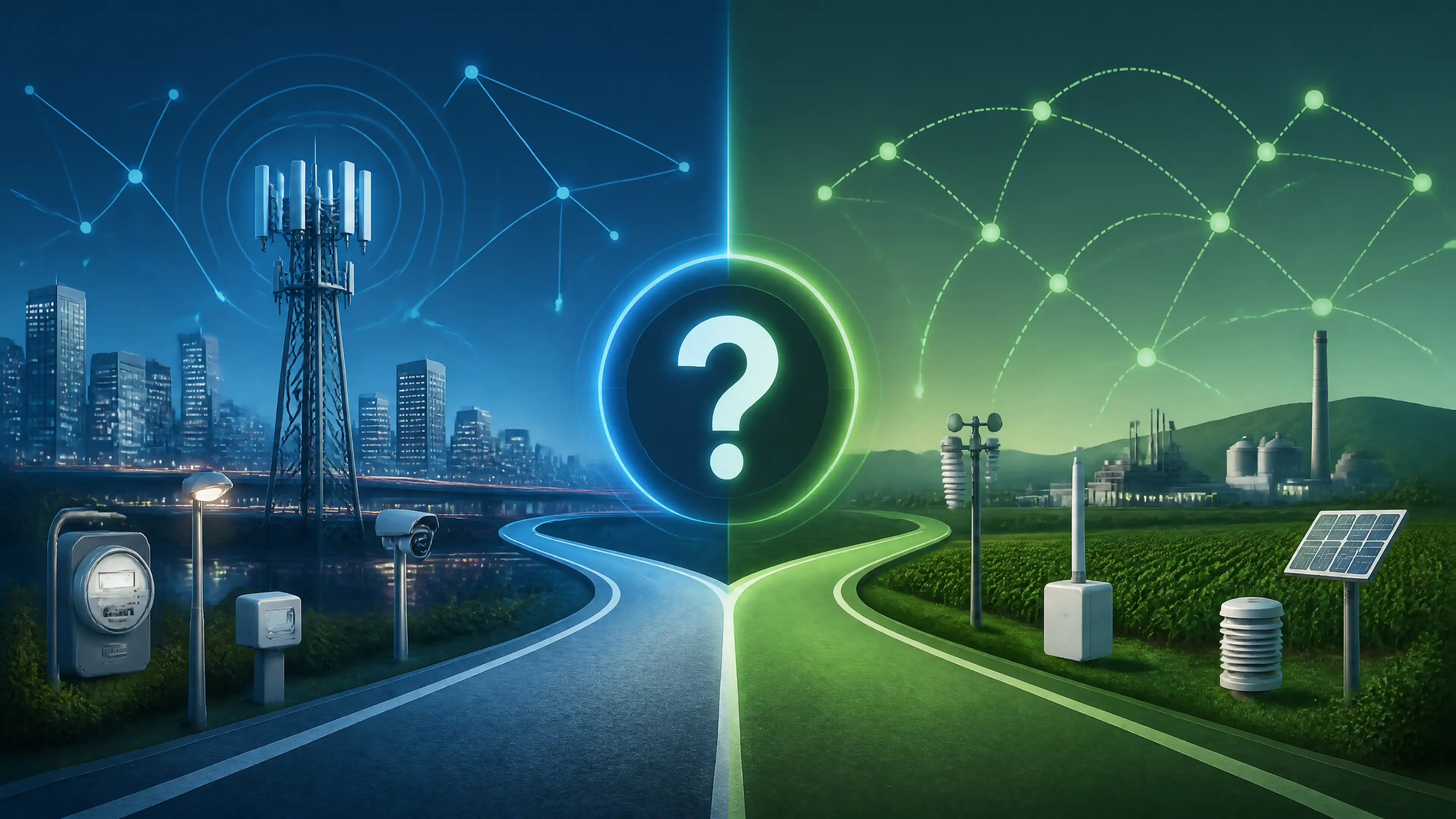
Quick answer: NB-IoT and LoRaWAN are both low-power wide-area network (LPWAN) technologies designed for IoT deployments, but they serve different enterprise needs. NB-IoT operates on licensed cellular spectrum and excels in high-density, mission-critical environments. LoRaWAN uses unlicensed spectrum and suits deployments that prioritize long range, low cost, and flexible infrastructure ownership.
Enterprise IoT is no longer a future-facing concept—it is a present-day operational priority. From smart meters in utility grids to asset trackers in logistics fleets, organizations are deploying connected devices at scale. And at the center of every deployment decision is one critical question: which wireless protocol will carry the data reliably, efficiently, and cost-effectively?
Two technologies dominate this conversation: NB-IoT (Narrowband IoT) and LoRaWAN (Long Range Wide Area Network). Both are purpose-built for low-power, wide-area connectivity. Both are designed to support massive device deployments. Yet the differences between them—in coverage, cost structure, data handling, and deployment model—can significantly affect the success of an enterprise IoT initiative.
This guide breaks down how each technology works, where each performs best, and which specific enterprise scenarios call for one over the other. Whether your team is evaluating smart city infrastructure, industrial automation, or supply chain visibility, the analysis below will give you a clear, structured framework for making the right decision.
How Does NB-IoT Work, and What Makes It Distinct?
NB-IoT is a 3GPP-standardized cellular technology that operates within licensed frequency bands—the same spectrum used by 4G LTE and 5G networks. It was designed specifically for IoT devices that need to transmit small volumes of data infrequently, while consuming minimal power.
Because NB-IoT runs on licensed spectrum, network quality of service (QoS) is guaranteed by the carrier. Signal interference is tightly managed, and coverage penetrates deep into buildings, underground infrastructure, and dense urban environments. This makes NB-IoT particularly effective for applications where signal reliability and latency predictability are non-negotiable.
Cellular network operators deploy and manage NB-IoT infrastructure, which means enterprises do not need to build or maintain their own network. The trade-off is ongoing subscription costs per device—a consideration that scales quickly across large fleets.
How Does LoRaWAN Work, and What Makes It Distinct?
LoRaWAN is an open-standard protocol that operates on unlicensed ISM (Industrial, Scientific, and Medical) radio bands—most commonly 868 MHz in Europe and 915 MHz in North America. It uses a star-of-stars topology, where end devices communicate with gateways, and gateways relay data to a central network server.
The defining characteristic of LoRaWAN is its exceptional range. A single gateway can cover tens of kilometers in open rural environments, and several kilometers in dense urban areas. This makes LoRaWAN an attractive option for large-scale outdoor deployments where building physical cellular infrastructure would be impractical or prohibitively expensive.
Critically, enterprises can deploy their own private LoRaWAN networks. This gives organizations full control over their infrastructure, eliminates per-device subscription costs, and allows for highly customized network configurations. The trade-off is that the enterprise assumes full responsibility for network management and maintenance.
NB-IoT vs LoRaWAN: Feature-by-Feature Comparison
The table below presents a direct comparison of both technologies across the parameters most relevant to enterprise decision-makers.
| Feature | NB-IoT | LoRaWAN |
|---|---|---|
| Spectrum | Licensed (cellular bands) | Unlicensed (ISM bands) |
| Network Deployment | Carrier-managed | Private or public (operator or self-deployed) |
| Coverage (Urban) | Excellent (deep indoor penetration) | Good |
| Coverage (Rural) | Dependent on carrier footprint | Excellent (up to 50 km line-of-sight) |
| Data Rate | Up to 250 kbps | 0.3–50 kbps |
| Latency | Low (~1.6–10 seconds) | Higher (variable, seconds to minutes) |
| QoS Guarantee | Yes (licensed spectrum) | No (best-effort) |
| Battery Life | Up to 10 years | Up to 10+ years |
| Device Cost | Moderate–High | Low–Moderate |
| Network Cost | Per-device subscription fees | Upfront infrastructure investment |
| Security | Built-in 3GPP security | AES-128 encryption (application and network layers) |
| Roaming Support | Yes (via cellular roaming) | Limited (requires compatible networks) |
| Scalability | High (carrier-grade infrastructure) | High (add gateways as needed) |
| Regulatory Compliance | Highly regulated (carrier-managed) | Self-managed compliance required |
| Best For | Urban, high-density, mission-critical IoT | Rural, large-area, cost-sensitive IoT |
Which Enterprise Use Cases Are Best Suited for NB-IoT?
NB-IoT is the preferred choice when reliability, latency, and guaranteed service quality take precedence over cost flexibility.
Smart Utilities and Metering in Dense Urban Environments
Municipal smart meter deployments—covering electricity, gas, and water—require devices installed in basements, meter closets, and underground vaults. NB-IoT's deep indoor penetration and carrier-grade reliability make it the dominant protocol in this vertical. National IoT deployments by utility companies across Europe and Asia have predominantly adopted NB-IoT for this reason.
Healthcare and Critical Asset Monitoring
Hospitals and healthcare facilities deploying connected medical equipment, patient monitoring devices, or pharmaceutical cold-chain sensors cannot afford connectivity gaps. NB-IoT's QoS guarantees and managed security framework—compliant with 3GPP standards—provide the reliability and auditability that regulated industries require.
High-Density Urban IoT Infrastructure
Smart parking systems, connected streetlights, and public safety sensors in densely populated urban centers benefit from NB-IoT's ability to handle large numbers of simultaneous device connections per cell—up to approximately 50,000 devices per base station, according to 3GPP specifications.
Which Enterprise Use Cases Are Best Suited for LoRaWAN?
LoRaWAN excels when geographic coverage is vast, device volumes are high, and budget constraints demand a lower total cost of ownership.
Agricultural and Environmental Monitoring
A single LoRaWAN gateway deployed in a rural agricultural environment can cover thousands of hectares, collecting data from soil moisture sensors, weather stations, and livestock trackers. Cellular coverage in remote areas is often insufficient or nonexistent, making LoRaWAN the only viable LPWAN option for many agricultural enterprises.
Industrial Campus and Private Network Deployments
Manufacturing facilities, port terminals, and logistics hubs that require full control over their IoT network architecture benefit significantly from a private LoRaWAN deployment. These organizations avoid per-device fees, maintain data sovereignty, and can tune network parameters to their specific operational requirements.
Supply Chain and Cold Chain Visibility Across Large Areas
For enterprises tracking assets across large, semi-open environments—such as shipping yards, rail depots, or warehousing facilities—LoRaWAN provides cost-effective wide-area coverage without relying on carrier infrastructure. The low cost per device also makes it viable to instrument every pallet, container, or vehicle in a large fleet.
What Are the Total Cost of Ownership Differences Between NB-IoT and LoRaWAN?
Total cost of ownership (TCO) is one of the most critical factors in enterprise IoT planning, and the two technologies follow fundamentally different cost models.
NB-IoT TCO profile: Hardware costs are moderate to high. Per-device carrier subscription fees apply monthly or annually and accumulate significantly at scale. No infrastructure investment is required, and the enterprise benefits from carrier-managed maintenance and upgrades. This model favors smaller deployments or scenarios where operational simplicity justifies subscription costs.
LoRaWAN TCO profile: Device costs are lower. Gateways typically range from $200 to $1,500 per unit depending on capabilities. There are no per-device subscription fees for private networks. However, the enterprise must account for gateway hardware, network server licensing or operation, installation, and ongoing maintenance. This model typically delivers lower long-term costs at scale—particularly deployments exceeding several thousand devices.
For enterprises deploying more than 10,000 devices, LoRaWAN's private network model frequently delivers a materially lower five-year TCO, provided the organization has the technical capacity to manage the infrastructure.
How Do NB-IoT and LoRaWAN Compare on Security?
Security is non-negotiable in enterprise IoT, and both technologies provide robust—but structurally different—protections.
NB-IoT leverages the established 3GPP security framework, which includes mutual authentication between the device and the network, over-the-air encryption, and SIM-based identity management. This framework is audited, standardized, and managed by the carrier, making it an attractive option for organizations with strict regulatory obligations.
LoRaWAN implements AES-128 encryption at both the network and application layers. Device authentication is handled via unique device EUIs and session keys. However, in a private LoRaWAN deployment, the enterprise is responsible for configuring and maintaining security policies—a significant operational consideration that requires dedicated expertise.
Both technologies support secure over-the-air updates (OTAA), which is essential for long-lifecycle device deployments.
Making the Right Decision for Your Enterprise IoT Strategy
The choice between NB-IoT and LoRaWAN is not about which technology is objectively superior—it is about which technology is better aligned with your specific operational context, infrastructure resources, and long-term IoT roadmap.
Choose NB-IoT if:
- Your deployment is concentrated in urban or suburban areas with strong carrier coverage
- Mission-critical reliability and guaranteed QoS are essential
- Your organization prefers a managed network without internal infrastructure responsibilities
- Regulatory compliance or security frameworks require carrier-grade standards
Choose LoRaWAN if:
- Your deployment spans rural or geographically dispersed areas
- You require full control over your network infrastructure and data
- Device volumes are large and per-device subscription costs would be prohibitive
- Your team has the technical capacity to deploy and manage a private network
Some enterprises may find that a hybrid approach—deploying NB-IoT for urban, mission-critical nodes and LoRaWAN for rural or large-area coverage—delivers the optimal balance of reliability, coverage, and cost efficiency.
Position Your Enterprise for Long-Term IoT Success
The LPWAN landscape will continue to evolve as 5G RedCap (Reduced Capability) introduces new alternatives and LoRaWAN standards mature. Enterprises that establish a clear understanding of their connectivity requirements today will be better positioned to adapt as the technology landscape shifts.
Selecting the right wireless protocol is one decision within a broader IoT architecture—but it is a foundational one. The protocol you choose will shape your device costs, network operations, data latency, and scalability for years to come.
Ready to evaluate the right IoT connectivity strategy for your organization? Our technology specialists can assess your infrastructure requirements, deployment environment, and operational goals to deliver a tailored recommendation. Contact our team today to schedule a consultation and take the first step toward a connected enterprise that performs at the highest level.
Frequently Asked Questions
-
What is the main difference between NB-IoT and LoRaWAN?
NB-IoT operates on licensed cellular spectrum managed by a carrier, offering guaranteed quality of service and deep indoor coverage. LoRaWAN operates on unlicensed spectrum and can be deployed as a private or public network, offering greater range in rural environments and lower long-term costs at scale. The right choice depends on your deployment environment, device volume, and infrastructure management preferences.
-
Which technology offers better battery life for IoT devices?
Both NB-IoT and LoRaWAN are engineered for low-power operation and can support device battery lifespans of up to 10 years under typical duty cycles. The actual battery life depends on transmission frequency, payload size, and the specific power management configuration of the device rather than the protocol alone.
-
Can an enterprise deploy both NB-IoT and LoRaWAN simultaneously?
Yes. A hybrid deployment strategy is increasingly common among large enterprises with geographically diverse IoT use cases. NB-IoT may serve urban, mission-critical applications while LoRaWAN covers rural or large-area monitoring deployments. Both networks can feed data into a unified IoT platform for centralized management and analytics.
-
Is LoRaWAN suitable for real-time data applications?
LoRaWAN is optimized for low-data-rate, periodic transmissions rather than real-time streaming. Its latency is variable and can range from seconds to minutes depending on network configuration. For applications requiring near-real-time responsiveness—such as alarm systems or time-sensitive industrial controls—NB-IoT is generally the more appropriate choice due to its lower and more predictable latency.
-
How does NB-IoT coverage compare to LoRaWAN in areas without carrier infrastructure?
In areas without cellular carrier coverage, NB-IoT is not a viable option, as it depends entirely on the carrier's network infrastructure. LoRaWAN, by contrast, can be deployed with private gateways in any location, making it the only practical LPWAN choice for remote environments where carrier coverage does not exist.