Shopping Cart



What Is a Smart Facade and How Does It Improve Building Efficiency
Discover how smart facades improve building efficiency by optimizing energy use, natural lighting, ventilation, and indoor comfort through intelligent building technologies.
By Blue Edge Team | Jul 21, 2026
What Is a Smart Facade and How Does It Improve Building Efficiency?
Quick answer: A smart facade is a dynamic building envelope system that automatically adjusts to environmental conditions—regulating heat, light, and airflow to reduce energy consumption. Smart facades can cut building energy use by up to 50%, improve occupant comfort, and support sustainability goals across commercial and residential developments.
Buildings account for nearly 40% of global energy consumption, according to the International Energy Agency (IEA, 2023). A significant portion of that energy is lost through poorly performing exteriors—windows that let in too much heat, walls that fail to insulate, and facades that offer no response to changing weather. Smart facades address this problem directly.
As green building standards tighten and operational costs rise, architects, developers, and facility managers are turning to intelligent building envelope solutions for measurable results. This post explains what a smart facade is, how it works, the key benefits it delivers, and how it compares to traditional facade systems.
What Is a Smart Facade?
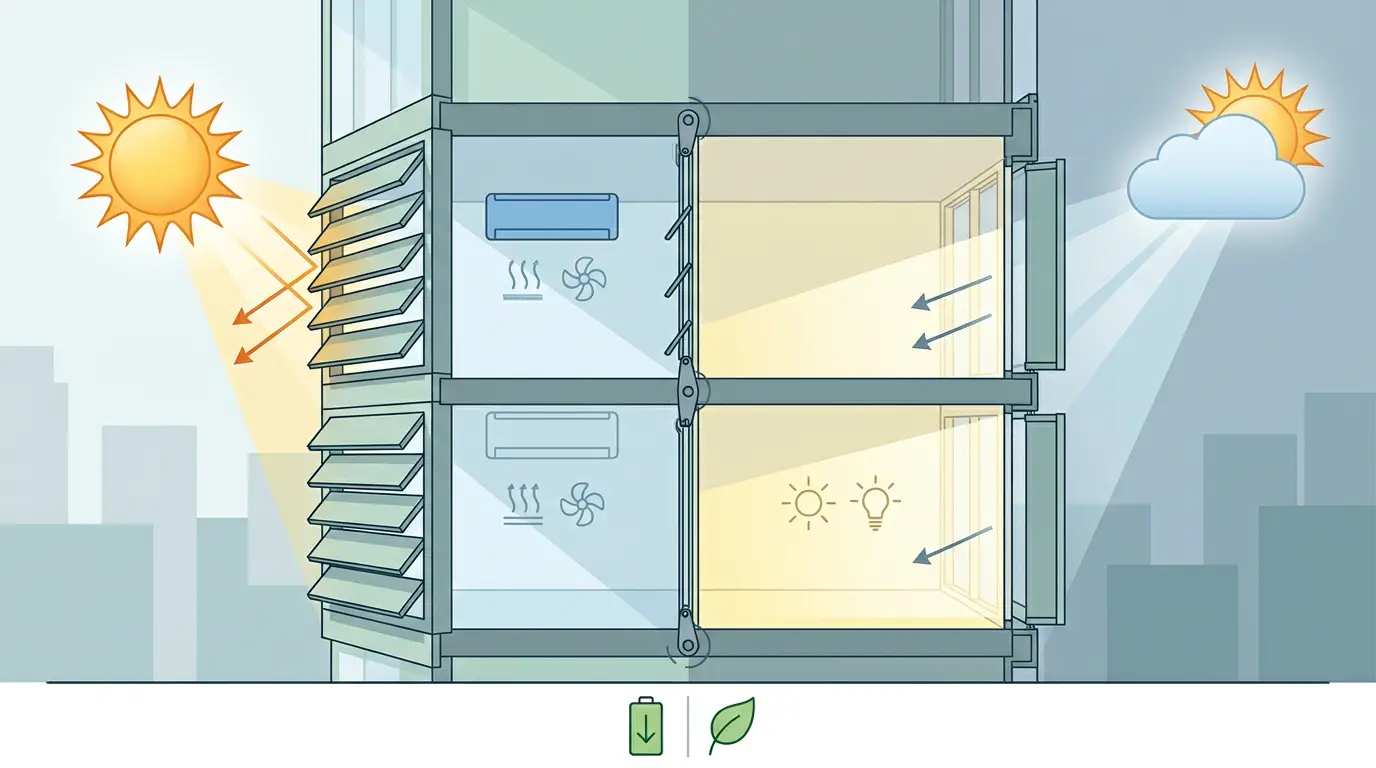
A smart facade—also referred to as an intelligent building envelope or adaptive facade—is an exterior building system that responds dynamically to environmental stimuli. Unlike conventional static facades, a smart facade integrates sensors, actuators, and control systems to automatically adjust its properties based on real-time data such as sunlight intensity, outdoor temperature, wind speed, and occupancy levels.
Smart facade systems can include:
- Electrochromic or thermochromic glazing that tints automatically to control solar gain
- Automated external shading systems such as motorized louvers or blinds
- Double-skin facades that create an insulating air buffer between inner and outer layers
- Photovoltaic panels embedded into facade surfaces to generate on-site energy
- Building-integrated sensors connected to a Building Management System (BMS)
The defining characteristic of a smart facade is its ability to respond, adapt, and optimize—continuously and without manual intervention.
How Does a Smart Facade Improve Building Efficiency?
Reducing Energy Consumption Through Adaptive Solar Control
One of the most direct benefits of a smart facade is its ability to manage solar heat gain. By automatically adjusting glazing opacity or deploying external shading in response to sunlight levels, smart facades reduce the demand placed on heating, ventilation, and air conditioning (HVAC) systems.
According to the U.S. Department of Energy, solar heat gain through windows can account for up to 40% of cooling loads in commercial buildings. Smart glazing solutions—particularly electrochromic glass—can reduce this figure significantly by modulating visible light and infrared radiation in real time.
Improving Thermal Performance and Insulation
Double-skin and ventilated facade systems create a controlled air cavity between exterior and interior surfaces. This buffer zone acts as a thermal insulator in winter and a ventilated exhaust channel in summer, reducing heat transfer in both directions.
The result: lower heating costs during colder months and reduced cooling demand during warmer periods—without sacrificing natural light or views.
Enhancing Daylighting While Minimizing Glare
Smart facades are designed to maximize the use of natural daylight. Automated shading and dynamic glazing allow diffused light to enter a space while blocking direct sunlight that causes glare and discomfort. This reduces reliance on artificial lighting—one of the largest energy loads in commercial buildings—while maintaining a visually comfortable interior environment.
Integrating Renewable Energy Generation
Photovoltaic smart facades convert the building's own exterior surface into an energy-generating asset. Building-Integrated Photovoltaics (BIPV) can be incorporated into spandrel panels, curtain wall systems, and canopies, generating clean electricity while simultaneously serving as a weather-resistant cladding layer.
Supporting Intelligent Building Management
Smart facades do not operate in isolation. When connected to a BMS or IoT-enabled platform, facade components share real-time performance data with central control systems. This enables predictive adjustments—for example, pre-cooling a space before anticipated peak solar exposure—and allows facility managers to monitor facade efficiency through dashboards and analytics tools.
Smart Facade vs. Traditional Facade: A Comparison
| Feature | Traditional Facade | Smart Facade |
|---|---|---|
| Solar control | Static (fixed shading or tinting) | Dynamic (auto-adjusting glazing or shading) |
| Energy efficiency | Moderate | High (up to 50% energy savings) |
| Occupant comfort | Inconsistent | Consistently optimized |
| Maintenance monitoring | Manual inspection | Sensor-based, real-time monitoring |
| Renewable energy integration | Rare | Supported (BIPV) |
| Initial cost | Lower | Higher upfront, lower lifecycle cost |
| BMS integration | Limited | Full integration capability |
The higher upfront investment of a smart facade is typically offset by long-term operational savings, reduced HVAC wear, and improved asset value. For large commercial buildings and mixed-use developments, the return on investment can be realized within 5 to 10 years, depending on climate and usage patterns.
Key Benefits of Smart Facade Systems at a Glance
- Energy savings: Reduced HVAC and lighting loads contribute to significantly lower operational costs
- Occupant well-being: Consistent thermal comfort and controlled daylighting improve productivity and satisfaction
- Sustainability compliance: Smart facades support LEED, BREEAM, and other green building certification requirements
- Building value: Intelligent building envelopes are increasingly valued by investors and tenants in commercial real estate markets
- Operational intelligence: Real-time data from facade sensors informs better facility management decisions
The Future of Smart Building Envelopes
Smart facade technology continues to advance rapidly. Emerging developments include kinetic facades that physically shift in geometry to track the sun, phase-change materials embedded in facade panels to store and release thermal energy, and AI-driven control systems that learn from historical weather and occupancy data to anticipate conditions before they occur.
As smart city infrastructure expands and net-zero building targets become regulatory requirements in more regions, smart facades are transitioning from a premium feature to a standard expectation in high-performance construction.
Make Your Building Work Smarter
Smart facades represent a measurable, technology-driven approach to reducing energy waste and improving the built environment. For developers, facility managers, and building owners seeking to lower operational costs, meet sustainability benchmarks, and deliver better occupant experiences, intelligent facade systems offer a compelling solution grounded in proven technology.
To explore how smart building technologies—including advanced facade systems, structured cabling, and building management integration—can be implemented in your next project, contact our team of specialists today.
Frequently Asked Questions
-
What is the primary purpose of a smart facade?
A smart facade's primary purpose is to dynamically regulate a building's interaction with its external environment—controlling heat, light, and airflow in real time to reduce energy consumption, lower HVAC loads, and improve occupant comfort.
-
How much energy can a smart facade save?
Smart facades can reduce a building's energy consumption by up to 50%, according to building performance research. Actual savings vary depending on the building type, climate zone, facade technology selected, and level of BMS integration.
-
What types of buildings benefit most from smart facade systems?
Commercial office buildings, hospitals, educational institutions, and large mixed-use developments benefit most due to their high energy loads, extended occupancy hours, and stringent comfort requirements. However, smart facade principles are increasingly being applied to high-performance residential projects as well.
-
How does a smart facade connect to a Building Management System (BMS)?
Smart facade components—such as motorized shading, electrochromic glazing, and environmental sensors—are connected to a BMS via wired or wireless protocols (e.g., BACnet, KNX, or Modbus). The BMS processes real-time sensor data and issues automated commands to facade actuators, enabling centralized monitoring and control.
-
Are smart facades compatible with green building certifications such as LEED or BREEAM?
Yes. Smart facades contribute directly to credits in energy efficiency, indoor environmental quality, and innovation categories within LEED and BREEAM frameworks. Their ability to reduce energy use intensity (EUI) and improve daylighting metrics makes them a valuable component of any green building strategy.