Shopping Cart


- Articles
- Networking
- Fiber vs. Copper Cabling: How to Choose for Your Office
Fiber vs. Copper Cabling: How to Choose for Your Office
Compare fiber optic and copper cabling to determine the best networking solution for your office based on speed, distance, scalability, security, and budget.
By Blue Edge Team | Published Jun 16, 2026 | Updated Sep 23, 2026 | 4 min read
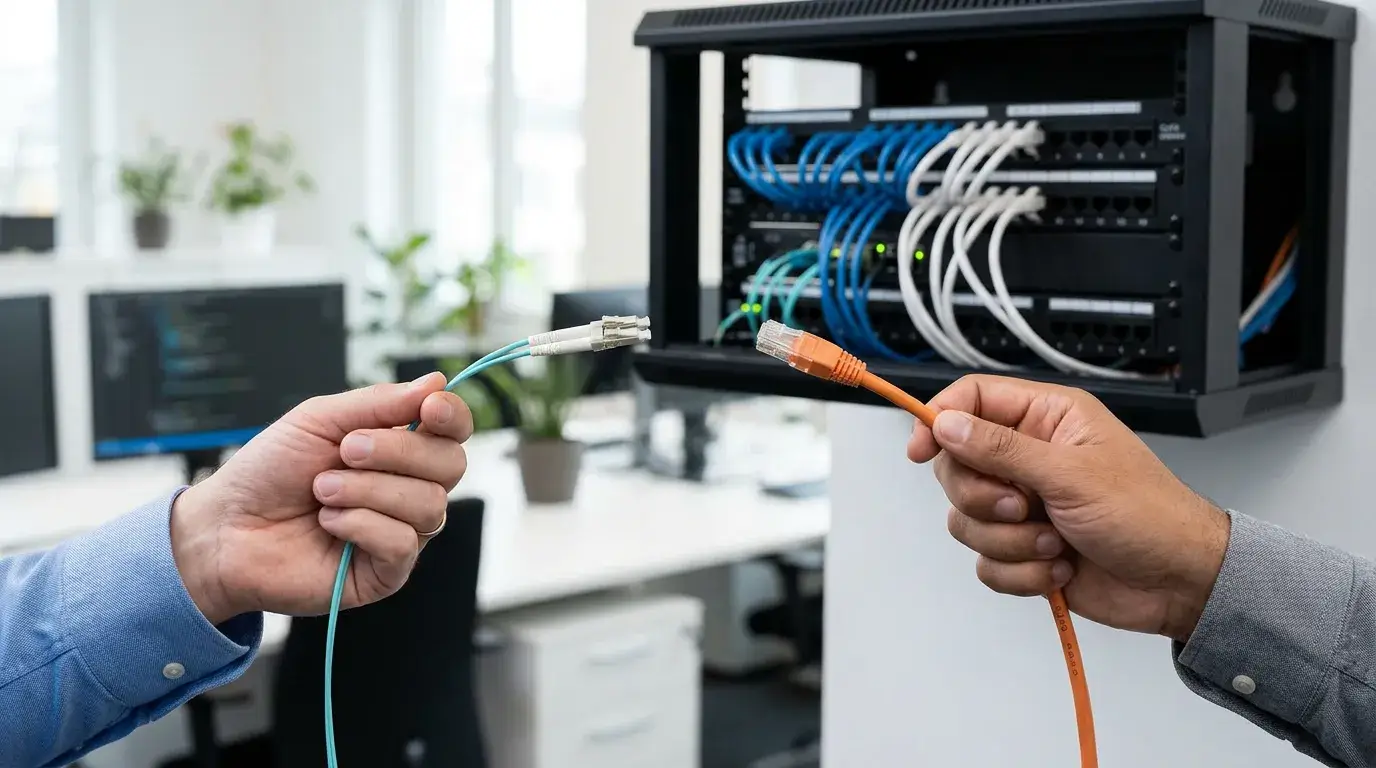
Choose fiber optic cabling for high-speed, long-distance data transmission and future-proofing large enterprise spaces. Select copper cabling for cost-effective, short-distance connections and devices requiring Power over Ethernet (PoE). Your decision depends directly on your budget, facility size, and specific bandwidth requirements.
Modern businesses require secure, flexible, and high-performance communication systems. A reliable network infrastructure serves as the backbone of daily operations, ensuring uninterrupted data flow and seamless connectivity. Selecting the correct structured cabling infrastructure directly impacts overall productivity and long-term scalability. This guide details the technical specifications, advantages, and specific use cases for both fiber optic cabling and copper cabling to help you make an informed investment.
What are the primary differences between fiber and copper cabling?
Understanding the fundamental technologies behind each cabling type is essential for designing an efficient enterprise network.
How does copper cabling work?
Copper cabling uses electrical pulses to transmit data across a network. It remains the standard choice for most local area networks (LANs).
- Transmission method: Sends electrical currents through solid or stranded copper wires.
- Standard categories: Includes Cat5e, Cat6, Cat6a, and Cat8, each offering progressive speed and bandwidth improvements.
- Distance limitation: Typically restricted to 100 meters (328 feet) before signal degradation occurs.
- Power delivery: Supports Power over Ethernet (PoE), allowing cables to deliver both data and electrical power to devices like IP telephony systems and smart building technologies.
How does fiber optic cabling work?
Fiber optic cabling transmits data using light pulses traveling through extremely thin strands of glass or plastic.
- Transmission method: Uses light to send data, making the system completely immune to electromagnetic interference (EMI).
- Speed and bandwidth: Offers vastly superior bandwidth capabilities, supporting modern network speeds up to 100 Gbps and beyond.
- Distance capabilities: Can transmit data over several kilometers without significant signal loss.
- Durability: The glass strands are highly resistant to environmental factors like temperature fluctuations and moisture once correctly deployed.
How do you choose between fiber and copper cabling for your office?
Your organization must carefully evaluate its operational requirements to determine the optimal cabling infrastructure.
When should your business choose copper cabling?
Choose copper cabling if your priority is cost-effective connectivity for standard office equipment within a single facility.
- Budget constraints: Copper cabling and its associated hardware (switches, routers) are significantly less expensive than fiber optic alternatives.
- Short distances: Ideal for connecting individual workstations, printers, and video conferencing solutions within a single floor or small office building.
- Device power requirements: Select copper when deploying PoE-enabled devices, successfully eliminating the need for separate electrical wiring to ceiling access points or security cameras.
When should your business choose fiber optic cabling?
Choose fiber optic cabling if your organization requires maximum network performance, advanced security systems, and long-term scalability.
- High bandwidth demands: Essential for enterprise data centers, server rooms, and businesses handling massive data transfers.
- Extended distances: Required for connecting multiple office buildings across a corporate campus or spanning large manufacturing facilities.
- Harsh environments: Optimal for industrial settings with high electromagnetic interference, as the light signals remain completely unaffected by heavy machinery or electrical noise.
- Maximum security: Fiber optic cables are extremely difficult to tap without detection, making them the preferred choice for secure cybersecurity systems and government applications.
Frequently Asked Questions
-
What is the cost difference between fiber and copper cabling?
Fiber optic cabling requires a higher initial investment than copper cabling. The fiber cables themselves, along with the specialized transceivers, switches, and installation labor, typically cost more than a standard copper installation. However, fiber optic cabling offers a longer lifecycle and lower maintenance costs over time, providing excellent long-term value for growing enterprises.
-
Can fiber and copper networks be combined in one office?
Yes, modern businesses frequently deploy hybrid networks to maximize efficiency and control costs. A highly effective architecture involves using fiber optic cabling for the primary network backbone (connecting main server rooms to individual floors) and utilizing copper cabling to connect desktop computers and IP phones to the local floor switches.
-
Which cabling type offers better network security?
Fiber optic cabling provides superior network security. Copper cables emit electromagnetic signals that can potentially be intercepted by sophisticated eavesdropping equipment. Conversely, fiber optic cables transmit light, emitting no external signals. Any physical attempt to tap the glass strands will instantly break the connection and alert network administrators to the intrusion.
Secure Your Network Infrastructure with Blue Edge
Selecting the correct structured cabling infrastructure is a critical operational decision. Both fiber optic cabling and copper cabling offer distinct advantages, and the optimal solution often involves a strategically designed combination of both technologies.
Blue Edge for Communication and Technology (BEC) empowers partners and clients across Saudi Arabia by delivering cutting-edge communication and technology solutions. We partner with world-leading brands to deliver innovative and reliable solutions. Every product we offer is tested and proven to meet the highest industry standards, ensuring optimal performance and durability.
Contact Blue Edge today to schedule a comprehensive consultation and build a secure, high-performance structured cabling infrastructure for your organization.
About Blue Edge
Blue Edge Company is a value-added technology distributor based in Dammam, Saudi Arabia, supplying interactive displays, smart building systems, networking infrastructure and IT security software to businesses and residential projects across the Kingdom, with installation and technical support.
Learn more about Blue Edge →Published 16 June 2026 • Last updated 23 September 2026 • This article is reviewed when standards, regulations or product guidance change.