Shopping Cart


- Articles
- Networking
- IP Cameras vs Analog CCTV: What Businesses Should Buy
IP Cameras vs Analog CCTV: What Businesses Should Buy
IP cameras vs analog CCTV compared on cabling, PoE, storage, cost and Saudi camera-law compliance, so you can pick the right system for your site.
By Blue Edge Team | Published Aug 31, 2026 | Updated Oct 03, 2026 | 15 min read
Quick answer
IP cameras are the right choice for almost every new business installation in Saudi Arabia, because Saudi Arabia's Law of the Use of Security Surveillance Cameras requires HD-or-higher resolution and long retention periods that analog CCTV struggles to deliver at scale. Analog CCTV remains defensible only where usable coaxial cable already exists and the site has no expansion plans.
Buying the wrong camera system is expensive twice. The first cost is the hardware and the labour. The second cost arrives eighteen months later, when an incident happens, the footage is either overwritten or too coarse to identify anyone, and the recorder has no spare channels for the cameras you now need.
Most buying guides settle this comparison on resolution alone, which is the least useful criterion available. The decision is actually made by cabling, power budget, storage arithmetic, cybersecurity exposure and regulatory obligation. Those five factors determine whether a camera system still does its job in year four.
This article compares IP cameras and analog CCTV on each of those criteria, gives you the maths that converts camera bitrate into disk capacity, sets out what Saudi Arabia's surveillance camera regulations require, and ends with a decision rule you can apply to your own building.
What Is the Difference Between IP Cameras and Analog CCTV?
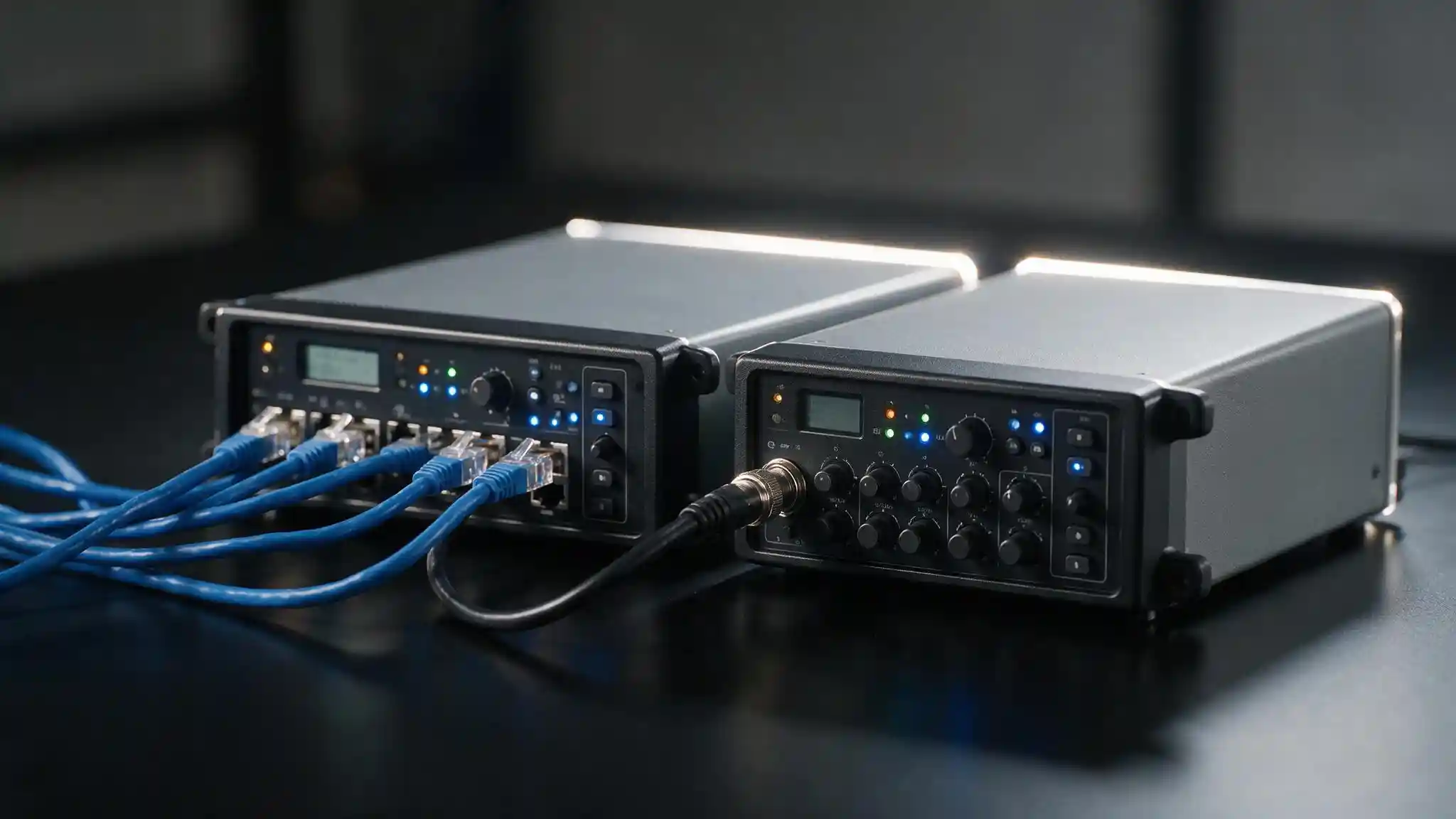
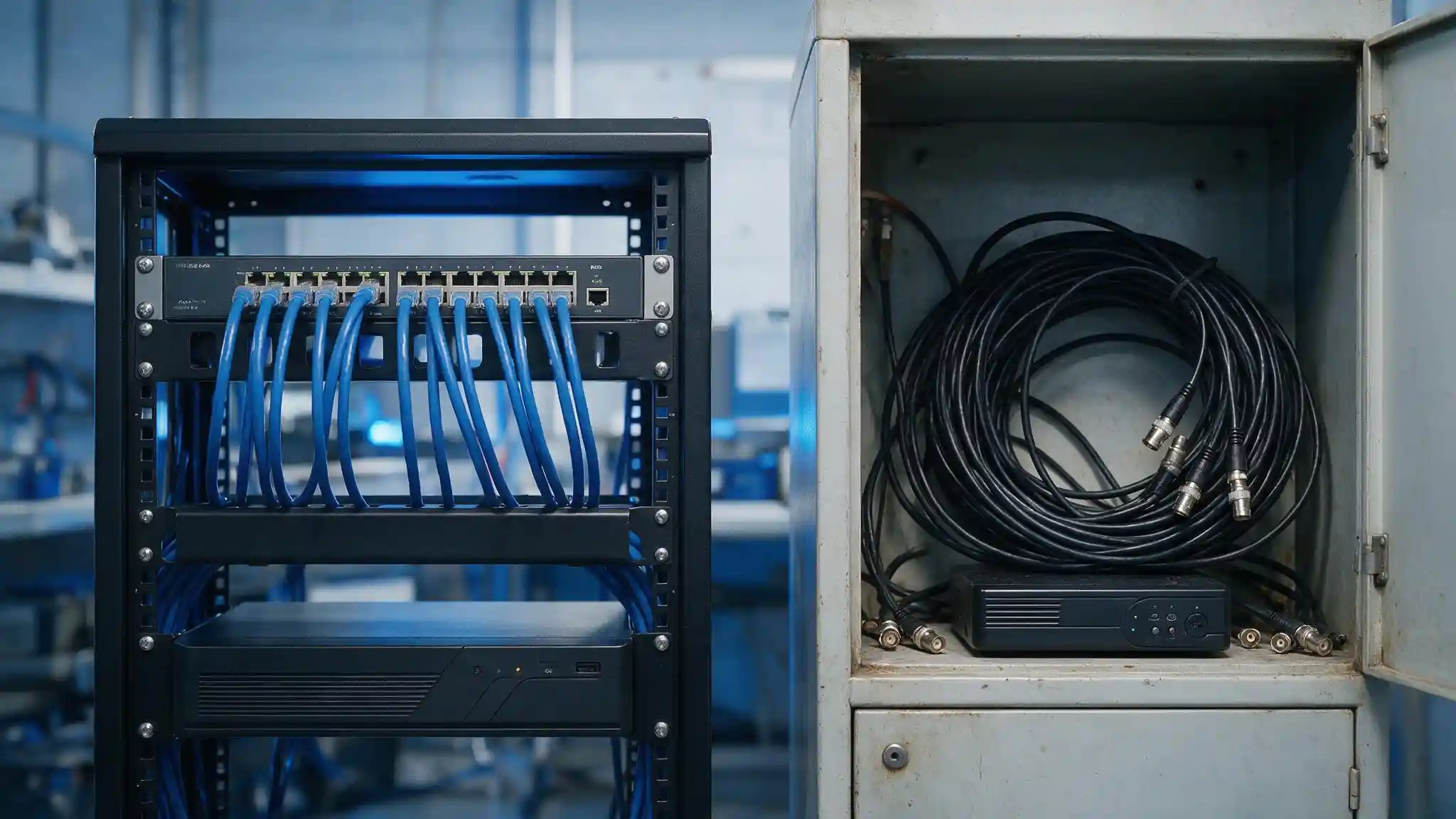
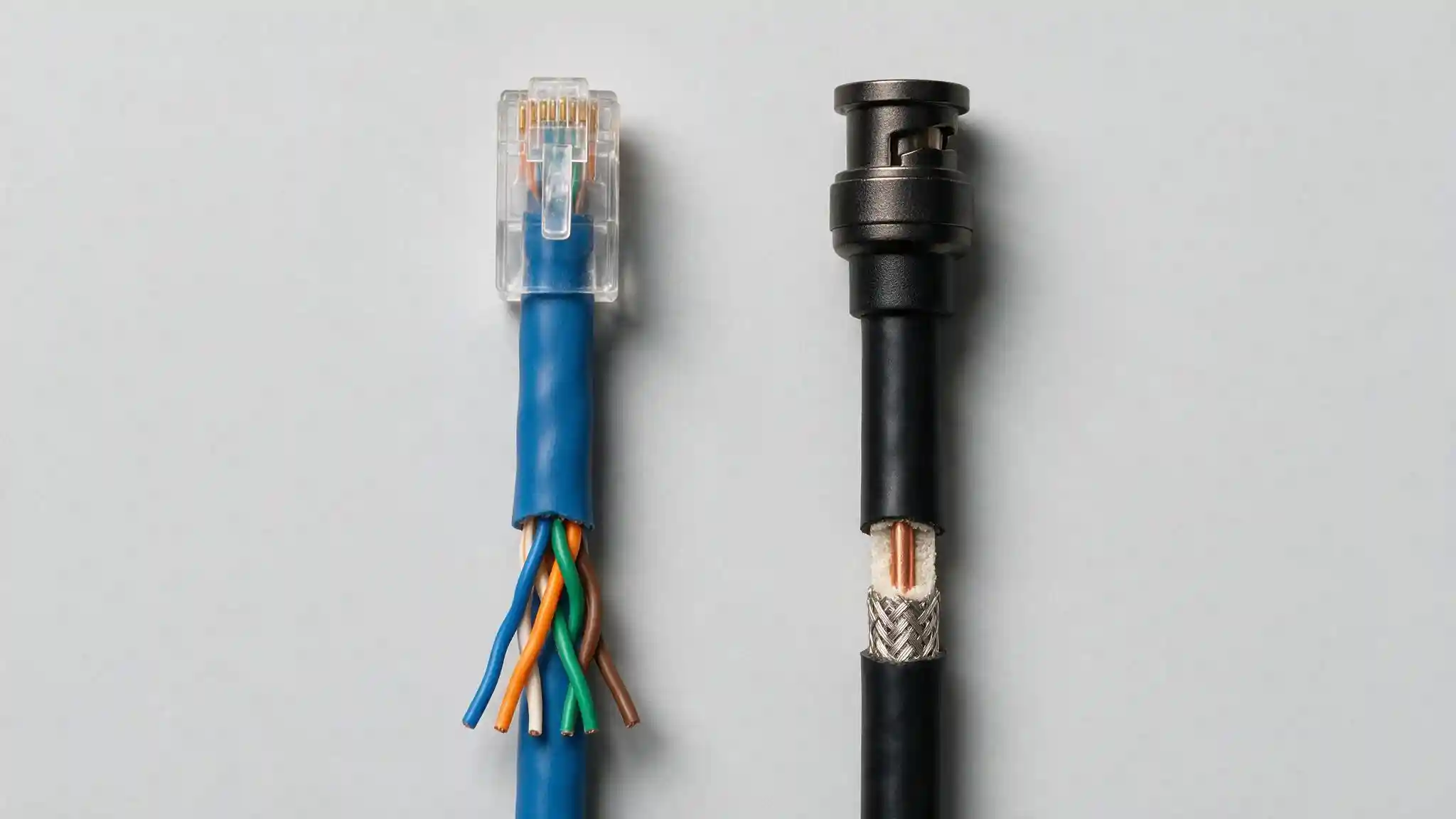
An IP camera is a network-attached surveillance device that digitises and compresses video on board, then transmits it over an Ethernet network to a Network Video Recorder (NVR) or a video management system. Analog CCTV is a closed-circuit video system in which each camera sends an unprocessed video signal over coaxial cable to a Digital Video Recorder (DVR), which performs all encoding, storage and processing centrally.
The practical difference is where the intelligence sits. In an IP camera system, the camera is a computer with a lens, running its own firmware, its own compression and often its own analytics. In an analog CCTV system, the camera is a sensor and nothing more, and every decision about image handling belongs to the DVR.
Modern analog is not the grainy analog of a decade ago. HD-over-coax formats such as HD-TVI, HD-CVI and AHD carry high-definition video over the same RG59 coaxial cable that older systems used. This is why analog CCTV still appears in tenders today. The transmission format changed; the topology did not.
The terminology is often used loosely. "CCTV" describes any closed-circuit video system, including IP-based ones. This article uses "analog CCTV" specifically to mean coax-to-DVR systems.
Which System Gives Better Image Quality and Coverage?
IP cameras win on image quality and coverage in almost every real deployment, because they are not constrained by a fixed transmission format. IP camera ranges include 4K sensors, multi-sensor units that cover 180 or 360 degrees from a single mounting point, and models with on-board analytics that classify people and vehicles rather than simply detecting motion.
Resolution alone is a weak comparison. What matters is pixel density at the distance you actually need to identify a face or a licence plate, usually expressed in pixels per metre. A 4K camera aimed across a wide car park may deliver worse identification than a 2 MP camera correctly positioned at a door. Specify the task first, then the sensor.
Coverage economics favour IP as well. One multi-sensor IP camera can replace three or four fixed analog cameras at a building corner or an atrium, which reduces mounting points, cable runs and installation labour. Analog CCTV has no equivalent, because each coaxial run carries exactly one video channel.
Analog CCTV does hold one genuine technical advantage. An analog signal travels from camera to DVR with effectively no encoding delay, while an IP stream adds encode, transport and decode latency measured in tens to hundreds of milliseconds. For live guard monitoring in a control room, that difference is rarely noticeable. For an operator driving a pan-tilt-zoom camera to follow a moving target, it can be.
Can a Business Reuse Its Existing Coaxial Cabling?
Yes, a business can reuse existing coaxial cabling, using either a video encoder that converts analog camera feeds into IP streams, or Ethernet-over-coax adapters that carry IP traffic over the legacy cable. Both routes let a site move to a modern video management system without opening walls and ceilings.
The limitation is important and rarely stated by vendors. A video encoder inherits the resolution of the analog camera in front of it. Reusing coax buys you IP management, remote access and centralised recording. It does not buy you IP image quality. If the reason for the upgrade is unusable footage, an encoder will not fix it.
Two practical checks decide whether reuse is viable:
Test the cable, do not assume it. Older RG59 runs in Gulf buildings frequently show corroded connectors, water ingress at outdoor terminations, and cable that was never rated for the run length. Certify the runs before you plan a budget around them.
Check where the coax terminates. Legacy coaxial cable usually converges on a single DVR cupboard, which may sit nowhere near the IDF or MDF room your IP network uses. Bridging that gap can erase the savings the reuse was supposed to deliver.
A hybrid approach often makes sense in phased refits. Keep encoders on legacy coax in low-risk zones, and run new Cat6 or Cat6A cabling to entrances, cash points, server rooms and loading bays where identification quality actually matters.
How Much Bandwidth and Storage Does an IP Camera System Need?
IP camera bandwidth depends on resolution, frame rate, compression codec and scene activity, and it varies continuously rather than sitting at a fixed number. H.265/HEVC and vendor smart codecs cut bitrate substantially against H.264 in static scenes, then rise sharply when a scene fills with movement. Size the system on peak bitrate, never on the average figure printed in a brochure.
How do you calculate storage for 90 days of footage?
Storage arithmetic is fixed and easy to verify, unlike bandwidth. Work through it in four steps:
- Convert bitrate to daily volume. One megabit per second of continuous recording consumes approximately 10.8 GB per day.
- Multiply by the retention period. At 90 days, that same 1 Mbps stream needs roughly 972 GB, or just under 1 TB.
- Multiply by camera count. Twenty cameras averaging 3 Mbps each equal 60 Mbps, which is about 648 GB per day and roughly 58 TB across 90 days.
- Add overhead. Allow headroom for RAID parity, peak-activity spikes, and any retention extension the facility classification requires.
That final number is usually the point at which the real budget conversation starts, and it is the single most common reason camera projects get re-scoped after award.
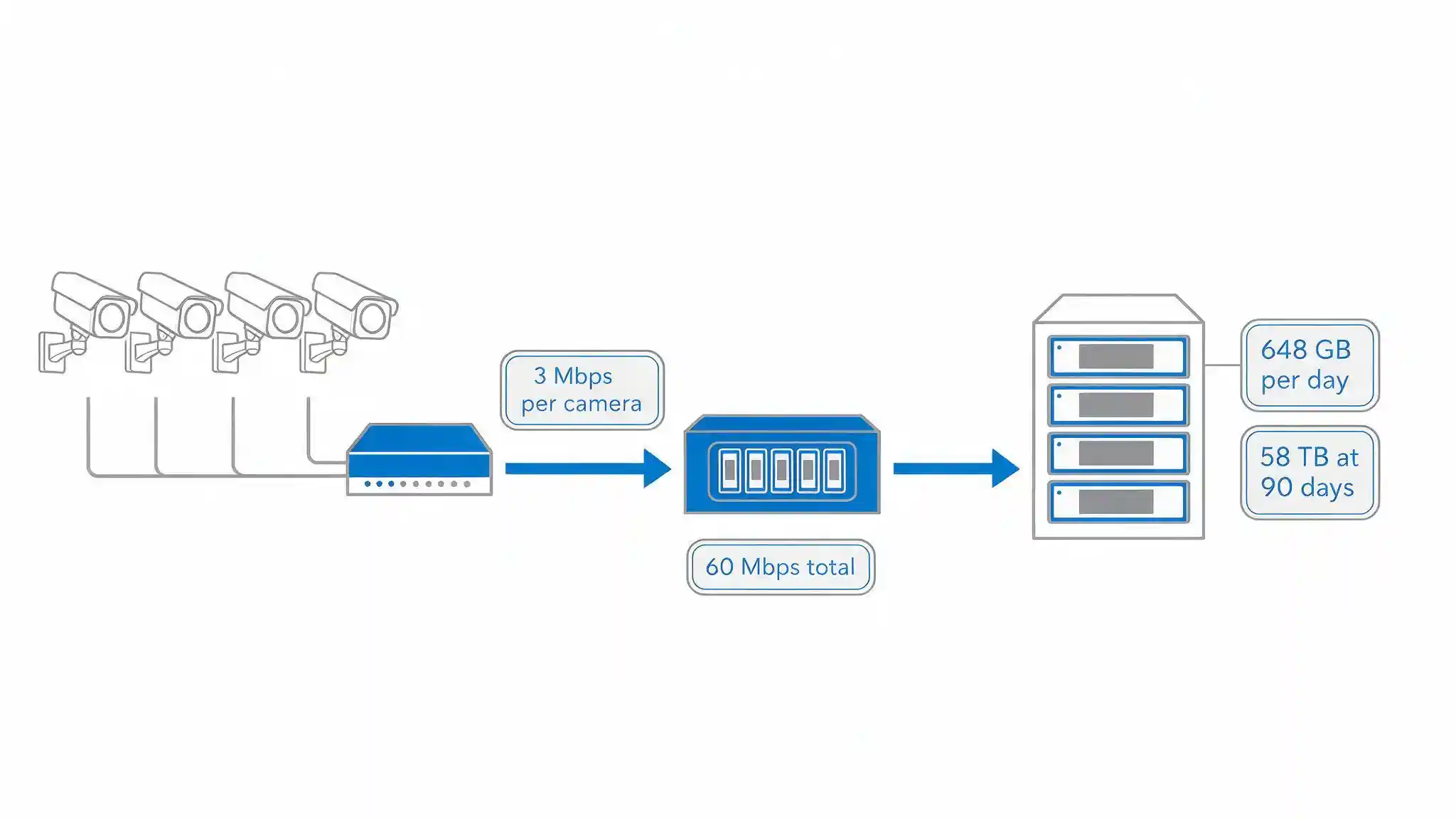
Network capacity matters as much as disk capacity. Twenty cameras at 3 Mbps will not trouble a gigabit link, but the traffic is continuous and it competes with everything else on the same infrastructure. Put cameras on a dedicated VLAN, both for network segmentation and to keep a compromised device away from business systems.
How much PoE power do IP cameras need?
Power planning is where IP camera deployments most often fail. IP cameras draw power over the network cable under the IEEE 802.3 Power over Ethernet standards. IEEE 802.3af (Type 1) supplies up to 15.4 W at the switch port, IEEE 802.3at (Type 2) up to 30 W, and IEEE 802.3bt (Types 3 and 4) up to 60 W and 90 W respectively.
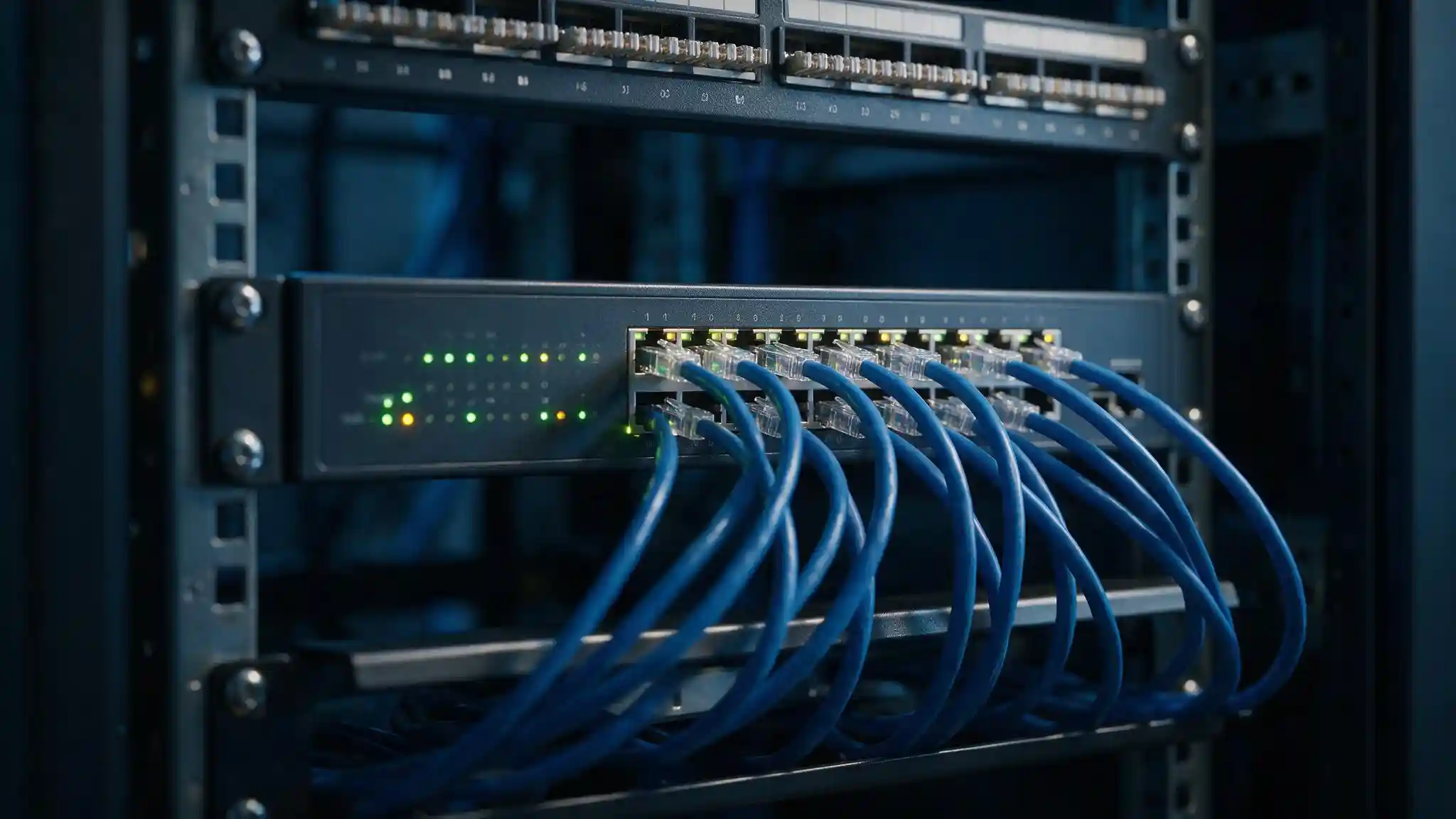
Add the per-port figures together and compare the total against the switch's PoE power budget, not its port count. A switch with 24 PoE ports rarely has the budget to run 24 high-draw cameras at once. Cameras typically fail at night, when infrared illuminators and heaters switch on together and push the switch past its limit. Size the PoE switch on total wattage, and review the Power over Ethernet guide before finalising the design.
Cable distance is a hard limit rather than a guideline. ANSI/TIA-568 specifies a maximum 100-metre channel for balanced twisted-pair cabling, which includes the patch cords at both ends. Analog coax runs several hundred metres depending on the format. For long external runs across large sites, the answer is usually a fibre backbone to a local switch rather than a longer copper run.
Comparing IP Cameras and Analog CCTV: Key Differences at a Glance
The table below compares both systems across the criteria that decide procurement outcomes.
| Criterion | IP Camera System | Analog CCTV (HD-over-Coax) |
|---|---|---|
| Cabling | Cat6 / Cat6A twisted pair, 100 m maximum channel under ANSI/TIA-568 | RG59 coaxial plus a separate power cable, several hundred metres |
| Power | Power over Ethernet on the same cable as data | Separate low-voltage power run to every camera |
| Resolution ceiling | 4K and above, plus multi-sensor and panoramic models | Up to 4K on modern formats, most installed base at 1080p |
| Compression | H.264, H.265/HEVC and vendor smart codecs, handled on camera | Handled at the DVR, format fixed by the recorder |
| Analytics | On-camera analytics including object classification and line crossing | Limited, DVR-side only |
| Interoperability | ONVIF profiles allow mixed-vendor cameras and VMS | Proprietary per format, limited cross-brand support |
| Cybersecurity exposure | Sits on the IP network, requires VLANs, hardening and patching | Camera is not IP-addressable, DVR still needs hardening |
| Latency | Encode and decode delay of tens to hundreds of milliseconds | Effectively real time across the coaxial run |
| Scalability | Add switch ports and licences | Fixed by DVR channel count, expansion means a new recorder |
| Best suited for | New builds, multi-site estates, regulated facilities, 90-day retention, analytics | Single-site retrofits with tested coax already installed and no growth plan |
Key takeaway
IP cameras are the stronger choice wherever retention, analytics, scalability or regulatory compliance are in scope, which covers most commercial premises in Saudi Arabia. Analog CCTV remains competitive in one narrow case: a single site with usable coaxial cable already in the walls, a modest camera count, and no plan to expand. Latency is the only criterion on which analog reliably outperforms IP, and it matters mainly for live pan-tilt-zoom operation.
What Does Each System Cost Over Five Years?
Analog CCTV is cheaper to buy and IP is cheaper to own, and the crossover usually falls in year two or three. The camera hardware gap has narrowed considerably, so the real difference now sits in cabling labour, licensing, storage and expansion.
| Cost Element | IP Camera System | Analog CCTV (HD-over-Coax) |
|---|---|---|
| Camera hardware | Medium to high | Low to medium |
| Cabling material | Medium (Cat6 / Cat6A) | Low (RG59 plus separate power cable) |
| Installation labour | Lower, one cable carries data and power | Higher, two cables to every camera |
| Recording platform | Medium to high, often licensed per channel | Low, DVR channels included |
| Storage | High at 4K with long retention | Medium |
| Expansion cost | Low, add switch ports and licences | High, a new DVR once channels run out |
| Analytics | Included on many cameras | Limited or unavailable |
| Five-year total | Medium | Medium to high once expansion is included |
Two cost drivers get underestimated consistently. The first is licensing, because per-channel video management licences accumulate quietly across a multi-site estate. The second is expansion, because DVR channel counts are fixed, and the seventeenth camera on a sixteen-channel DVR costs the price of an entire new recorder.
What Do Saudi Regulations and Gulf Climate Demand From a Camera System?
Saudi Arabia regulates business camera systems directly, and the regulation shapes the specification before any technical preference does.
What does Saudi Arabia's surveillance camera law require?
The Law of the Use of Security Surveillance Cameras, issued under Royal Decree No. M/34 of 1444H and administered by the Ministry of Interior, governs how camera systems are supplied and operated in the Kingdom. Four obligations affect procurement most:
Prior approval. The Ministry of Interior requires approval covering the manufacture, import, sale, installation, operation and maintenance of security surveillance cameras. This applies to your installer as much as to your business.
Covered facilities. The law applies to a broad list including government bodies, oil and petrochemical facilities, power and desalination plants, commercial complexes and shopping centres, financial institutions, hotels and tourist accommodation, residential towers, healthcare and education facilities, warehouses, fuel stations and food service establishments.
Prohibited areas. Cameras must not be installed in medical examination and operating rooms, inpatient and physiotherapy rooms, changing rooms, restrooms, women's salons and clubs, or other private spaces named in the Implementing Regulation.
Signage and retention. Visible signage is mandatory in covered areas, and minimum retention periods apply according to facility classification. Industry guidance in the Saudi market commonly cites a 90-day minimum, and the Ghazzawi Law Firm reports penalties ranging from SR 500 for installing a camera that fails the specification requirements to SR 20,000 for circulating or copying recordings. Confirm the exact period for your facility against the current Security Conditions and Requirements Document rather than relying on a vendor's summary.
What do the PDPL and NCA ECC add?
Two further Saudi frameworks apply to any business camera system. Recorded footage of identifiable individuals is personal data under the Personal Data Protection Law (PDPL) administered by the Saudi Data and Artificial Intelligence Authority (SDAIA), which brings obligations around purpose limitation, access control and disclosure.
Cameras are also network-connected assets under the National Cybersecurity Authority's Essential Cybersecurity Controls (ECC), which expect asset inventory, network segmentation and patch management. An unpatched camera running default credentials is an audit finding, not a minor housekeeping item.
How does Gulf climate change the specification?
Climate is a specification input in the Eastern Province, not an afterthought. Summer ambient temperatures, airborne dust and coastal salt air around Dammam, Khobar and Jubail attack outdoor equipment in ways European datasheets do not anticipate. Specify accordingly:
- IP66 or IP67 ingress protection on all outdoor housings
- IK10 impact rating wherever vandalism is a credible risk
- Marine-grade stainless housings within a few kilometres of the coast
- Sun shields on any camera in direct exposure
- Ventilation and cooling in the IDF cabinet, because heat derates switch capacity and shortens the life of the PoE switch running your cameras
Our guide to network design for extreme desert climates covers the enclosure and cooling detail in full.
Which System Should Your Business Buy?
Buy IP cameras if any of the following is true. Most Saudi businesses match at least two.
- The site is a new build, a major refit, or already has structured cabling in place
- The facility falls into a category covered by the Law of the Use of Security Surveillance Cameras
- Retention of 90 days or more is required
- Analytics such as line crossing, loitering, people counting or licence plate recognition have operational value
- The estate spans more than one location and needs central viewing
- Camera count is likely to grow within three years
Consider analog CCTV only if all of the following are true.
- Usable coaxial cable already exists and has been tested rather than assumed
- The site is a single location with roughly 16 cameras or fewer
- No analytics, integration or multi-site viewing is required
- No expansion is planned within the equipment's service life
Choose a hybrid if working coax exists in low-risk areas and genuine identification quality is needed only at specific points. Encoders preserve the existing investment, and new Cat6A runs go where the footage has to hold up in an investigation.
Blue Edge, a technology distributor based in Dammam, Saudi Arabia, supplies the structured cabling and networking and IT installation and configuration services that IP camera deployments depend on, alongside Axis security solutions.
What Are the Most Common Mistakes in Camera Procurement?
Six mistakes account for most failed camera projects, and every one of them is visible at the design stage.
Sizing storage on average bitrate. The recorder fills faster than planned and begins overwriting early, which quietly breaks the retention period the facility is required to hold.
Ignoring the switch PoE budget. Cameras drop out at night, when infrared illuminators and heaters draw peak power at the same time.
Putting cameras on the business VLAN. One compromised camera with default credentials becomes a lateral movement path into finance and HR systems.
Specifying resolution instead of pixel density. A 4K camera on the wrong lens at the wrong distance still produces footage in which nobody can identify a face.
Skipping Ministry of Interior approval and signage. The system works and is still non-compliant, which surfaces during inspection or immediately after an incident.
Selecting enclosures on price. Under-rated housings fail within one or two Gulf summers, and the replacement labour costs more than the original saving.
Choose Based on Lifespan, Not Sticker Price
For most Saudi businesses buying in 2026, IP cameras are the correct answer, and the deciding factor is regulatory rather than technical. A system that must hold 90 days of high-definition footage, survive audit against the PDPL and the NCA Essential Cybersecurity Controls, and expand as the site grows is an IP system by definition. Analog CCTV can satisfy a point-in-time requirement, but it cannot follow the building.
The exception is real and worth respecting. A single-site facility with tested coax, a modest camera count and no growth plan can buy analog HD-over-coax, get several good years from it, and spend the difference somewhere it matters more. That decision is sound as long as it is made deliberately rather than by default.
Whichever direction you choose, size the network first. Storage volume, PoE budget, VLAN design and cable distance decide whether a camera system performs, and every one of those is settled before a single camera is mounted.
Frequently Asked Questions
-
Can I connect IP cameras to my existing office network switch?
You can, but you generally should not without changes. IP cameras produce continuous traffic and require Power over Ethernet, so the switch needs both a sufficient PoE wattage budget and headroom for sustained streams. Place cameras on a dedicated VLAN so a compromised camera cannot reach business systems, and confirm the switch's total PoE budget rather than its port count before connecting anything.
-
How long must CCTV footage be kept in Saudi Arabia?
Minimum retention in Saudi Arabia is set by the Implementing Regulation of the Law of the Use of Security Surveillance Cameras and varies with facility classification. Industry guidance in the Saudi market commonly cites a 90-day minimum for covered facilities. Because the requirement depends on how your premises are classified, confirm the applicable period against the current Security Conditions and Requirements Document before sizing storage, since retention drives disk capacity more than any other factor.
-
Is analog CCTV still worth buying in 2026?
Analog CCTV is still worth buying in narrow circumstances. It suits a single-site facility that already has tested coaxial cable, needs roughly 16 cameras or fewer, requires no analytics or multi-site viewing, and has no expansion planned. Outside those conditions, analog CCTV costs more over five years, because DVR channel counts are fixed and expansion means replacing the recorder rather than adding capacity.
-
How much bandwidth do 20 IP cameras use?
Twenty IP cameras averaging 3 Mbps each generate roughly 60 Mbps of continuous traffic, which a gigabit network handles comfortably. The storage figure matters more: 60 Mbps consumes about 648 GB per day and roughly 58 TB across a 90-day retention period. Actual bitrate varies with resolution, frame rate, codec and scene activity, so size the system on peak bitrate and use the manufacturer's bandwidth calculator.
-
Do I need approval before installing cameras at my business in Saudi Arabia?
Yes. The Law of the Use of Security Surveillance Cameras requires Ministry of Interior approval covering the sale, installation, operation and maintenance of security surveillance cameras at covered facilities, which include commercial complexes, financial institutions, hotels, warehouses, healthcare and education premises. Visible signage is also mandatory in monitored areas, and cameras are prohibited in restrooms, changing rooms, medical examination rooms and other private spaces.
Planning a camera deployment?
Blue Edge designs and installs the structured cabling, PoE switching and network infrastructure these systems depend on across Saudi Arabia.
Call +966 53 9855 188 or contact our team to review your site requirements.
Cabling & Networking Solutions in KSAAbout Blue Edge
Blue Edge Company is a value-added technology distributor based in Dammam, Saudi Arabia, supplying interactive displays, smart building systems, networking infrastructure and IT security software to businesses and residential projects across the Kingdom, with installation and technical support.
Learn more about Blue Edge →Published 31 August 2026 • Last updated 3 October 2026 • This article is reviewed when standards, regulations or product guidance change.