Shopping Cart



BACnet vs Modbus: Building Protocols Explained
BACnet vs Modbus compared on data models, discovery, security and cost, plus how to layer both in a Saudi building automation system that actually works.
By Blue Edge Team | Sep 02, 2026
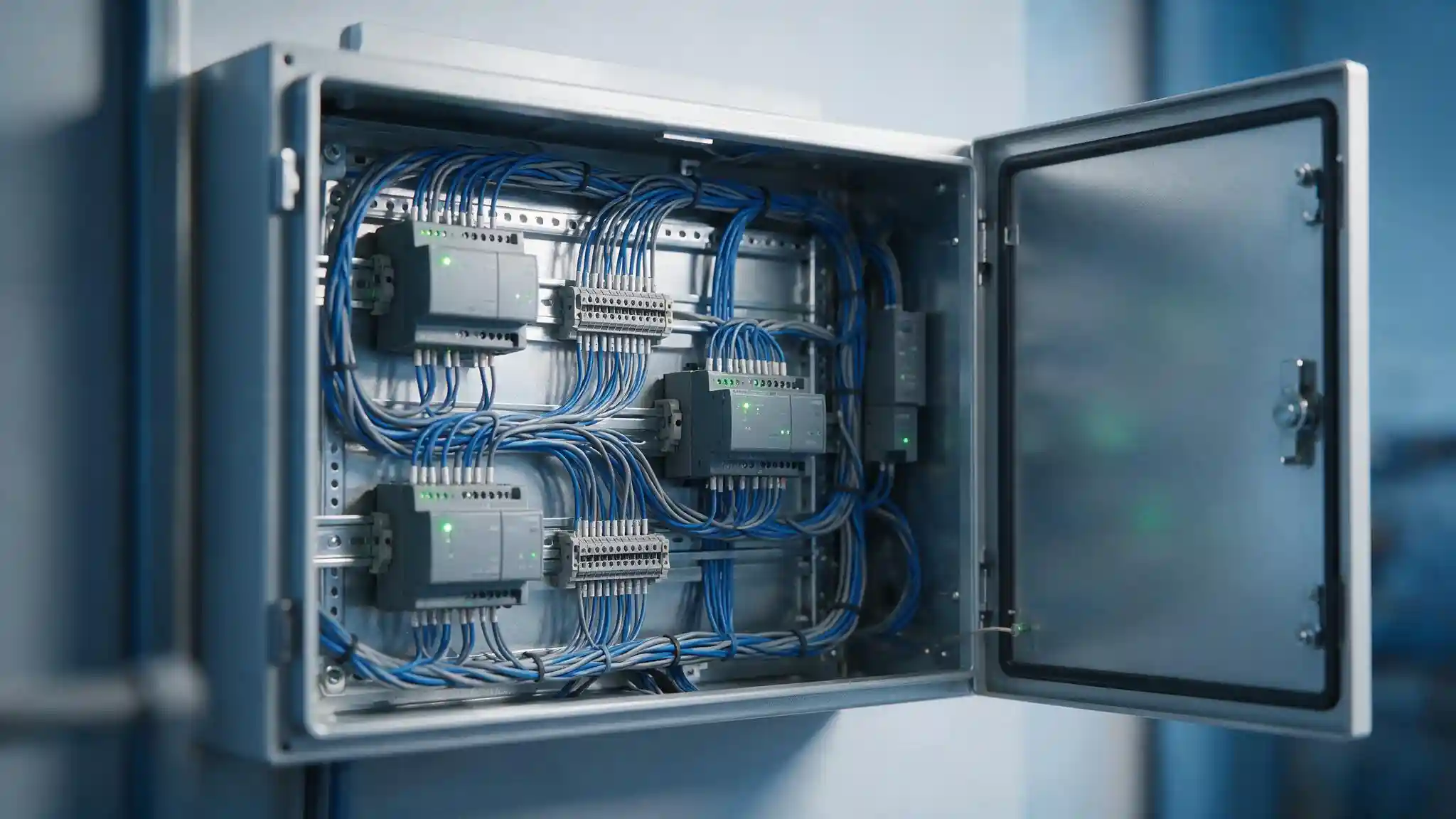
BACnet vs Modbus: Building Protocols Explained
Quick answer: BACnet is a building automation protocol developed by ASHRAE that uses a self-describing object model, so a device reports what a value means, its units and its status. Modbus is a simpler industrial protocol that moves raw 16-bit registers with no description attached. Most buildings use both: BACnet as the building-wide backbone and Modbus at the field device layer, joined by a gateway.
Every building automation project eventually reaches the same conversation. The chiller speaks one protocol, the energy meters speak another, the lighting controller speaks a third, and the head-end system has to make sense of all of them. That conversation is where budgets get spent and schedules slip.
BACnet and Modbus are the two protocols that dominate this space, and they were designed for different jobs. Treating them as competitors leads to bad specifications. Understanding what each one was built to do leads to a system that integrates on the first attempt.
This guide explains what each protocol actually is, how their data models differ, why that difference decides integration effort, how gateways bridge them and where those gateways commonly fail, and what to specify for a building in Saudi Arabia.
What Is BACnet and How Does It Work?
BACnet, short for Building Automation and Control Networks, is a communication protocol developed by ASHRAE specifically for building systems, published as ASHRAE Standard 135 and adopted internationally as ISO 16484-5. BACnet was created to let equipment from different manufacturers share information inside a building without custom drivers for every pairing.
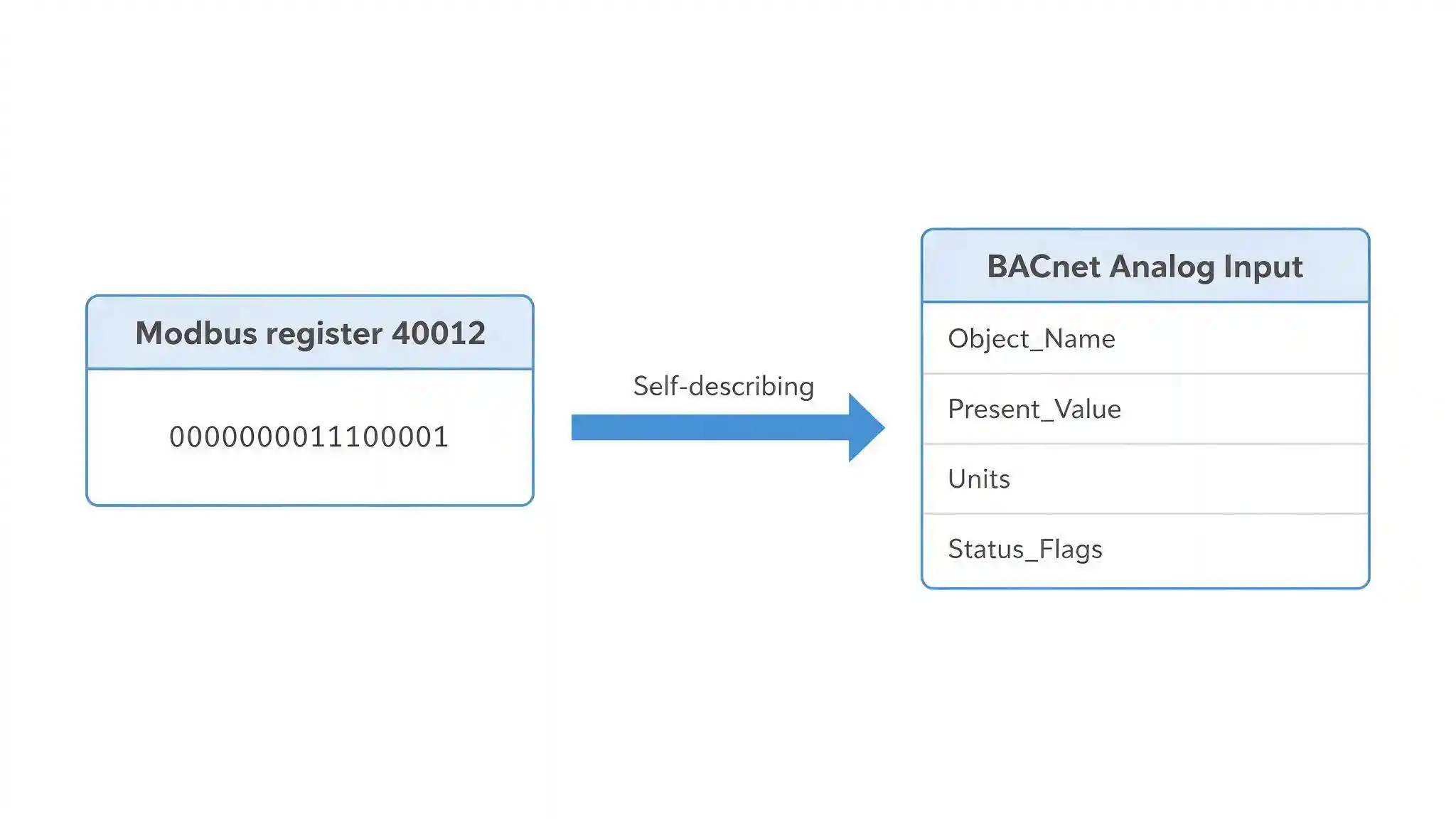
BACnet's defining feature is its object model. Instead of moving anonymous numbers, a BACnet device presents its data as standard objects such as Analog Input, Analog Output, Binary Value, Multi-state Value, Schedule, Calendar and Trend Log. Each object carries properties, including Present_Value, Object_Name, Units, Description and Status_Flags.
The practical consequence is that a BACnet device describes itself. A head-end system reading an Analog Input does not just receive the number 22.5. It receives a value named "AHU-3 Supply Air Temp", in degrees Celsius, with a status flag indicating whether the sensor is in fault or out of service.
BACnet also builds services into the protocol that would otherwise be application features:
- Who-Is and I-Am for automatic device discovery on the network
- Change of Value (COV) subscription, so a device pushes an update when a value changes instead of being polled continuously
- Scheduling and calendars held in the controller rather than the head-end
- Trend logs stored at the device, surviving a head-end outage
- Alarm and event notification with acknowledgement and priority
What is the difference between BACnet MS/TP and BACnet/IP?
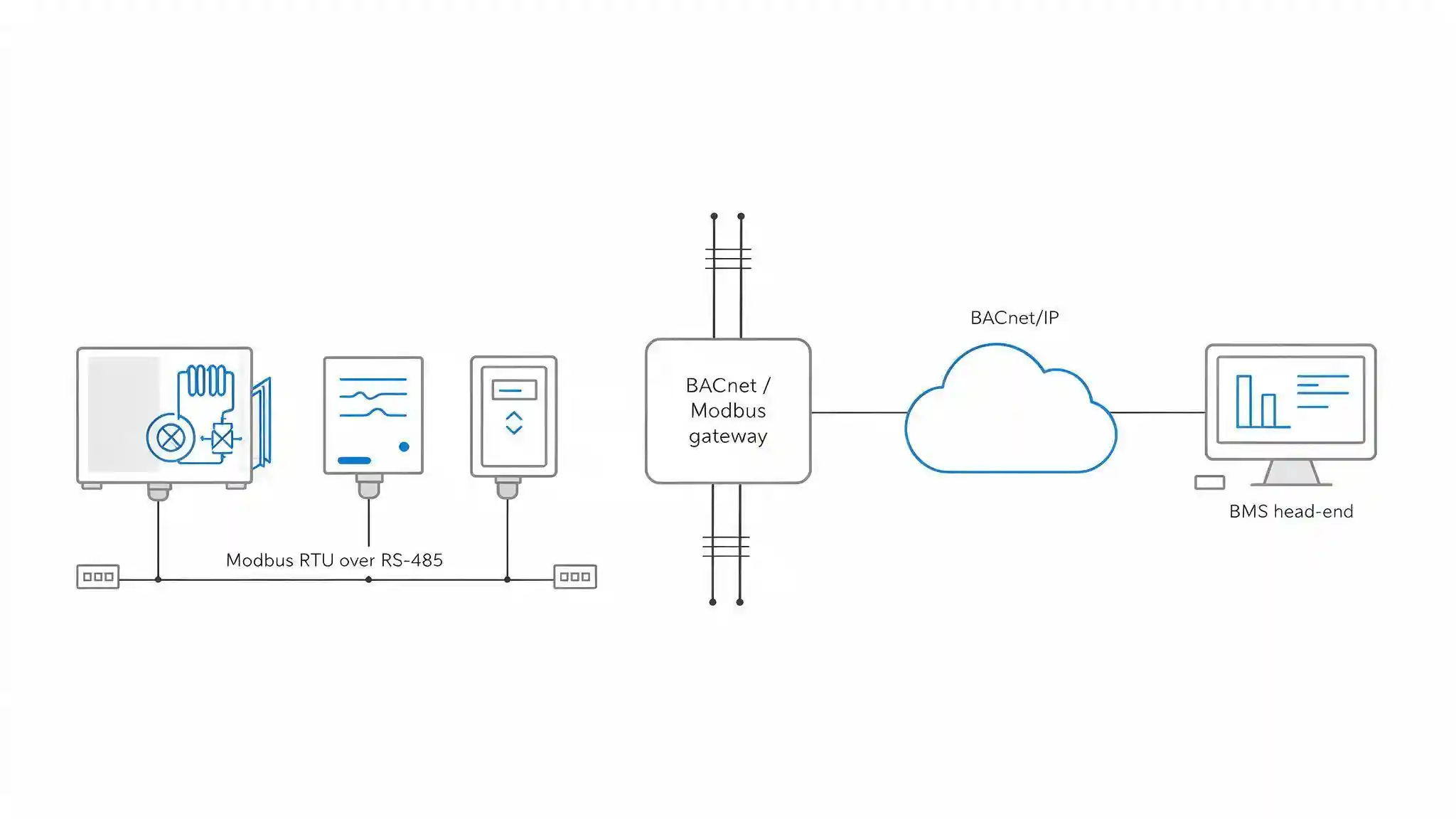
BACnet runs over several data link layers, and the two most common in buildings are BACnet MS/TP and BACnet/IP. BACnet MS/TP is a token-passing protocol running over RS-485 twisted pair, used for field controllers, VAV boxes and room devices where cabling cost matters. BACnet/IP runs over standard Ethernet and IP, used for supervisory controllers and the building backbone.
Mixing them is normal, and a BACnet router joins the two. One long-standing complication is that BACnet/IP relies on broadcasts for discovery, which do not cross IP subnets. A BACnet Broadcast Management Device, or BBMD, forwards those broadcasts between subnets, and a misconfigured BBMD is one of the most common reasons devices fail to appear during commissioning.
BACnet Secure Connect, added to the standard more recently, carries BACnet over WebSockets with TLS encryption. It removes the need for broadcasts and BBMDs entirely and is the right choice for any new IP-based deployment where the network team has a say.
What Is Modbus and How Does It Work?
Modbus is an application-layer messaging protocol introduced by Modicon in 1979 that reads and writes numbered registers on a device using a simple request and response exchange. Modbus was designed for industrial controllers, and its longevity comes from being simple enough to implement on almost any hardware.
A Modbus device exposes four data tables:
| Data type | Size | Access |
|---|---|---|
| Coils | 1 bit | Read and write |
| Discrete Inputs | 1 bit | Read only |
| Input Registers | 16 bit | Read only |
| Holding Registers | 16 bit | Read and write |
A client reads or writes those addresses using function codes, such as 03 to read holding registers or 16 to write multiple registers. That is effectively the whole protocol.
What Modbus does not include is as important as what it does. There is no data typing, no units, no object names, no device discovery, no alarming, no scheduling and no trending. Holding register 40012 returns sixteen bits. Whether those bits represent a temperature in tenths of a degree, a fan speed percentage or a fault bitmask is documented in the manufacturer's register map and nowhere in the protocol.
What is the difference between Modbus RTU and Modbus TCP?
Modbus RTU is the serial version, transmitting compact binary frames over RS-485 twisted pair, typically at 9600 to 38400 baud. Modbus TCP is the Ethernet version, carrying the same messages inside TCP packets on port 502.
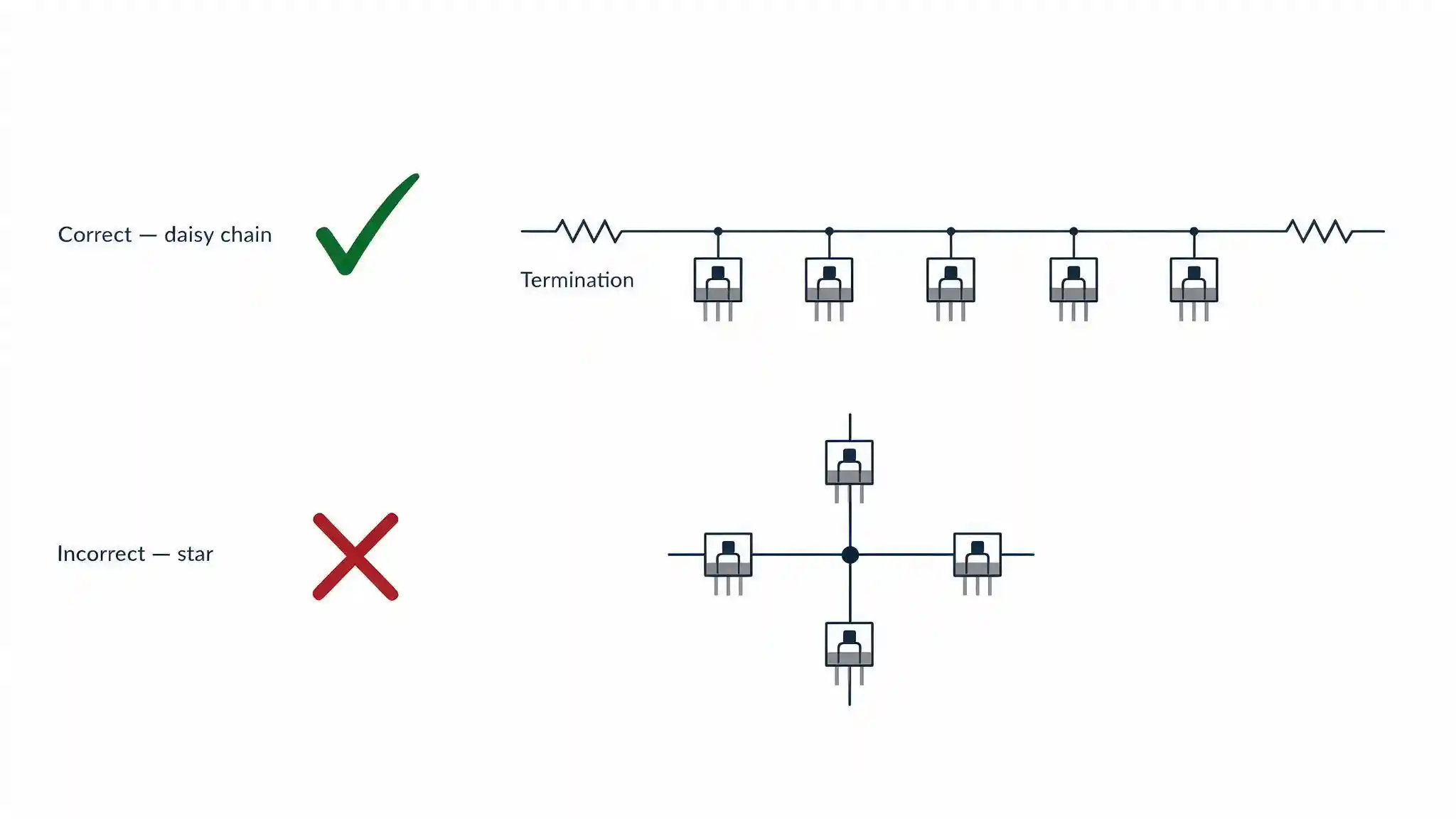
Modbus RTU shares a physical constraint with BACnet MS/TP, because both run on RS-485. A standard RS-485 segment supports up to 32 device loads before repeaters are needed, requires correct termination at both ends, and depends on consistent polarity across the daisy chain. Star wiring on an RS-485 trunk is a frequent cause of intermittent faults that get blamed on the protocol.
Why Do Chillers, Meters and VFDs Usually Speak Modbus?
Field equipment defaults to Modbus because the protocol is inexpensive to implement and the manufacturer only needs to expose a register map, not model their device as building automation objects. A variable frequency drive, an energy meter, a generator controller, a UPS and a solar inverter all have the same commercial incentive.
This is why the protocol question is rarely settled at the building level. A specification can mandate BACnet for the building management system and still end up with a dozen Modbus devices, because the chiller manufacturer offers Modbus as standard and BACnet as a paid option card.
Two practical points follow. First, ask for the protocol at tender stage, in writing, per device, because retrofitting a communication card after delivery costs more than specifying it. Second, accept that some devices will be Modbus regardless, and design the integration layer for that reality rather than treating it as a failure.
BACnet vs Modbus: How the Two Compare
The table below sets out the differences that affect specification and integration cost.
| Criterion | BACnet | Modbus |
|---|---|---|
| Developed by | ASHRAE, published as Standard 135 and ISO 16484-5 | Modicon, 1979, now maintained by the Modbus Organization |
| Designed for | Building automation | Industrial control and field devices |
| Data model | Self-describing objects with named properties and units | Numbered 16-bit registers with no description |
| Device discovery | Built in, through Who-Is and I-Am | None, addresses must be configured manually |
| Scheduling and calendars | Built into the protocol | Not available |
| Trending and alarms | Trend Log objects and event notification built in | Not available, handled by the head-end |
| Change of Value updates | Supported through COV subscription | Not available, requires continuous polling |
| Physical layers | MS/TP over RS-485, BACnet/IP over Ethernet, BACnet Secure Connect over TLS | RTU over RS-485, TCP over Ethernet on port 502 |
| Built-in security | BACnet Secure Connect provides TLS encryption | None in the base protocol |
| Device cost | Higher, communication cards often optional extras | Lower, frequently included as standard |
| Integration effort | Lower, devices describe themselves | Higher, every register must be mapped and scaled by hand |
| Typical layer in a building | Building-wide backbone and HVAC controls | Field devices such as chillers, meters, VFDs and generators |
Key takeaway: BACnet moves meaning and Modbus moves numbers. That single difference explains almost every other row in the table. BACnet costs more per device and saves time during integration and for the life of the building, because a technician in year six can read the point names. Modbus costs less per device and moves that cost into commissioning, documentation and every future modification. Specify BACnet for the building backbone and accept Modbus at the field device layer.
Can BACnet and Modbus Work Together?
Yes, BACnet and Modbus work together through a protocol gateway, and this is how the majority of commercial buildings are actually built. A BACnet to Modbus gateway is a device that polls Modbus registers on one side and presents them as BACnet objects on the other, so the building management system sees a single consistent protocol.
The gateway is where integration projects succeed or fail, and five issues cause most of the failures:
Register scaling. A register returning 225 may mean 22.5 degrees. Scaling factors live in the manufacturer's documentation and must be applied at the gateway. An unscaled point silently reports wrong values that look plausible.
Word order in 32-bit values. Values larger than 16 bits occupy two consecutive registers, and manufacturers differ on which register holds the high word. Reversed word order produces nonsense readings on energy totals and runtime hours.
Polling load. Modbus has no change-of-value mechanism, so the gateway must poll continuously. Polling hundreds of registers too aggressively over a serial trunk causes timeouts that appear as random communication faults.
Point count limits. Gateways are licensed or hardware-limited by point count. Discovering the limit after the panel is installed means buying a second gateway and re-splitting the field network.
Documentation. The register map is the only description Modbus provides. If the map is not attached to the project handover, the next engineer is reverse-engineering the building.
Insist that the point schedule, register map, scaling factors and gateway configuration form part of the commissioning documentation. That paperwork is worth more over the building's life than the gateway hardware.
Are BACnet and Modbus Secure?
Neither protocol was designed with security in mind, and both are commonly deployed on networks that assume physical isolation that no longer exists. Modbus TCP has no authentication and no encryption, which means any device that can reach port 502 can read and write registers on a controller. BACnet/IP has similar exposure in its traditional form.
Building management networks are operational technology, and they are increasingly reachable from the corporate network because someone needed remote access to a dashboard. Four measures matter more than protocol choice:
- Segment the BMS onto its own VLAN, isolated from the business network, using network segmentation with explicit firewall rules rather than implicit trust.
- Never expose a BMS controller or gateway directly to the internet. Remote access belongs behind a VPN.
- Use BACnet Secure Connect on new IP deployments, which encrypts traffic with TLS and removes the broadcast dependency.
- Include building systems in asset inventory and patching, because controllers run firmware that is rarely updated after handover.
These controls sit within the National Cybersecurity Authority's Essential Cybersecurity Controls (ECC) and the wider discipline of operational technology security. A building management system is a control system, and it deserves the same treatment as any other.
What Do Saudi Buildings Need From a Building Protocol?
Building automation in Saudi Arabia has three characteristics that push protocol decisions in a particular direction, and none of them appear in a generic international comparison.
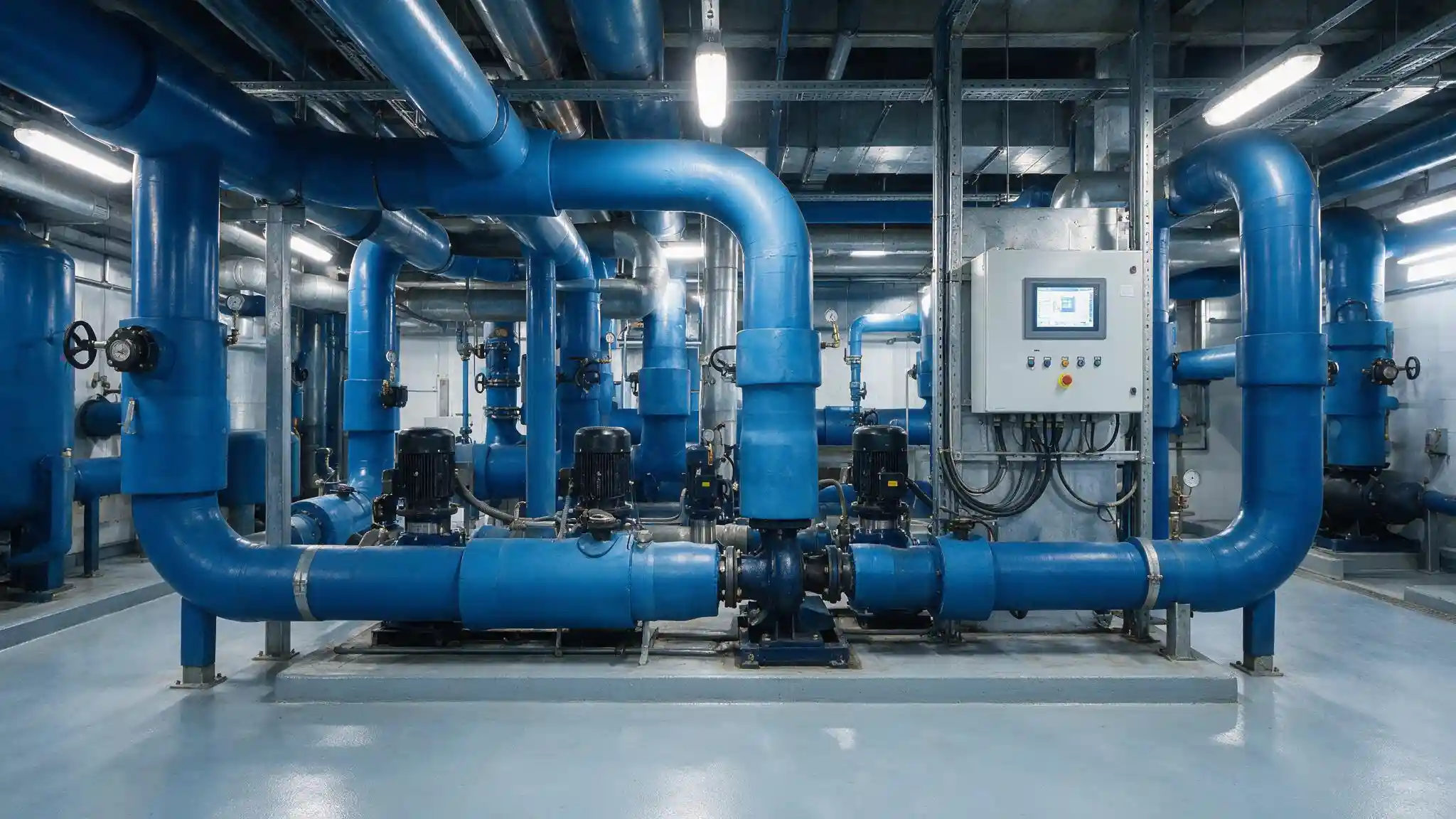
Cooling dominates the load. Air conditioning is the largest energy consumer in most Saudi commercial buildings, which makes chiller plant integration the highest-value part of the system. Chiller plant managers, BTU meters and pumps typically speak Modbus, so the gateway between the chiller plant and a BACnet head-end is usually the most important integration point in the whole building.
District cooling is common. Many developments buy chilled water rather than generating it, and the energy transfer station brings its own metering, almost always over Modbus. Billing depends on those readings, which raises the cost of a scaling or word-order error from an inconvenience to a commercial dispute.
Multi-vendor procurement is the norm. Contractors deliver HVAC, lighting, fire, elevators, access control and metering as separate packages from different suppliers. BACnet as a specified backbone is what keeps those packages from arriving as isolated islands.
Sustainability requirements add a fourth factor. Saudi Arabia's Mostadam green building rating system and the Kingdom's Vision 2030 energy efficiency objectives both depend on measured building performance, and measurement depends on the BMS being able to read every meter reliably. A smart energy management system is only as good as the point data underneath it, which returns the question to protocols and gateways.
Blue Edge, a technology distributor based in Dammam, Saudi Arabia, supplies Akubela smart building systems alongside the structured cabling and networking and IT installation and configuration services that building automation networks depend on.
Which Protocol Should You Specify for a New Building?
Specify BACnet for the building backbone and the HVAC control layer if the building has more than one subsystem, more than one vendor, or any requirement for scheduling, trending or alarming. This covers most commercial buildings, and BACnet/IP or BACnet Secure Connect should be the default at the supervisory level.
Accept Modbus at the field device layer for chillers, energy meters, variable frequency drives, generators, UPS units and inverters. Fighting this is usually more expensive than accommodating it, because the BACnet option card costs more than the gateway point.
Specify a gateway with documented mapping wherever the two meet, and make the point schedule and register map a contractual deliverable rather than a favour.
Consider a BACnet-only specification where the building is large, the operator has an in-house BMS team, and lifetime maintainability outweighs capital cost. Consider a Modbus-only approach only for a small single-purpose installation such as a standalone plant room with a handful of devices and no building-wide head-end.
Whatever the mix, three requirements belong in the specification: BTL listing for BACnet devices, a full point schedule with units and scaling for Modbus devices, and the gateway configuration handed over as an editable file.
What Are the Most Common Building Protocol Mistakes?
Six mistakes account for most protocol-related problems on building projects.
Assuming a device supports BACnet because the brochure says so. Ask which BACnet data link, which device profile, and whether the communication card is included or an option.
Star-wiring an RS-485 trunk. Both BACnet MS/TP and Modbus RTU need a daisy chain with termination at both ends. Star topology produces intermittent faults that get misdiagnosed for weeks.
Overloading a serial segment. A standard RS-485 segment supports up to 32 device loads. Exceeding that without a repeater causes progressive communication failures as the trunk grows.
Leaving BBMD configuration to commissioning day. BACnet/IP broadcasts do not cross subnets. Agree the network design with the IT team before devices arrive, or move to BACnet Secure Connect and avoid the problem.
Accepting handover without register maps. The building is then only maintainable by the original contractor, which is a commercial position rather than an engineering one.
Putting the BMS on the corporate network. A flat network makes an unauthenticated Modbus controller reachable from any office workstation.
Specify the Backbone, Then Accommodate the Field
The BACnet versus Modbus question resolves into a layering decision rather than a choice between two products. BACnet earns its higher device cost at the building level, where self-description, discovery, scheduling and trending reduce integration time and keep the system maintainable for decades. Modbus earns its place at the field device level, where it is cheap, universal and entirely adequate for moving a meter reading.
The buildings that integrate cleanly are the ones where this was decided at specification stage, the gateway was scoped properly, and the point documentation was contractual. The buildings that struggle are the ones where protocol was left to whichever contractor arrived first.
Get the network layer right alongside the protocol layer. VLAN design, cabling topology and RS-485 discipline determine whether a building automation system communicates reliably, and none of those can be corrected by changing protocol later.
Planning a building automation project? Blue Edge supplies smart building systems and the network infrastructure they run on across Saudi Arabia. Call +966 53 9855 188 or contact our team to discuss your requirements. Learn more about Akubela smart building solutions.
Frequently Asked Questions
-
Is BACnet better than Modbus?
BACnet is better for building-wide automation and Modbus is better for simple field devices, so neither is universally superior. BACnet includes device discovery, units, scheduling, trending and alarming, which reduces integration effort and keeps a building maintainable. Modbus is cheaper to implement and adequate where a device only needs to report a handful of values. Most buildings specify BACnet as the backbone and connect Modbus devices through a gateway.
-
Can I connect a Modbus device to a BACnet building management system?
Yes, through a BACnet to Modbus gateway, which polls the Modbus registers and presents them as BACnet objects to the head-end system. The gateway needs the manufacturer's register map, the correct scaling factors, and the right word order for any value spanning two registers. Confirm the gateway's licensed point count covers every device before installation, because exceeding it means adding hardware.
-
Why do chillers and energy meters use Modbus instead of BACnet?
Manufacturers of field equipment default to Modbus because it is inexpensive to implement and only requires publishing a register map. BACnet support usually exists as a paid option card rather than a standard feature. Specify the required protocol per device at tender stage and in writing, because adding a communication card after delivery costs considerably more than ordering it with the equipment.
-
Is Modbus secure?
Modbus has no built-in security. Modbus TCP includes no authentication and no encryption, so any device able to reach port 502 can read and write registers on a controller. Protect Modbus networks with segmentation rather than protocol features: put the building management system on its own VLAN, keep it off the corporate network, never expose controllers to the internet, and require VPN access for remote support.
-
How many devices can one RS-485 segment support?
A standard RS-485 segment supports up to 32 device loads before a repeater is required, and this applies equally to BACnet MS/TP and Modbus RTU because both share the same physical layer. The segment must be wired as a daisy chain with termination resistors at both ends and consistent polarity throughout. Star wiring and missing termination cause intermittent faults that are frequently misdiagnosed as protocol problems.