Shopping Cart


- Articles
- Smart Buildings
- Smart Locks for Commercial Buildings: What to Know
Smart Locks for Commercial Buildings: What to Know
Smart locks for commercial buildings: fail-safe vs fail-secure, card and OSDP security, battery life in Gulf heat, and Saudi Civil Defence requirements.
By Blue Edge Team | Published Sep 02, 2026 | Updated Oct 03, 2026 | 13 min read
Quick answer
A commercial smart lock is an electronic locking device that authenticates a credential, controls a locking mechanism and records every event for audit. The critical specification is not the credential type but the failure mode: locks on escape routes must be fail-safe and release on a fire alarm signal, while free mechanical egress from inside must always work without power.
Smart lock procurement usually starts with the wrong question. The conversation opens with credentials, apps and fingerprint readers, and closes without anyone establishing what each door does when the power goes out. That omission is how a building ends up with a locked escape route.
Commercial locking is a different discipline from residential. A residential lock operates a few times a day and answers to nobody. A commercial lock operates hundreds of times a day, sits inside a life-safety system, has to prove who went where and when, and must revoke a departing employee's access the same afternoon.
This guide covers the lock types used in commercial buildings, the fail-safe and fail-secure distinction that decides compliance, which credentials are actually secure in 2026, how locks connect to the rest of the building, and what Saudi regulation and climate add to the specification.
What Is a Commercial Smart Lock and How Does It Work?
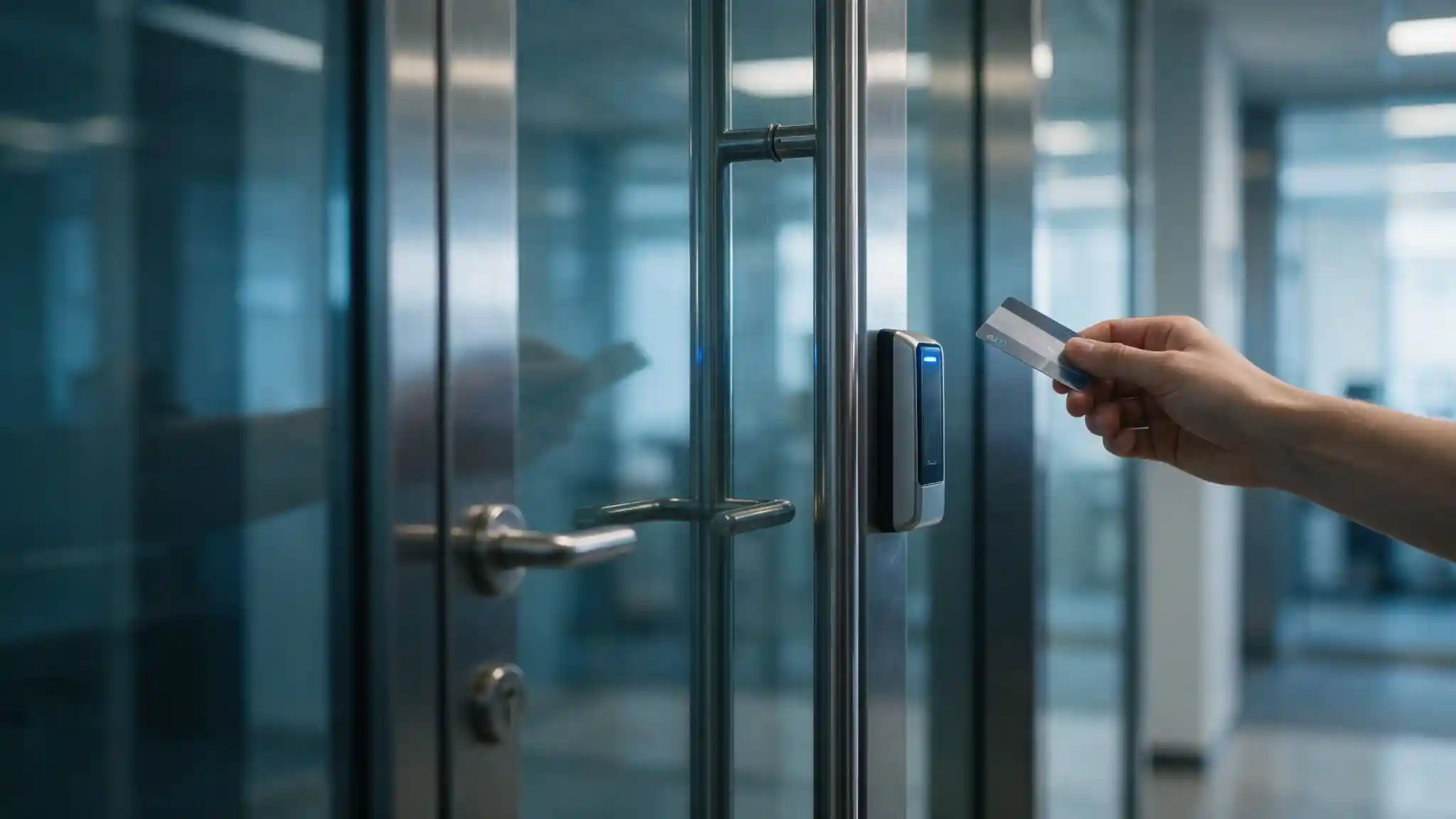
A commercial smart lock is an electronic locking device that verifies a credential, releases or holds a locking mechanism, and reports the event to a management system for audit. The credential may be a card, PIN, mobile phone or biometric, and the decision may be made at the lock itself or by a central controller.
Every commercial installation combines four elements, and they can sit in different physical devices:
- The credential carried by the user
- The reader that receives it
- The decision point that checks the credential against a permission set and a schedule
- The locking hardware that physically holds or releases the door
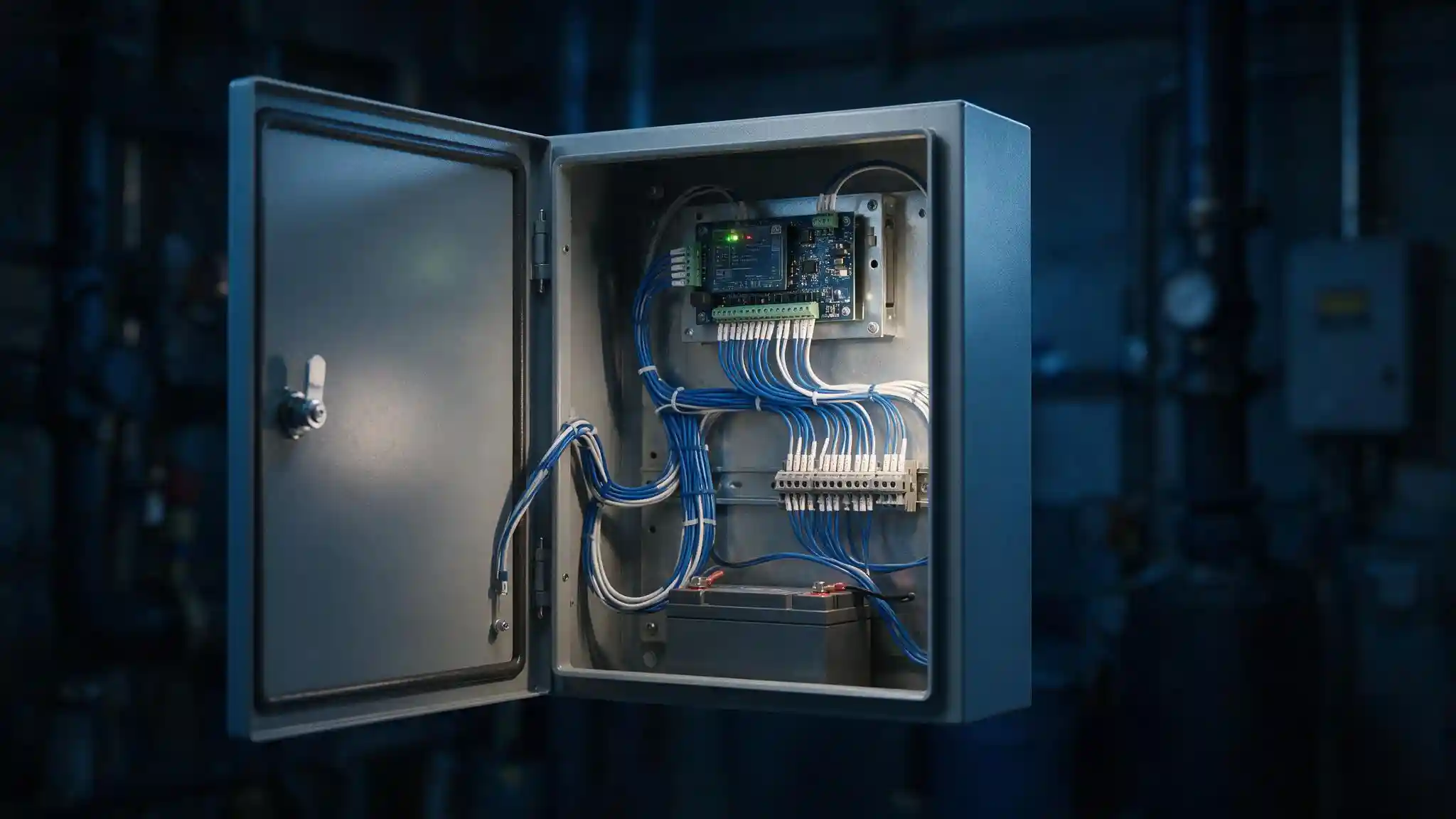
In a standalone lock, all four live in one unit on the door. In an integrated system, the reader sits outside, the decision point is a controller in a riser cupboard, and the locking hardware is wired back to it. That separation is what makes real-time revocation and audit possible.
Three requirements separate commercial from residential locking. Duty cycle comes first, because a main office door may see several hundred cycles daily and residential hardware is not built for it. Audit comes second, since a commercial building needs to prove who entered a server room at 2 a.m. Life safety comes third, and it overrides both.
What Types of Smart Locks Are Used in Commercial Buildings?
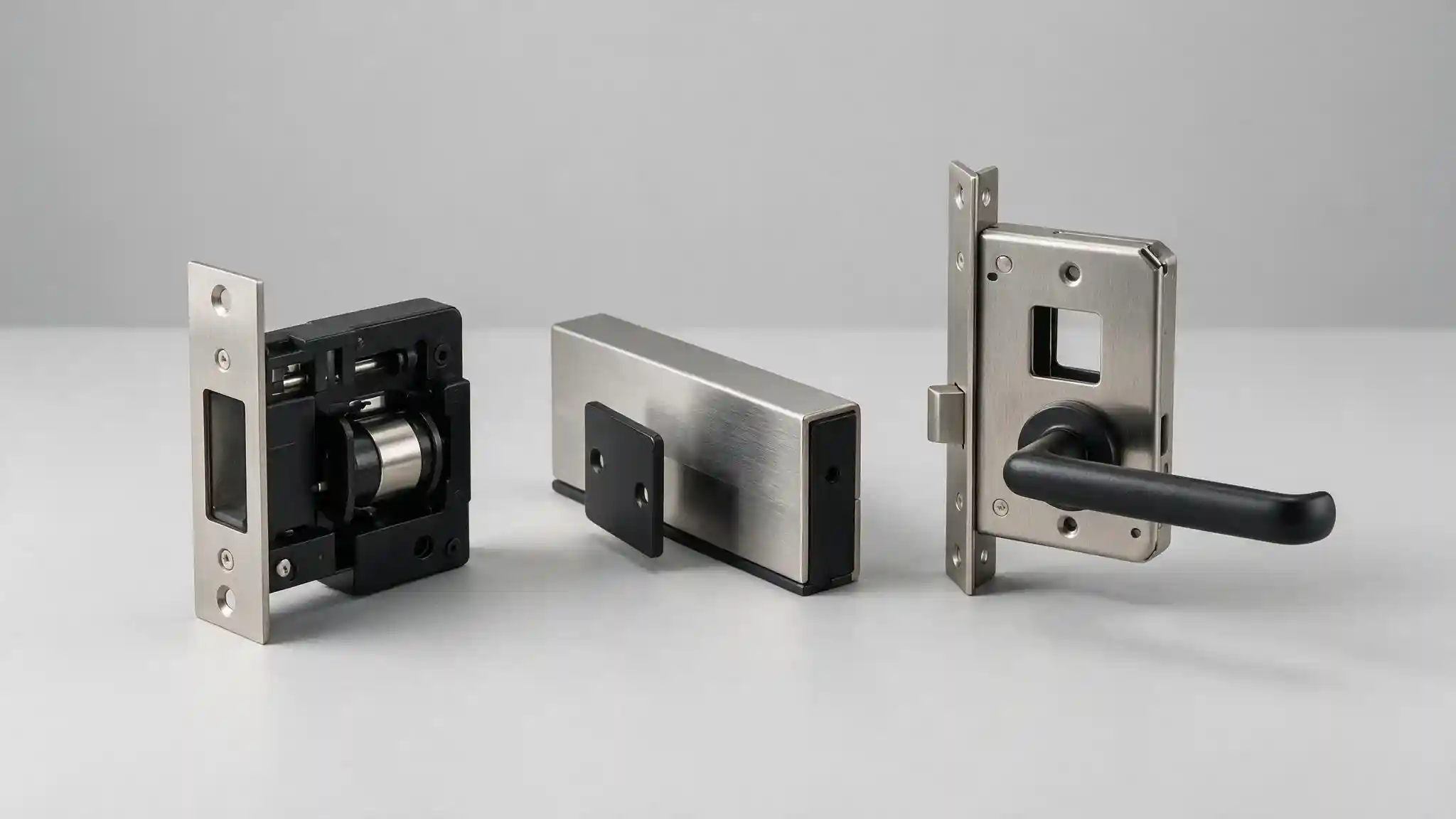
Five locking mechanisms cover almost every commercial door, and the door itself usually decides which one is appropriate.
Electric strike. Replaces the strike plate in the door frame and releases the latch when energised. Inexpensive, widely used on interior office and timber doors, and available in both fail-safe and fail-secure versions.
Electromagnetic lock. An electromagnet on the frame holds a steel armature plate on the door, commonly rated at 600 or 1200 pounds of holding force, roughly 270 kg and 540 kg. A maglock has no moving parts and is inherently fail-safe, because losing power releases the door. Maglocks always require a separate free-egress device on the inside.
Electrified mortise or cylindrical lock. A motorised latch built into the door leaf, retaining the mechanical lever and key override. The right choice for main entrances and any door needing both electronic control and conventional hardware feel.
Motorised deadbolt. Used on secure stores, cash rooms and equipment rooms where a solid throw is required rather than a latch.
Wireless integrated lockset. A battery-powered handle set with reader, controller and lock in one unit, communicating over a wireless link to a gateway. Attractive for retrofits because it needs no cabling to the door, and the trade-off is battery logistics.
Door condition matters more than most specifications admit. A warped door, a sagging hinge or a misaligned frame will defeat any electronic lock, and the resulting intermittent faults get blamed on the technology. Survey the existing doors before selecting hardware.
Fail-Safe or Fail-Secure: Which Does Each Door Need?
A fail-safe lock unlocks when power is lost, and a fail-secure lock stays locked when power is lost. Choosing between them is the most consequential decision in a commercial locking project, because one option protects people and the other protects property, and the two requirements meet at the same door.
The rules that resolve it are straightforward.
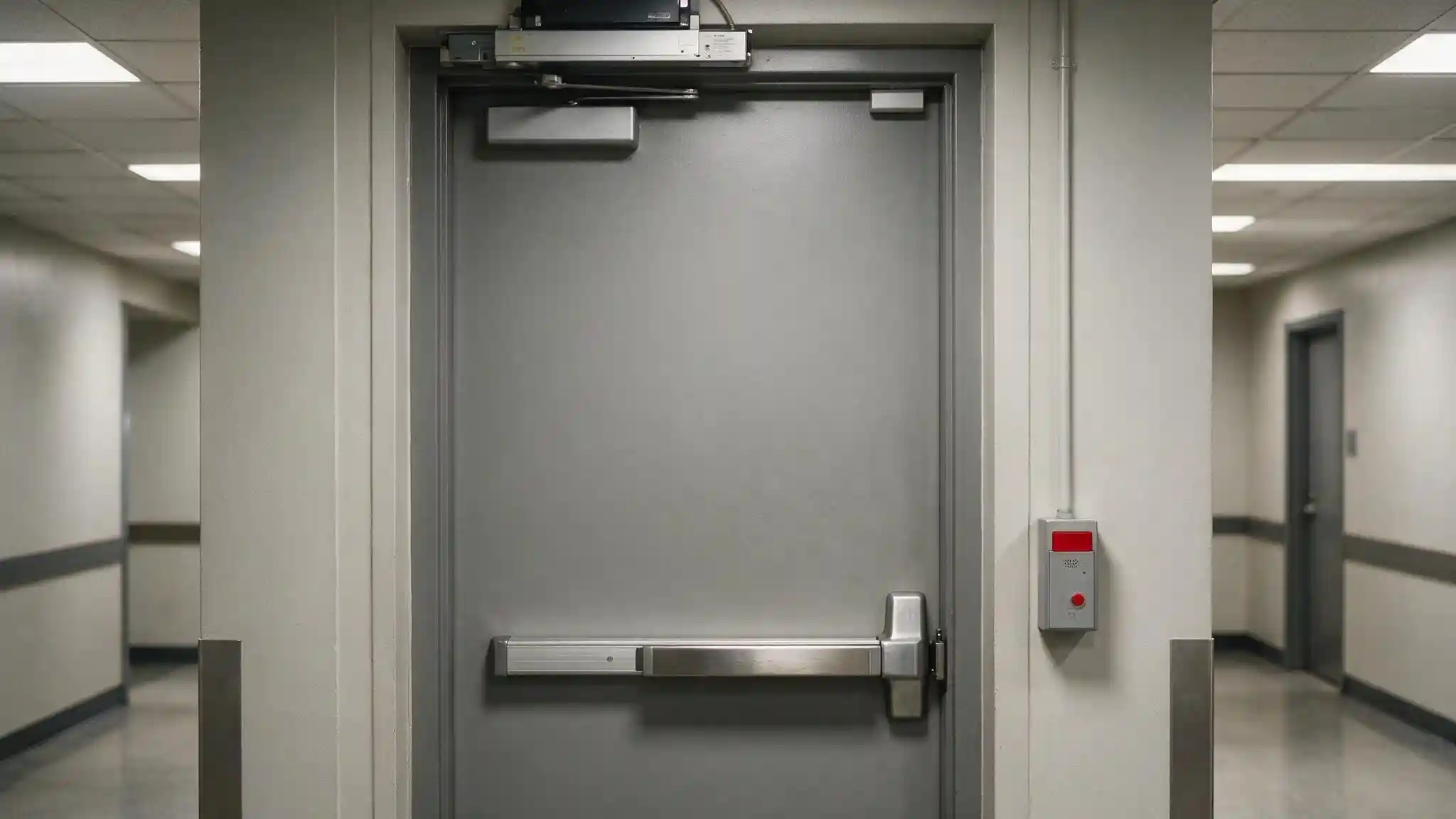
Escape routes must be fail-safe. Any door forming part of a means of escape must release when power fails and must release on a fire alarm signal. The lock is interfaced to the fire alarm panel so that an alarm condition drops power to it.
Free mechanical egress must always exist. People leaving a building must be able to open the door from the inside without a key, a code, special knowledge or electricity. This is achieved with mechanical hardware, a lever handle or panic bar that retracts the latch physically, and it must work whether or not the electronics are alive.
Fail-secure suits doors that are not escape routes. Server rooms, storerooms, plant rooms and cash offices are typically fail-secure, so a power cut does not open them. Free egress from inside is still provided mechanically.
Maglocks need particular care. A maglock has no mechanical override at all, so it depends entirely on the egress device beside it: a request-to-exit sensor, a push-to-exit button and, on escape routes, a fire alarm interface and often an emergency break-glass release. If any of those fail, the door does not open.
Battery backup does not change the classification. A fail-safe lock on a UPS still has to release on a fire alarm signal, and wiring it so the UPS keeps it locked during an evacuation defeats the entire purpose. Design the fire alarm interface first and the security behaviour second. The wider integration approach is covered in fire safety integration in modern smart buildings.
Should Locks Be Offline, Wireless or Wired?
The table below compares the three connectivity classes on the criteria that decide cost and capability.
| Criterion | Offline standalone lock | Wireless online lock | Wired online lock |
|---|---|---|---|
| Power source | Battery in the lock | Battery in the lock | Mains through a controller, often PoE |
| Network connection | None | Wireless link to a gateway | Cabled to an access control panel |
| Audit trail | Stored at the lock, collected manually | Near real time | Real time |
| Remote unlock | Not possible | Yes | Yes |
| Credential revocation | Only on the next site visit or card update | Minutes | Immediate |
| Fire alarm release | Not supported | Limited, depends on product | Full hardwired interface |
| Installation cost | Low, no cabling | Medium | High, cabling to every door |
| Ongoing maintenance | Battery replacement across every door | Battery replacement plus gateway upkeep | Minimal, powered from the panel |
| Best suited for | Low-traffic interior doors, stores, lockers | Retrofits and interior doors where cabling is impractical | Main entrances, escape routes, server rooms, high-traffic doors |
Key takeaway
Wired online locks are the only class suitable for escape routes and high-security doors, because they are the only ones that support a hardwired fire alarm interface and immediate credential revocation. Offline and wireless locks are cost-effective for interior doors and retrofits, and their real expense is battery management at scale rather than the hardware. A building with 200 battery locks has created a recurring maintenance task, not a one-time purchase.
Which Credentials Should a Commercial Building Use?
Credential choice determines whether an access control system is actually secure, and several widely deployed technologies no longer are.
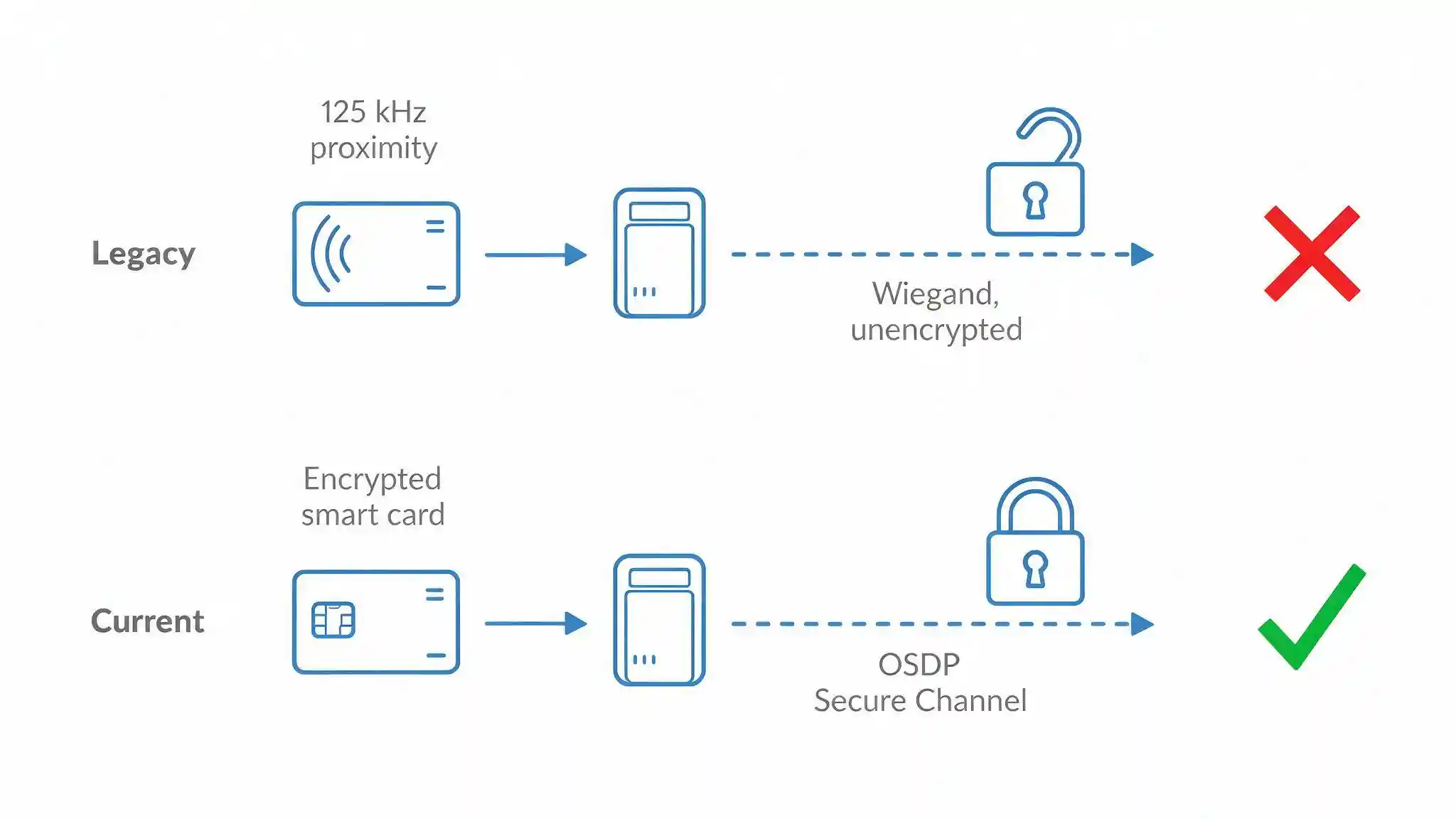
Avoid 125 kHz proximity cards. Legacy proximity credentials transmit a fixed number with no encryption and no mutual authentication, and inexpensive handheld tools clone them in seconds. Any building still running 125 kHz proximity has a card system that provides convenience rather than security.
Avoid MIFARE Classic. Its CRYPTO1 cipher has been publicly broken for well over a decade, and cloning tools are widely available. It remains common in the field because it is cheap.
Specify encrypted smart cards. Modern 13.56 MHz credentials such as MIFARE DESFire EV2 and EV3, or equivalent secure card families, use AES encryption with mutual authentication between card and reader. This is the current baseline for commercial access control.
Consider mobile credentials. A phone-based credential using Bluetooth or NFC removes card issuance and replacement entirely, and revocation happens instantly from the management platform. It also depends on staff phones, so a card fallback is still required.
Treat biometrics as a separate decision. Biometric authentication removes the shared-credential problem, since a fingerprint or face cannot be lent to a colleague. It also creates a data protection obligation, addressed later in this article.
Reader-to-controller communication matters as much as the card. OSDP, the Open Supervised Device Protocol, is the current standard for connecting readers to controllers and supports encrypted, supervised, two-way communication. It replaces Wiegand, a decades-old unencrypted one-way format in which credential data travels in clear text along the reader cable and can be captured and replayed by anyone able to reach the wiring behind the reader.
Specify OSDP with Secure Channel enabled. A building can deploy the best encrypted card in the world and still lose it to a Wiegand cable.
How Do Smart Locks Integrate With the Rest of the Building?
A smart lock delivers most of its value through integration, because an isolated lock is only a key replacement. Five integrations are worth specifying from the outset.
Access control platform. One credential set, one permission model and one audit log across every door, rather than per-door programming. This is the foundation everything else sits on.
HR joiner, mover and leaver process. Linking the access platform to the HR system means a departing employee loses access when their record closes, instead of whenever facilities remembers. Orphaned credentials are one of the most common findings in a physical security audit.
Video surveillance. Binding a door event to a camera clip turns "card 4417 opened the server room at 02:14" into footage of who was actually holding the card. Card sharing and tailgating are only visible when the two systems are linked.
Building management system. Occupancy from access events can drive lighting and HVAC in low-use zones, which is a measurable energy saving in a large building. The approach is set out in how smart access control integrates with building management.
Elevators and lifts. Floor-level access control restricts which floors a credential can select, which matters in mixed-tenant buildings. The mechanics are covered in smart elevator systems.
Treat the access control network as operational technology. Controllers and readers belong on a segmented VLAN with restricted access, never on the general office network, and they belong in the asset inventory and patching cycle alongside every other connected device. The reasoning applies here exactly as it does in operational technology security.
What Do Saudi Regulations and Climate Require?
Three factors shape commercial locking specifications in Saudi Arabia beyond the generic international guidance.
Civil Defence approval governs locked doors. Fire and life safety provisions in the Kingdom fall under the General Directorate of Civil Defence, and locked doors on escape routes are squarely within that scope. Any electronic locking on a means of escape needs a documented fire alarm release, free mechanical egress and, where required, emergency release hardware. Establish this with the Civil Defence consultant before hardware is ordered, because retrofitting a compliant arrangement after installation is expensive and slow.
Biometric data carries a heavier obligation. Fingerprint and facial templates identify a specific person and are treated as sensitive under Saudi Arabia's Personal Data Protection Law (PDPL), administered by the Saudi Data and Artificial Intelligence Authority. Before deploying biometric readers, establish a lawful basis for processing, decide whether templates are stored centrally or on the credential itself, define a retention period, and confirm where the data physically resides. Storing a template on the card or on the device rather than in a central database materially reduces exposure. Access logs are personal data as well, so retention and access rules apply to them too.
Climate shortens hardware life. Exterior and semi-exterior doors in the Eastern Province face heat, blowing dust and coastal salt air. Specify with that in mind:
- Sealed keypads and readers rated for dust ingress, since fine sand destroys unsealed membrane keypads
- Confirmed operating temperature range for readers and locks, checked against peak local ambient rather than a European average
- Shading or recessed mounting for readers in direct sun, which also protects the electronics behind the panel
- Realistic battery expectations, because high temperatures reduce the effective life of lithium and alkaline cells well below datasheet figures
- Corrosion-resistant hardware within a few kilometres of the coast
The wider environmental design principles are covered in network design for extreme desert climates, and access control devices sit under the National Cybersecurity Authority's Essential Cybersecurity Controls (ECC) as connected assets.
Blue Edge, a technology distributor based in Dammam, Saudi Arabia, supplies Akubela smart building and smart lock systems alongside the structured cabling and networking and IT installation and configuration services these deployments require.
What Are the Most Common Smart Lock Mistakes?
Six mistakes account for most problems in commercial smart lock projects, and every one of them is decided at design stage.
Specifying fail-secure on an escape route. The most serious mistake available, and it turns a security improvement into a life-safety failure. Establish the fire strategy before the security strategy.
Deploying legacy proximity or MIFARE Classic cards. Both are cloneable with cheap equipment, which means the audit log records a card number rather than a person.
Wiring readers with Wiegand. Credential data travels unencrypted along the cable behind the reader and can be captured and replayed. Specify OSDP with Secure Channel.
Underestimating battery logistics. Two hundred battery locks with an unpredictable replacement cycle in Gulf heat becomes a permanent maintenance workload nobody budgeted for.
Leaving credential revocation manual. Without an HR integration, departed employees keep working credentials for weeks. Offline locks make this considerably worse, because revocation waits for a physical visit.
Ignoring door and frame condition. A misaligned door defeats the lock, the strike or the sensor, and the resulting faults get attributed to the electronics for months.
Specify the Failure Mode Before the Feature List
Commercial smart locks earn their place through audit, instant revocation and integration, not through the credential on the front of the reader. The features that get demonstrated in a showroom are the least important part of the decision.
Work in a fixed order. Establish what each door does during a fire and a power cut, confirm the arrangement with the Civil Defence consultant, then choose the locking hardware that delivers that behaviour, then select an encrypted credential and OSDP wiring, and only then look at mobile apps and dashboards.
Treat the access control system as part of the building network. VLAN separation, patching, asset inventory and the physical condition of every door decide whether the system works for a decade, and none of those improve by choosing a better app.
Frequently Asked Questions
-
What is the difference between fail-safe and fail-secure locks?
A fail-safe lock unlocks when power is lost and a fail-secure lock stays locked. Doors on escape routes must be fail-safe and must release on a fire alarm signal, while server rooms, stores and plant rooms are typically fail-secure so a power cut does not open them. In both cases, free mechanical egress from inside must work without power, using a lever handle or panic bar that retracts the latch physically.
-
What does Saudi Civil Defence require for electronically locked doors?
Locked doors on means of escape fall within the scope of the General Directorate of Civil Defence, which means any electronic locking on an escape route needs a documented fire alarm release and free mechanical egress from the inside. Agree the arrangement with your Civil Defence consultant before ordering hardware, since correcting a non-compliant installation after commissioning is far more expensive than specifying it correctly.
-
Are RFID access cards secure?
It depends entirely on the card technology. Legacy 125 kHz proximity cards and MIFARE Classic are both cloneable with inexpensive handheld tools, so they provide convenience rather than security. Encrypted credentials such as MIFARE DESFire EV2 or EV3 use AES encryption with mutual authentication and are the current commercial baseline. Reader wiring matters too: specify OSDP with Secure Channel rather than unencrypted Wiegand.
-
How long do smart lock batteries last in a commercial building?
Battery life is measured in operations rather than months, so a high-traffic door drains a lock far faster than a store cupboard. High ambient temperatures in the Gulf reduce effective cell life below datasheet figures, and dust ingress adds mechanical load. Plan a scheduled replacement programme rather than reacting to low-battery alerts, and use wired locks on any door where a dead battery would be unacceptable.
-
Do biometric locks create a privacy problem in Saudi Arabia?
Biometric templates identify a specific individual and are treated as sensitive personal data under Saudi Arabia's Personal Data Protection Law. Before deployment, establish a lawful basis for processing, define a retention period, and confirm where templates are stored. Keeping the template on the credential or on the device rather than in a central database materially reduces exposure. Access logs are also personal data and need their own retention and access rules.
Planning an access control project?
Blue Edge supplies smart lock and access control systems along with the network infrastructure they depend on across Saudi Arabia.
Call +966 53 9855 188 or contact our team to review your requirements.
Akubela smart building solutionsAbout Blue Edge
Blue Edge Company is a value-added technology distributor based in Dammam, Saudi Arabia, supplying interactive displays, smart building systems, networking infrastructure and IT security software to businesses and residential projects across the Kingdom, with installation and technical support.
Learn more about Blue Edge →Published 2 September 2026 • Last updated 3 October 2026 • This article is reviewed when standards, regulations or product guidance change.