Shopping Cart



Indoor Air Quality Monitoring in Commercial Buildings
What to measure, which sensors drift, where to place them, and why an outdoor reference sensor matters during Saudi dust storms. IAQ monitoring explained.
By Blue Edge Team | Sep 03, 2026
Indoor Air Quality Monitoring in Commercial Buildings
Quick answer: Indoor air quality monitoring is a network of sensors that continuously measures carbon dioxide, particulate matter, volatile organic compounds, temperature and humidity inside a building, and reports the results to a dashboard or building management system. In Saudi Arabia the single most important addition is an outdoor reference sensor, because increasing fresh air during a dust event makes indoor air worse.
Most indoor air quality projects produce a dashboard nobody looks at. The sensors go in, the graphs appear, and within a year the readings have drifted far enough that facilities staff have stopped believing them. Nothing about the building changed.
The failure is rarely the concept. It is usually the sensor technology chosen, the placement, or the absence of any defined action when a reading crosses a threshold. Data that triggers nothing is a cost with no return.
This guide covers what a commercial building should actually measure, which sensor technologies produce trustworthy numbers and which do not, where sensors belong, how readings turn into ventilation and filtration decisions, and what Saudi buildings need to handle that generic specifications get wrong.
What Is Indoor Air Quality Monitoring?
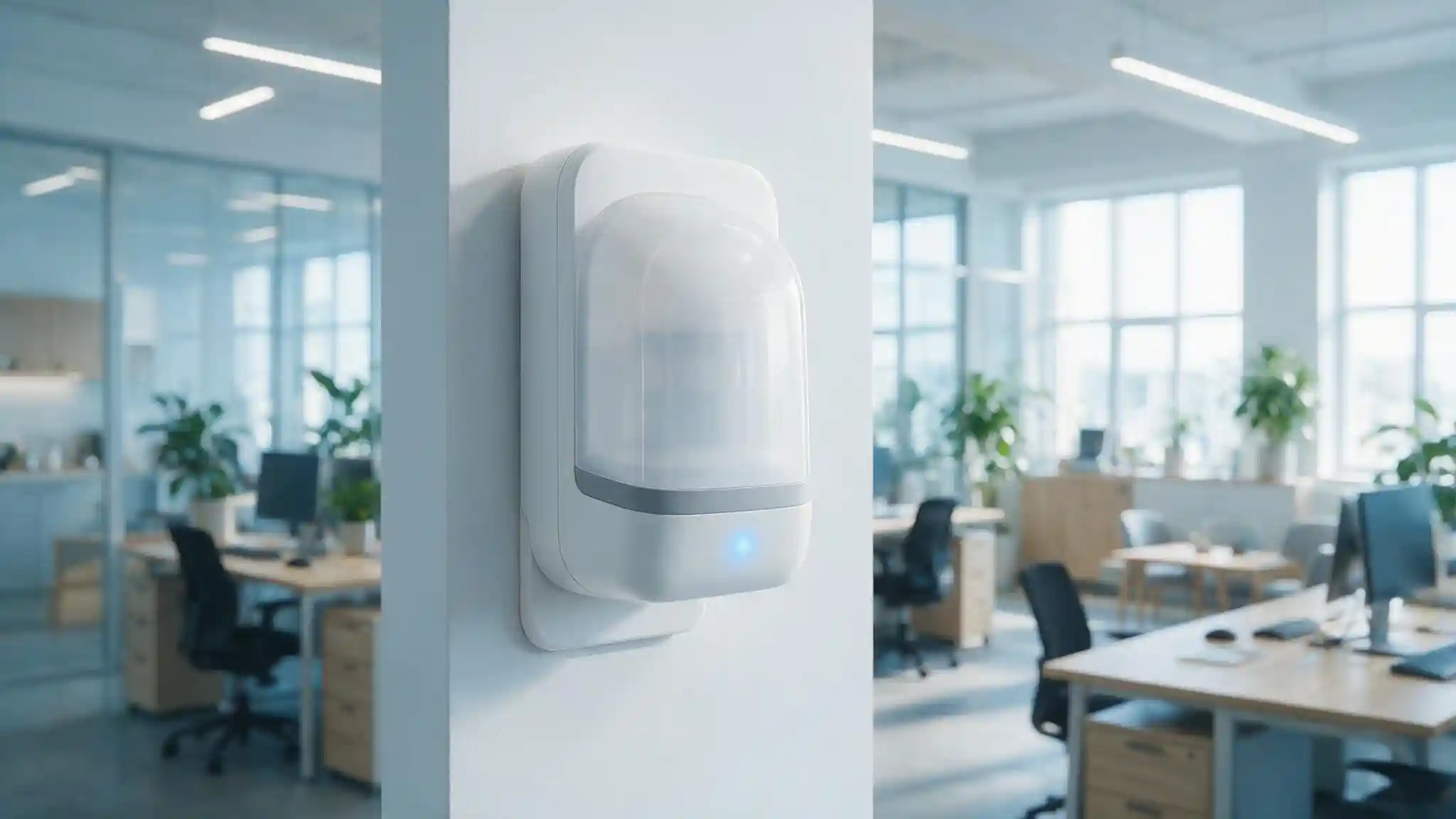
An indoor air quality monitoring system is a network of sensors that continuously measures air parameters inside a building and reports them to a dashboard or building management system, so ventilation and filtration can be adjusted and problems identified before occupants notice them.
A monitoring system has three levels of ambition, and the level should be decided before any hardware is chosen.
Visibility only. Sensors report to a dashboard, and a person decides what to do. Simple, cheap, and it depends entirely on someone reading the dashboard.
Alerting. Thresholds generate notifications to facilities staff, so nobody has to watch a screen. This is the practical minimum for a building of any size.
Closed-loop control. Readings feed the building management system, which adjusts outdoor air dampers, fan speeds and filtration automatically. This is where the energy savings and the real air quality improvement come from.
Deciding this early matters, because closed-loop control demands more accurate sensors, tighter calibration discipline and a proper building management system integration. A specification written for a dashboard will not support control later without replacing hardware.
What Should a Commercial Building Measure?
Six parameters cover the large majority of commercial requirements. The table below sets out what each one tells you and what to do about it.
| Parameter | What it indicates | Sensor technology | Practical target | Action when exceeded |
|---|---|---|---|---|
| Carbon dioxide (CO₂) | Ventilation adequacy relative to occupancy | NDIR infrared | Below roughly 1,000 ppm | Increase outdoor air to that zone |
| PM2.5 | Fine particulates from dust, combustion and outdoor infiltration | Laser light scattering | WHO guideline 24-hour mean of 15 µg/m³ | Improve filtration, check outdoor reading before adding fresh air |
| PM10 | Coarse dust and sand particulates | Laser light scattering | WHO guideline 24-hour mean of 45 µg/m³ | Same, plus check filter condition and building sealing |
| Total volatile organic compounds (TVOC) | Off-gassing from finishes, furniture, cleaning products, printers | Metal oxide or photoionisation | Trend based, watch for step changes | Ventilate, identify and remove the source |
| Relative humidity | Comfort, mould risk, condensation | Capacitive | Roughly 40 to 60 percent | Adjust dehumidification or humidification |
| Temperature | Comfort and complaint driver | Thermistor or digital | Per design and occupancy | Adjust setpoint or investigate zoning |
Key takeaway: Carbon dioxide and PM2.5 carry the most decision value in a commercial building, because CO₂ tells you whether ventilation matches occupancy and PM2.5 tells you whether the air being delivered is clean. Add carbon monoxide near loading bays, car parks and generator rooms, and formaldehyde after a new fit-out. Everything else is refinement, and a system measuring four parameters reliably is worth more than one measuring twelve badly.
A note on carbon dioxide thresholds. Outdoor ambient CO₂ sits at roughly 420 ppm, so indoor readings are always higher. A common rule of thumb treats sustained readings below about 1,000 ppm as adequate ventilation for the occupancy, and readings persistently above 1,500 ppm as clearly under-ventilated. ASHRAE Standard 62.1 sets ventilation rates rather than a CO₂ limit, so treat CO₂ as an indicator of ventilation performance rather than a compliance threshold.
Which Sensor Technologies Actually Work?
Sensor selection determines whether the data is trustworthy, and several widely sold technologies are not suitable for a system that will drive decisions.
What is the difference between an NDIR sensor and an eCO2 sensor?
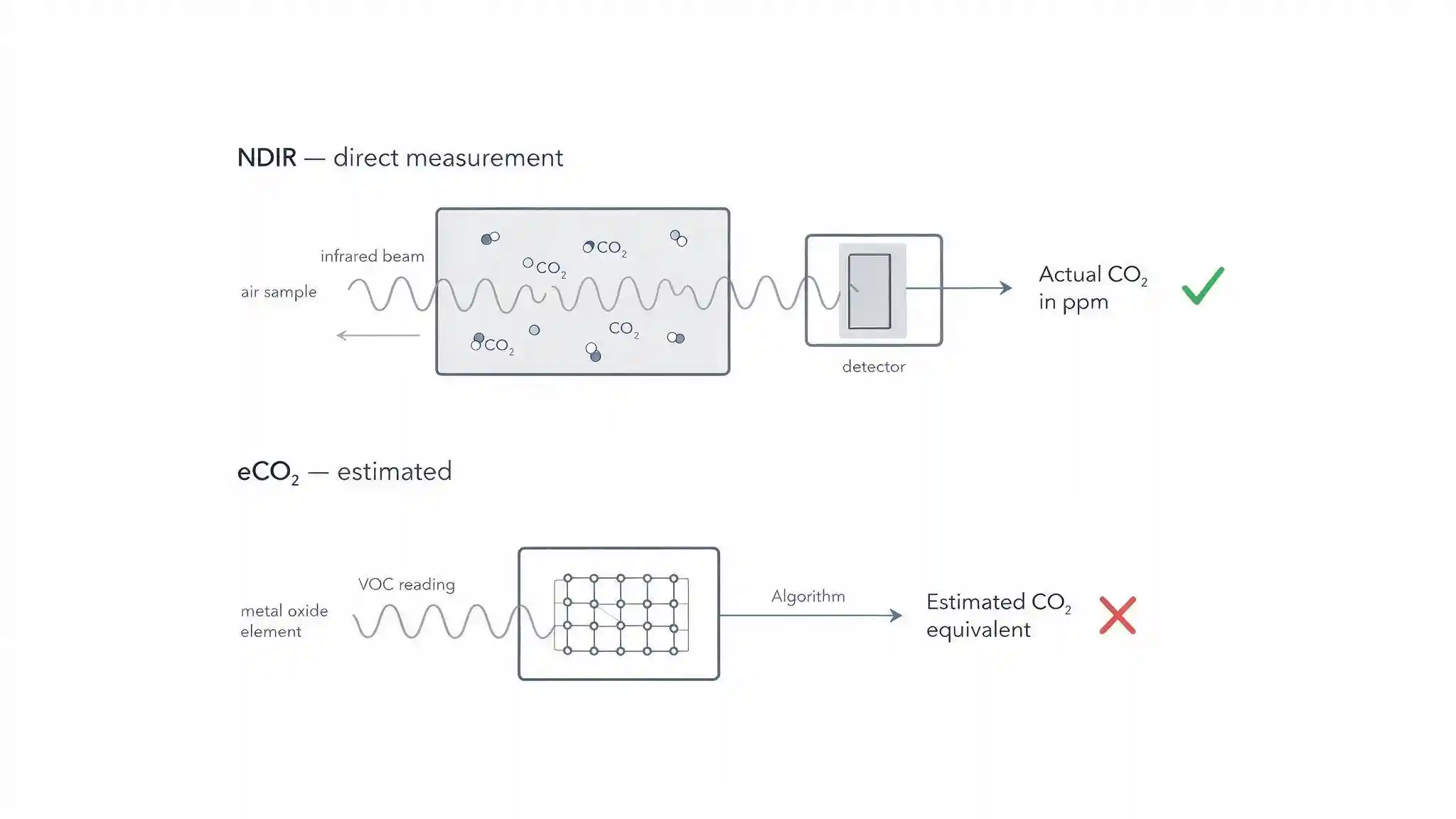
An NDIR sensor measures carbon dioxide directly, by passing infrared light through an air sample and measuring how much is absorbed at the wavelength CO₂ absorbs. An eCO2 sensor does not measure carbon dioxide at all. It measures volatile organic compounds with a metal oxide element and estimates a CO₂-equivalent value from that reading using an algorithm.
The distinction matters commercially. In a meeting room, VOC levels and CO₂ levels both rise with occupancy, so an eCO2 sensor produces a number that looks plausible. Introduce a cleaning product, a whiteboard marker or a new carpet and the eCO2 reading climbs with no change in ventilation at all. Specify NDIR for any building where CO₂ will drive a ventilation decision, and reject eCO2 outright in a commercial tender.
Why do air quality sensors drift?
Every sensor class in this category drifts, and the specification should say how each one is corrected.
NDIR carbon dioxide sensors drift slowly and are usually corrected by automatic baseline correction, an algorithm that assumes the space returns to outdoor CO₂ levels at some point during each week and resets the baseline accordingly. In a 24-hour occupied building, a data centre, a hospital or a control room, the space never reaches outdoor levels, so the algorithm progressively pulls the baseline down and the sensor under-reports. Disable automatic baseline correction in continuously occupied spaces and calibrate manually instead.
Optical particulate sensors over-read at high humidity, because hygroscopic particles absorb water and grow, scattering more light. A sensor without humidity compensation reports elevated PM2.5 on a humid coastal morning when nothing has changed.
Metal oxide VOC sensors produce relative rather than absolute values and drift substantially. They are useful for spotting a step change, not for reporting an absolute concentration.
Electrochemical sensors for carbon monoxide, nitrogen dioxide and ozone have a finite service life, commonly two to three years, after which the cell must be replaced rather than recalibrated. Budget for this from the start, because a building with expired cells is reporting nothing useful.
Write the calibration and replacement schedule into the maintenance contract at handover. A network of drifting sensors produces data nobody trusts, and once trust is gone the dashboard is ignored regardless of how accurate the readings later become.
Where Should Air Quality Sensors Be Placed?
Placement decides whether a sensor measures the air people breathe or something else entirely, and bad placement is more common than bad hardware.
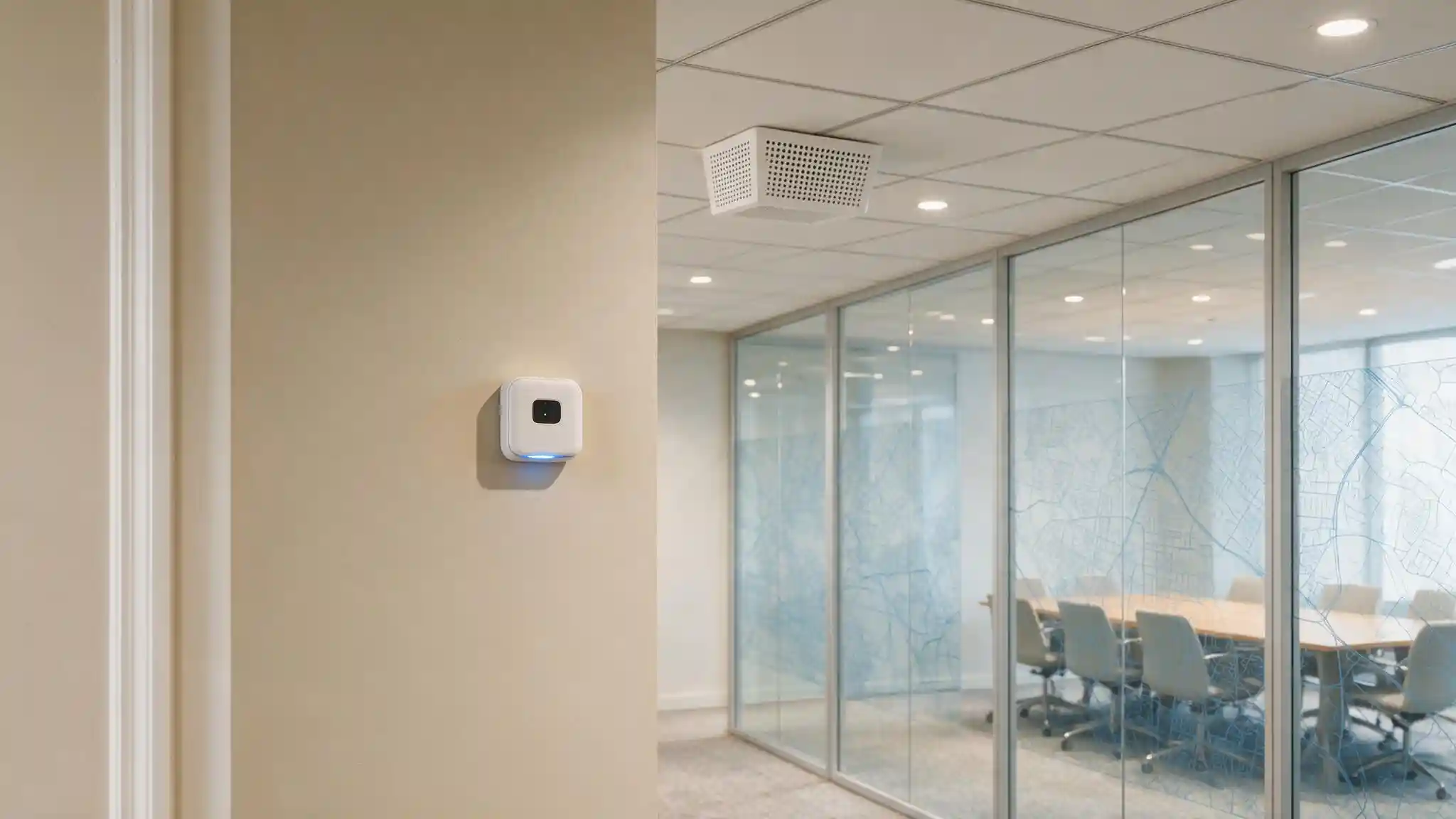
Mount sensors in the breathing zone, roughly 1.1 to 1.7 metres above floor level, in the occupied part of the space. Then avoid the positions that produce misleading readings:
- Not near a supply air diffuser, where the sensor measures conditioned supply air rather than room air and reports excellent results while the room is stale
- Not beside a door, window or lift lobby, where air movement produces readings unrelated to the zone
- Not above a heat source, radiator or equipment cabinet, which distorts temperature and humidity
- Not in a corner or behind furniture, where air is stagnant and readings lag the room
- Not immediately next to a printer, kitchenette or cleaning store, unless monitoring that source is the specific intent
Sensor density follows the zoning rather than the floor area. One sensor per ventilation zone is the sensible baseline, meaning per area served by a single air handling unit or terminal control device. Add sensors where occupancy is dense or variable, such as meeting rooms, training rooms, call centres and canteens, because those are the spaces that go out of specification first.
Duct-mounted sensors in the return air path give a useful zone average and suit demand-controlled ventilation, but they cannot identify a single stale room within the zone. Most buildings use both: return air sensors for control, room sensors for diagnosis.
One position matters more than all the others, and it is outside the building. An outdoor reference sensor measuring PM2.5, PM10, temperature and humidity is what makes every indoor reading actionable, because it tells you whether the outdoor air is a solution or the problem.
How Does Monitoring Turn Into Action?
Monitoring only pays for itself when readings drive a response, and three control strategies deliver most of the value.
Demand-controlled ventilation. Demand-controlled ventilation modulates the volume of outdoor air supplied to a zone based on measured carbon dioxide rather than a fixed design rate. A meeting room designed for twelve people and occupied by three does not need full outdoor air, and delivering it anyway means cooling and dehumidifying air nobody is breathing. In a hot, humid climate that conditioning cost is substantial, which makes demand-controlled ventilation worth considerably more in the Gulf than in a temperate location. The relationship between control strategy and consumption is covered in smart HVAC controls for Saudi commercial buildings.
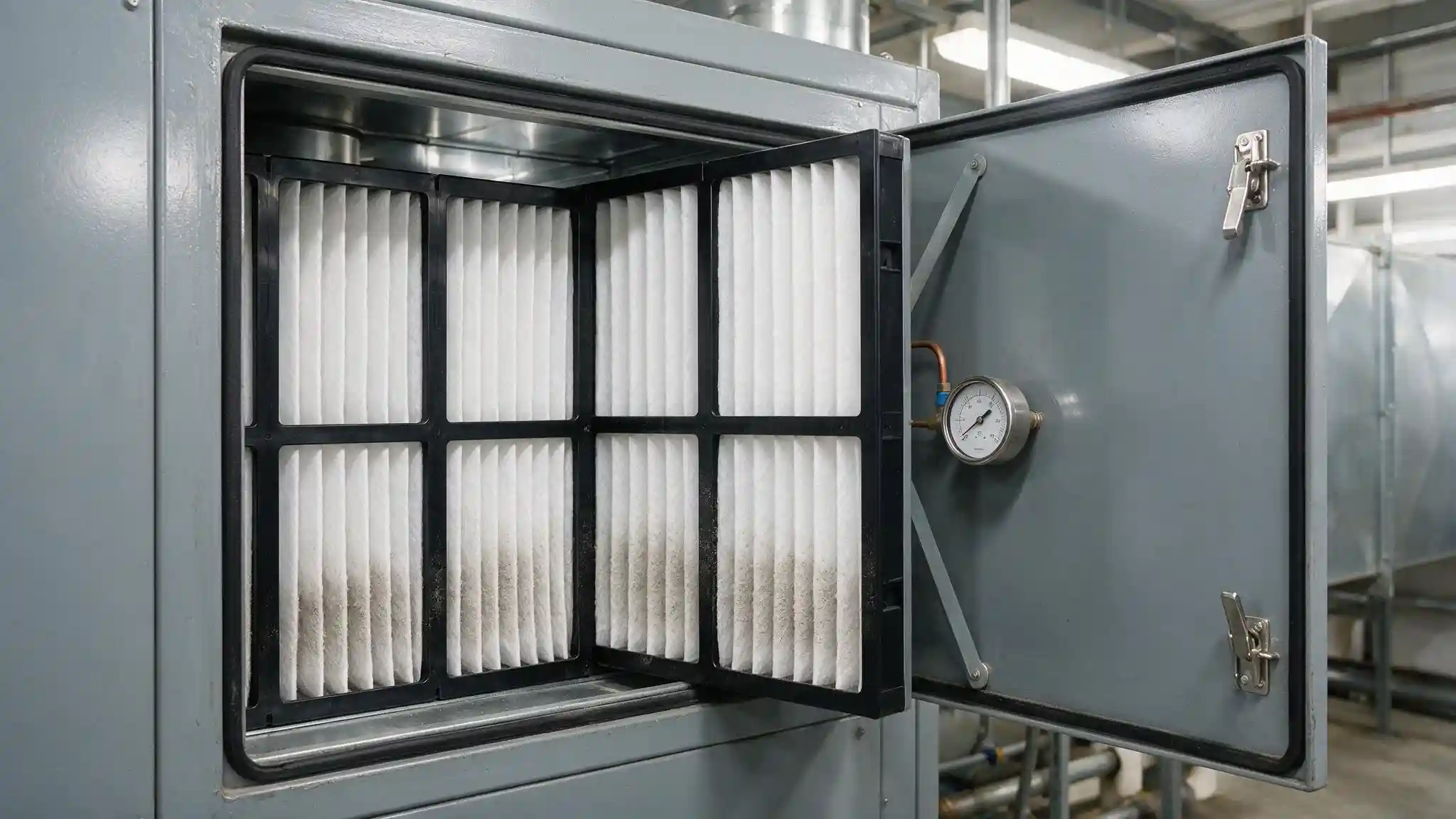
Filtration matched to the particulate load. Capturing PM2.5 requires filtration graded to do it, commonly MERV 13 or better under ASHRAE Standard 52.2, or the equivalent classification under ISO 16890. Higher filtration increases pressure drop across the filter, which increases fan energy, so the grade should be chosen deliberately rather than maximised. Monitor differential pressure across the filter bank so replacement happens when the filter is loaded rather than on a calendar.
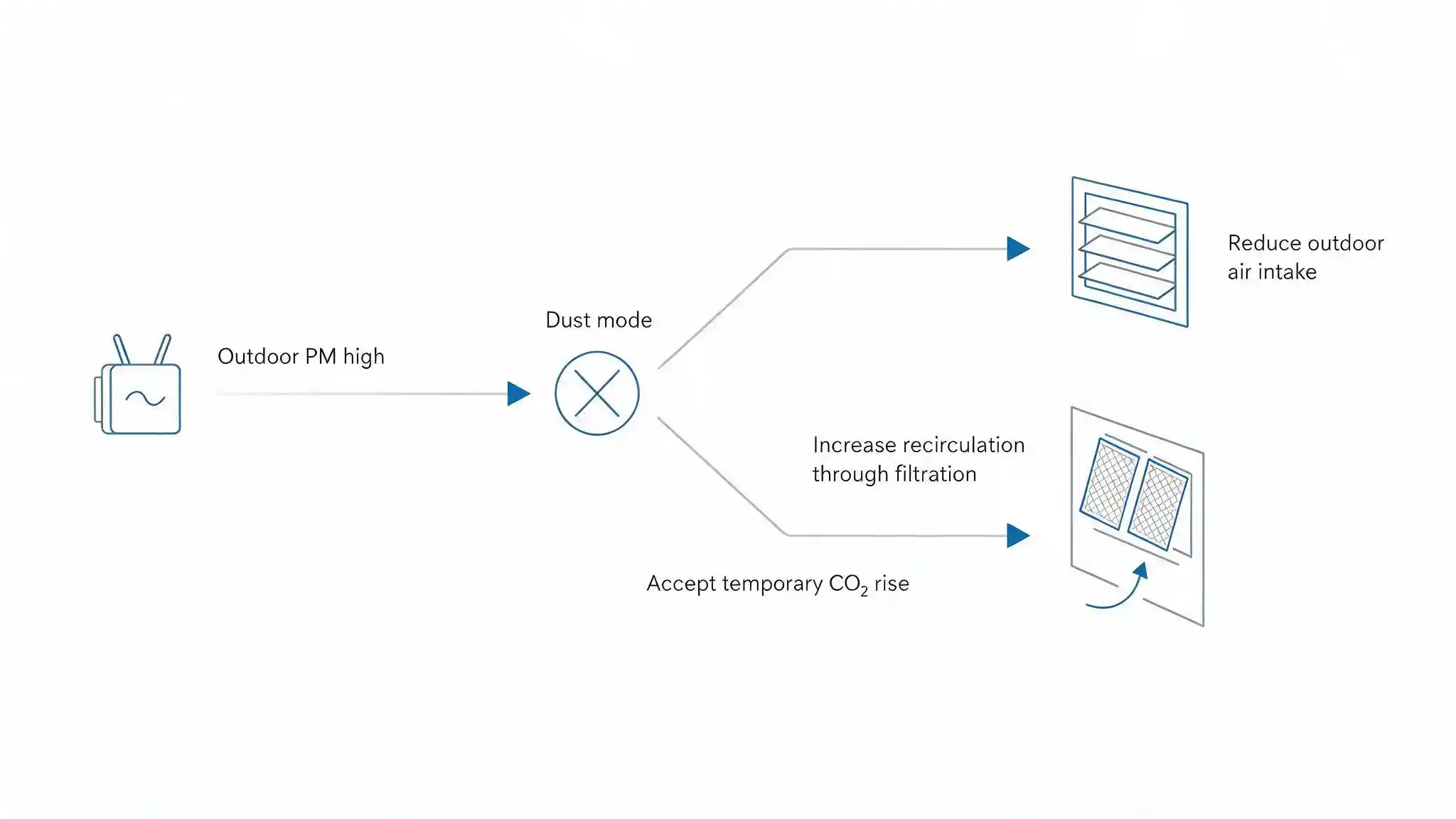
Event-driven mode changes. The system should have defined modes, not just alarms. A high outdoor particulate reading should trigger reduced outdoor air with increased recirculation through filtration. A high indoor CO₂ reading with clean outdoor air should trigger increased outdoor air. Those two responses are opposite, which is exactly why the outdoor reference sensor is not optional.
Integration is usually over BACnet or Modbus into the building management system, or over MQTT for IoT-native sensor platforms feeding an analytics layer. Ask at tender stage which open protocol the sensors present, because a platform that only reports to its own cloud dashboard cannot drive plant. The broader integration picture is set out in the smart building BMS and IoT integration guide.
Put the sensor network on its own VLAN like any other building system, and include the devices in the asset inventory.
What Do Saudi Buildings Need to Get Right?
Three conditions shape indoor air quality in Saudi commercial buildings, and the first one reverses the standard international advice.
Dust events invert the ventilation response. Saudi Arabia experiences dust and sand events that raise outdoor PM10 and PM2.5 far above normal levels, sometimes for days. The default IAQ instinct, to bring in more fresh air when readings deteriorate, makes the building significantly worse during these periods. A correct system compares indoor and outdoor particulates and switches to a dust mode: minimise outdoor air intake, increase recirculation through filtration, and accept a temporary rise in CO₂ as the lesser problem. Without an outdoor reference sensor the system cannot make this distinction, which is why that one sensor changes the value of the entire installation.
Dust events also load filters rapidly. Differential pressure monitoring across the filter bank is worth more in Saudi Arabia than almost anywhere, because a filter that lasted six months last year can be loaded in weeks after a bad season. The same environmental thinking applies to enclosures and equipment as described in design for extreme desert climates.
Sealed, heavily recirculated buildings push CO₂ up. Outdoor air in Saudi Arabia is expensive to cool and dehumidify for most of the year, which creates a standing commercial incentive to minimise ventilation rates. Buildings are tightly sealed for the same reason. The predictable result is elevated indoor carbon dioxide, which correlates with drowsiness and reduced concentration long before anyone reports a complaint. CO₂ monitoring is how that problem becomes visible, and demand-controlled ventilation is how it gets solved without simply over-ventilating the whole building.
Green building certification rewards measured performance. Saudi Arabia's Mostadam green building rating system includes indoor environmental quality among its assessed categories, and continuous monitoring produces the evidence. If certification is a project objective, specify monitoring at design stage rather than adding it afterwards, since retrofitting sensors into finished ceilings and ductwork costs far more.
One further point on data. Carbon dioxide readings closely track occupancy, so a dense sensor grid can reveal when individuals are present at specific desks. Keep monitoring at zone level rather than desk level, aggregate the reporting, and be transparent with staff about what is measured and why. Where readings could be linked to identifiable individuals, the data falls within Saudi Arabia's Personal Data Protection Law (PDPL) administered by the Saudi Data and Artificial Intelligence Authority. The same considerations apply as with occupancy sensing for space optimisation.
Blue Edge, a technology distributor based in Dammam, Saudi Arabia, supplies Akubela smart building systems alongside the structured cabling and networking and IT installation and configuration services that building sensor networks depend on.
What Are the Most Common IAQ Monitoring Mistakes?
Six mistakes account for most abandoned indoor air quality systems.
Buying eCO2 sensors instead of NDIR. The readings respond to cleaning products and markers rather than ventilation, so any control decision based on them is wrong.
Omitting the outdoor reference sensor. Without it the system cannot tell whether fresh air will improve or worsen indoor conditions, which is the most consequential decision it makes.
Mounting sensors near supply diffusers. The sensor reports the quality of the supply air, the dashboard looks excellent, and the room is stale.
Leaving automatic baseline correction enabled in 24-hour spaces. The algorithm assumes the room empties periodically. In a control room or a hospital it never does, and the sensor slowly under-reports.
No calibration or cell replacement plan. Electrochemical cells expire in two to three years, optical sensors drift, and a network nobody maintains produces numbers nobody believes.
Monitoring with no defined response. A dashboard that triggers nothing changes nothing. Write the thresholds and the actions into the sequence of operation before installation.
Measure Less, but Measure It Properly
The value of an indoor air quality system comes from a small number of accurate readings connected to a defined response, not from a long parameter list on a datasheet. Four trustworthy measurements that adjust ventilation and filtration will outperform twelve unreliable ones on a dashboard.
Specify in order. Choose NDIR for carbon dioxide and humidity-compensated optical sensing for particulates. Add an outdoor reference sensor. Place the indoor sensors in the breathing zone away from diffusers and doors. Write the thresholds, the actions and the dust-event mode into the sequence of operation. Then commit to a calibration and cell replacement schedule in the maintenance contract.
Plan the network alongside the sensors. Protocol support, VLAN separation and BMS integration determine whether readings can ever drive plant, and a platform that only talks to its own cloud dashboard will never control a damper.
Planning a building monitoring project? Blue Edge supplies smart building systems and the network infrastructure behind them across Saudi Arabia. Call +966 53 9855 188 or contact our team to discuss your building. Learn more about Akubela smart building solutions.
Frequently Asked Questions
-
What is a good CO2 level in an office?
Outdoor ambient carbon dioxide sits at roughly 420 ppm, so indoor readings are always higher. A common working rule treats sustained indoor readings below about 1,000 ppm as adequate ventilation for the occupancy, and readings persistently above 1,500 ppm as clearly under-ventilated. ASHRAE Standard 62.1 specifies ventilation rates rather than a carbon dioxide limit, so use CO₂ as an indicator of ventilation performance rather than a pass or fail threshold.
-
What is the difference between an NDIR sensor and an eCO2 sensor?
An NDIR sensor measures carbon dioxide directly using infrared absorption. An eCO2 sensor measures volatile organic compounds and estimates a carbon dioxide equivalent from that reading, so it is not measuring CO₂ at all. Because VOC levels rise with cleaning products, markers and new furnishings, an eCO2 reading can climb with no change in ventilation. Specify NDIR wherever carbon dioxide will drive a ventilation decision.
-
Where should indoor air quality sensors be placed?
Mount sensors in the breathing zone, roughly 1.1 to 1.7 metres above the floor, in the occupied part of the space. Avoid positions near supply air diffusers, doors, windows, heat sources and stagnant corners, because each produces readings unrelated to the air people are breathing. Provide at least one sensor per ventilation zone, add sensors in dense or variable spaces such as meeting rooms, and always include an outdoor reference sensor.
-
Should ventilation increase or decrease during a dust storm?
Decrease outdoor air intake and increase recirculation through filtration. Raising fresh air volume during a dust event pulls high outdoor particulate concentrations into the building, which is the opposite of the normal response to deteriorating air quality. Accept a temporary rise in carbon dioxide as the lesser problem and return to normal operation once outdoor readings recover. This decision requires an outdoor reference sensor to make correctly.
-
Do indoor air quality sensors raise privacy concerns?
They can, because carbon dioxide readings track occupancy closely and a dense sensor grid can indicate when individuals are at specific desks. Keep monitoring at zone level rather than desk level, aggregate the reporting, and tell staff what is measured and why. Where readings could be linked to identifiable individuals, the data falls within Saudi Arabia's Personal Data Protection Law, so define retention periods and access rules before deployment.