Shopping Cart



Guest Room Management Systems for Hotels
How guest room management systems cut hotel energy use: occupancy detection that works, HVAC setback states, PMS integration and Saudi climate factors.
By Blue Edge Team | Sep 03, 2026

Guest Room Management Systems for Hotels
Quick answer: A guest room management system, or GRMS, is a control system that manages lighting, air conditioning, curtains, do-not-disturb signalling and room status inside a hotel guest room, and reports that state to the hotel's property management and building systems. Its energy savings depend entirely on accurate occupancy detection, which is why key card holders alone are no longer sufficient.
Walk a hotel corridor at two in the afternoon and open a few vacant rooms. In a badly configured property, most of them will be cooling an empty room at full setpoint, because a key card is sitting in the wall holder and the system believes someone is home.
That single failure explains why so many guest room control projects deliver a fraction of the savings promised in the business case. The hardware works. The occupancy logic underneath it does not.
This guide covers what a GRMS controls, how occupancy should actually be detected, where the energy savings come from and how deep setback can safely go, the difference between wired and wireless architectures, how the system talks to the property management system, and what Saudi hotels need to specify beyond the generic international package.
What Is a Guest Room Management System?
A guest room management system is a control system that manages the electrical and mechanical services inside a hotel guest room and reports room state to the hotel's central systems. A GRMS sits between the room's devices and the property's back-of-house platforms, turning a set of independent fittings into a single controllable, reportable unit.
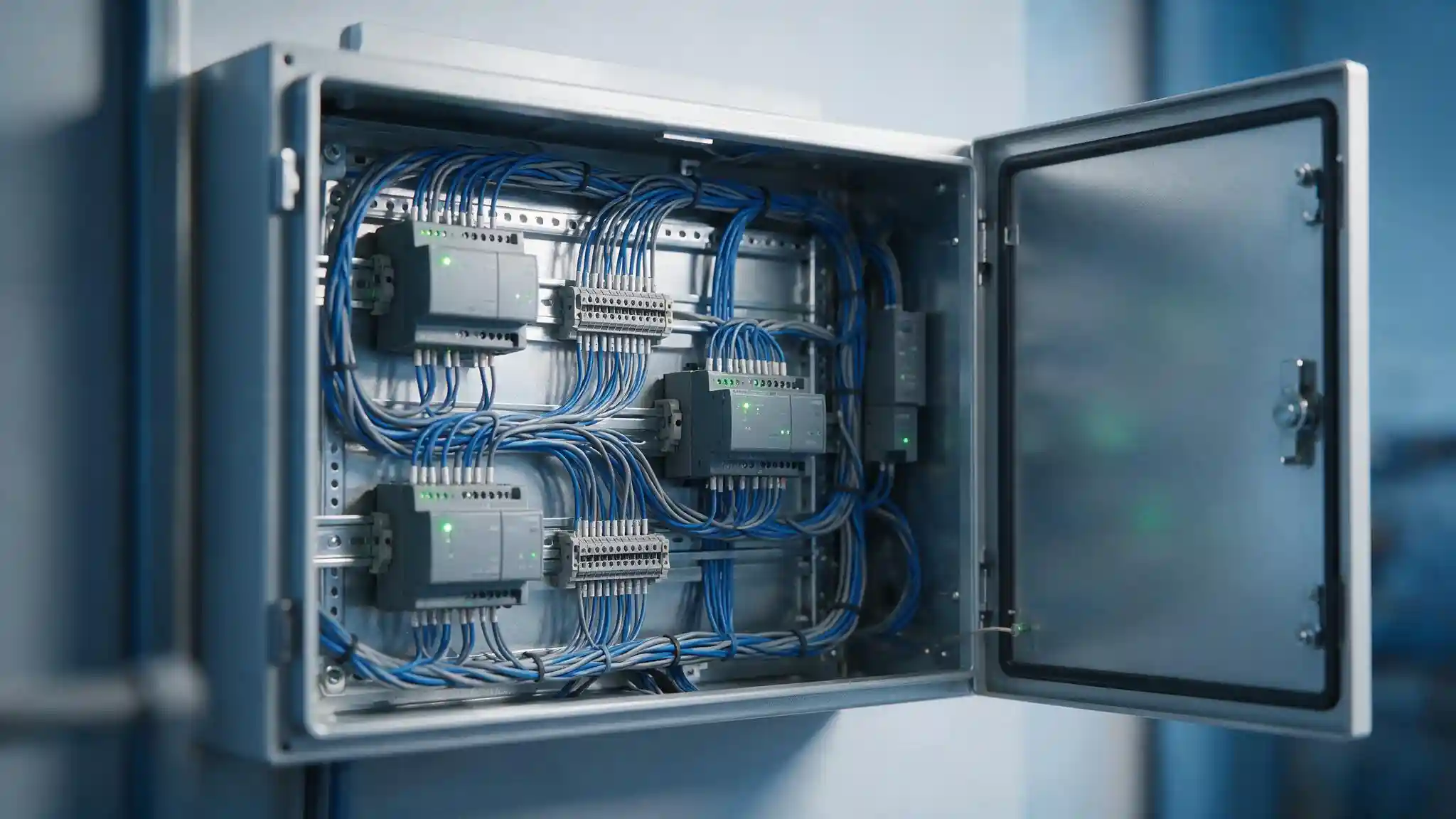
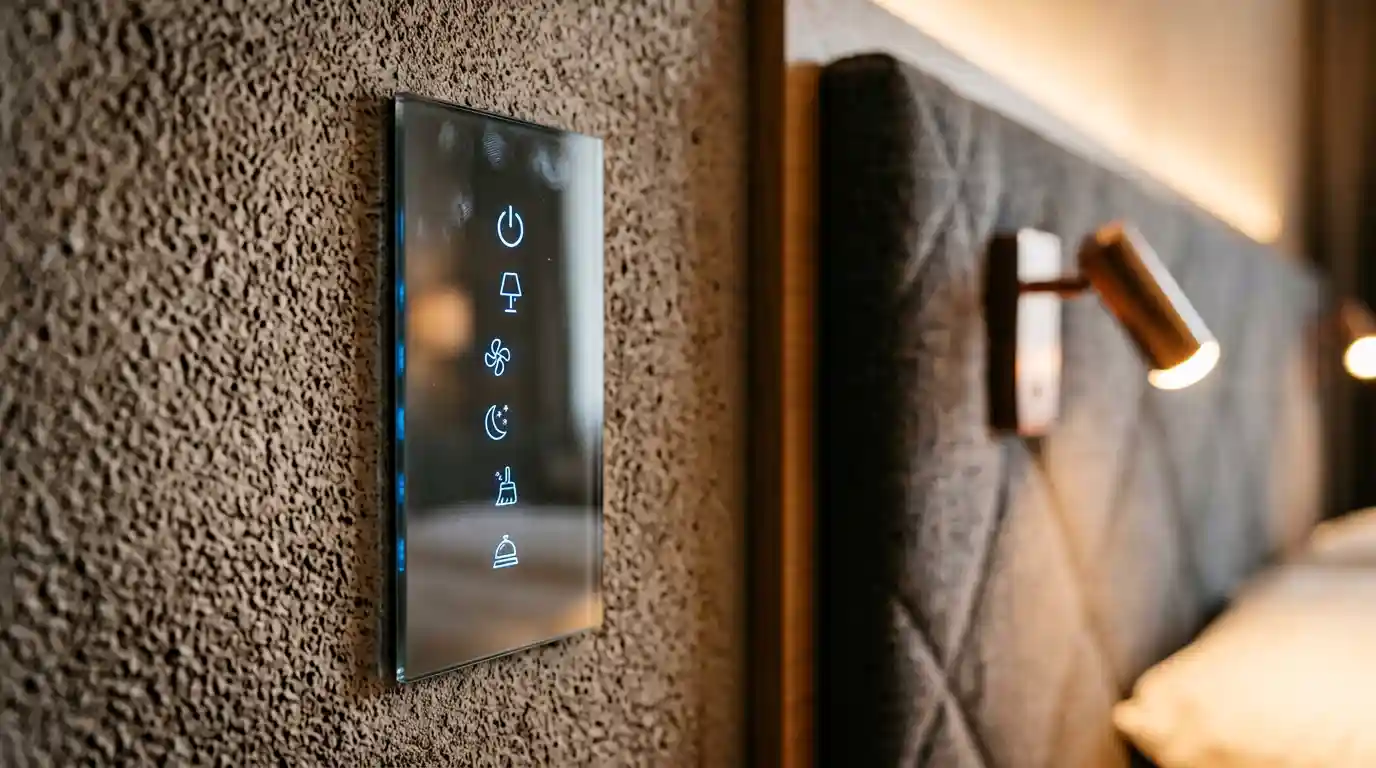
A typical room installation includes a room controller hidden in the ceiling void or wardrobe, a bedside or wall panel, a thermostat, occupancy and door sensors, and a do-not-disturb panel outside the door.
The system usually controls:
- Air conditioning, including setpoint, fan speed and setback by occupancy state
- Lighting, including welcome scenes, bedside control, night path lighting and a master off at the door
- Curtains and blinds, motorised open and close
- Do-not-disturb and make-up-room signalling, replacing the door hanger and appearing on a housekeeping dashboard
- Room status reporting, covering occupied, vacant, sold, unsold, cleaned and service required
- Fault reporting, so a failed fan coil or an open balcony door is visible centrally rather than discovered by a guest
The guest-facing benefit is a room that behaves consistently. The operator benefit is energy control and visibility across every room at once, which is where the investment is justified.
How Does a GRMS Know When the Room Is Occupied?
Occupancy detection is the foundation of the entire system, because every energy saving depends on the controller correctly knowing whether someone is in the room. Get this wrong and the rest of the system is decoration.
Four detection methods are used, and they are not equivalent.
Key card holder. A wall slot that energises the room when a card is inserted. This method is effectively obsolete as a sole occupancy signal. Guests leave a spare card, a loyalty card or an expired key in the slot when they go out, and the room reports occupied for the entire stay. A property relying on card holders alone will never see its projected savings.
Door contact. A magnetic contact reporting when the entrance door opens and closes. On its own it says nothing about who is inside, but combined with presence sensing it becomes the trigger that starts an occupancy evaluation.
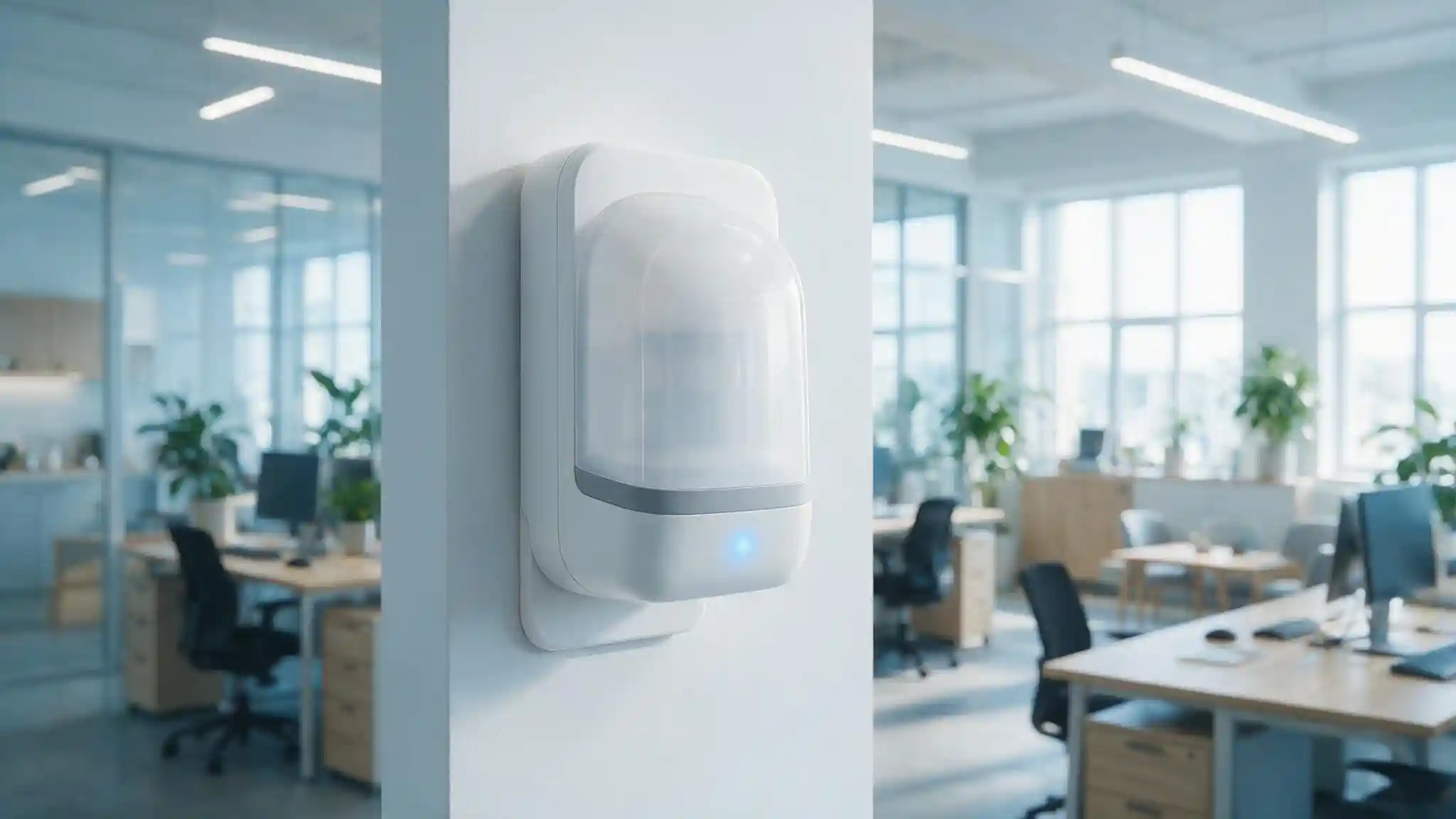
Passive infrared presence sensing. A PIR sensor detects movement and heat. It is inexpensive and widely used, and its weakness is that a guest sitting still or asleep produces no motion, so a PIR-only room can decide the guest has left and drop into setback overnight.
Radar or microwave presence sensing. Detects fine movement including breathing at rest, which resolves the sleeping-guest problem. It costs more and is the correct choice for the bedroom zone in an upper-tier property.
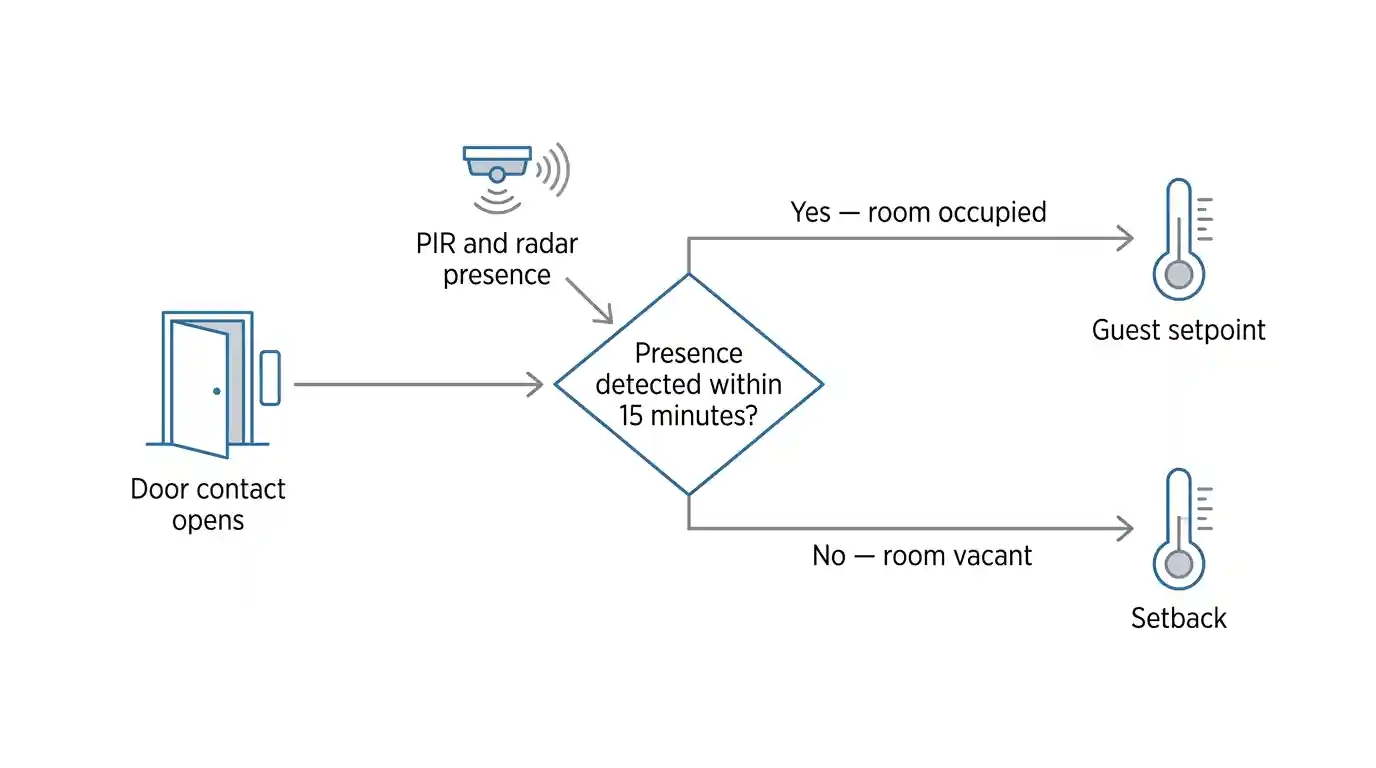
The reliable approach combines them. Door contact establishes a change of state, presence sensing confirms whether anyone is inside, a bathroom sensor covers the case of a guest out of view of the main sensor, and generous timeouts prevent the system from acting on a few quiet minutes. A rule such as "door opened, no presence detected for fifteen minutes, therefore vacant" is far more dependable than any single sensor.
Where a key card holder is retained, treat it as a convenience for switching on the room, not as the occupancy source of truth.
How Does a GRMS Reduce Hotel Energy Costs?
A GRMS saves energy by running the air conditioning in different states rather than one, and in a Gulf climate air conditioning is the dominant load in the building. The saving comes from hours, not from degrees.
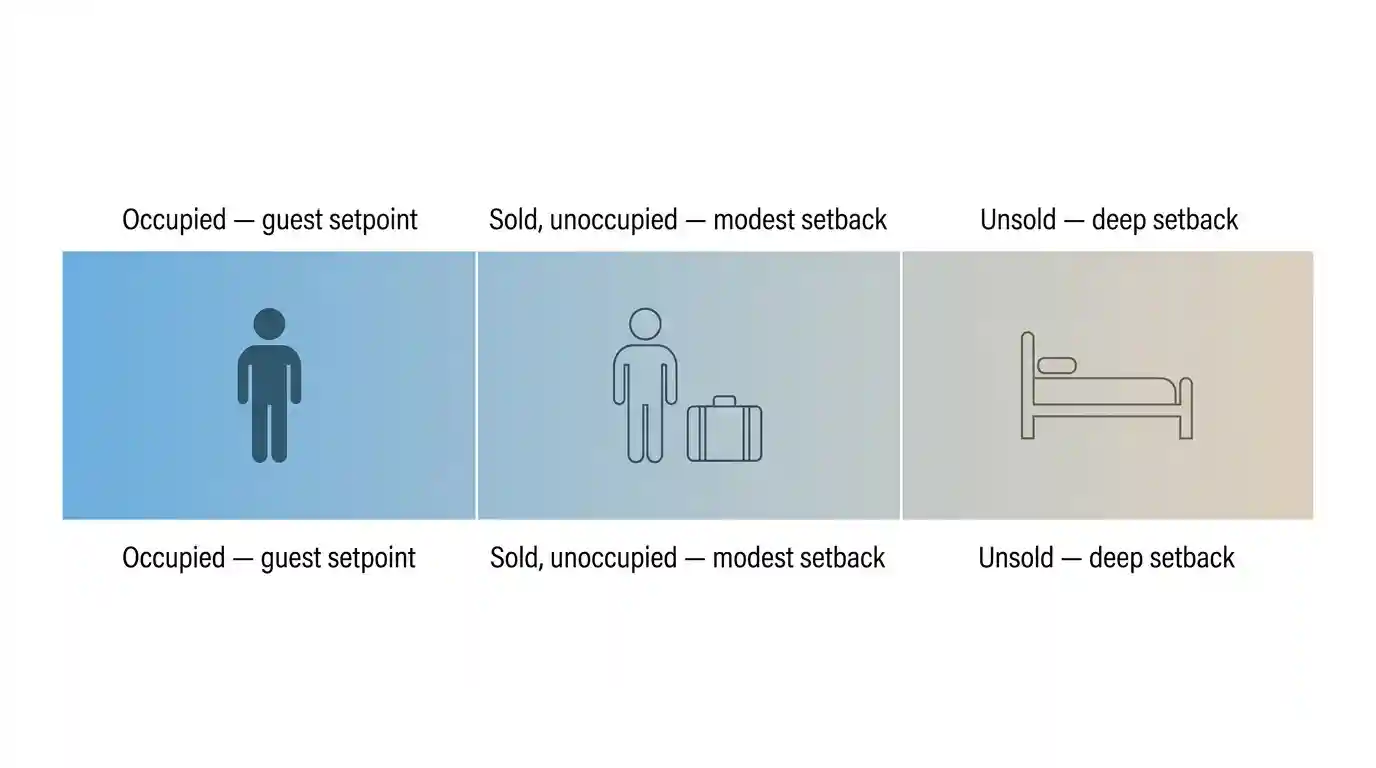
Three thermal states cover a guest room:
- Occupied. The guest's chosen setpoint, within a permitted range.
- Sold but unoccupied. A modest setback of a few degrees while the guest is out for the day, chosen so the room recovers quickly on return.
- Unsold or vacant. A deeper setback, since nobody is returning to the room until it is next allocated.
Four additional controls contribute:
- Balcony and window contacts that stop the fan coil when a door is opened, which prevents the system cooling the outside air. In a hot, humid coastal city this single control can be the largest saving in the room.
- Setpoint limits that prevent a guest requesting an unrealistically low temperature the system will never reach.
- Lighting scenes and master off, which reduce lighting load and, indirectly, cooling load.
- Unsold room scheduling driven by the property management system, so rooms not allocated for the night are not conditioned at all.
Setback depth needs care, and this is where projects fail commercially rather than technically. In high ambient conditions a deeply set-back room takes a long time to pull back down to a comfortable temperature. A guest returning to a warm room complains, engineering receives repeated complaints, and the eventual response is to disable setback across the property. Choose a setback the room can recover from within a reasonable period, and use the property management system to pre-cool a room ahead of a known check-in.
The reporting side matters as much as the control. A GRMS feeding a smart energy management system shows which rooms consume more than their peers, which usually reveals a failing fan coil or a door contact that has been taped over.
Wired, Wireless or Standalone: Which Architecture Fits?
The table below compares the three approaches on the criteria that decide a hotel project.
| Criterion | Wired GRMS | Wireless GRMS | Standalone room controls |
|---|---|---|---|
| Installation | Cabling to each room during construction or major refit | Wireless mesh to a floor gateway, minimal cabling | Local thermostat and switches only |
| Suitable for | New build and full refurbishment | Occupied hotels and phased retrofits | Small properties with no central reporting |
| Occupancy accuracy | Highest, supports multiple wired sensors | Good, sensor choice may be limited by battery life | Basic or none |
| PMS integration | Full | Full | None |
| Central reporting | Full room status and fault reporting | Full, subject to gateway coverage | None |
| Energy savings | Highest | High | Limited to local thermostat behaviour |
| Maintenance | Low, mains powered devices | Battery replacement across sensors | Low |
| Disruption to operating rooms | High, rooms out of service | Low, typically a day per room | Minimal |
| Cost per room | Highest | Medium | Lowest |
Key takeaway: A wired GRMS is the correct specification for any new build or full refurbishment, because cabling is cheap while the walls are open and it removes battery maintenance permanently. A wireless system is the right answer for an operating hotel, since rooms can be converted one at a time with roughly a day of downtime each. Standalone controls only make sense for small properties that will never integrate with a property management system, and they deliver a fraction of the available saving.
How Does a GRMS Connect to the Rest of the Hotel?
A GRMS delivers most of its operational value through integration, and four connections matter.
Property management system. The PMS tells the GRMS which rooms are sold, when a guest checks in and when they check out, and the GRMS tells the PMS the real occupancy and cleaning status. This link is what enables unsold room setback and pre-arrival cooling, and it is usually made through a middleware or interface layer rather than a direct connection.
Building management system. Room-level demand feeds chiller plant sequencing, and floor-level faults reach the engineering team. Guest room systems commonly present to the BMS over BACnet, while devices inside the room use KNX, Zigbee, DALI for lighting, or a proprietary room bus.
Housekeeping and service. Do-not-disturb and make-up-room status on a dashboard removes the corridor walk. Housekeeping sees which rooms are ready to service, which stops the knock on a sleeping guest's door.
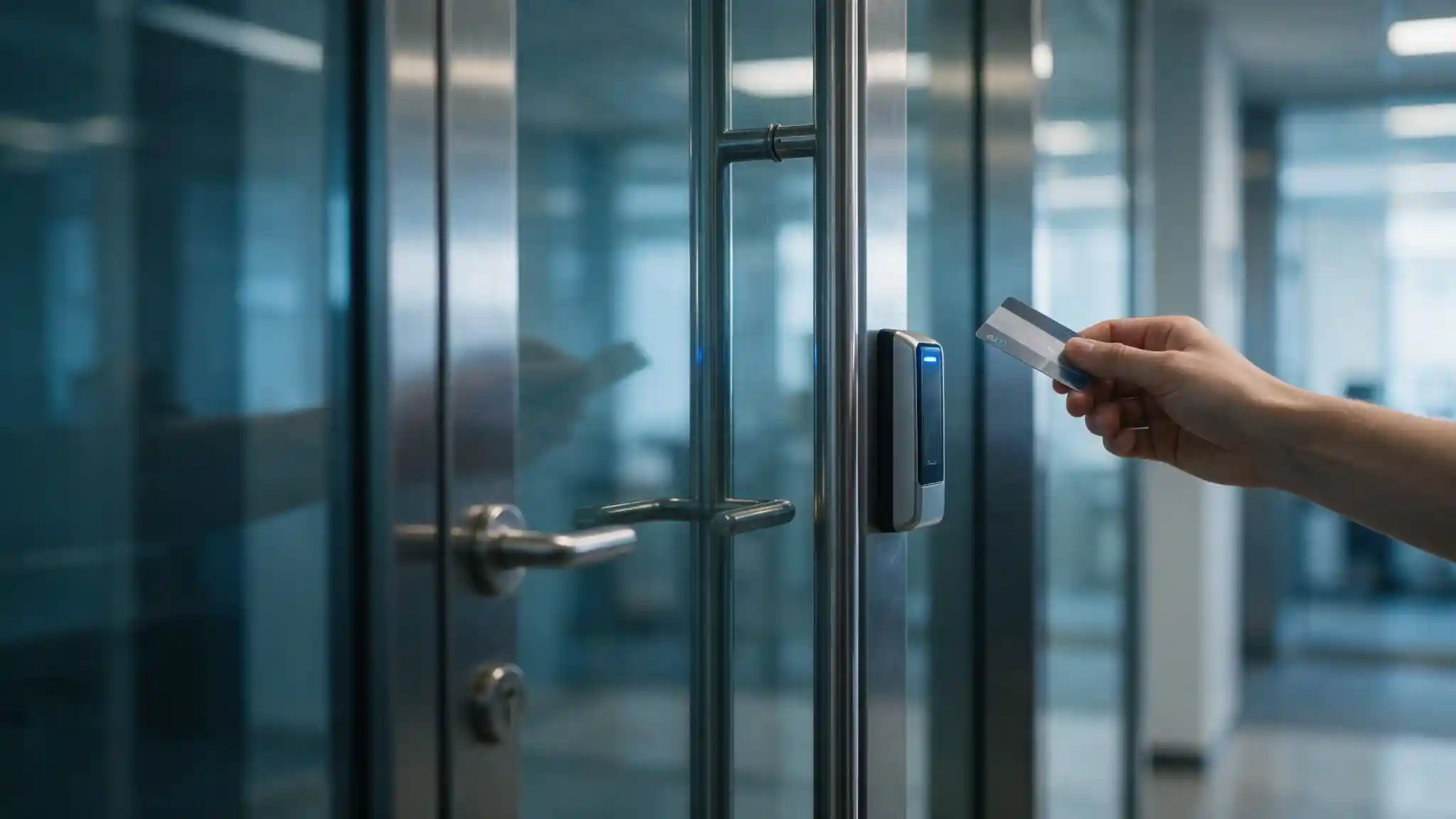
Access control and door locks. Sharing credential and door events links entry to room activation, and it means the room responds when the guest actually arrives. The mechanics are covered in how smart access control integrates with building management.
Ask two questions of any vendor at tender stage. Which open protocol does the system present to the BMS, and is the PMS interface a supported standard product or a bespoke development. A GRMS that only integrates through custom work becomes a permanent dependency on one contractor.
What Network Does a GRMS Need?
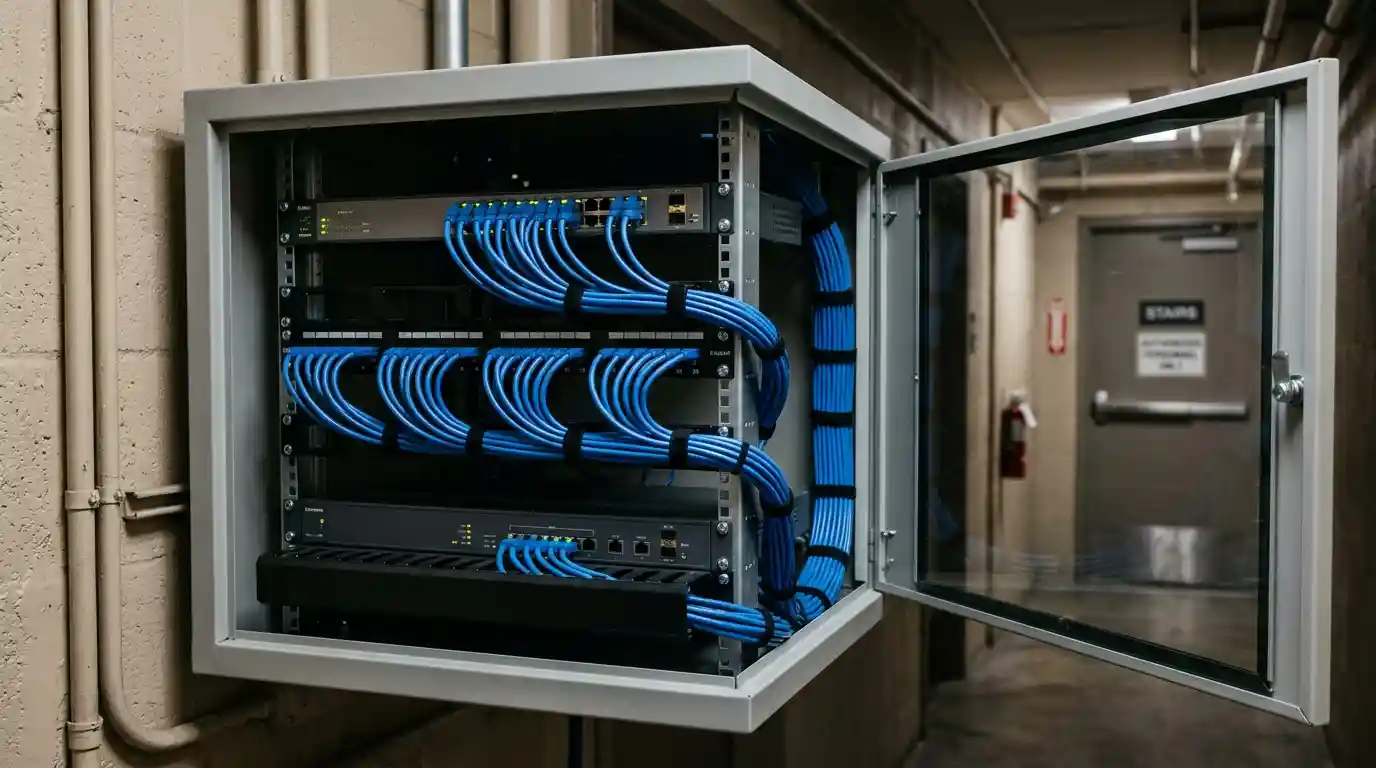
A GRMS needs a small amount of bandwidth and a well-separated, reliable network, and two design rules matter more than capacity.
The room must work when the network does not. Room controllers should hold their logic locally, so lighting, temperature and curtain control continue through a network outage or a head-end failure. Only reporting and PMS-driven functions should degrade. A system that leaves guests unable to turn on a light because a floor switch failed will not survive its first incident.
The GRMS belongs on its own VLAN. Guest room controllers must never be reachable from the guest Wi-Fi network. A guest device connecting to the wireless network should have no path to any room controller, gateway or head-end, and this is enforced through VLAN separation and firewall rules rather than obscurity. Treat the room control network with the same discipline as any other segmented operational network.
Three further requirements belong in the design:
- Structured cabling planned per room, since a modern room needs drops for the access point, television, room controller and door lock, and adding them later means opening finished walls
- PoE for controllers, panels and gateways where the product supports it, which removes local power supplies from ceiling voids. Size the switch on total Power over Ethernet budget rather than port count
- Coordination with the guest Wi-Fi design, because access point placement, room controllers and wireless sensors share the same 2.4 GHz space and interfere if planned separately, as set out in Wi-Fi design for smart buildings
What Do Saudi Hotels Need to Specify?
Three factors shape guest room system specifications in Saudi Arabia that a generic international package does not address.
Cameras are prohibited in guest rooms, so occupancy sensing must be non-imaging. The Law of the Use of Security Surveillance Cameras, issued under Royal Decree No. M/34 of 1444H and administered by the Ministry of Interior, prohibits camera installation in private spaces, and guest rooms and bathrooms fall squarely into that category. Several international vendors now market vision-based occupancy sensors that count and classify people. Those products are not appropriate for a Saudi guest room. Specify passive infrared or radar presence sensing, and confirm in writing that no image sensor is present in the device.
Occupancy data is personal data once it meets the PMS. Room-level presence records linked to a reservation identify an individual guest's movements, which brings them within Saudi Arabia's Personal Data Protection Law (PDPL) administered by the Saudi Data and Artificial Intelligence Authority. Define what presence data is retained, for how long, who can view it, and whether the platform stores it inside the Kingdom. Aggregate energy reporting rarely needs guest-level detail, so retain the minimum the operation actually uses.
Cooling load and occupancy volatility raise the value of the system. Air conditioning is the largest energy consumer in a Saudi hotel, and the temperature difference between inside and outside is large for much of the year, which means every hour a room is conditioned unnecessarily costs more than it would in a temperate climate. Properties in Makkah and Madinah face extreme seasonal occupancy swings around Hajj and Umrah, so unsold room setback driven by the PMS is worth considerably more there than average figures suggest.
Two practical climate points follow. Specify equipment rated for the ambient conditions of unconditioned ceiling voids and risers, which run far hotter than the room. And confirm the pull-down performance of the fan coil before setting setback depth, using the approach described in network and systems design for extreme desert climates.
Sustainability certification adds a further driver. Saudi Arabia's Mostadam green building rating system rewards measured energy performance, and a GRMS is one of the few systems that produces room-level evidence of it.
Blue Edge, a technology distributor based in Dammam, Saudi Arabia, supplies Akubela smart building and room control systems alongside the structured cabling and networking and IT installation and configuration services hotel deployments depend on.
What Are the Most Common GRMS Mistakes?
Six mistakes account for most underperforming guest room systems.
Using the key card holder as the only occupancy signal. Guests leave a spare card in the slot, the room reports occupied all week, and the energy business case never materialises.
Relying on PIR sensing alone in the bedroom. A sleeping guest produces no motion, the room decides it is vacant, and the air conditioning drops back overnight.
Omitting balcony and window contacts. The fan coil runs continuously against an open door, which is both the largest avoidable waste in the room and a frequent cause of condensation.
Setting setback too deep. The room cannot recover before the guest returns, complaints follow, and engineering eventually disables setback across the whole property.
Leaving room controllers dependent on the network. A floor switch failure means guests cannot control their own lights, which turns a technical fault into a guest experience incident.
Putting room controllers on the guest network. A guest device should never have a path to a room controller. Separate the networks at design stage rather than after a penetration test.
Get the Occupancy Logic Right and the Rest Follows
A guest room management system is sold on guest experience and paid for by energy savings, and those savings live or die on whether the controller knows if anyone is in the room. Every other feature depends on that one signal being correct.
Specify occupancy detection first, using door contact plus presence sensing with sensible timeouts rather than a card slot. Set setback depth against the fan coil's real pull-down performance, not a theoretical figure. Confirm the property management system interface is a supported product rather than a bespoke build. Then look at scenes, panels and dashboards.
Plan the network alongside the room system. Cabling per room, VLAN separation from guest Wi-Fi, PoE budget and local controller autonomy decide whether the system runs reliably for a decade, and none of those can be retrofitted cheaply once the rooms are finished.
Planning a hotel project or refurbishment? Blue Edge supplies smart building and room control systems along with the network infrastructure they run on across Saudi Arabia. Call +966 53 9855 188 or contact our team to discuss your property. Learn more about Akubela smart building solutions.
Frequently Asked Questions
-
Why are key card holders no longer enough for occupancy detection?
Guests routinely leave a spare key, a loyalty card or an expired room card in the wall slot when they go out, so the room reports occupied for the whole stay and never enters setback. A key card holder is a convenient way to switch a room on, but it cannot serve as the occupancy source of truth. Combine a door contact with presence sensing and a timeout so the controller evaluates actual occupancy.
-
Can a guest room management system be retrofitted into an operating hotel?
Yes. Wireless systems are designed for exactly this, using a mesh back to a floor gateway so no new cabling runs to each room. Conversion typically takes about a day per room, which lets a property work floor by floor while continuing to trade. The trade-off is battery-powered sensors, so plan a scheduled replacement programme rather than waiting for low-battery alerts.
-
What happens to the room if the network goes down?
That depends on how the system was specified. A well-designed room controller holds its logic locally, so lighting, temperature and curtain control keep working through a network or head-end outage, and only reporting and PMS-driven functions are lost. Systems that depend on a central server for basic room functions leave guests unable to control their own lights, so require local autonomy in the specification.
-
How deep should air conditioning setback be in a hotel room?
Deep enough to save energy while allowing the room to recover before the guest returns. In high ambient conditions a heavily set-back room takes a long time to pull back down, and the resulting complaints usually lead to setback being disabled entirely. Use a modest setback for sold but unoccupied rooms, a deeper one for unsold rooms, and pre-cool ahead of a known check-in using the property management system.
-
Are occupancy sensors allowed in guest rooms in Saudi Arabia?
Non-imaging sensors such as passive infrared and radar presence detectors are used routinely. Camera-based occupancy sensing is not appropriate, because the Law of the Use of Security Surveillance Cameras prohibits camera installation in private spaces, which includes guest rooms and bathrooms. Confirm in writing that any presence sensor contains no image sensor, and treat presence data linked to a reservation as personal data under the Personal Data Protection Law.