Shopping Cart


- Articles
- Cybersecurity
- Attack Surface Management for Growing Businesses in Saudi Arabia
Attack Surface Management for Growing Businesses in Saudi Arabia
Find the assets you forgot: subdomain takeover, shadow SaaS, integrator-built servers and building systems, plus the .sa domains international tools miss.
By Blue Edge Team | Published Sep 08, 2026 | Updated Oct 03, 2026 | 13 min read

Quick answer
Attack surface management is the continuous process of discovering, inventorying, prioritising and reducing every point where an attacker could enter an organisation or extract data from it. The emphasis falls on discovery, because breaches routinely begin at an asset nobody knew existed, such as a forgotten subdomain, a test environment left exposed or a server a contractor built and never handed over.
The uncomfortable question in most security reviews is not which vulnerabilities exist. It is how many systems the organisation owns.
Ask an IT manager in a company that has doubled in three years and the answer arrives with a pause. There is the documented estate, and then there is everything else: the campaign microsite marketing commissioned two years ago, the staging environment a developer stood up for a demonstration, the storage account created during a migration, and the server the system integrator built to commission the building management platform.
Attackers do not attack the documented estate. They attack whatever is reachable, and the reachable things nobody is watching are the easiest place to start.
This guide covers what actually forms an attack surface, where it hides in a fast-growing business, how to find assets nobody wrote down, how to prioritise what you find, and the parts of a Saudi estate that international tooling routinely misses.
What Is Attack Surface Management?
The attack surface is the total set of points at which an unauthorised party could attempt to enter an organisation or extract data from it. Attack surface management is the continuous process of discovering those points, recording them, prioritising the risk each one carries, and reducing the total.
The surface has four parts, and organisations usually track only one of them well:
- External. Domains and subdomains, public IP addresses, web applications, APIs, exposed services and ports, cloud storage, certificates, DNS records, mobile applications and public code repositories.
- Internal. Endpoints, servers, internal applications, file shares, service accounts and management interfaces.
- Operational technology and building systems. Building management controllers, access control panels, cameras, recorders, digital signage players and environmental sensors.
- Human and third party. Employees and contractors as a phishing surface, and suppliers holding access or data.
The word doing the work in the definition is continuous. An inventory produced once and filed is a description of a moment that has already passed. Every new service, environment, subscription and branch adds surface, and the gap between an asset appearing and someone noticing it is the exposure window.
The principle underneath is simple enough to state and difficult to live by. You cannot protect what you do not know you have, and the assets you do not know about are precisely the ones with no patching schedule, no monitoring and no owner.
Where Does the Surface Actually Hide?
In a growing business the surface expands faster than the function responsible for it. Nine places account for most of what goes missing.
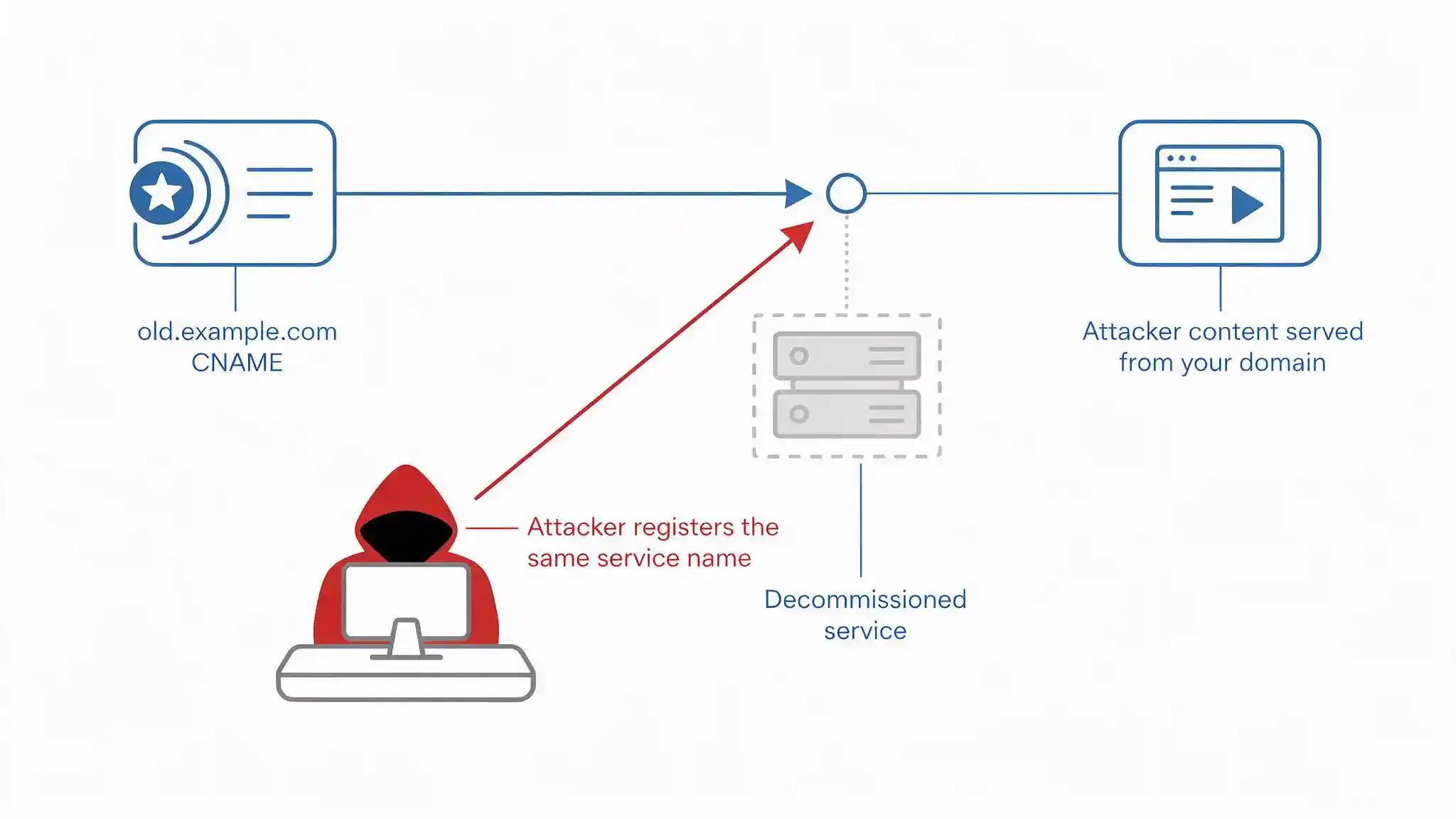
Forgotten subdomains and dangling DNS. A subdomain takeover occurs when a DNS record still points at a cloud service that has been decommissioned, allowing an attacker to register that service name and serve their own content from your domain. The attacker inherits your brand, your TLS certificate trust and, in some configurations, your cookies.
Development and staging environments. Frequently internet-reachable, frequently holding a copy of production data, and almost always under weaker controls than production.
Orphaned cloud resources. A storage container created during a migration, a virtual machine with a public address left running after a project closed, a database snapshot exported for testing.
Shadow SaaS. Departments subscribe on a company card. The tool holds customer or employee data, and the security function learns of its existence during the breach notification. This is where a cloud access security broker earns its place.
Old marketing microsites. Campaign sites running an unpatched content management system, still resolving years after the campaign ended.
Exposed management interfaces. Remote desktop, database ports, administrative panels, printer web interfaces and device management consoles reachable from the internet because a firewall rule was added temporarily and never removed.
Public code repositories. Source code, configuration and, frequently, credentials. The response to a credential found this way is covered in secrets management.
Systems built by contractors. A system integrator stands up a server or a gateway to commission a project, uses their own naming, and the asset never enters the client's inventory because handover covered documentation and acceptance rather than assets.
Inherited estates. Acquisitions and joint ventures bring an unknown environment with unknown exposure, usually connected to the corporate network before anyone has mapped it.
How Do You Discover Assets Nobody Documented?
Discovery has to start somewhere other than the existing inventory, because searching the list of known assets can only ever return known assets. Use the same sources an attacker would.
Certificate transparency logs. Every publicly trusted TLS certificate issued is recorded in public logs, so searching those logs for your domain returns subdomains you have forgotten, including internal-sounding names that were never meant to be public. This is free, takes minutes and is consistently the highest-yield first step.
DNS enumeration and record review. Walk the full zone for every domain you own. Look specifically for records pointing at services you no longer use, which are the dangling records behind subdomain takeover.
Public IP range review. Confirm which addresses are allocated to the organisation and what answers on each one, then compare that against what should be reachable.
Cloud provider inventory. Every major cloud platform exposes an asset inventory across all regions and subscriptions. Run it across every account, including the ones a single team opened independently.
Single sign-on and identity logs. Authentication records show which applications people are actually signing into, which reveals SaaS the security function never approved.
Finance and expense records. This is the most underused discovery source available and it costs nothing. Finance holds a record of every subscription the organisation pays for. Cross-reference card statements and expense claims against the approved application list and the difference is your shadow SaaS estate, complete with an owner already attached to each line.
Internal network scanning. Sweep internal ranges for live hosts and open services, including the ranges facilities and operations equipment sit on.
Public code and paste sources. Search public repositories for the organisation's domains and internal hostnames.

Run discovery continuously rather than annually. A quarterly cycle finds an exposed development environment an average of six weeks after it appeared, and the attacker scanning the internet continuously found it the first day.
Is a Vulnerability Scan the Same as Attack Surface Management?
No, and the table below sets out why the distinction matters when choosing where to spend.
| Criterion | Manual asset inventory | Periodic vulnerability scan | Continuous external ASM | Penetration test |
|---|---|---|---|---|
| What it produces | A documented list | Findings on scanned targets | Discovered assets plus exposure findings | Demonstrated exploitation paths |
| Discovers unknown assets | No | No, it scans what you point it at | Yes, discovery is the purpose | Sometimes, within the agreed scope |
| Frequency | When someone updates it | Monthly or quarterly | Continuous | Annually or on major change |
| Depth of finding | None | Moderate, automated | Moderate, breadth over depth | High, with proof of impact |
| Cost | Staff time | Low to moderate | Subscription | High per engagement |
| Main limitation | Goes stale immediately | Blind to anything outside its target list | Limited internal visibility | Point in time, scoped |
| Best used for | Ownership and accountability records | Routine hygiene on known systems | Finding what nobody documented | Validating defences on critical systems |
Key takeaway
A vulnerability scanner reports on the assets you tell it about, which means it inherits every gap in your inventory. Attack surface management exists to find the assets that were never on the list, and that difference is the entire point. Most growing businesses get more value from continuous external discovery than from a deeper scan of the systems they already knew about, because the systems they already knew about are the ones already being patched.
How Do You Prioritise What You Find?
Discovery produces more findings than any team can address, and prioritising by severity score alone sends effort to the wrong places.
Rank by three factors together:
Exposure. Is it reachable from the internet, from the corporate network, or only from an isolated segment. An internet-facing service outranks an identically vulnerable internal one, which is why network segmentation changes priority as well as risk.
Exploitability. Is the weakness known to be actively exploited in the wild. Catalogues of known exploited vulnerabilities and exploit prediction scoring exist precisely because severity scores do not distinguish between a theoretical flaw and one being used today.
Value. What sits behind it. An exposed interface fronting customer personal data or financial systems outranks the same interface on a brochure site.
A severity score treated alone produces the familiar failure: a critical rating on an isolated internal system consuming a week of effort while a moderate finding on an internet-facing application with customer data waits behind it.
One principle changes the economics of the whole programme. Reduction beats remediation. The strongest response to a discovered asset is frequently to remove it rather than to secure it. A campaign microsite nobody has updated in two years does not need a patching plan, it needs to be retired. A staging environment does not need hardening if it should never have been reachable from the internet. A SaaS subscription nobody uses should be cancelled and its data deleted.
Every asset removed is an asset that needs no patching, no monitoring, no certificate renewal and no place in next year's audit. Work through findings asking whether the thing should exist at all before asking how to secure it.
Finally, assign an owner to every asset that stays. Findings without a named owner are rediscovered at the next review in exactly the state they were found in.
What Do Saudi Businesses Need to Include?
Four elements of a Saudi estate are routinely missed, two of them by international tooling specifically.
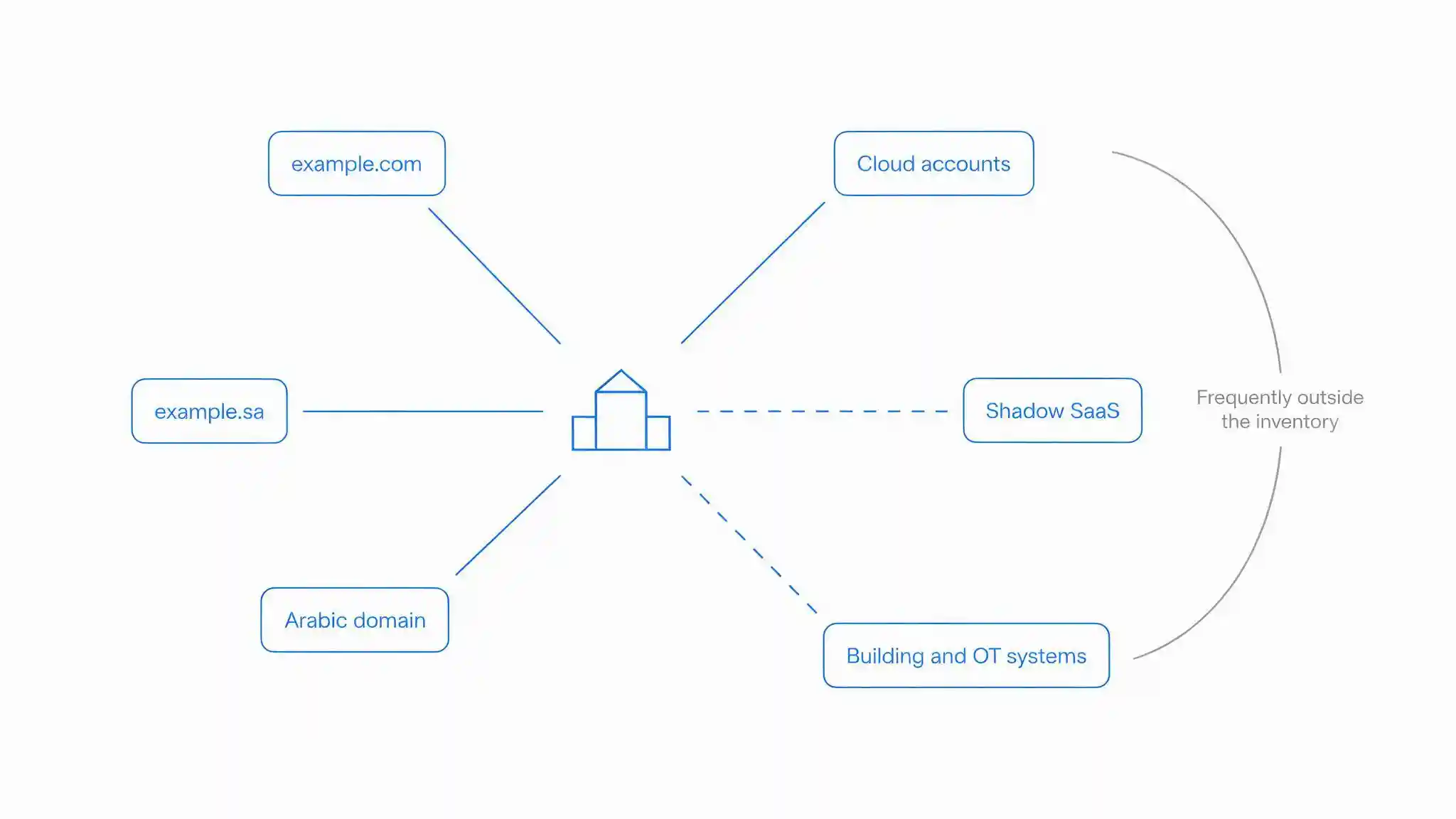
The .sa and Arabic domain estate. Saudi organisations commonly hold a .com alongside a .sa or .com.sa registered through SaudiNIC, and frequently an Arabic internationalised domain as well. Those additional domains are often registered by a marketing agency or a founder rather than IT, renewed automatically, and never inventoried. External discovery tooling scoped to the primary .com will not find them, their subdomains, or the dangling records under them. Build the domain list from registrar and finance records first, then run discovery against every domain in it rather than against the one everybody thinks of.
Systems built and retained by integrators. Saudi IT delivery relies heavily on system integrators, and project teams routinely stand up servers, gateways and management platforms to commission an environment. Where handover covers documentation and acceptance but not an asset register, those systems exist on the network with no owner in the client organisation. Make an asset list a contractual handover deliverable, and reconcile it against a network sweep rather than accepting it on trust. This sits alongside the supply chain and third-party risk work an organisation should already be doing.
Building and operational technology systems. Building management controllers, access control panels, video recorders, digital signage players, environmental sensors and irrigation controllers are all network-connected computers, and in most organisations they are owned by facilities rather than IT. They rarely appear in the cybersecurity asset inventory, they are rarely patched after commissioning, and a video recorder or building gateway with a public address is directly exposed infrastructure. Include facilities equipment in discovery scope, and treat it with the discipline described in operational technology security and IoT device lifecycle management.
Growth-driven expansion. Organisations scaling under Vision 2030 programmes add entities, joint ventures, branches and acquisitions faster than governance follows. Each one brings an estate. Make an attack surface review a standard step before any new environment is connected to the corporate network, not a task for the following year.
Two regulatory anchors apply. Cybersecurity asset management is a control domain within the National Cybersecurity Authority's Essential Cybersecurity Controls (ECC), which expect an accurate and maintained inventory of assets. And personal data held in shadow SaaS is still processing under the Personal Data Protection Law (PDPL) administered by the Saudi Data and Artificial Intelligence Authority, whether or not the security function knew the tool existed. Financial institutions carry the additional obligations of the SAMA Cybersecurity Framework.
Blue Edge, a technology distributor based in Dammam, Saudi Arabia, distributes NinjaOne endpoint and patch management, which discovers and patches endpoints and servers, and KnowBe4 security awareness training, which addresses the human portion of the surface.
What Are the Most Common Attack Surface Mistakes?
Six mistakes account for most estates that surprise their owners.
Treating inventory as a project rather than a process. A list produced once describes a moment that has already passed, and the assets added since are exactly the unmonitored ones.
Scoping discovery to the known estate. Pointing a scanner at the asset list can only return the asset list. Discovery has to start from external sources instead.
Prioritising by severity score alone. A critical rating on an isolated system consumes effort that an internet-facing moderate finding on a customer-facing application needed more.
Patching what should be decommissioned. Retiring an unused asset removes it from every future patch cycle, audit and monitoring requirement at once.
Excluding facilities and operational technology. Building controllers, recorders and signage players are network-connected computers, and being owned by another department does not remove them from the attack surface.
Leaving findings without an owner. An asset with no named owner has nobody to fix it, and the finding reappears unchanged at the next review.

Find It, Then Get Rid of Most of It
The instinct with attack surface work is to buy a platform and start scanning. Before that, spend an afternoon on two free sources. Search certificate transparency logs for every domain the organisation owns, including the .sa and Arabic ones. Then ask finance for twelve months of subscription and card records and compare them against the approved application list.
Those two exercises consistently surface more unknown assets than the first month of any tooling deployment, and they cost nothing but attention.
Then work through what you find with removal as the first option. Retire the microsite, close the firewall rule, cancel the unused subscription, delete the orphaned storage. What remains gets an owner, a patching path and a place in monitoring.
The programme only works if it repeats. Assets appear continuously, so discovery has to as well, and the practical measure of a mature programme is how long a new internet-facing asset exists before somebody in the organisation knows about it.
Frequently Asked Questions
-
What is a subdomain takeover?
A subdomain takeover happens when a DNS record still points at a cloud service that has been deprovisioned, allowing an attacker to register that service name and serve content from your subdomain. The attacker gains the trust of your domain name, which makes phishing far more convincing, and in some configurations can access cookies scoped to the parent domain. Reviewing DNS records for entries pointing at services you no longer use prevents it.
-
What is certificate transparency and how does it help discovery?
Certificate transparency is a public logging system that records every publicly trusted TLS certificate issued. Because certificates are logged with the hostnames they cover, searching those logs for your domain returns subdomains that exist but were never documented, including internal-sounding names that were never intended to be public. It is free, takes minutes, and consistently reveals assets no internal list contains.
-
Is a vulnerability scan the same as attack surface management?
No. A vulnerability scanner assesses the targets you point it at, so it inherits every gap in your asset inventory and cannot report on systems nobody recorded. Attack surface management is built around discovering assets that were never on the list, using external sources such as certificate logs, DNS records and cloud inventories. Both are useful, and the scanner only covers what discovery has already found.
-
Should you patch an exposed asset or remove it?
Remove it where you can. Retiring an unused asset eliminates it from every future patch cycle, certificate renewal, monitoring requirement and audit at once, whereas patching keeps all of those obligations alive indefinitely. Work through discovered assets by asking first whether the thing should exist at all, and only then how to secure the ones that genuinely should.
-
Do international attack surface tools cover .sa and Arabic domains?
Not automatically. Tooling is scoped to the domains you provide, and organisations frequently supply the primary .com while a .sa or .com.sa registered through SaudiNIC, and any Arabic internationalised domain, sit outside the scope. Those domains are often registered by marketing or a founder rather than IT and never inventoried. Build the domain list from registrar and finance records first, then scope discovery against all of them.
Reviewing what your business actually has exposed?
Blue Edge works with organisations across Saudi Arabia on endpoint management, patching and security awareness.
Call +966 53 9855 188 or contact our team to discuss your requirements.
NinjaOne in Saudi ArabiaAbout Blue Edge
Blue Edge Company is a value-added technology distributor based in Dammam, Saudi Arabia, supplying interactive displays, smart building systems, networking infrastructure and IT security software to businesses and residential projects across the Kingdom, with installation and technical support.
Learn more about Blue Edge →Published 8 September 2026 • Last updated 3 October 2026 • This article is reviewed when standards, regulations or product guidance change.