Shopping Cart


- Articles
- Cybersecurity
- Cybersecurity for Retail and POS Environments
Cybersecurity for Retail and POS Environments
Reduce PCI scope with P2PE, segment the store network, inspect terminals for tampering, and secure the ZATCA credentials now living on your POS.
By Blue Edge Team | Published Sep 09, 2026 | Updated Oct 03, 2026 | 14 min read
Quick answer
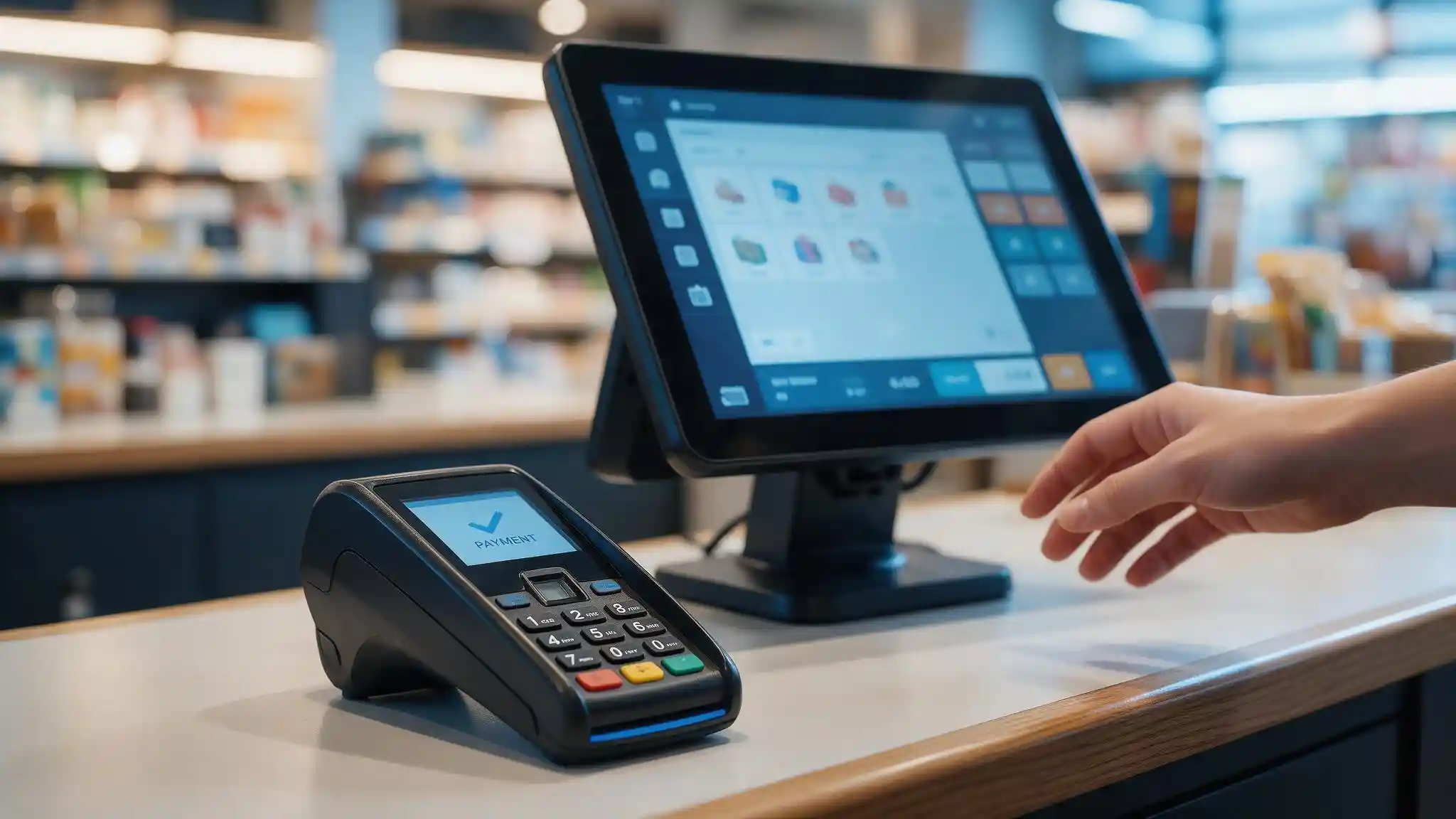
Retail and point of sale security depends less on defending card data than on arranging for the business never to hold it. Point-to-point encryption and tokenisation keep readable card data out of the terminal, the till system and the store network entirely, which removes most of those systems from compliance scope and makes the classic point of sale malware attack impossible rather than merely difficult.
A retailer's weakest computer is usually a back-office PC in a stockroom, shared by four people, running an operating system two versions behind, connected to the same network as the tills, and used for everything from stock counts to checking a personal email account.
That machine exists in every store. Head office does not see it, the store manager does not think of it as a computer, and no security programme designed around the corporate office ever reaches it.
Retail security is not office security applied to more locations. It is a different problem with different physics: many sites, almost no technical staff on site, equipment the public can physically touch, staff turnover measured in months, and money moving through the middle of it.
This guide covers how to remove card data from the equation entirely, the attack paths that have repeatedly compromised entire chains at once, how a store network should be built, how to spot a tampered terminal, and what ZATCA integration has added to every Saudi point of sale.
What Makes Retail Different?
Six characteristics change the security problem, and none of them apply to a head office.
- Scale without staffing. Fifty stores means fifty networks, fifty sets of equipment and no technical person at any of them. Whatever the control is, a shop assistant has to be able to follow it.
- Public physical access. Payment terminals sit within arm's reach of anyone who walks in. No other business function hands its hardware to strangers hundreds of times a day.
- High turnover. Seasonal and part-time staff arrive faster than annual training cycles, so security awareness has to be delivered in minutes on day one, not in an hour-long module in month three.
- Uptime beats everything. A store that cannot take payment is losing money in real time, which creates constant pressure to work around any control that slows a queue.
- Money is the objective. Retail attackers are not looking for intellectual property. Card data, refund fraud and ransom payments are all directly monetisable, which makes retail a volume target rather than an opportunistic one.
- Fragmented ownership. Franchise and concession models split responsibility between brand owner and operator, and security frequently falls into the gap.
Where Does Card Data Actually Go?
The most effective control in retail is not protecting card data. It is arranging never to hold it.
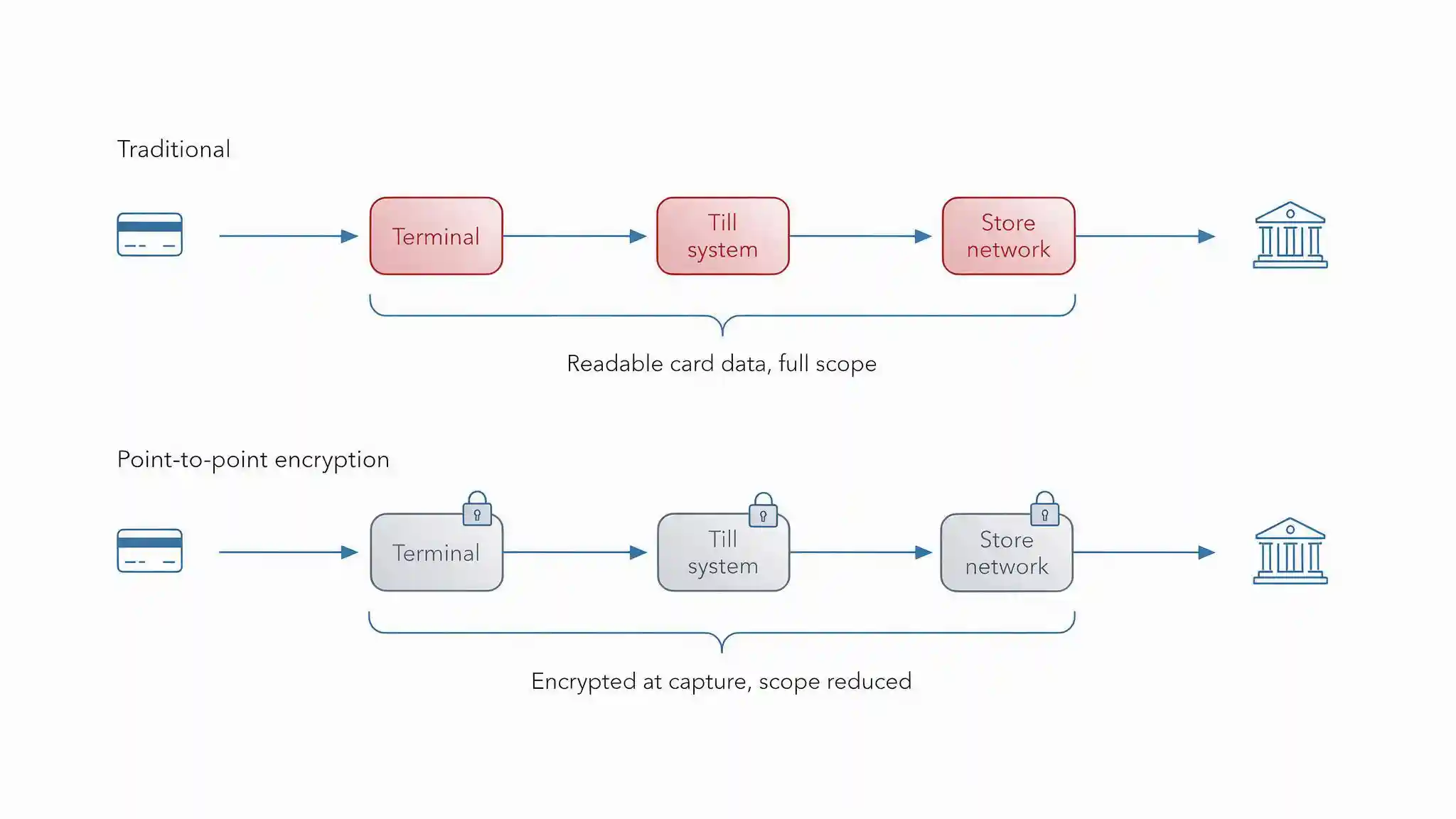
Point-to-point encryption means the payment terminal encrypts card data at the moment of capture, using keys the merchant does not hold, so that the data passes through the till system and the store network in a form nobody there can read. Only the payment provider can decrypt it.
Tokenisation replaces the card number with a substitute value that is useless outside the specific merchant context. Refunds, recurring charges and reporting all work against the token, so no card number is ever stored.
The consequence is structural. If readable card data never exists on the till, the network or the back-office server, then malware on those systems cannot steal it, a network breach does not expose it, and the systems fall largely outside the scope of the Payment Card Industry Data Security Standard. Scope reduction is not an administrative convenience. It removes an entire attack from the estate.
| Criterion | Traditional POS | Tokenised | Validated point-to-point encryption |
|---|---|---|---|
| Where card data is readable | Terminal, till software, network, sometimes storage | At capture and in transit to the provider | Nowhere the merchant controls |
| Card numbers stored | Frequently, for refunds and reporting | No, tokens only | No |
| Compliance scope of the till system | Full | Reduced | Substantially reduced |
| Compliance scope of the store network | Full | Reduced | Substantially reduced |
| Impact of POS malware | Card data harvested from memory | Tokens only, of no external value | Nothing readable to harvest |
| Impact of a store network breach | Card data exposed | No card data present | No card data present |
| Refunds and recurring charges | Work from stored card data | Work from the token | Work through the provider |
| Implementation effort | None, it is the default | Moderate, integration work | Moderate to high, terminal replacement likely |
| Best suited for | Nothing, at this point | Any retailer handling repeat customers | Any retailer taking card payments in person |
Key takeaway
The single highest-value decision in retail security is made at procurement, not in the security team. A validated point-to-point encryption deployment with tokenisation removes the merchant's systems from the path of readable card data entirely, which turns the classic point of sale malware attack from a threat to be defended against into an attack with nothing to take. It costs terminal replacement and integration effort once. Everything else in this article becomes cheaper afterwards, because the scope it applies to is smaller.
Note that the Payment Card Industry Data Security Standard, currently at version 4.0 and its 4.0.1 revision, applies to any business accepting card payments regardless of size. What changes with size and card handling method is the assessment burden, not whether the standard applies.
What Attacks Actually Hit Retail Environments?
Six paths account for the majority of retail compromises, and the most damaging one is not technical sophistication.
Shared vendor remote access. Support providers, till vendors and maintenance contractors are frequently given remote access to every store using one shared credential set. One compromised support account then reaches the entire chain simultaneously. This pattern has been the root cause of some of the largest retail breaches on record, and it persists because it is convenient. Per-vendor named accounts, multi-factor authentication and time-bound access are the corrections, and they belong in the third-party risk process.
Lateral movement from a non-payment system. A supplier connection for building services, a signage player, a camera recorder or a stockroom PC becomes the entry point, and a flat store network lets that foothold reach the till segment. The store network was never designed; it accumulated.
Point of sale malware. Historically the defining retail attack. Malware resident on the till reads card data from memory during processing, before it is encrypted for transmission. Point-to-point encryption removes the readable data this attack depends on.
Physical terminal tampering. A device is swapped for a modified one, or a skimming component is added to a genuine unit. This requires no network access at all and is frequently discovered weeks later, if at all.
Payment page script injection. For the online channel, malicious code added to the checkout page harvests card details as they are typed, often introduced through a legitimate third-party script rather than the retailer's own code. Version 4.0 of the Payment Card Industry standard introduced requirements addressing exactly this, covering management of scripts on payment pages and detection of unauthorised changes to them.
Ransomware. Less about data theft than about trading. A chain unable to process payment loses revenue every hour, which is precisely the leverage the attacker is buying. Recovery planning matters more than in most sectors, as set out in ransomware recovery.
How Should a Store Network Be Built?
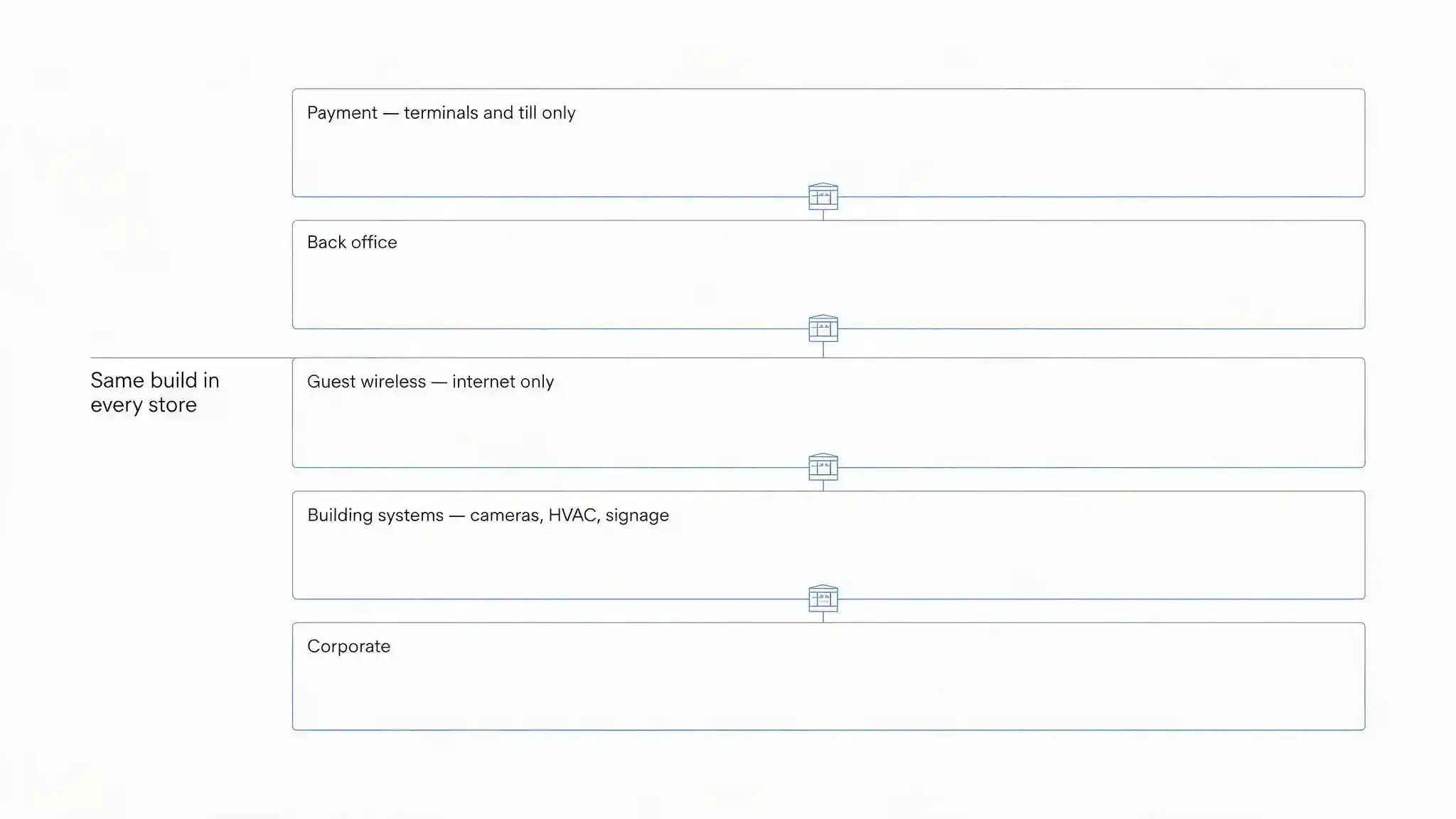
A store network should be segmented by function, and the segmentation should be identical in every store so that a control verified once is verified everywhere.
Five segments cover almost every retail site:
- Payment. Terminals and till systems only. No general internet access, outbound connectivity restricted to the payment provider and the specific head office services required. Nothing else joins this segment for any reason.
- Back office. The stockroom PC, printers and store operations systems. Separate from payment, with its own rules.
- Guest wireless. Fully isolated, internet only, with no route to any internal segment. Customer devices must not be able to reach anything.
- Physical security and building systems. Cameras, recorders, access control, HVAC and signage. These are network computers and belong on their own segment, for the reasons set out in converged security.
- Corporate. Where staff devices that need business systems connect, kept distinct from payment.
The reasoning behind separating them is covered in network segmentation and VLAN design. What matters in retail specifically is standardisation. Fifty stores each configured slightly differently produce fifty different risk profiles and no way to verify any of them, which is why scalable multi-branch network design is a security concern rather than only an operations one.
Vendor access deserves its own rule set. Every support provider gets named individual accounts rather than a shared one, reaches the store through a controlled path rather than a direct connection, authenticates with multi-factor authentication, receives access only for the period of the work, and has every session logged. If a vendor cannot work within that, the risk of the alternative should be priced into the contract rather than absorbed silently.
How Do You Protect the Physical Terminal?
Payment terminal tampering needs no network access and is invisible in every log, which makes it the one retail attack that only a physical routine detects.
Five practices cover it:
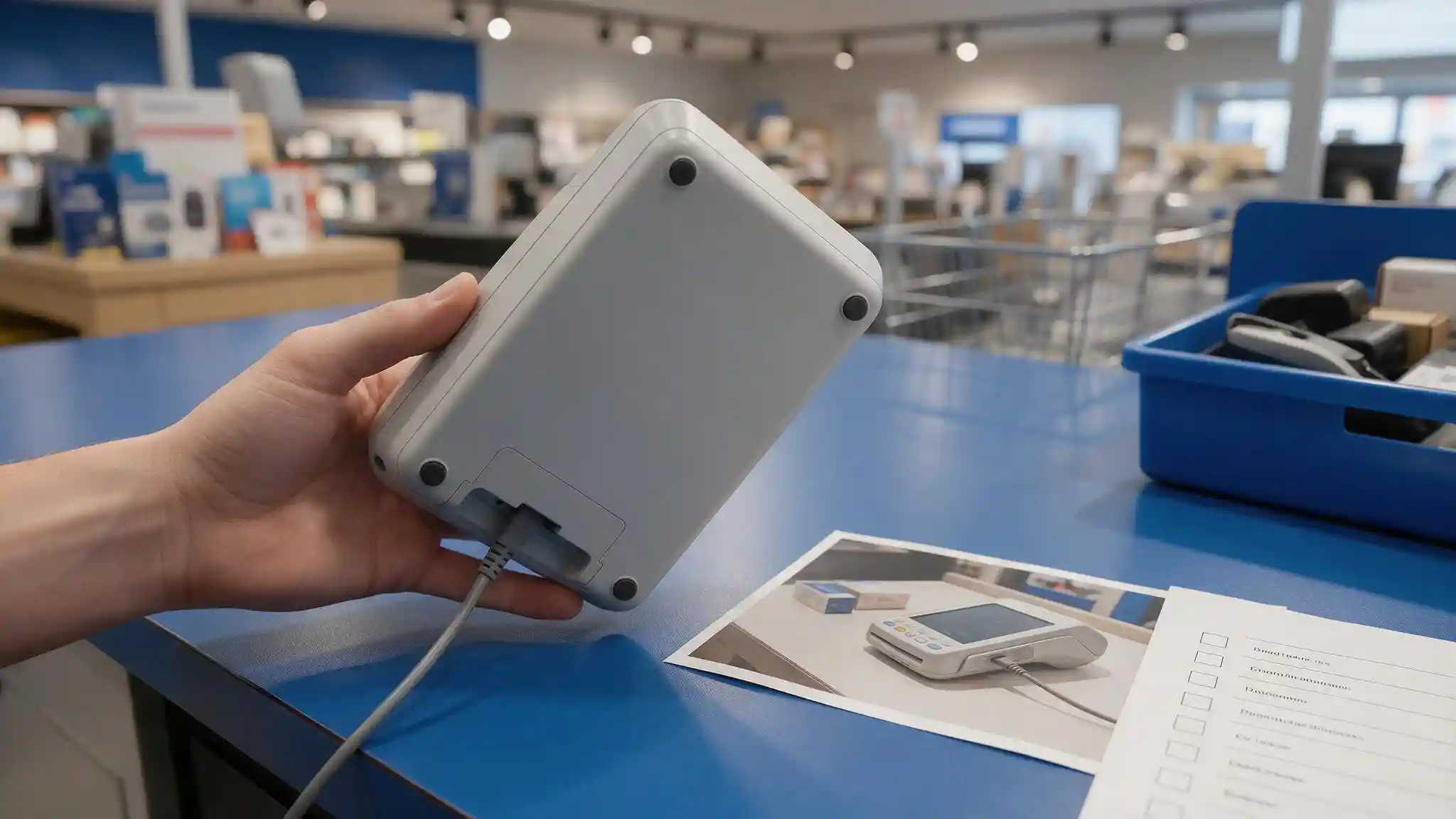
- Inventory every device by serial number, recorded centrally against the store and the counter position. A device swap is only detectable against a known baseline.
- Photograph each terminal at installation, from the same angles, and store the reference images with the inventory. Staff compare against the photograph rather than against memory.
- Inspect on a defined schedule, daily at opening for high-risk locations and at least weekly elsewhere. Check for unexpected attachments, altered casing, loose or damaged seals, additional cables and any change against the reference image.
- Verify anyone who arrives to service a terminal. Legitimate technicians are expected, scheduled and confirmed with head office before any device is touched. Staff must have explicit authority to refuse, and must know that refusing is the correct answer if verification fails.
- Record chain of custody for any device removed or replaced, including who authorised it and where the original went.
The Payment Card Industry standard requires periodic inspection of payment devices for tampering and substitution, so this is a compliance obligation as well as a practical control. In most stores it takes two minutes at opening, and it is the only defence against an attack that leaves no trace anywhere else.
What Do Saudi Retailers Need to Address?
Four factors shape retail security in the Kingdom, and the first is a genuinely new attack surface that did not exist a few years ago.
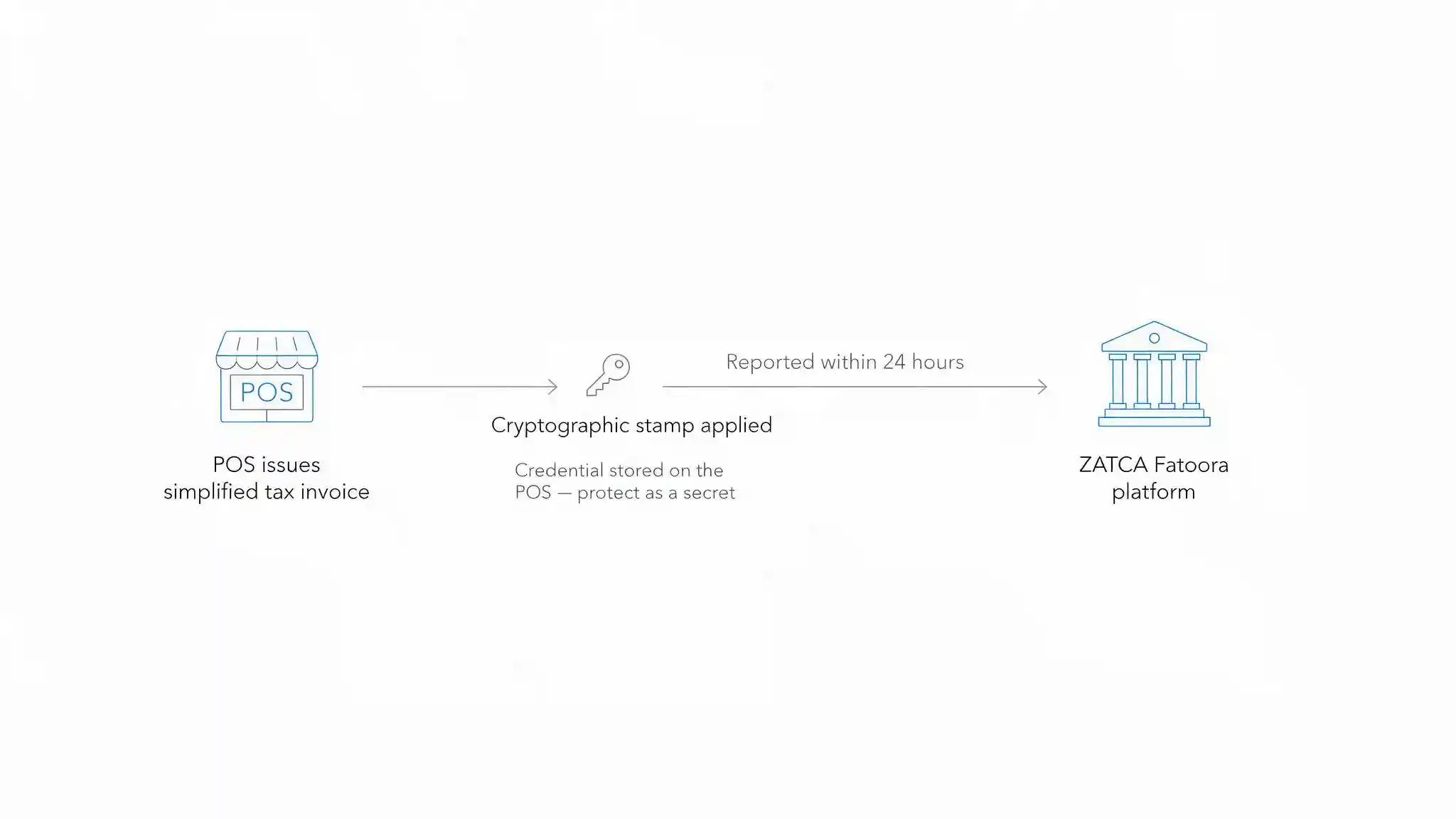
ZATCA e-invoicing put cryptographic credentials inside every point of sale. Under the Zakat, Tax and Customs Authority e-invoicing mandate, Phase 2 integration requires invoicing systems to connect to the Fatoora platform, obtain a cryptographic stamp identifier, cryptographically stamp every invoice and include a QR code. Simplified tax invoices, which is what a retail point of sale produces, must be reported to the platform within twenty-four hours of issue.
Two consequences follow that most retailers have not considered. The point of sale now holds a cryptographic credential, which is a secret requiring the same protection as any other, and the questions in secrets management apply to it directly: where is it stored, who can extract it, what happens when the device is replaced or disposed of. And the till now has an outbound connection to a government platform, which means the payment segment's firewall rules must permit that path explicitly and monitor it, rather than leaving a broad allow rule that also permits everything else.
Payment scheme and regulatory obligations. Domestic card payments run predominantly through the national scheme under the Saudi Central Bank, and merchants operate within its rules alongside the Payment Card Industry standard. Regulated financial entities and payment service providers carry the obligations of the SAMA Cybersecurity Framework, and larger retail organisations fall within the scope of the National Cybersecurity Authority's Essential Cybersecurity Controls (ECC).
Store cameras carry two sets of obligations. Retail premises are covered facilities under the Law of the Use of Security Surveillance Cameras, which requires Ministry of Interior approval, signage and defined retention. Separately, recorded footage and any loyalty or customer data is personal data under the Personal Data Protection Law (PDPL) administered by the Saudi Data and Artificial Intelligence Authority. The camera system is also a network asset that belongs on its own segment and in the patching cycle, which retailers frequently overlook because it was bought as a loss prevention tool.
Franchise structures split accountability. Much of Saudi retail operates through franchise and concession arrangements, where the brand owner sets standards and the operator runs the store. Security responsibilities need to be written into the franchise agreement explicitly: who patches the till software, who holds the vendor contracts, who is accountable if a store is breached, and what the brand owner may audit. Left unstated, each party reasonably assumes the other has it.
On people, keep the training short and role-specific. Retail turnover makes annual e-learning ineffective, so deliver five minutes on day one covering three things: never share a login, verify anyone who wants to touch a terminal, and report anything unusual without fear of being wrong. Reinforce it with periodic simulation as described in security awareness training.
Blue Edge, a technology distributor based in Dammam, Saudi Arabia, distributes NinjaOne endpoint and patch management for distributed store estates and KnowBe4 security awareness training, alongside the structured cabling and networking that store networks depend on.
What Are the Most Common Retail Security Mistakes?
Six mistakes account for most retail compromises.
A flat store network. Tills, the stockroom PC, guest wireless, cameras and signage sharing one segment means any weak device reaches the payment system.
Shared vendor remote access across every store. One credential compromised is every store compromised, simultaneously, and it is the pattern behind several of the largest retail breaches on record.
No physical terminal inspection. Tampering leaves no log entry anywhere, so a routine that nobody performs means an attack nobody detects.
Shared manager logins. One account used across shifts destroys accountability, survives every leaver, and makes refund fraud untraceable.
Treating compliance as an annual exercise. A questionnaire completed once a year describes a state that existed for one afternoon. The controls either operate daily or they do not exist.
Leaving ZATCA credentials unprotected on the till. The cryptographic stamp identifier is a secret. Storing it in a readable location on a shared machine is the same mistake as a hardcoded password, with a regulator attached.
Take the Card Data Out of the Building
The most valuable thing a retailer can do about card data security is stop being in a position to lose card data. Point-to-point encryption and tokenisation are procurement decisions rather than security projects, and once they are in place a whole category of attack becomes irrelevant rather than defended.
After that, three things carry most of the remaining risk, and none of them are exotic. Segment the store network the same way in every store so a control verified once is verified everywhere. Give every vendor named accounts with multi-factor authentication and time-bound access rather than one shared credential that opens the whole chain. And put a two-minute terminal inspection into the opening routine, because it is the only control that detects physical tampering at all.
For Saudi retailers there is now a fourth. The point of sale holds a cryptographic credential and talks to a government platform, which makes it a system with secrets to protect and an outbound path to control. Treat that credential exactly as you would a database password, and write the firewall rule for the Fatoora connection narrowly rather than leaving the segment open to reach it.
Frequently Asked Questions
-
What is point-to-point encryption and why does it matter?
Point-to-point encryption means the payment terminal encrypts card data at the moment of capture, using keys the merchant does not hold, so the data passes through the till and the store network in a form nobody there can read. Only the payment provider can decrypt it. It matters because malware on the till has nothing readable to steal and a network breach exposes no card data, which also removes those systems from most compliance scope.
-
Should vendors have remote access to every store?
Not with shared credentials, which is how it is usually arranged. A single compromised support account then reaches the entire chain at once, and this pattern is behind several of the largest retail breaches on record. Give each vendor named individual accounts, require multi-factor authentication, route access through a controlled path rather than direct connections, grant it only for the period of the work, and log every session.
-
How do you detect a tampered payment terminal?
Through a physical routine, because tampering produces no log entry anywhere. Record every device by serial number against its store and counter position, photograph each terminal at installation from consistent angles, and have staff compare against those reference images daily or weekly. Check for unexpected attachments, altered casing, damaged seals and extra cables, and require verification with head office before anyone is allowed to service a device.
-
What does ZATCA e-invoicing mean for point of sale security?
Phase 2 integration requires the invoicing system to connect to the Fatoora platform, hold a cryptographic stamp identifier and stamp every invoice, with simplified tax invoices reported within twenty-four hours. That places a cryptographic credential inside the point of sale and creates an outbound connection from the payment segment to a government platform. Protect the credential as you would any other secret, and write the firewall rule for that connection narrowly.
-
How do you train retail staff given high turnover?
Keep it short, specific and delivered on day one rather than in an annual module most seasonal staff never reach. Three points cover most of the risk: never share a login, verify anyone who wants to touch a payment terminal and refuse if verification fails, and report anything unusual without worrying about being wrong. Reinforce with periodic phishing simulation, and make clear that reporting a false alarm is always the right outcome.
Reviewing security across your store estate?
Blue Edge works with organisations across Saudi Arabia on endpoint management, patching, security awareness and store networking.
Call +966 53 9855 188 or contact our team to discuss your requirements.
NinjaOne in Saudi ArabiaAbout Blue Edge
Blue Edge Company is a value-added technology distributor based in Dammam, Saudi Arabia, supplying interactive displays, smart building systems, networking infrastructure and IT security software to businesses and residential projects across the Kingdom, with installation and technical support.
Learn more about Blue Edge →Published 9 September 2026 • Last updated 3 October 2026 • This article is reviewed when standards, regulations or product guidance change.