Shopping Cart


- Articles
- Networking
- Industrial Switches for Saudi Sites: Heat, Dust and DIN-Rail
Industrial Switches for Saudi Sites: Heat, Dust and DIN-Rail
How to choose an industrial switch for hot, dusty Saudi sites: cabinet heat ratings, DIN rail, DC power and PoE, with the Huawei S210I models compared.
By Blue Edge Team | Published Oct 23, 2026 | Updated Nov 13, 2026 | 10 min read
Quick answer
An industrial switch is built for outdoor cabinets and plant rooms, with a wide temperature range, DC power, DIN-rail mounting and no fans. Huawei's S210I-8T4SX runs to +65 °C in a sealed cabinet, and the PoE S210I-8P4SX to +60 °C with 240 W of PoE+, both reaching +75 °C with a blower.
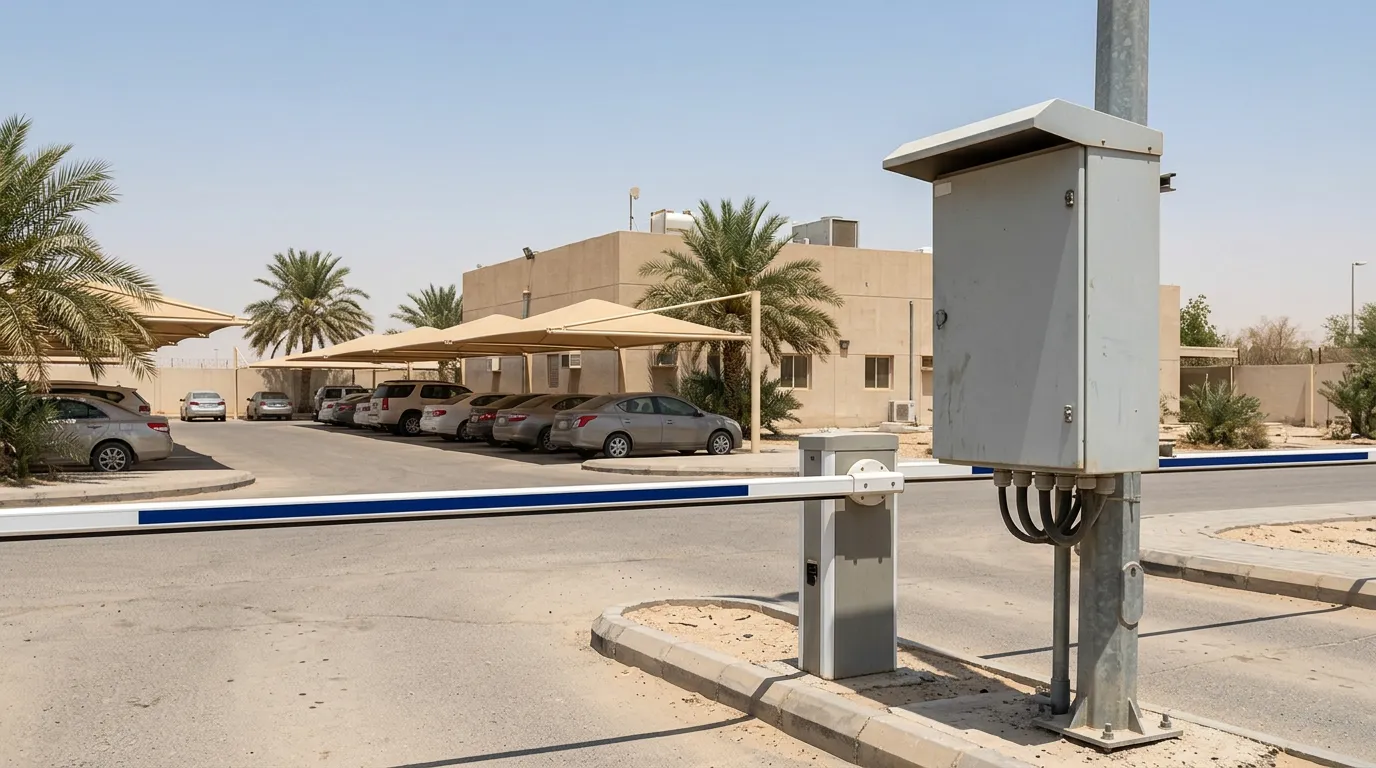
Car parks, gatehouses, perimeter fences, pump stations and warehouse mezzanines all need network connections for cameras, intercoms, barriers and sensors. The switch serving them usually lives in a small metal cabinet in the sun, often with no air conditioning, and an ordinary office switch rated to 45 or 50 °C is not built for that.
Industrial switches are made for exactly these places, and the difference shows within the first summer. This guide explains what makes a switch industrial, what the temperature ratings in a datasheet actually mean, and how Huawei's eKit S210I-8T4SX and S210I-8P4SX compare with an office switch. For the wider design of networks in hot conditions, see our guide to network design for extreme desert climates.
What is an industrial switch?
An industrial switch is a network switch built to run in harsh places, such as outdoor cabinets, plant rooms and factory panels, rather than an air-conditioned comms room. Compared with an office switch, it typically has:
- A wide temperature range: the S210I is rated from −40 °C, with upper limits depending on the cabinet.
- No fans: natural heat dissipation, so it does not pull dust through the case.
- DIN-rail mounting: it clips onto the standard rail used in electrical and control panels.
- DC power and redundancy: two power inputs, so one supply can fail without stopping the switch.
- Stronger surge protection: the S210I lists ±6 kV common-mode protection on its ports.
- A compact metal case: about 150 x 44 x 133 mm and under 1 kg for the S210I models.
How is it different from an office switch?
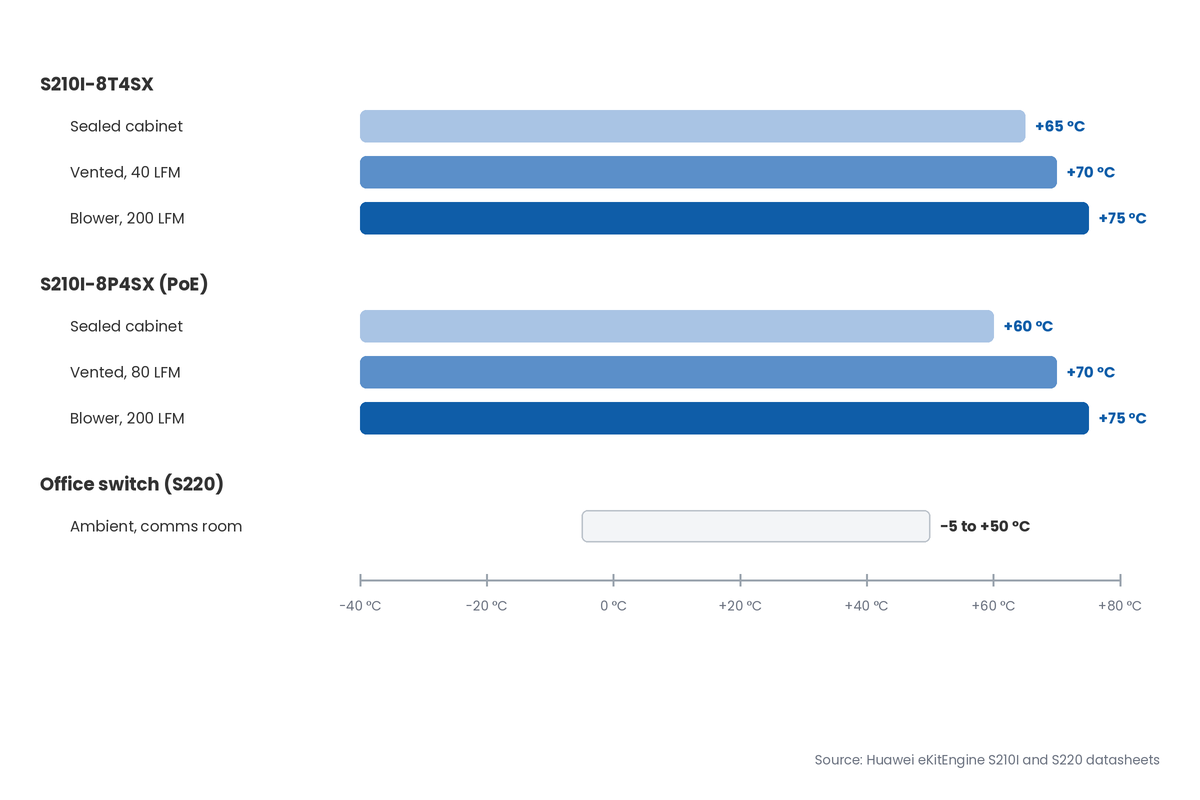
An office switch assumes cool, clean air and a mains socket. Huawei rates its S220 office switches to −5 to +50 °C, while the S210I runs to +60 or +65 °C sealed in a cabinet and +75 °C with a blower. The S210I also takes DC power and mounts on a DIN rail, so it fits the same panels as the site's other control equipment.
What do sealed, vented and blower ratings mean?
They describe the cabinet the switch sits in, not the outdoor air. Huawei rates the S210I-8T4SX to +65 °C in a sealed cabinet, +70 °C in a vented cabinet with at least 40 LFM (linear feet per minute) of airflow, and +75 °C in a cabinet with a blower moving at least 200 LFM. The PoE S210I-8P4SX is rated to +60 °C sealed, +70 °C vented at 80 LFM and +75 °C with a blower.
Why fanless matters in dust
A fan pulls air, and dust, through a switch, and a clogged fan is a common reason equipment overheats. Both S210I models cool by natural heat dissipation, with no fans to fail or fill with dust. They still need space around them inside the cabinet for heat to rise away.
How do you choose an industrial switch?
Choose by the devices it must power, the cabinet it sits in and the power available on site. These are the key numbers from Huawei's S210I datasheet and product specifications:
- Ports: 8 gigabit copper ports, 2 GE SFP ports and 2 x 10GE SFP+ uplinks on both models.
- PoE: none on the S210I-8T4SX; 240 W of PoE+ on the S210I-8P4SX, or 220 W on Huawei's recommended 240 W module.
- Sealed cabinet: up to +65 °C (8T4SX) or +60 °C (8P4SX).
- Blower cabinet: up to +75 °C for both, with at least 200 LFM of airflow.
- Humidity and altitude: 5 to 95% non-condensing, up to 1,800 m.
- Storage temperature: −40 to +85 °C, for spares kept on site.
What power does each model need?
The S210I-8T4SX takes 9.6 to 60 V DC, or a 60 W AC adapter with 12 V DC output, and draws up to 16.2 W. The S210I-8P4SX needs 48 to 57 V DC, at 54 to 57 V for PoE+, and is supplied without a power module. Both support 1+1 redundant inputs, so wire two supplies where the site allows.
How much PoE does the S210I-8P4SX supply?
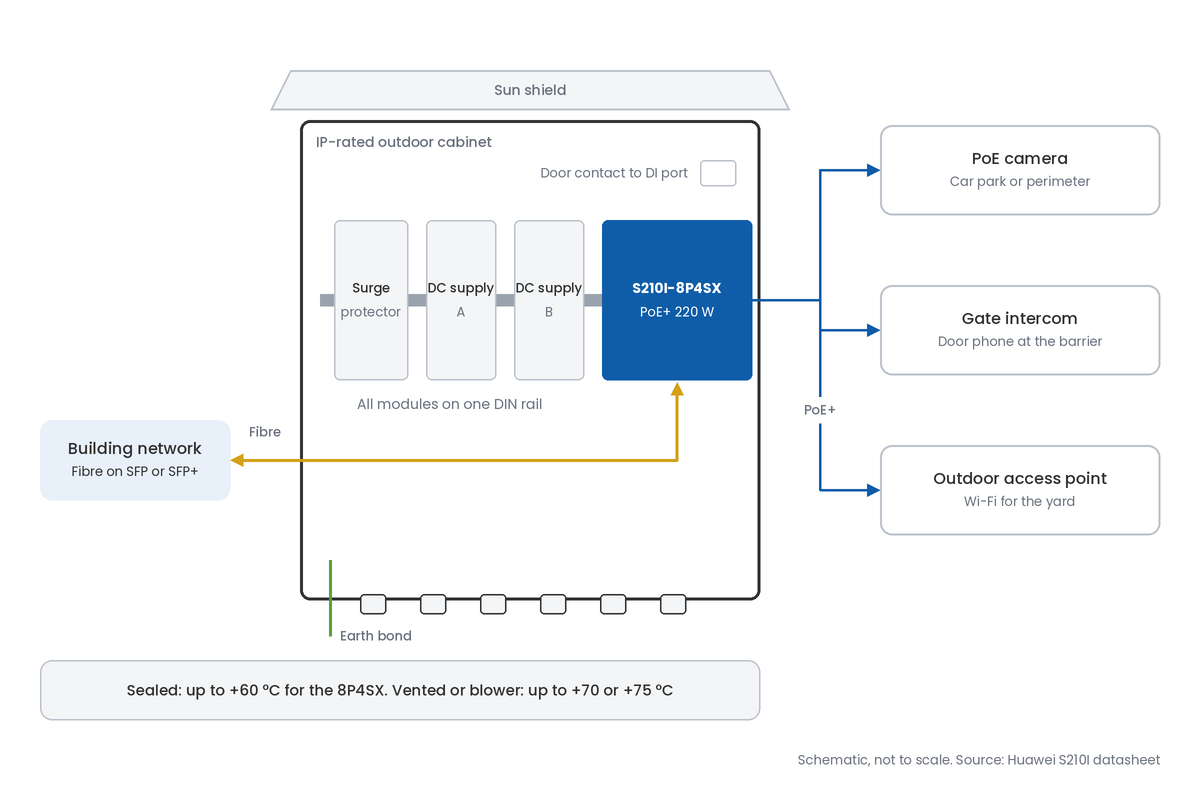
Huawei lists a 240 W PoE+ budget across its 8 copper ports, but with its recommended 240 W power module (PAC240S56-CN) a maximum of 220 W is available. Budget your cameras, intercoms and access points against 220 W, as our guide to Power over Ethernet in Saudi Arabia explains. At full PoE load, the switch draws 257.6 W in total.
Why DIN-rail mounting?
DIN rail is the standard metal rail used in electrical and control panels, so the switch clips in beside breakers, power supplies and controllers. That keeps cabinets small and tidy. Huawei notes that the bracket for mounting the rail in a cabinet or chassis is sold separately.
How do the S210I models compare with an office switch?
The two S210I models are the same switch with and without PoE; the office switch is shown for contrast. Figures come from Huawei's S210I datasheet and product specifications, and the S220 datasheet for the office switch.
| Factor | S210I-8T4SX | S210I-8P4SX | Office switch (S220-8P4S) |
|---|---|---|---|
| Access ports | 8 x GE copper | 8 x GE copper, PoE+ | 8 x GE copper, PoE+ |
| Uplinks | 2 x GE SFP, 2 x 10GE SFP+ | 2 x GE SFP, 2 x 10GE SFP+ | 4 x GE SFP |
| PoE budget | None | 240 W (220 W on 240 W module) | 125 W |
| Power input | 9.6 to 60 V DC, or 12 V adapter | 48 to 57 V DC, module sold separately | AC mains |
| Sealed cabinet | −40 to +65 °C | −40 to +60 °C | Not rated for cabinets |
| With a blower (200 LFM) | Up to +75 °C | Up to +75 °C | −5 to +50 °C ambient |
| Mounting | DIN rail or rack | DIN rail or rack | Rack or desk |
| Cooling | Fanless | Fanless | Office comms room |
| Port surge protection | ±6 kV | ±6 kV | ±6 kV |
| Best fit | Sensors, controllers, non-PoE devices | Outdoor cameras, gate intercoms, APs | Air-conditioned rooms |
Key takeaway
For most outdoor cabinets feeding cameras, intercoms or access points, the S210I-8P4SX is the right choice, provided the cabinet stays within its +60 °C sealed rating or adds ventilation. Choose the S210I-8T4SX where the devices have their own power, and keep office switches indoors.
What do Saudi sites need to consider?
Four local conditions decide whether an industrial switch lasts. Each is cheaper to plan for than to fix after a summer failure.
How hot will the cabinet get?
Hotter than the air around it, because a closed metal cabinet in direct sun absorbs heat all day. Fit a sun shield, choose a light-coloured cabinet, and add ventilation or a blower if the sealed rating, +60 °C for the 8P4SX, could be exceeded. Measure the inside of an existing cabinet on a summer afternoon before deciding.
Does the switch need an IP rating?
The switch itself has no IP rating in Huawei's datasheet, so the cabinet must provide it. Choose a cabinet with an ingress protection (IP) rating suited to dust and rain, as defined in IEC 60529, and use cable glands that keep the seal intact. If the cabinet is vented for cooling, use filtered vents and clean them on a schedule.
How do you protect against surges?
The S210I lists ±6 kV common-mode protection on its ports, and ±2 kV common-mode and ±1 kV differential-mode on its DC power. Long outdoor cable runs and lightning-prone sites still benefit from separate surge protectors on power and data lines, and a proper earth bond for the cabinet. Fibre uplinks avoid surges travelling back to the building, as our guide to fibre versus copper cabling explains.
Do altitude limits matter in Saudi Arabia?
Occasionally. Huawei rates the S210I for up to 1,800 m, which covers most Saudi sites, but some highland areas in the south-west, such as around Abha, sit higher. Check the site's altitude before specifying, and confirm with Huawei for anything above 1,800 m. [NEED: warranty and in-Kingdom replacement terms for Huawei eKit industrial switches]
Blue Edge supplies the Huawei eKit S210I-8P4SX industrial PoE switch and the S210I-8T4SX, alongside Axis cameras for outdoor sites, to projects across Saudi Arabia. Our cabling and networking service designs outdoor cabinets, fibre runs and earthing. [NEED: confirm Blue Edge's status for the Huawei eKit switch line before publishing]
What are the most common industrial switch mistakes?
- Putting an office switch in an outdoor cabinet. Rated to 50 °C ambient, it fails early in a sun-heated box, usually in the first summer.
- Assuming the PoE model has the same heat rating. The S210I-8P4SX is rated 5 °C lower than the 8T4SX in a sealed cabinet, because PoE adds heat.
- Forgetting the power module. The S210I-8P4SX ships without one, so installation stalls until a 48 to 57 V supply arrives.
- Budgeting PoE at 240 W. On Huawei's recommended module, 220 W is available, so the last device may not power up.
- Relying on the switch for dust and water protection. The switch has no stated IP rating; the cabinet has to do that job.
- Running copper uplinks across open ground. Long copper runs carry surges back to the building, where fibre would not.
Plan the cabinet first, then the switch
Start with the site: where each cabinet will stand, how much sun it gets, which devices it feeds and how far it is from the building. Measure or estimate the cabinet's internal temperature in summer, and decide whether it will be sealed, vented or fitted with a blower.
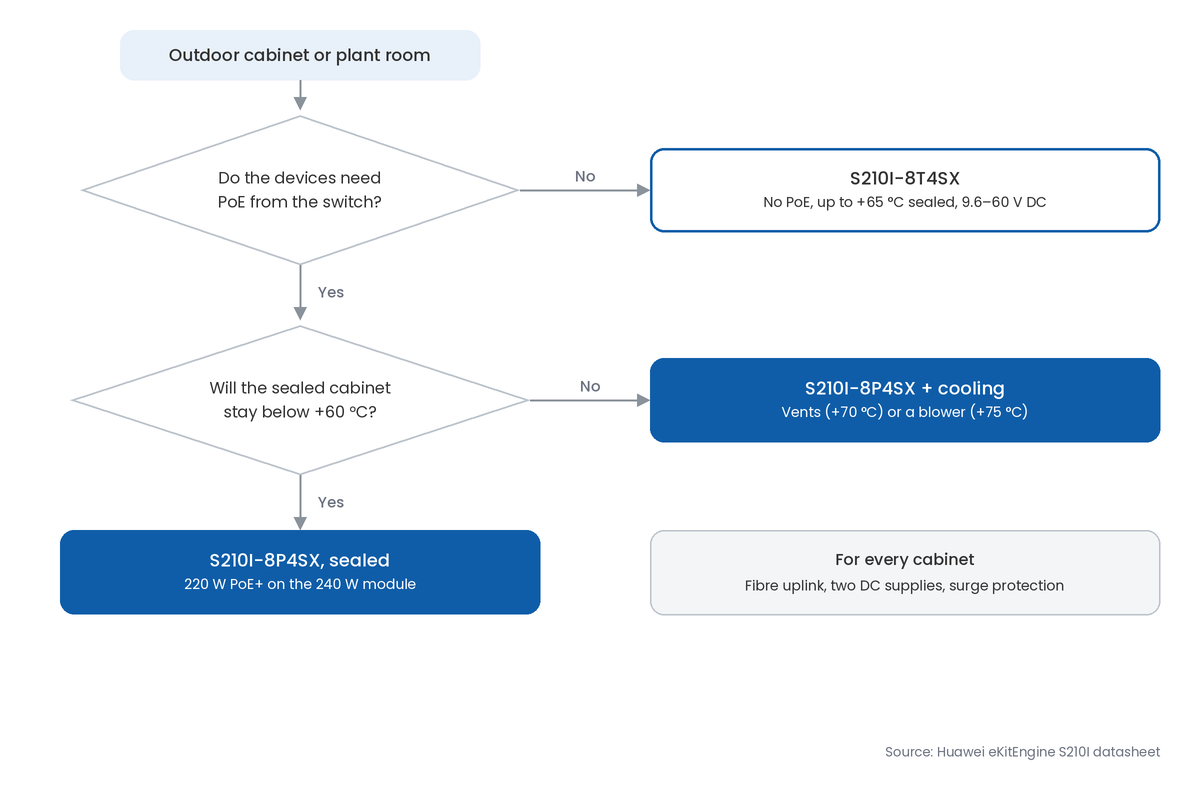
Next, choose the switch: the S210I-8P4SX where devices need PoE, the 8T4SX where they do not. Then size the DC supplies, with two where possible, and run fibre to the building on the SFP or SFP+ uplinks.
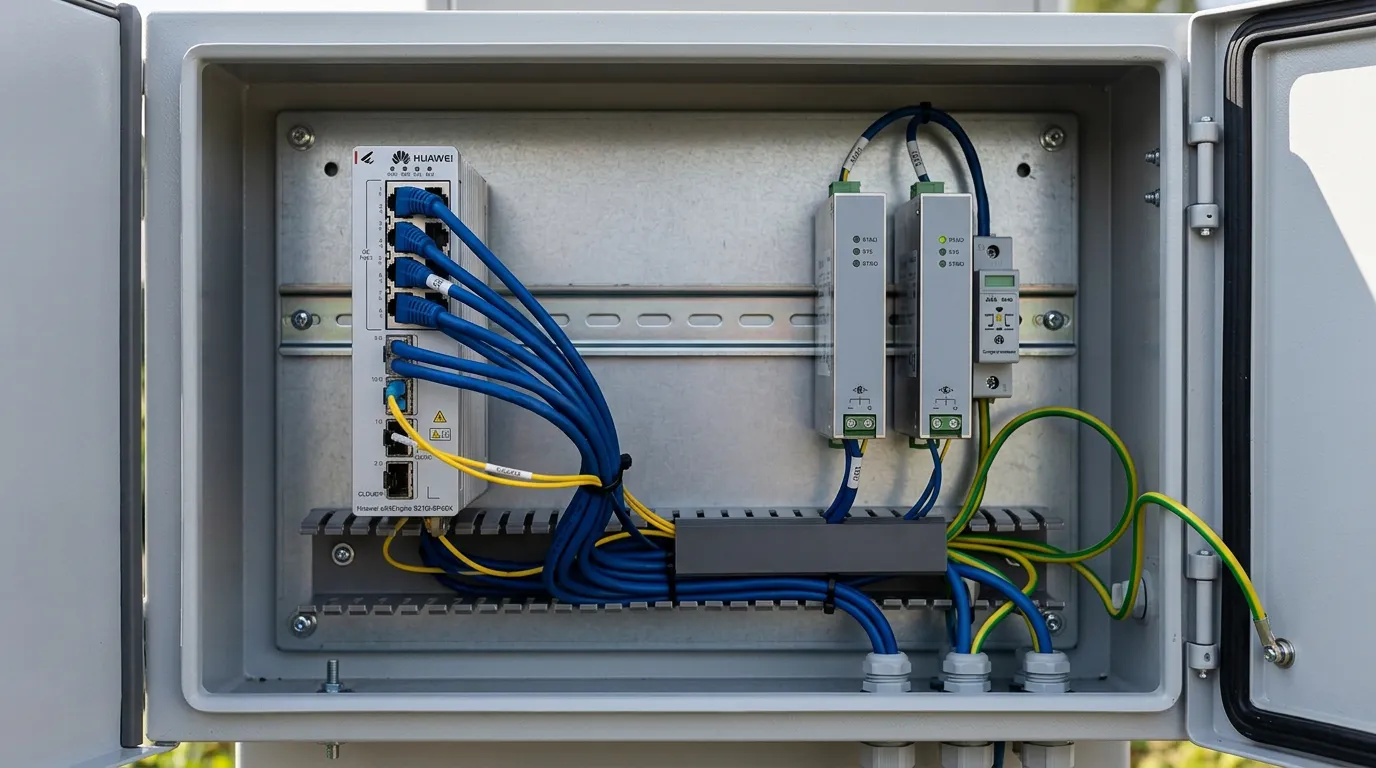
Finally, fit surge protection and earthing, label every cable, and record the cabinet's location and contents so a fault can be found quickly. For wireless links to cabinets beyond cable reach, see our guide to outdoor wireless bridges.
Schema about: Choosing industrial network switches for hot, dusty sites in Saudi Arabia
Key Takeaways
- Industrial switches are built for cabinets and plant rooms: wide temperature range, DC power, DIN-rail mounting and no fans.
- The Huawei S210I-8T4SX is rated to +65 °C in a sealed cabinet; the PoE S210I-8P4SX to +60 °C.
- Both S210I models run to +75 °C in a cabinet with a blower moving at least 200 LFM of air.
- The S210I-8P4SX has a 240 W PoE+ budget, or 220 W on Huawei's recommended 240 W power module, which is sold separately.
- The S210I datasheet gives no IP rating, so the cabinet must keep out dust and water.
- Both models are rated for altitudes up to 1,800 m.
Frequently Asked Questions
-
Can an industrial switch be installed outdoors without a cabinet?
Not the S210I. Huawei's datasheet gives no IP rating for the switch and describes it for installation in an outdoor cabinet, rated by cabinet type: sealed, vented or blower-equipped. Mount it on a DIN rail inside a cabinet with a suitable IP rating, cable glands and sun protection, and earth the cabinet properly.
-
Which uplink should an outdoor cabinet use?
Fibre, wherever the run is long or crosses open ground. Both S210I models have two GE SFP ports and two 10GE SFP+ ports, so a cabinet can connect back to the building over fibre at 1 or 10 Gbps. Use industrial-grade optical modules, since Huawei's temperature ratings assume them.
-
Why is the S210I-8P4SX rated lower than the 8T4SX?
Because PoE adds heat. Delivering up to 220 W to cameras and access points means more power passing through the switch, so Huawei rates the 8P4SX to +60 °C in a sealed cabinet against +65 °C for the 8T4SX. In a vented cabinet both reach +70 °C, and with a blower both reach +75 °C.
-
What is the DI/DO port on the S210I?
Huawei lists one digital input and output (DI/DO) on both S210I models. A digital input can connect to a simple contact, such as a cabinet door switch, and a digital output can drive an alarm or indicator. Check Huawei's documentation for how the switch reports DI/DO events in your management system.
-
How is the S210I managed?
Through local web management, a web-based network management system, Huawei's cloud management and the eKit App. It supports 32 VLANs, STP and RSTP loop protection, storm suppression, port isolation and secure boot. That is enough to separate cameras, intercoms and building systems at a remote cabinet and manage them centrally.
Sources & References
- Huawei — eKitEngine S210I Series Extended-Temperature Switches Datasheet, hosted on the Blue Edge product page vendor documentation
- Huawei — S210I-8P4SX product specifications, Blue Edge product page vendor documentation
- Huawei — S210I-8T4SX product specifications, Blue Edge product page vendor documentation
- Huawei — eKitEngine S220 Series Switches Datasheet, hosted on the Blue Edge product page vendor documentation
Planning a network for a harsh site?
Blue Edge supplies Huawei eKit industrial switches and outdoor equipment to projects across Saudi Arabia, with cabinet design, fibre and cabling support.
Call or WhatsApp +966 53 9855 188, contact the Blue Edge team, or see the S210I-8P4SX industrial PoE switch.
About Blue Edge
Blue Edge Company is a value-added technology distributor based in Dammam, Saudi Arabia, supplying interactive displays, smart building systems, networking infrastructure and IT security software to businesses and residential projects across the Kingdom, with installation and technical support.
Learn more about Blue Edge →Published 23 October 2026 • Last updated 13 November 2026 • This article is reviewed when standards, regulations or product guidance change.