Shopping Cart



Building a Reliable WiFi Network for Large Spaces in Saudi Arabia
Learn how to build a reliable WiFi network for large spaces in Saudi Arabia including access point planning, high-density coverage, and enterprise networking.
By Blue Edge Team | May 01, 2026

Building a Reliable WiFi Network for Large Spaces in KSA
Modern businesses and institutions across Saudi Arabia require secure, flexible, and high-performance communication systems. As the Kingdom experiences rapid infrastructure development and technological advancement, the demand for seamless connectivity in expansive environments has never been higher. Providing consistent internet access across massive corporate campuses, retail malls, educational institutions, and industrial facilities requires meticulous planning and deployment.
A standard consumer-grade internet setup simply cannot meet the complex demands of expansive commercial spaces. When thousands of users and smart devices attempt to connect simultaneously, networks face immense pressure that can lead to dropped connections, slow speeds, and compromised security. To ensure optimal performance and durability, organizations must approach wireless networking with an enterprise-level mindset, utilizing specialized hardware and strategic configurations.
This comprehensive guide details the essential steps and technologies required to build a reliable WiFi network for large spaces in Saudi Arabia. By understanding the core principles of network design, selecting appropriate hardware, and addressing regional environmental factors, you can empower your partners and clients with cutting-edge communication and technology solutions.
Understanding the Challenges of Large-Scale WiFi Deployments
Deploying a wireless network across a massive footprint introduces specific technical challenges that network engineers must overcome. Identifying these obstacles early in the planning phase is crucial to delivering a system that meets the highest industry standards.
Physical Obstructions and Structural Materials
Commercial buildings in Saudi Arabia often feature heavy structural materials designed to aid in climate control and structural integrity. Materials such as reinforced concrete, thick glass, and steel frames actively absorb or reflect radio frequency (RF) signals. When signals are blocked by these dense materials, users experience frustrating dead zones and weak coverage areas.
High Client Density and Bandwidth Demands
Large spaces typically host a high volume of users, each bringing multiple smart devices. A reliable WiFi network must support high client density without degrading the user experience. Furthermore, modern applications such as 4K video conferencing solutions, cloud-based enterprise networking tools, and smart building technologies consume massive amounts of bandwidth. Managing this traffic requires intelligent routing and robust bandwidth allocation protocols.
Environmental Factors in Saudi Arabia
Outdoor or semi-outdoor large spaces face extreme temperature fluctuations, high humidity near the coasts, and exposure to fine dust and sand. Networking equipment deployed in these areas must be ruggedized. Using hardware with high Ingress Protection (IP) ratings ensures that your network remains operational regardless of the harsh environmental conditions prevalent in the region.
Key Components of an Enterprise-Grade Network
To deliver innovative and reliable solutions, you must utilize hardware designed specifically for commercial demands. Every product integrated into the system should be tested and proven to handle continuous, heavy usage.
High-Capacity Access Points (APs)
Access points act as the bridge between wireless devices and your wired network. For large spaces, deploying high-capacity access points utilizing the latest WiFi 6 or WiFi 7 standards is mandatory. These modern APs utilize advanced technologies like Orthogonal Frequency-Division Multiple Access (OFDMA) and Multi-User, Multiple Input, Multiple Output (MU-MIMO) to communicate with multiple devices simultaneously, significantly reducing latency. Learn more about WiFi 7 adoption for businesses in Saudi Arabia.
Core and Edge Switches
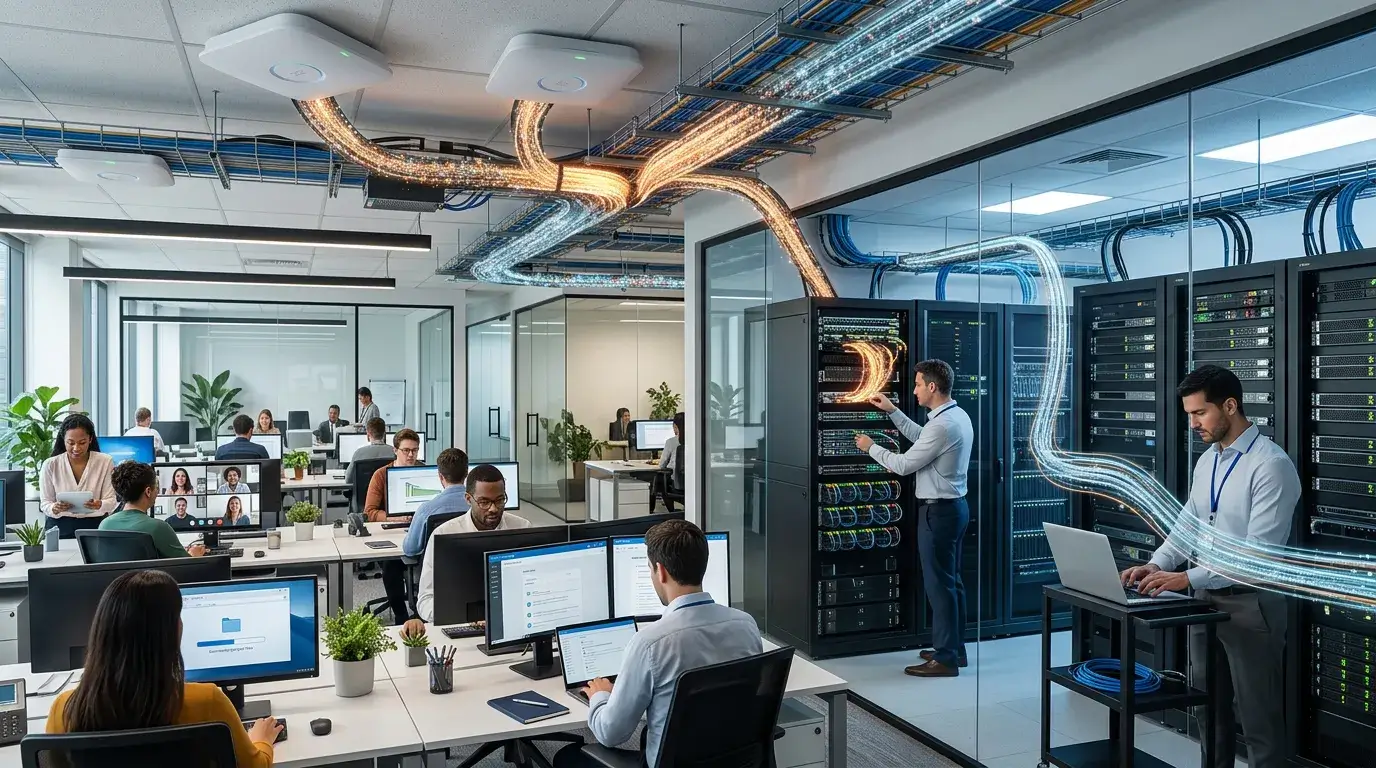
A wireless network is only as strong as the wired infrastructure supporting it. Edge switches connect directly to your access points, providing both data connection and Power over Ethernet (PoE). Core switches manage the heavy lifting, routing traffic efficiently between the edge switches and the primary internet gateway. Implementing structured cabling infrastructure with fiber optics ensures maximum throughput across long distances.
Centralized Network Controllers
Managing dozens or hundreds of access points individually is inefficient and prone to configuration errors. A centralized network controller provides a unified dashboard to monitor performance, push firmware updates, and manage user access policies across the entire network. This centralized approach guarantees that security protocols are uniformly enforced and simplifies troubleshooting procedures. For businesses seeking remote oversight capabilities, explore remote management solutions.
Strategic Planning and Wireless Site Surveys
The foundation of a reliable WiFi network relies entirely on accurate data collection and strategic planning. Skipping this phase inevitably leads to overlapping channels, severe interference, and coverage gaps.
Predictive Site Surveys
Before any equipment is purchased, network engineers conduct predictive site surveys using specialized software. By importing the building's floor plans and specifying the wall materials, the software generates a highly accurate simulation of RF signal propagation. This simulation helps determine the exact number of access points required and their optimal locations. Our IT technical consultation services can guide you through this planning process.
Active and Passive Surveys
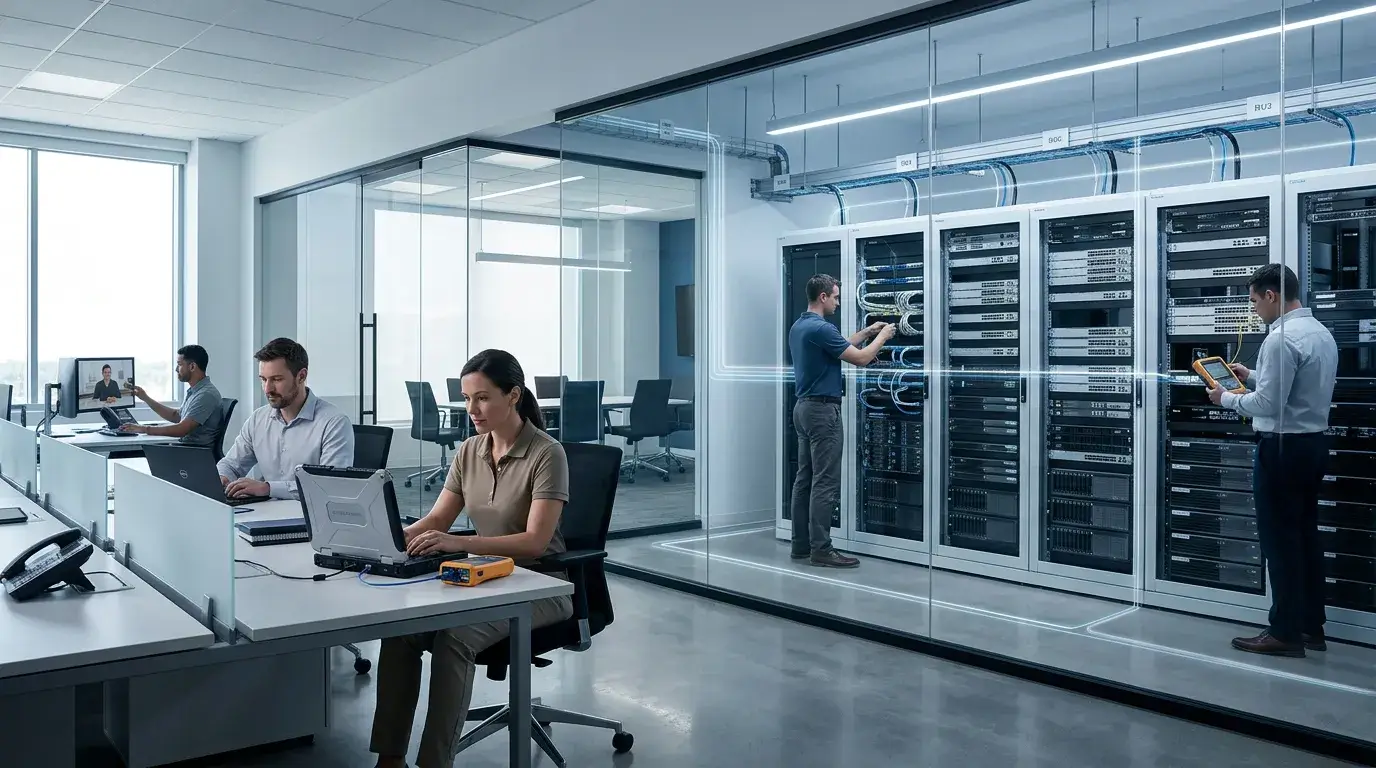
Once the facility is built or accessible, engineers perform on-site active and passive surveys. A passive survey involves listening to existing RF environments to identify rogue APs or external interference sources, such as neighboring corporate networks or heavy machinery. An active survey tests actual data throughput and roaming capabilities, ensuring that users can move seamlessly from one side of the facility to the other without losing their connection.
Best Practices for Implementation and Security
Proper installation and configuration and rigorous cybersecurity systems are critical to maintaining network integrity and protecting user data.
Optimizing Access Point Placement
Access points must be mounted carefully to maximize their coverage patterns. Mounting APs on the ceiling in clear, unobstructed areas generally provides the best signal distribution. Avoid placing APs near metal ductwork, large liquid containers, or thick concrete pillars. Additionally, configuring the transmit power correctly prevents AP signals from overlapping excessively, which can cause co-channel interference and confuse client devices attempting to roam.
Implementing Robust Cybersecurity Measures
Securing an enterprise network requires a multi-layered approach. You must implement robust cybersecurity systems, including next-generation firewalls (NGFW) and intrusion detection systems (IDS). Furthermore, separating network traffic using Virtual Local Area Networks (VLANs) ensures that guest traffic is entirely isolated from internal corporate data, preventing unauthorized access to sensitive company information. For businesses looking to further strengthen their defenses, explore endpoint security solutions.
Frequently Asked Questions
-
How many access points do I need for a large warehouse or mall?
The exact number of access points depends on the square footage, ceiling height, structural materials, and expected user density. A professional wireless site survey is the only precise method to determine the required quantity. Estimating without a survey often leads to critical coverage gaps or unnecessary hardware expenditures. Contact our team for expert IT consultations.
-
Which WiFi standard is best for commercial deployment in Saudi Arabia?
Currently, WiFi 6 (802.11ax) and the emerging WiFi 7 (802.11be) standards are the most appropriate for large commercial spaces. These standards are specifically engineered to handle high-density environments efficiently, ensuring that smart building technologies and high-bandwidth applications function seamlessly.
-
How do we ensure outdoor WiFi equipment survives the summer heat?
Outdoor access points must feature industrial-grade ruggedization. Ensure the hardware carries an IP67 rating, which certifies complete protection against dust ingress and resistance to water. Additionally, the equipment must be rated to operate in temperatures exceeding 60 degrees Celsius to withstand the regional climate.
-
Why do users experience dropped connections when walking across our facility?
Dropped connections during movement usually indicate poor roaming configuration or improper access point placement. If transmit power levels are too high, devices hold onto a weak signal from a distant AP instead of seamlessly transitioning to a closer one. Adjusting power levels and utilizing centralized controllers resolves this issue. Our IT installation and configuration team can help audit and optimize your current setup.
-
How can we secure our public guest WiFi network?
Securing a public network requires implementing a captive portal for user authentication, isolating guest traffic onto a dedicated VLAN, and utilizing robust cybersecurity systems like advanced firewalls. You must restrict bandwidth per user to prevent network abuse and block access to known malicious domains.
Empower Your Organization with Seamless Connectivity
Building a reliable WiFi network for large spaces in Saudi Arabia demands precision, expertise, and a commitment to utilizing cutting-edge communication and technology solutions. By conducting thorough site surveys, selecting high-capacity hardware, and prioritizing robust cybersecurity systems, organizations can overcome the complexities of dense deployments and harsh environmental factors.
We partner with world-leading brands to deliver innovative and reliable solutions tailored to your specific requirements. Investing in a properly engineered wireless infrastructure ensures that your business operations run smoothly, securely, and efficiently. If you are ready to upgrade your enterprise networking capabilities, consult with experienced technology partners to begin planning your structured cabling and wireless deployment today.